Panel Bonding Strength Improvement Methods In Rockwool Board Production Line
Sep 17, 2026
Panel bonding strength is a core performance indicator of rockwool boards, directly determining their structural stability and service durability.
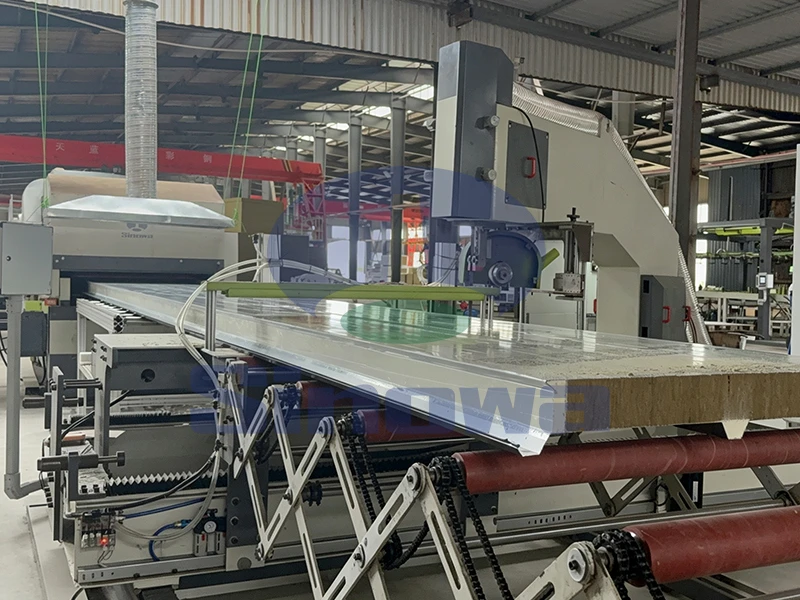
Raw material quality control serves as the fundamental foundation for stabilizing and improving rockwool board panel bonding strength, as unqualified raw materials are the primary cause of inconsistent bonding effects in production. Rockwool fibers with uneven fineness and irregular length distribution will form loose and uneven fiber networks inside the board, creating numerous tiny gaps that weaken the adhesion between fiber layers and bonding agents. In daily production, it is essential to maintain stable fiber spinning conditions to ensure uniform fiber morphology and consistent fiber surface activity. Meanwhile, the selection and pretreatment of bonding agents play a decisive role in bonding performance. High-compatibility bonding agents with moderate viscosity can fully infiltrate fiber surfaces without forming excessive adhesive accumulation, which avoids both insufficient bonding caused by incomplete infiltration and brittle bonding layers caused by over-concentrated adhesive. In addition, strictly controlling the moisture content of raw rockwool fibers is crucial. Excess moisture will dilute the bonding agent during production, reduce adhesive activity, and generate internal steam during subsequent curing processes, leading to micro-bubbles between board layers that damage bonding integrity. Reasonable raw material storage and dehumidification pretreatment can effectively eliminate such hidden troubles and lay a solid foundation for stable panel bonding strength.
Optimization of fiber laying and mat forming processes effectively improves the internal compactness and structural uniformity of rockwool boards, which is a key intermediate link to enhance panel bonding strength. The traditional random fiber laying process often leads to local fiber accumulation and sparse areas in the rockwool mat, resulting in unbalanced stress distribution and inconsistent bonding force across different parts of the finished board. By adjusting the operating parameters of the fiber laying equipment, including uniform feeding speed and orderly fiber dispersion, producers can form a flat, dense, and evenly structured fiber mat. A uniform fiber mat enables the bonding agent to adhere evenly to every fiber surface and form continuous and stable bonding interfaces between adjacent fiber layers. Moreover, reasonable control of mat forming thickness and compactness avoids two extreme problems: overly loose mats lead to insufficient contact area between fibers and bonding agents, while overly compact mats block the infiltration channel of adhesives. Fine-tuning the roller pressure and transmission speed in the mat forming process ensures gradual and uniform compression of the fiber mat, eliminates internal hollow structures, and makes the internal bonding stress of the rockwool board more balanced, thereby significantly improving the overall bonding firmness of the panel.
Precise adjustment of curing process parameters is the core technical means to solidify bonding effect and maximize panel bonding strength. The curing process determines the curing degree and film-forming quality of the bonding agent, and inappropriate temperature, time and ventilation parameters will directly lead to poor bonding performance. Insufficient curing temperature or short curing time will make the bonding agent unable to complete cross-linking reaction fully, resulting in low adhesive hardness, poor adhesion and easy delamination of rockwool boards. On the contrary, excessively high curing temperature or prolonged curing time will cause the bonding agent to age and decompose, destroy the molecular structure of the adhesive film, and make the bonding layer brittle and easy to crack. In actual production, graded curing temperature control can be adopted to realize low-temperature pre-curing and high-temperature final curing. Pre-curing enables the bonding agent to initially shape and adhere to fibers, while final curing completes thorough cross-linking and film formation. Meanwhile, matching ventilation volume in the curing oven ensures timely discharge of volatile substances generated during adhesive curing, preventing residual volatile components from forming isolation layers between bonding interfaces. Stable and standardized curing parameter control can greatly improve the bonding stability and tensile resistance of rockwool board panels.
Equipment operation and maintenance optimization eliminates production process fluctuations and maintains long-term stable panel bonding strength. Long-term operation of production equipment will cause wear, deviation and parameter drift of key components, which indirectly affect the bonding effect of rockwool boards. For fiber spinning and spraying equipment, nozzle blockage and pipeline aging will lead to uneven bonding agent spraying, resulting in local lack of glue or glue accumulation on the fiber mat surface. Regular cleaning, inspection and maintenance of spraying systems can ensure uniform and continuous adhesive spraying, forming consistent bonding interfaces across the entire board surface. For pressing and curing equipment, the deviation of roller gap and uneven heating of the oven will cause inconsistent compression degree and curing effect of different parts of the rockwool board. Regular calibration of equipment operating parameters and correction of component deviation can eliminate production differences caused by equipment failure. In addition, standardized equipment operation procedures should be formulated to avoid bonding quality fluctuations caused by manual operation errors. Stable equipment operation state ensures the continuity and consistency of each production link, which is an important guarantee for the sustainable improvement of rockwool board bonding strength.
Microstructure regulation of rockwool boards further optimizes bonding interfaces and enhances the overall structural adhesion of panels. The bonding strength of rockwool boards depends not only on the performance of bonding agents but also on the combination state between fibers and adhesives at the micro level. By appropriately adjusting the fiber crimp degree in the spinning process, the contact area between fibers and bonding agents can be increased effectively. Crimped fibers form a staggered three-dimensional network structure, which produces mechanical occlusion between layers in addition to chemical adhesion of adhesives, greatly improving the interlayer bonding force. Meanwhile, controlling the spraying uniformity and infiltration depth of the bonding agent enables the adhesive to penetrate into the interior of the fiber mat rather than only attaching to the surface of fiber layers. This deep infiltration forms integrated bonding structures inside the board, avoiding the separation of surface bonding and internal loose structure. Fine microstructural regulation can eliminate weak bonding areas inside the rockwool board, improve the overall uniformity of bonding performance, and enhance the structural stability of the panel under external force and long-term service conditions.
Scientific post-production treatment and quality inspection feedback mechanism realizes continuous optimization of panel bonding strength in rockwool board production. After the completion of curing and forming, proper post-treatment can eliminate residual stress inside the board and stabilize the bonding structure. Slow cooling treatment after curing avoids rapid temperature change-induced shrinkage and cracking of the bonding layer, maintaining the integrity of adhesive film and interlayer bonding structure. In addition, establishing a real-time quality inspection system to sample and test the bonding strength of finished products regularly can timely capture subtle changes in bonding performance in the production process. The inspection data is fed back to each production link, realizing targeted adjustment of raw material parameters, process conditions and equipment states. This closed-loop production and quality control mode can continuously optimize the bonding process, eliminate potential quality hazards, and steadily improve the panel bonding strength of rockwool boards while ensuring the consistency of batch product quality.
Main Products
-

Continuous PU Sandwich Panel Production Line
This continuous PU sandwich panel production line is an integrated automatic equipment. It covers uncoiling, forming, foaming, curing and cutting processes. With automatic raw material proportioning and precise temperature & pressure control, PIR sandwich panel production line continuously composites panels with double skins. Polyurethane sandwich panel production line stably produces steel and aluminum sandwich panels. Featuring high automation, the line makes fireproof and thermal-insulation panels for building enclosure and cold storage. -

Rock Wool Sandwich Panel Production Line
Continuous rockwool sandwich panel production line is an automatic integrated production equipment, consisting of uncoiling, forming, gluing and compounding, heating curing, fixed-length cutting, automatic stacking and other modules. The mineral wool sandwich panel production line continuously conveys color steel plates and rock wool core materials to automatically complete lamination and curing, which can produce fireproof and thermal insulation sandwich panels. Featuring high automation degree and stable operation, this production line is suitable for mass production of panels used for building walls, roofs and other scenarios. -

Phenolic Insulation Board Production Line
This integrated automatic production line continuously manufactures PU and phenolic insulation boards. The insulation board production line covers raw material proportioning, high-pressure foaming, laminating, curing and fixed-length cutting. Featuring high automation and stable molding, the insulation panel production line supports various surface materials. PU boards offer excellent thermal insulation, while phenolic boards have superior fire resistance. These products are widely used in construction, cold chain, ventilation ducts and other thermal insulation fields.