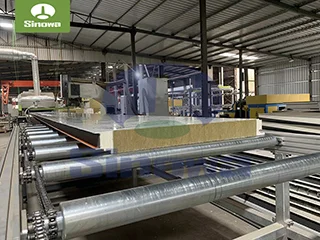
sandwich panel line
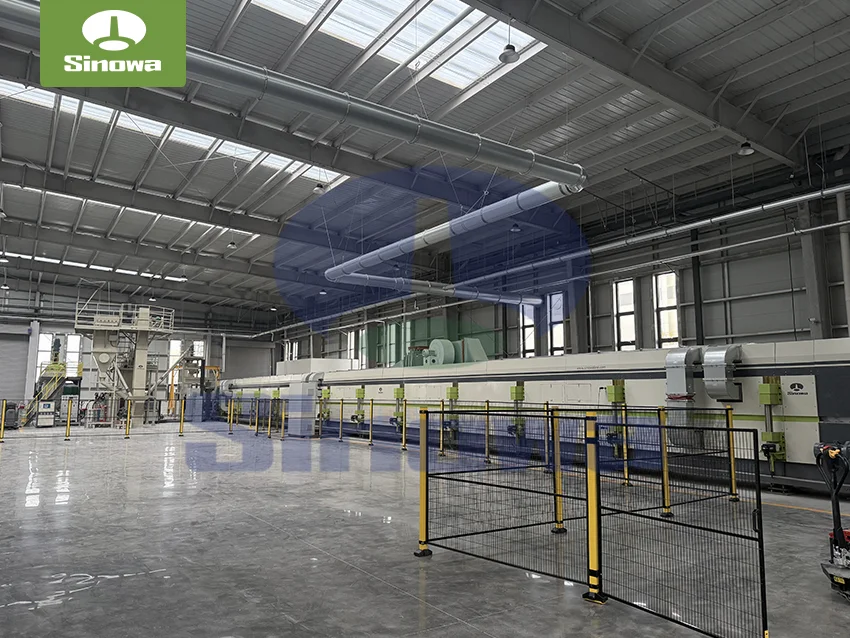
The overall design of the fully automatic rock wool board production line follows the logic of continuous industrial production, integrating multiple functional modules into an interconnected and collaborative mechanical system. Every production link from raw material feeding to finished product stacking is completed by automated mechanical equipment, with minimal manual intervention throughout the entire process. The basic composition of the production line covers raw material pretreatment system, high-temperature melting system, fiber centrifugal forming system, cotton collection and laying system, curing molding system, cutting and trimming system, as well as finished product conveying and stacking system. All functional modules are linked by intelligent control components, which can realize synchronous operation and parameter synchronization adjustment, ensuring the continuity and stability of material transmission and processing. Different from decentralized semi-automatic production equipment, this integrated production line optimizes the spatial layout of each device, shortens the material transmission path between processes, effectively reduces material loss caused by intermediate handling, and improves the overall utilization rate of raw materials.
Raw material pretreatment serves as the initial link of the entire production flow, laying a solid foundation for subsequent high-quality fiber forming. The main raw materials for rock wool production are natural silicate minerals with stable physical and chemical properties, which need to undergo strict screening, crushing and precise proportioning before entering the melting process. The automated feeding system is equipped with intelligent metering devices and screening structures. Bulk raw materials are transported to the crushing equipment through closed conveying pipelines, where large mineral blocks are crushed into uniform fine particles. Impurities with inconsistent particle size and non-compliant composition are automatically screened out during the crushing process to avoid affecting the purity of subsequent molten materials. After crushing, various raw materials are mixed in a specific proportion under the precise control of the metering system. The built-in sensing components in the mixing equipment monitor the mixing uniformity of materials in real time, and adjust the mixing speed and stirring amplitude according to the material state to ensure that the mixed raw materials have consistent component distribution. The entire pretreatment process operates in a fully enclosed space, which not only avoids dust diffusion and maintains a clean production environment, but also prevents external impurities from mixing into raw materials, ensuring the basic quality stability of raw materials.
The high-temperature melting system is the core link to realize the physical transformation of raw materials, and it is also the key process to determine the fiber quality of rock wool. The uniformly mixed raw materials are automatically transported to the melting furnace through sealed conveying equipment. The melting furnace adopts an intelligent temperature control mode, which can maintain a stable high-temperature melting environment inside the furnace. Under continuous high-temperature action, solid mineral raw materials are gradually heated, softened and finally melted into homogeneous flowing molten liquid. The internal temperature sensing system of the furnace dynamically monitors the molten state of the materials. Once the viscosity and fluidity of the molten liquid reach the optimal fiber-forming standard, the material discharging mechanism will be automatically started to transport the molten liquid to the fiber centrifugal equipment. In order to ensure the uniformity of molten material output, the discharging port is designed with a flow-limiting and homogenizing structure, which can stabilize the outflow speed and flow of the molten liquid, avoiding the quality fluctuation of subsequent fibers caused by uneven material output. Compared with manual temperature regulation in traditional production lines, the automatic temperature control system can accurately control the temperature fluctuation range in the furnace, reduce the energy consumption caused by repeated heating, and improve the energy utilization efficiency of the melting process.
After completing high-temperature melting, the molten material enters the fiber centrifugal forming system to complete the transformation from liquid melt to fibrous structure. The centrifugal forming equipment is equipped with high-speed rotating centrifugal wheels. When the molten liquid flows onto the surface of the centrifugal wheels, it is rapidly thrown out under the action of high-speed centrifugal force. During the throwing process, the molten liquid is stretched into fine and slender fibrous filaments. Meanwhile, the auxiliary blowing structure around the centrifugal wheels generates stable airflow, which further refines the fibers and adjusts the spatial distribution state of the fibers. In order to enhance the bonding performance between fibers, a quantitative spraying device is installed near the fiber forming area. The spraying system can evenly spray a moderate amount of adhesive on the surface of scattered fibers, so that the fibers can form a preliminary bonded structure in the subsequent accumulation process. The rotating speed of the centrifugal wheels and the airflow intensity of the blowing structure are intelligently linked. The system can automatically adjust the operating parameters according to the preset fiber fineness standard, so as to produce rock wool fibers with uniform diameter and smooth surface, avoiding the defects of thick fiber diameter and uneven distribution caused by unstable manual operation.
The cotton collection and laying system undertakes the task of gathering scattered fibers and forming preliminary wool layers, which directly affects the thickness uniformity and internal structure density of finished rock wool boards. The fibers formed by centrifugal blowing fall into the sealed settling chamber, and the internal negative pressure air suction structure of the settling chamber can stably gather the scattered fibers on the surface of the conveying mesh belt. The production line adopts an optimized pendulum cotton laying process. The reciprocating swinging cotton laying mechanism evenly spreads the fibers on the moving conveying equipment. Compared with the traditional single settling method, this process can change the single planar distribution state of fibers, form a three-dimensional staggered stacking structure, and effectively improve the compression resistance and interlayer bonding strength of rock wool boards. In the cotton laying stage, the thickness sensing device installed above the conveying belt monitors the real-time thickness of the wool layer. When the thickness deviates from the preset standard, the system will automatically adjust the running speed of the cotton laying mechanism and the conveying belt to ensure that the thickness of the wool layer remains within a stable range. The stacked wool layer has a fluffy and uniform structure, with no local hollow or dense agglomeration, providing a good semi-finished product foundation for subsequent curing and molding.
The curing molding system is responsible for solidifying the fluffy wool layer into a rigid board structure, realizing the qualitative change from semi-finished wool layer to rock wool board products. The wool layer after cotton laying is automatically sent to the curing furnace by the conveying device. The internal space of the curing furnace is equipped with a constant temperature heating structure and a circulating air system. The stable high-temperature environment inside the furnace activates the adhesive sprayed on the fiber surface, so that the adhesive can quickly bond the staggered fibers into an integrated structure. Meanwhile, the upper and lower pressing rollers arranged at the inlet of the curing furnace apply uniform pressure to the wool layer to squeeze out the excess gaps between fibers, adjust the overall density of the board, and make the surface of the wool layer flat and smooth. The internal temperature and pressure of the curing furnace are controlled by an intelligent linkage system. According to the preset product density and thickness parameters, the system dynamically adjusts the heating temperature, curing time and pressing pressure. After continuous heating and pressure maintaining curing, the loose fiber wool layer is solidified into a hard rock wool board with stable shape, uniform density and firm internal structure. The closed curing space can avoid the interference of external temperature and humidity, ensuring the consistency of curing effect of each batch of products.
After curing and molding, the rock wool board has stable structural performance, and then enters the cutting and trimming system for finishing processing. The continuously output rock wool boards are transported to the cutting area through the automatic conveying track. The cutting system is equipped with high-precision servo driving components and multi-group cutting tools. Firstly, the edge trimming mechanism cuts off the irregular rough edges on both sides of the board to make the board edges neat and smooth. Then, according to the preset length and width specifications, the transverse and longitudinal cutting equipment completes fixed-size cutting to divide the continuous board into independent finished rock wool boards. In order to meet the diverse needs of different application scenarios, the intelligent control terminal can modify the cutting parameters in real time. The mechanical positioning structure can accurately lock the cutting position, and the cutting error is controlled within a tiny range. In addition, the cutting system is equipped with a waste recycling device, which can automatically collect the edge materials generated by trimming. The recycled waste materials are crushed and reintroduced into the raw material pretreatment link, realizing the cyclic utilization of resources and reducing the production cost of raw materials.
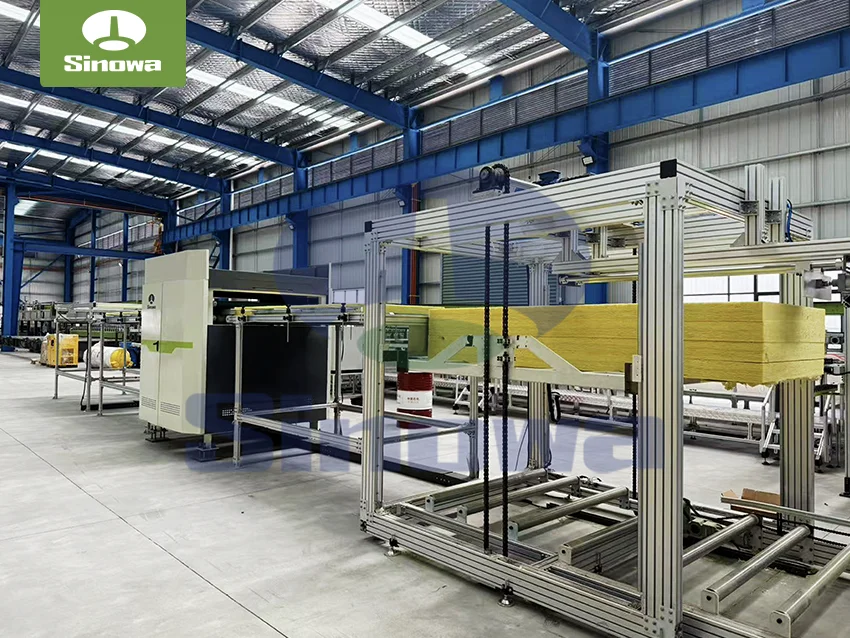
The final stage of the production line is finished product conveying, sorting and stacking. The cut rock wool boards are inspected by an automatic detection device on the conveying line. The sensing components monitor the surface flatness, thickness consistency and structural integrity of the boards in real time. Products with minor defects are automatically sorted out and sent to the reprocessing area, while qualified products are transported to the stacking station. The stacking mechanism adopts a dual-station alternating operation design. While one station completes stacking and shaping, the other station receives conveyed products, realizing uninterrupted continuous stacking operation. The built-in automatic alignment device can correct the placement position of each rock wool board to ensure neat stacking and consistent gaps between boards. The stacked finished products have stable structures and are not easy to shift during subsequent transportation and storage. The entire stacking process does not require manual handling, which effectively reduces the labor intensity of workers and avoids product damage caused by manual carrying.
The intelligent control system runs through all operation links of the fully automatic rock wool board production line and is the core brain to ensure the coordinated operation of various mechanical structures. The production line adopts a programmable control mode with a touch-type human-computer interaction interface. Operators can complete parameter setting, equipment start-stop, running state monitoring and other operations through a simple interactive panel. A large number of high-precision sensors are arranged inside each functional module of the production line, which collect real-time data such as material temperature, conveying speed, processing pressure and product size during the production process. The data is transmitted to the central control system for intelligent analysis and processing. Once abnormal parameters such as excessive temperature fluctuation and blocked material transmission are detected, the system will automatically trigger an early warning mechanism and perform adaptive adjustment. If the abnormal state cannot be eliminated automatically, the equipment will stop running safely to avoid mechanical failure and product batch quality problems. In addition, the control system has an operation data storage function, which can record the production parameters of each batch of products, providing data support for subsequent production optimization and quality traceability.
Compared with traditional semi-automatic production equipment, the fully automatic rock wool board production line has prominent comprehensive advantages in production efficiency, product quality and production safety. In terms of production efficiency, the integrated streamlined structure realizes uninterrupted continuous production from raw material input to finished product output. The automatic linking of each process eliminates the waiting time for manual material transfer, greatly improves the hourly output of products, and is suitable for large-scale batch production tasks. In terms of product quality, the intelligent parameter control mode avoids human operation errors. The raw material proportioning, fiber forming, curing pressure and cutting size are all controlled within a fixed standard range. The produced rock wool boards have uniform density, stable thermal insulation performance and consistent structural strength, effectively solving the problem of uneven quality of products produced by traditional equipment. In terms of production safety, the fully enclosed production structure reduces dust and harmful gas emission during the production process, and the automated mechanical operation replaces manual high-risk operations such as high-temperature feeding and heavy material handling, reducing the safety hazards in the production process.
From the perspective of industrial development, the popularization and application of fully automatic rock wool board production lines conform to the development trend of modern building material industrialization. With the continuous improvement of global energy conservation and environmental protection standards, the market has put forward higher requirements for the production process and product performance of thermal insulation materials. This automated production line optimizes the production process from multiple dimensions such as energy consumption control, resource utilization and environmental protection emission. The sealed melting and curing structure reduces heat loss and lowers energy consumption per unit product. The waste recycling system realizes the reuse of leftover materials, reducing the waste of mineral resources. At the same time, the centralized dust removal and purification device configured in the production line can effectively filter dust generated during production, making the production process more environmentally friendly and compliant.
In the future, with the continuous innovation of intelligent manufacturing technology, the fully automatic rock wool board production line will develop in the direction of higher intelligence, stronger flexibility and lower energy consumption. The upgrading of sensing technology and artificial intelligence algorithms will further improve the system's automatic identification and adaptive adjustment capabilities, realizing intelligent judgment and optimization of complex production working conditions. The modular equipment structure will enhance the production line's compatibility with raw materials of different qualities, and can quickly adjust production parameters to manufacture rock wool boards with different densities, thicknesses and performance indicators to meet the personalized needs of diversified markets. In addition, the optimization of energy-saving structures and clean production technologies will further reduce the energy consumption and carbon emission of the production process, making the rock wool board manufacturing industry more in line with the green and low-carbon development concept. As an important intelligent manufacturing equipment in the field of building thermal insulation materials, the fully automatic rock wool board production line will continue to empower the high-quality development of the construction industry and industrial thermal insulation field with stable performance and efficient production capacity.
https://www.cnsinowa.com/sandwich-panel-machines/rock-wool-board-fully-automatic-production-line.html