 sandwich panel machine
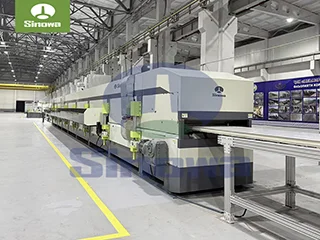
The internal structure of a thermal insulation foam board machine presents a highly integrated modular design, and each functional module is closely connected to form a complete closed-loop production system without redundant mechanical structures. The raw material feeding and conveying module serves as the starting point of the entire production line, undertaking the task of stable and quantitative delivery of various raw materials required for foam board production. This module is equipped with automated conveying components and metering auxiliary structures, which can accurately control the feeding amount of solid raw materials such as cement, lightweight aggregate, and fiber reinforcements, as well as liquid materials including water and foaming agents. During the feeding process, the built-in buffering structures effectively avoid raw material splashing and dust diffusion, reducing material waste while maintaining a clean production environment. The metering system inside the module adjusts the feeding proportion in real time according to the preset production parameters, ensuring that the raw material ratio of each batch of mixed materials remains consistent, which lays a solid foundation for the uniformity of the internal structure of finished foam boards.
Following the feeding module is the material mixing and stirring module, which is the key link to determine the uniformity of raw material fusion. This module is composed of high-power driving components, multi-layer stirring blades, and sealed mixing tanks. Different from ordinary industrial mixers, the stirring structure of the thermal insulation foam board machine is optimized for the viscosity and fluidity of foam slurry. In the early mixing stage, solid raw materials are subjected to dry stirring to break up agglomerated particles and evenly disperse various powdery ingredients. After completing the dry mixing process, liquid raw materials are quantitatively injected into the mixing tank for wet stirring. The low-speed and high-torque stirring mode prevents excessive bubble rupture in the slurry, while ensuring that foaming agents, stabilizers, and reinforcing ingredients are fully blended into the base slurry. The sealed tank body effectively isolates the outside air, avoiding the interference of external impurities on the slurry quality, and the temperature control structure attached to the mixing tank can maintain the slurry within a constant temperature range, optimizing the chemical reaction efficiency of foaming ingredients.
The foaming and molding module is the core functional section of the entire equipment, directly deciding the pore structure, density, and molding stability of thermal insulation foam boards. This module combines physical foaming and mild chemical reaction principles. After the uniformly mixed slurry is transported to the molding area, it is slowly injected into customized molding molds. The internal pressure adjustment structure of the mold keeps the pressure in the molding cavity within a stable range, enabling the foam components in the slurry to expand evenly. The foaming process lasts for a fixed period, during which the tiny bubbles generated inside the slurry gradually expand and connect to form a uniform porous structure. The mold itself is made of high-strength metal materials with smooth inner walls and good thermal conductivity, which can reduce the adhesion between the slurry and the mold while ensuring uniform heat dissipation during the molding process. In addition, the demolding auxiliary structure is installed around the mold to provide stable supporting force during the initial solidification of the foam board blank, preventing deformation, warping, or cracking caused by uneven stress during the molding stage.
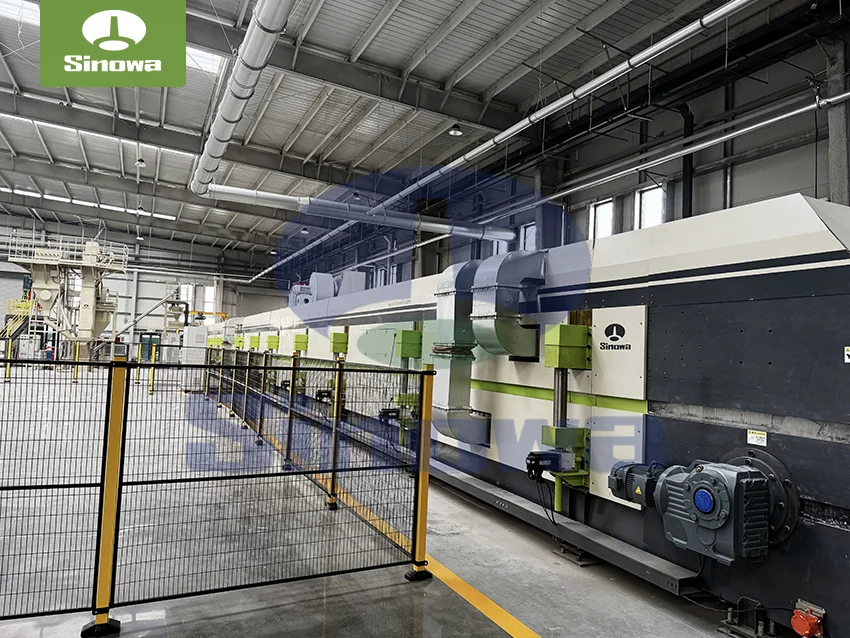
The curing module undertakes the task of stabilizing the physical properties of foam board blanks after preliminary molding. Newly demolded foam boards have low structural strength and poor compression resistance, requiring a specific curing environment to complete the solidification and aging reaction. The curing area of the machine is an independent closed space with adjustable temperature and humidity. By simulating natural curing conditions, it accelerates the internal molecular bonding of the foam board materials and eliminates unstable stress generated during molding. During the curing process, the internal circulation system of the equipment keeps the air flow in the curing area uniform, avoiding local moisture loss or excessive temperature difference that may cause inconsistent hardness of the board surface. The curing cycle can be adjusted according to different raw material formulas and product usage scenarios. After systematic curing, the compression resistance, toughness, and structural stability of the foam boards are significantly improved, enabling them to adapt to complex application environments such as outdoor buildings and industrial workshops.
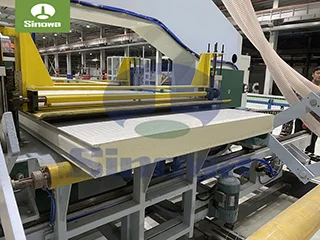
The precise cutting and finishing module realizes the dimensional shaping of finished foam boards. After curing, the foam board blanks are transported to the cutting area through an automated conveying track. This module is equipped with high-speed rotating cutting blades and intelligent positioning systems. Before cutting, the sensing components scan the appearance size of the blanks and transmit the data to the control terminal, which automatically generates cutting schemes according to preset dimensional standards. The cutting process adopts a smooth cutting mode to avoid jagged edges and surface cracks on the boards. The adjustable blade spacing and cutting angle can meet the production requirements of foam boards with different thicknesses and specifications. Moreover, the recycling structure is designed at the bottom of the cutting area to collect leftover materials generated during cutting. These recycled materials are crushed and re-transported to the feeding system for secondary utilization, effectively improving the comprehensive utilization rate of raw materials and reducing production consumption.
The intelligent control module runs through all functional links of the thermal insulation foam board machine and serves as the operation command center of the entire equipment. This module consists of data sensing components, intelligent control terminals, and linkage transmission circuits. All operation parameters such as feeding speed, stirring time, foaming pressure, curing temperature, and cutting size can be uniformly set and adjusted through the control terminal. Multiple high-precision sensors are installed in each production link to monitor real-time data including material flow, equipment operating temperature, and molding pressure. Once abnormal data such as uneven feeding and excessive equipment vibration is detected, the system will automatically trigger early warning prompts and carry out mild adjustment operations to ensure continuous and stable production. The simplified human-computer interaction logic reduces the operation difficulty of the equipment, enabling operators to complete parameter setting, production monitoring, and equipment debugging through simple operations.
Compared with traditional scattered foam board production equipment, integrated thermal insulation foam board machines have prominent technical advantages in production logic and mechanical performance. In terms of production efficiency, the integrated assembly line design realizes uninterrupted connection from raw material feeding to finished product stacking, shortening the material transfer time between independent processes. The automated operation mode reduces manual intervention links, effectively lowering the error rate caused by human operation and improving the consistency of product quality. In terms of production flexibility, the equipment can adjust raw material formulas and production parameters according to different usage needs, producing thermal insulation foam boards with different density, thermal conductivity, and fire resistance to adapt to diverse market demands. In addition, the optimized mechanical structure reduces energy consumption during operation. The low-loss transmission components and circulating heat preservation structure cut down ineffective energy consumption, making the equipment have outstanding energy-saving characteristics in long-term continuous production.
In terms of product performance guarantee, the standardized production mode of thermal insulation foam board machines optimizes the internal pore structure of foam boards. The evenly distributed closed-cell pores formed by stable foaming effectively block heat conduction and air convection, endowing finished products with excellent thermal insulation performance. The precise material ratio control avoids excessive impurity particles inside the boards, improving the compression resistance and weather resistance of the materials. Foam boards produced by such machines can maintain stable physical properties for a long time in high-temperature, low-temperature, and humid environments, without obvious shrinkage, expansion, or mildew. Meanwhile, the closed-cell structure also gives the products good sound insulation and moisture-proof capabilities, expanding the application scope of thermal insulation foam boards in interior decoration and industrial noise reduction scenarios.
Daily maintenance and scientific operation are crucial to extending the service life of thermal insulation foam board machines and maintaining stable production quality. In the daily operation process, operators need to regularly clean the residual slurry and sundries inside the mixing tank, mold cavity, and cutting gap to prevent material agglomeration from affecting the precision of subsequent production. It is necessary to regularly check the tightness of transmission parts such as conveyor belts and gears, and supplement lubricating oil for rotating components to reduce mechanical wear caused by long-term friction. The temperature and humidity sensing components in the control module need to be calibrated periodically to ensure the accuracy of monitored data. During the shutdown interval, the equipment should be kept in a dry and ventilated environment to avoid metal corrosion and circuit aging caused by humid air. In addition, regular systematic inspection of the hydraulic system and sealing structure can prevent liquid leakage and pressure instability, ensuring the safety and stability of the equipment during high-load operation.
From the perspective of industrial development, the upgrading trend of thermal insulation foam board machines is closely linked to the global energy-saving and environmental protection development concept. With the continuous improvement of environmental protection standards in various industries, the equipment is gradually developing towards low pollution, low energy consumption, and high resource utilization. The optimized internal circulation system reduces dust and waste water discharge during production, and the recyclable processing technology of leftover materials realizes green production. In terms of intelligent upgrading, the equipment is gradually introducing data analysis and remote monitoring functions. The production data generated every day is automatically recorded and analyzed by the system, providing data support for production parameter optimization and equipment fault prediction. In terms of structural optimization, the miniaturized and compact design reduces the floor space of the production line, making it suitable for small and medium-sized production plants with limited space.
In the application market, the stable output capacity of thermal insulation foam board machines strongly supports the development of downstream industries. In the construction industry, high-quality foam boards are used for external wall thermal insulation and roof heat insulation, effectively reducing the energy consumption of building heating and cooling. In the industrial field, the boards are applied to the outer wrapping of chemical pipelines and storage tanks to avoid heat loss or low-temperature frost damage of materials. In the cold chain logistics industry, foam boards serve as the inner lining of refrigerated warehouses and transportation containers to maintain internal low-temperature environments and reduce refrigeration energy consumption. With the continuous expansion of the application market, the market demand for thermal insulation foam board machines with stable performance and strong adaptability is also steadily increasing.
In conclusion, the thermal insulation foam board machine, as core processing equipment in the thermal insulation material industry, relies on its modular structure, automated production logic, and stable operating performance to realize efficient and standardized manufacturing of foam insulation boards. All links from raw material transportation, mixing and foaming to cutting and curing are precisely controlled by mechanical systems, ensuring the excellent and stable comprehensive performance of finished products. With the continuous progress of mechanical manufacturing technology and the improvement of global energy-saving requirements, such equipment will further develop in the direction of higher intelligence, lower energy consumption, and stronger production flexibility. In the future, thermal insulation foam board machines will continue to play an irreplaceable role in the construction, industrial manufacturing, and cold chain logistics industries, providing reliable equipment support for the popularization of energy-saving thermal insulation materials and promoting the high-quality development of the entire thermal insulation material industry.
https://www.cnsinowa.com/sandwich-panel-machines/thermal-insulation-foam-board-machine.html