sandwich panel machine
The operational logic of the PU sandwich panel machine is built on the seamless integration of mechanical transmission, fluid chemical control, and thermosetting molding principles, forming a fully continuous and automated production loop that covers all procedures from raw material pretreatment to finished product shaping. The entire production process abandons fragmented manual operation and intermittent processing modes adopted by traditional panel manufacturing equipment, realizing streamlined production that fundamentally improves the consistency and uniformity of finished panel products. The system mainly processes composite panels composed of double-layer surface materials and a polyurethane foam core layer, where the surface materials can be adapted to multiple industrial building needs, including profiled metal sheets and flat non-metal decorative plates, while the intermediate polyurethane core layer is formed through in-situ foaming and curing during the production process. This integrated one-time molding method ensures stable bonding strength between the core layer and surface materials, avoiding delamination, cracking, and other quality defects that easily occur in secondary composite processing, and greatly enhances the overall structural integrity and service stability of industrial building panels.
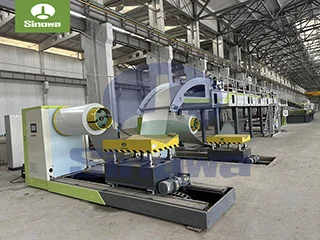
The complete production workflow of the PU sandwich panel production line starts with the automatic feeding and pretreatment of surface raw materials. Bulk coiled surface materials are placed on the automatic unwinding device of the equipment, which achieves uniform and stable material output through servo speed regulation, effectively preventing material deviation and tension unevenness during the unwinding process. Subsequently, the raw materials enter the roll forming unit, where multiple groups of precision forming rollers conduct gradual rolling, bending, and shaping according to preset industrial building specification standards. This progressive forming process can precisely adjust the flatness, waveform, and edge structure of the surface materials, meeting the diverse structural requirements of industrial building walls, roofs, and partition components. For industrial buildings with high requirements for waterproofing and wind resistance, the roll forming unit can process specialized edge-locking structures on the panel edges, providing reliable structural conditions for subsequent on-site assembly and overall sealing of the building enclosure. After forming, the surface materials undergo leveling and surface cleaning treatment to remove surface impurities and tension stress generated during rolling, ensuring a clean and flat bonding interface for subsequent composite molding.
Following the surface material pretreatment stage, the sandwich panel equipment enters the core functional link of polyurethane foaming and composite filling, which determines the core thermal insulation and structural performance of the finished panels. The machine is equipped with a high-precision chemical metering and mixing system that independently stores and conveys the two basic components of polyurethane raw materials. Through closed-loop precise flow regulation, the system controls the proportion of raw material components accurately, ensuring that the chemical reaction degree of polyurethane is maintained in the optimal state. The mixed liquid polyurethane raw materials are evenly sprayed on the surface of the lower-layer formed plate through a reciprocating spraying mechanism. The liquid material undergoes rapid chemical reaction immediately after spraying, producing uniform and fine foam bodies that expand steadily to fill the entire space between the upper and lower surface plates. The whole foaming process is dynamically adjusted according to production speed and preset density parameters, realizing precise control of foam core density, pore uniformity, and filling thickness. This intelligent foaming control mode enables the core layer to maintain consistent structural performance in all parts of the panel, effectively avoiding local hollowing, uneven density, and insufficient thermal insulation that often plague low-quality panel products.
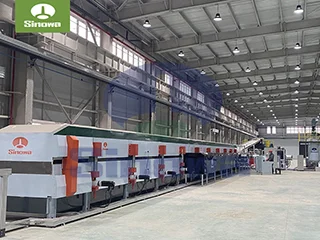
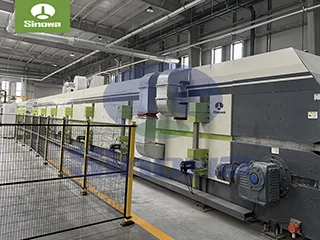
After the completion of foam filling and preliminary expansion, the semi-finished panels enter the continuous laminating and curing unit for integral molding and solidification. The unit adopts a segmented constant-temperature heating and pressure-maintaining structure, which applies uniform and stable pressure vertically and horizontally to the composite panels while maintaining a constant temperature environment suitable for polyurethane curing. The synergistic effect of constant pressure and constant temperature promotes the full reaction and rapid curing of the polyurethane foam core layer, while tightly bonding the core layer with the upper and lower surface materials into an integrated structure. The pressure control system can adaptively adjust the pressure value according to different surface material thicknesses and panel specifications, ensuring that the foam structure is not crushed and deformed while achieving zero-gap bonding. The segmented temperature setting meets the gradual curing law of polyurethane materials, realizing preliminary shaping, intermediate strengthening, and final stable curing of the core layer in stages. After continuous curing, the polyurethane foam forms a closed-cell porous structure with high compactness, endowing the panels with excellent thermal insulation, sound insulation, and pressure resistance, fully adapting to the long-term service environment of industrial buildings.
The final stage of the production process involves precision sizing, cutting, and finished product output. The fully cured continuous panel strip is transported to the automatic cutting unit through a stable transmission system. The high-precision cutting system adopts servo positioning and fixed-length cutting technology, which can accurately set the cutting length according to the customized needs of industrial building projects. The cutting mechanism runs smoothly with neat cutting sections, without burrs, deformation, or core layer cracking, ensuring the dimensional accuracy and appearance quality of each finished panel. After cutting, the finished panels are automatically transported to the stacking platform through the output system, realizing orderly stacking and temporary storage of finished products. The entire process from raw material feeding to finished product stacking is completed automatically by the equipment, with minimal manual intervention, which not only greatly improves production efficiency but also eliminates quality fluctuations caused by human operation errors, ensuring that each batch of panels maintains consistent performance and specifications.
The structural design and performance advantages of the PU sandwich panel line are highly targeted to the functional needs of industrial buildings, making the produced panels uniquely suitable for industrial construction scenarios compared with traditional building materials. First of all, the equipment realizes the integrated molding of lightweight composite structures, and the produced panels have low overall density while maintaining high bending and compressive strength. This lightweight and high-strength characteristic can effectively reduce the self-weight of industrial building enclosures, lower the load-bearing pressure on the main steel structure of industrial workshops and warehouses, and thus reduce the engineering cost of main structure construction. At the same time, the closed-cell polyurethane foam core layer produced by precise foaming control has extremely low thermal conductivity, enabling the panels to achieve excellent thermal insulation and heat preservation effects. For industrial buildings such as constant-temperature workshops, cold chain storage warehouses, and production workshops with temperature control requirements, this performance can effectively isolate external temperature changes, stabilize the internal building temperature, and reduce long-term energy consumption for building temperature regulation.
In terms of environmental adaptability and durability, the panels manufactured by the polyurethane sandwich panel production line show outstanding performance suitable for complex industrial environments. The integrated composite structure effectively resists moisture penetration, preventing the core material from absorbing water and mildewing, and avoiding the attenuation of thermal insulation performance caused by moisture accumulation. The surface materials processed by precision rolling have good weather resistance and corrosion resistance, and can stably resist the erosion of industrial waste gas, humid air, and ultraviolet radiation in outdoor and semi-outdoor industrial environments. The tightly bonded integral structure can effectively resist local impact and vibration, adapting to the mechanical vibration environment generated by industrial production equipment operation. In addition, the foam core layer has excellent sound absorption and sound insulation performance, which can isolate the noise generated by industrial production operations, reduce the internal and external noise interference of industrial buildings, and create a relatively stable and comfortable production and working environment.
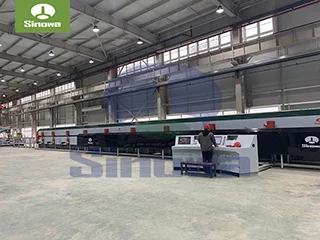
The automated and intelligent design of modern polyurethane sandwich panel line brings significant production advantages for large-scale industrial building construction projects. The equipment is equipped with an integrated intelligent control system, which can realize one-key setting of panel specifications, production speed, foaming density, curing temperature and other core parameters. Operators can complete parameter adjustment and production state monitoring through a simple operation interface, realizing standardized and standardized production. The continuous production mode breaks the bottleneck of low efficiency of traditional intermittent panel production equipment, and can maintain stable and efficient production operation for a long time, meeting the large-scale material supply demand of industrial park construction, factory expansion, and industrial facility renovation projects. Moreover, the equipment has strong specification adaptability, which can adjust production parameters to manufacture panels of different thicknesses, widths, and surface structures, covering the diverse needs of industrial building exterior walls, interior partitions, roof enclosures, and special functional compartments.
In terms of construction practicability, the panels produced by the polyurethane sandwich panel machine have obvious assembly advantages, which perfectly match the prefabricated construction mode of modern industrial buildings. The panels have precise overall dimensions and standardized interface structures, which can realize rapid assembly and splicing on the construction site without complex secondary processing such as painting and plastering. This assembly construction method greatly shortens the construction cycle of industrial buildings, reduces the demand for on-site construction personnel, and lowers the impact of on-site construction on the surrounding environment. The good sealing performance of the panel splicing gap can effectively prevent air leakage and water seepage of the building enclosure, ensuring the overall tightness and waterproof performance of industrial buildings. For temporary industrial production facilities and rapidly built industrial projects, the reusable and easy-to-disassemble characteristics of the panels also provide flexible space adjustment conditions for subsequent building renovation and functional adjustment.
With the continuous advancement of industrial building energy conservation and green construction concepts, the technical performance of continuous PU sandwich panel line is also constantly optimized and upgraded, adapting to the higher requirements of the construction industry for energy-saving and environmental protection building materials. The optimized foaming system of the equipment can improve the utilization rate of polyurethane raw materials, reduce material waste in the production process, and realize efficient and economical utilization of raw materials. The produced panels do not contain harmful substances in the production process, and the materials have stable chemical properties, which will not release volatile pollutants during long-term use, meeting the environmental protection standards of green industrial buildings. At the same time, the excellent thermal insulation performance of the panels can effectively reduce the energy consumption of industrial building heating and cooling, reduce the carbon emission of building operation, and provide strong support for the energy-saving transformation and green upgrading of modern industrial buildings.
In practical industrial construction applications, the matching degree between the continuous PU sandwich panel production line and industrial building scenarios is constantly improving, and the equipment has formed a mature production system for different types of industrial facilities. For large-span steel structure industrial workshops, the equipment can produce ultra-long and ultra-wide integrated panels, reducing the number of splicing joints of building enclosures and improving the overall stability and aesthetics of the building. For special industrial buildings such as dust-free workshops and sterile production workshops, the equipment can produce smooth and seamless panels with anti-fouling and easy-cleaning surfaces, meeting the high-cleanliness environmental requirements of special industrial production. For outdoor industrial facilities such as industrial storage canopies and logistics warehouses, the equipment can produce high weather-resistant and high-load-resistant panels, adapting to long-term outdoor harsh environmental conditions. This strong scenario adaptability makes the PU sandwich panel machine an essential core equipment in the field of industrial building material production.
Looking at the overall development of the industrial construction industry, the popularization and technical iteration of PU sandwich panel machine is promoting the transformation of industrial building enclosure materials from traditional heavy and high-energy-consuming materials to lightweight, energy-saving, and high-efficiency composite materials. The equipment integrates advanced mechanical manufacturing technology, chemical material control technology, and intelligent automation technology, realizing the precise, efficient, and standardized production of industrial building special panels. It not only solves many pain points of traditional building materials such as poor thermal insulation, complex construction, and short service life but also provides reliable material support for the high-quality development of modern industrial architecture. With the continuous improvement of industrial building prefabrication level and the continuous upgrading of energy-saving and environmental protection requirements, the PU sandwich panel manufacturing machine will further develop in the direction of higher automation, more precise control, and stronger scenario adaptability, continuously empowering the efficient construction and green upgrading of industrial buildings worldwide.
https://www.cnsinowa.com/sandwich-panel-machines/pu-sandwich-panel-machine-for-industrial-building.html