sandwich panel machine
The core working logic of the fire retardant foam core PU sandwich panel machine lies in the precise control of the polyurethane foaming reaction and the continuous composite bonding of multi-layer materials. The entire production process is a closed and automated cycle without excessive manual intervention, which effectively avoids quality fluctuations caused by human operation errors. The basic production workflow starts with the feeding and pretreatment of upper and lower surface materials. Common surface materials include metal sheets and composite plates with good weather resistance and mechanical strength. These base materials are uncoiled, leveled and precisely conveyed by the machine’s automatic feeding system, ensuring flat and consistent feeding speed and tension throughout the process, which lays a foundation for the uniform thickness and flat appearance of finished panels. The tension control system built in the equipment can adapt to surface materials of different thicknesses and textures, effectively preventing material wrinkling, deviation and deformation during high-speed conveying, and ensuring the structural consistency of each batch of products.
The most critical link that distinguishes this equipment from ordinary PU sandwich panel line is the optimized foam raw material processing and fire retardant foaming system. Polyurethane foam is formed by the chemical reaction between polyol and isocyanate components, and the fire retardant performance of the foam core is realized by adding professional fire-retardant functional components into the raw material formula. The equipment is equipped with high-precision metering and pumping units, which can accurately control the mixing ratio of dual-component foam raw materials and fire retardant additives. Strict proportional control is not only the key to ensuring the uniform density and stable physical properties of the foam core, but also the core guarantee for exerting the fire retardant effect of functional additives. Inaccurate proportioning will lead to insufficient foaming reaction, uneven distribution of fire retardant components, local poor fire resistance, or excessive foam expansion resulting in loose core structure, which reduces the overall strength and durability of the panel. The advanced mixing head of the machine can realize instantaneous and uniform mixing of multiple raw materials, making the fire retardant components fully fused with the polyurethane matrix, avoiding component precipitation and uneven dispersion, so that every microscopic area of the formed foam core has stable and consistent fire-resistant performance.
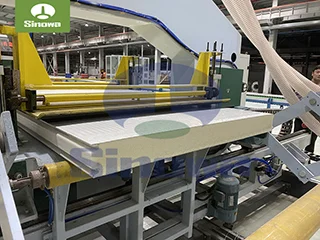
After the raw materials are fully mixed, the liquid foam mixture is evenly sprayed on the surface of the lower base material through the automatic dispensing system. The PU sandwich panel equipment adopts a multi-point uniform spraying mode, which can adjust the spraying width and flow rate according to the production specifications of different panels, ensuring that the liquid foam completely covers the base material without dead ends or accumulation. Subsequently, the upper and lower base materials coated with the foam mixture enter the double-track laminating and curing system together. The closed-cell foaming reaction of polyurethane occurs stably in the constant-temperature and constant-pressure environment built by the laminating equipment. With the gradual expansion and curing of the foam, a dense and uniform fire retardant foam core layer is formed between the two layers of surface materials, and firm chemical and mechanical bonding is generated between the foam core and the surface materials. This integrated composite molding process completely avoids the problem of delamination and peeling that easily occurs in traditional secondary bonding processes, greatly improving the overall structural integrity and service life of the sandwich panel.
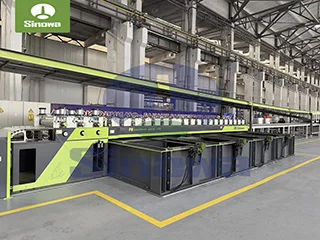
The curing and forming system of the PU sandwich panel production line has excellent process parameter adjustment capability, which can adapt to the foaming and curing requirements of fire retardant foam formulas with different components. The machine can precisely adjust the molding pressure, curing temperature and walking speed of the conveyor chain according to the characteristics of raw materials and product specifications, so that the foam can complete expansion, filling and solidification in the most suitable environment. Moderate and stable molding pressure ensures that the foam core has a compact closed-cell structure, which not only improves the compressive strength and structural stability of the panel, but also optimizes the thermal insulation and sound insulation performance. Reasonable temperature control ensures that the fire retardant components do not fail during the chemical reaction, and the polyurethane molecular structure is fully cross-linked, giving the foam core durable fire resistance and structural toughness. After preliminary curing and molding, the panel will enter the constant-temperature cooling and shaping section. The tension-stabilized cooling process can eliminate the internal stress generated during foaming and pressing, effectively prevent the finished panel from warping and deforming after leaving the factory, and further stabilize the dimensional accuracy and performance consistency of the product.
The fire retardant mechanism of the foam core produced by this professional polyurethane sandwich panel production line is derived from the perfect combination of optimized material formula and precise process control. The uniformly distributed fire retardant components in the foam core will release inert gas rapidly when encountering high temperature, which can dilute the oxygen concentration around the combustion area, isolate the oxygen supply required for combustion, and inhibit the continuous spread of flame. At the same time, the high-temperature carbonization reaction occurs on the surface of the foam core, forming a dense carbonized protective layer. This layer can effectively block heat transfer, prevent the internal foam structure from being continuously decomposed by high temperature, and avoid molten droplet generation and flame spreading. Compared with ordinary polyurethane foam cores that are easy to burn and melt, the fire retardant foam core produced by this equipment significantly reduces flame spread speed and heat release rate, and has excellent self-extinguishing performance, which can effectively control fire hazards in building use scenarios.
In terms of production performance, this automated polyurethane sandwich panel line has obvious advantages over traditional intermittent production equipment. It supports long-term continuous uninterrupted production, with stable operating speed and uniform product output quality, which can fully meet the large-scale and batch production needs of industrial building materials. The highly automated operation mode minimizes manual participation links, reduces labor demand and human-induced quality defects, and improves overall production efficiency. The equipment has a high material utilization rate. The precise metering and spraying system avoids excessive waste of foam raw materials, and the closed molding environment reduces material loss during the foaming process, realizing efficient and economical production. In addition, the modular structural design of the equipment makes it highly adaptable. It can adjust production parameters to manufacture sandwich panels of different thicknesses, widths and specifications, covering the production needs of wall panels, roof panels, insulation panels and other different types of products, with strong production flexibility.
The finished sandwich panels produced by this polyurethane sandwich panel machine integrate multiple excellent performance characteristics, making them widely applicable in various high-demand construction and industrial fields. First of all, the efficient thermal insulation performance brought by the closed-cell foam structure can effectively block heat conduction, reduce building energy consumption, and meet the energy-saving and environmental protection requirements of modern green buildings. Secondly, the optimized fire retardant core layer enables the panels to adapt to public buildings, industrial workshops, cold storage facilities and other scenarios with high fire safety standards, effectively improving the overall fire protection level of buildings. In addition, the integrated composite structure gives the panels light weight and high strength characteristics. Compared with traditional building materials, they can reduce the self-weight of buildings, simplify the construction process, shorten the construction cycle, and reduce construction costs. The panels also have good moisture resistance and weather resistance. The closed-cell structure can prevent moisture and water vapor from penetrating, avoiding core layer mildew, performance attenuation and structural damage caused by moisture absorption, and ensuring stable long-term use performance in different climatic environments.
In the context of the global construction industry's emphasis on safety, energy conservation and environmental protection, the market demand for fire-retardant and energy-saving building enclosure materials is continuously upgrading, which also promotes the continuous technological iteration of polyurethane sandwich panel production equipment. Modern fire retardant foam core PU sandwich panel machine is gradually developing towards higher precision, higher intelligence and stronger environmental adaptability. The intelligent parameter adjustment system can realize real-time monitoring and automatic correction of foaming ratio, temperature, pressure and other core parameters, further improving product quality stability. The optimized foaming process reduces the generation of harmful substances during production, making the production process more environmentally friendly and in line with the sustainable development requirements of the industry.
The application value of this sandwich panel production machine is not only reflected in the production of high-performance building materials, but also in promoting the standardized and high-quality development of the entire sandwich panel industry. By virtue of precise process control capabilities, it solves the common quality problems of traditional products such as unstable fire resistance, inconsistent core density and easy delamination, and improves the overall quality level of PU sandwich panel products. The efficient and flexible production mode enables manufacturers to quickly respond to the differentiated needs of the market, realize customized production of products, and provide reliable material support for various high-standard construction projects. With the continuous improvement of building safety standards and energy-saving policies, this professional fire retardant foam core PU sandwich panel production equipment will become more popular in the industry, and continue to play an important role in promoting the upgrading of green and safe building materials.
https://www.cnsinowa.com/sandwich-panel-machines/pu-sandwich-panel-machine-with-fire-retardant-foam-core.html