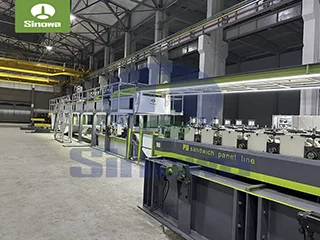
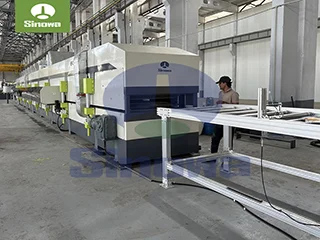
sandwich panel machine
The whole set of wall PU sandwich panel machine adopts modular integrated mechanical design, and all functional units maintain synchronous operating speed through unified servo linkage control system, avoiding production defects caused by asynchronous operation of individual equipment units. The complete production system can be divided into front-end surface material processing module, middle-end PU foaming and composite forming module, back-end curing and fixed-length cutting module and automatic conveying and stacking auxiliary module, and each module cooperates closely to realize fully automatic unmanned continuous production. The front-end surface material processing part is the initial link of the whole PU sandwich panel production line, mainly responsible for unwinding, leveling, surface cleaning and roll forming of upper and lower surface base materials. In actual production, common surface materials include color-coated metal plates, aluminum alloy plates and other metal substrates, as well as glass fiber reinforced plastic plates and other non-metal decorative substrates. After being released from the coil rack, the coiled surface materials will pass through multi-group leveling rollers to eliminate subtle bending deformation and surface wrinkles generated during coil storage and transportation, ensuring the flatness of surface materials before composite processing. Subsequently, the surface materials will enter the automatic cleaning unit to remove surface dust, oil stains and oxide attachments. This surface pretreatment process is indispensable because residual impurities will directly isolate the bonding interface between surface materials and PU foam core, leading to delamination, degumming and peeling of finished panels in later long-term use, and greatly reducing the overall structural stability and service life of wall panels. After cleaning, the flat surface materials will be processed by roll forming devices to fold edge structures such as tongue and groove, which helps finished wall panels realize seamless splicing during on-site construction, reduce cold and hot bridge gaps at assembly joints, and further optimize the overall thermal insulation and airtight performance of building walls.
The middle-end PU high-pressure foaming and composite pressing unit is the core functional part of the entire wall PU sandwich panel making machine, which determines the thermal insulation performance, internal compactness and interlayer bonding strength of finished wall panels. Polyurethane foam is formed by the full chemical reaction of two-component raw materials including polyol composite materials and isocyanate, matched with quantitative flame retardant additives, foaming regulators and stabilizers. The equipment is equipped with closed-loop automatic raw material proportioning system, which can accurately adjust the output flow and mixing ratio of two raw materials in real time according to set production parameters. Compared with manual proportioning in early intermittent equipment, the automatic proportioning system avoids material reaction imbalance caused by human operation errors. Insufficient mixing will lead to loose internal foam structure and a large number of hollow pores, while excessive mixing viscosity will reduce the fluidity of foaming materials, resulting in uneven distribution of foam core between upper and lower surface layers. After high-speed collision and uniform mixing through the high-pressure mixing head, the liquid polyurethane raw materials are evenly poured on the surface of the lower-layer forming plate through the circulating material distribution pipeline. Immediately afterwards, the upper-layer surface material is automatically covered by the conveying roller way, and the preliminary sandwich composite structure is formed before entering the constant-pressure composite pressing area.
The constant-pressure laminating and pressing section adopts multi-group segmented pressing roller design, with independent pressure monitoring and temperature maintaining systems installed inside. During the foam expansion and primary curing process, stable pressure and constant ambient temperature are always maintained inside the pressing tunnel. Reasonable pressure setting can make the expanding polyurethane foam fully fill the gap between upper and lower surface plates without extrusion deformation of thin surface plates; matched constant-temperature environment can stabilize the chemical reaction speed of foaming materials, ensure consistent foam expansion ratio along the whole length of panels, and realize uniform core density of finished wall panels. In this process, the equipment also supports stepless adjustment of pressing gap, so manufacturers can flexibly produce wall panels with different thickness specifications only by modifying system parameters without replacing mechanical molds, meeting the wall insulation needs of different building scenarios. For exterior wall enclosure structures requiring high thermal insulation performance, thickened panels can be produced; for indoor partition walls with low insulation requirements and high space utilization demands, thin lightweight sandwich panels can be manufactured efficiently. This flexible production feature greatly improves the equipment utilization rate of production enterprises and enriches product categories without additional production line investment.
After preliminary composite pressing and primary foaming curing, the continuous long strip composite panel enters the constant-temperature curing tunnel for secondary complete curing treatment, which is a key process to enhance the overall structural strength of wall panels. The internal temperature and walking speed of the curing tunnel are linked with the front-end foaming speed synchronously. The slow and stable conveying speed matches the full curing cycle of polyurethane foam, ensuring that the internal chemical reaction of foam is completely finished before cutting. Fully cured PU foam forms a closed-cell microcellular structure inside the panel. This dense closed-cell structure endows sandwich wall panels with ultra-low thermal conductivity, excellent water resistance and moisture resistance. Different from open-cell insulation materials, closed-cell PU foam can effectively block moisture penetration, avoid condensation inside wall structures in high-humidity environments, and prevent insulation performance attenuation caused by moisture absorption of core materials in long-term service. Meanwhile, the fully cured integrated composite structure makes the surface layer and foam core form an inseparable whole, with strong shear resistance and impact resistance, so the wall panels can withstand external wind pressure and daily mechanical impact during building operation without interlayer separation or local depression.
The back-end fixed-length cutting, edge trimming and automatic stacking unit realizes finished panel shaping and offline collection. The equipment adopts flying saw tracking cutting technology instead of traditional static cutting mode. The cutting tool runs synchronously with the moving panel in real time during cutting, which completely avoids length error and section burrs caused by panel static parking cutting. After fixed-length cutting, both sides of the panel will be automatically trimmed to remove excess foam overflow and irregular edge materials generated during composite pressing, ensuring uniform width and neat cross-section of each finished panel. Finally, qualified finished panels are automatically transported to the stacking platform by the rear conveyor system, and stacked neatly by mechanical positioning devices. The whole process does not require manual carrying, cutting measurement and sorting operations, which greatly reduces on-site labor demand, reduces labor cost in panel production workshops, and eliminates potential safety hazards caused by manual contact with operating mechanical equipment.
Compared with traditional intermittent PU sandwich panel production equipment, modern integrated wall PU sandwich panel production machine has prominent advantages in production stability, energy consumption control and environmental protection performance. First of all, the full-line servo synchronous control system realizes one-button parameter setting and unattended continuous operation, effectively reducing fluctuation of finished panel quality caused by manual intervention. The polyurethane sandwich panel production line can run stably for a long time without frequent startup and shutdown, avoiding raw material waste and performance instability of foaming materials caused by repeated equipment startup. Secondly, the equipment adopts closed raw material conveying and circulating pipeline design, which reduces volatilization loss of liquid polyurethane raw materials in the production process. Equipped with centralized waste gas collection and treatment structure in the foaming area, it processes trace volatile gas generated by chemical reaction in a closed space, reducing impact on workshop working environment and surrounding atmospheric environment, adapting to increasingly strict global industrial environmental protection production standards. In terms of energy consumption optimization, the curing tunnel adopts circulating heat recovery structure, which recycles residual heat generated by foam chemical reaction to maintain internal constant temperature, reducing additional heating power consumption of the equipment and realizing energy-saving production throughout the line.
In actual industrial production operation, the intelligent monitoring system built in wall PU sandwich panel manufacturing machine can realize real-time collection and feedback of all core operating data, including raw material mixing pressure, foaming temperature, pressing pressure, line running speed and curing room temperature. Once any parameter deviates from the preset standard range, the system will send early warning prompts automatically and conduct fine automatic parameter calibration without stopping production. This intelligent self-correction function reduces equipment failure rate and unqualified product rate, lowers later maintenance cost and production loss of manufacturers. In addition, the equipment adopts humanized mechanical protection design for all rotating rollers, transmission chains and cutting tools, isolating all dangerous moving parts, which improves the overall operation safety of the continuous PU sandwich panel line and reduces equipment maintenance difficulty in daily use. The modular assembly structure also supports targeted disassembly and replacement of individual functional units during later maintenance, without overall shutdown and disassembly of the whole continuous PU sandwich panel production line, shortening daily maintenance time and improving overall equipment operation rate.
Driven by the upgrading of global prefabricated buildings and green building policies, finished wall PU sandwich panels manufactured by this professional equipment have covered diversified construction scenarios. In industrial factory buildings and large warehouses, these wall panels reduce overall building load thanks to their lightweight characteristics, lowering foundation construction cost, while excellent thermal insulation performance cuts long-term heating and refrigeration energy consumption of industrial plants. In cold storage, constant-temperature workshops and pharmaceutical clean rooms requiring strict temperature control and airtightness, the closed-cell PU foam core effectively blocks cold and heat transfer, maintains stable indoor temperature, and avoids cooling capacity loss caused by wall heat exchange. In commercial buildings such as office buildings, shopping centers and hotels, the diversified surface appearance of finished panels meets architectural decoration needs, and the integrated wall structure shortens on-site enclosure construction period greatly compared with traditional brick wall pouring and plastering processes. In emergency prefabricated houses, temporary construction facilities and mobile modular buildings, the lightweight, easy-to-transport and quick-splicing characteristics of PU sandwich wall panels match the rapid assembly demand of temporary buildings perfectly. In addition, with the upgrading of foaming formula matching with the equipment, the produced wall panels can also enhance fire retardant performance, meeting fire safety requirements of public buildings and high-rise buildings, further expanding market application boundaries.
Looking into the future development direction of wall polyurethane sandwich panel machine, technological innovation will focus on three core dimensions: higher intelligent integration, multi-material composite compatibility and near-zero carbon production optimization. Firstly, the equipment will further combine digital twin technology to realize remote online monitoring, fault remote diagnosis and unattended full-line operation, helping production enterprises realize digital workshop management and reduce reliance on on-site operation technicians. Secondly, the optimized composite pressing and foaming structure will support mixed production of polyurethane core matched with mineral wool edge sealing, realizing complementary advantages of PU thermal insulation performance and mineral wool fireproof performance on the same production line, enabling one equipment to produce composite wall panels with higher fire resistance grade. Thirdly, matching with the global dual-carbon goal, future equipment will be compatible with bio-based environmental protection polyurethane raw materials, cooperate with whole-line heat circulation optimization and low-power driving motors, further reducing production carbon emission and realizing greener manufacturing process of insulated building panels.
In summary, wall PU sandwich panel machinery is highly automated and process-intensive manufacturing equipment connecting mechanical engineering, material chemistry and construction material industry. It optimizes the production process of insulated composite wall panels from source, improves production efficiency and finished product quality stability, and provides reliable material and equipment support for the popularization of energy-saving prefabricated buildings worldwide. As the global construction industry continues to transform towards low carbon, high efficiency and modularization, the market demand for high-performance wall PU sandwich panel line will keep growing steadily. Continuous technological upgrading of such equipment will further promote iterative upgrading of building enclosure materials, accelerate the elimination of backward high-energy-consumption wall construction processes, and play an indispensable role in promoting the sustainable development of the whole construction industry.
https://www.cnsinowa.com/sandwich-panel-machines/wall-pu-sandwich-panel-machine.html