sandwich panel line
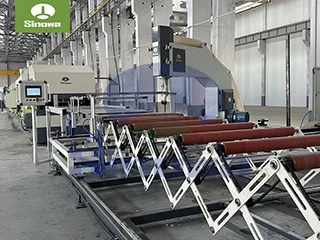
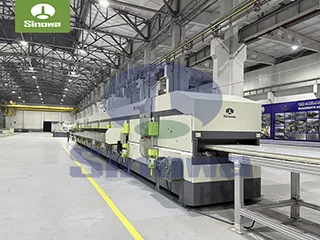
The entire automatic PU sandwich panel production line with auto stacker is a highly integrated mechatronic system that combines metal sheet forming, continuous PU foaming, composite pressing, constant temperature curing, fixed-length cutting and intelligent automatic stacking into one uninterrupted production workflow. Unlike discontinuous intermittent production equipment that requires frequent manual material transfer and production line shutdown, this continuous production line allows raw materials to flow through each functional module sequentially without intermediate stagnation. The core design concept of the equipment is to minimize human participation in the whole production chain, unify production parameters through centralized intelligent control system, and match the operating speed of front-end panel manufacturing units and back-end stacking units perfectly to eliminate production bottlenecks caused by mismatched working efficiency between upstream and downstream processes. The auto stacker, as the core terminal module of the whole production line, undertakes all finished panel collection, arrangement and stacking work, which completely replaces manual stacking and manual handling links that consume massive labor resources in traditional production lines.
The complete working flow of the polyurethane sandwich panel production line can be divided into six interconnected and synchronized stages, and every procedure operates in closed-loop linkage with the terminal auto stacker to ensure overall production coordination. The first stage is automatic surface material unwinding and surface pretreatment. Metal coil materials used for panel upper and lower surface layers are placed on automatic unwinding racks, which release metal sheets at a constant and adjustable speed according to the preset production line operating parameters. After unwinding, the metal sheets pass through surface cleaning and leveling modules to remove surface dust, oil stains and subtle deformation generated during coil storage and transportation. This pretreatment process ensures tight bonding force between metal surface layers and PU foam core materials in the subsequent composite process, avoiding delamination, hollowing and other quality defects of finished panels. All operations in this stage are completed automatically by mechanical rollers and cleaning components, with no need for workers to contact raw materials directly.
The second stage is precision roll forming of metal surface sheets. Leveled metal sheets enter the roll forming unit composed of multiple groups of high-precision forming rollers. According to the design requirements of roof panels, wall panels and cold storage special panels, the rollers bend and press metal sheets into preset profile structures, including trapezoidal ridges, flat surfaces and various edge occlusion structures. The roll forming speed is synchronously linked with the follow-up foaming and traction system, so that the forming rhythm of metal sheets can fully match the expansion and curing speed of PU foam materials. The high-precision roller structure ensures consistent size and uniform appearance of each formed metal sheet, laying a solid foundation for the dimensional accuracy of final finished sandwich panels.
The third stage is continuous PU raw material metering, mixing and in-line foaming, which is the most critical core process determining the thermal insulation and structural performance of sandwich panels. Liquid polyurethane raw materials are transported to the high-pressure mixing unit through independent pipeline conveying systems. The system automatically adjusts the proportion of different raw materials according to preset formulas, realizing accurate quantitative mixing without manual proportion adjustment. The uniformly mixed liquid PU materials are evenly sprayed between the upper and lower formed metal sheets through a mobile pouring head that moves horizontally at a constant speed. After pouring, the liquid foam starts to expand rapidly and fill the gap between two layers of metal sheets automatically. The whole foaming process is carried out in a closed space, which effectively controls foam expansion range and avoids material overflow and waste. Compared with manual foaming operation, automatic metering and pouring technology maintains stable foam density for each batch of panels, ensuring consistent thermal insulation performance and compression resistance of all finished products.
The fourth stage is composite pressing and constant temperature curing. After PU foam pouring, the integrated semi-finished panels composed of upper metal sheet, PU foam core and lower metal sheet enter the continuous double-layer laminating pressing machine. The pressing machine maintains stable pressure and constant temperature environment inside the cavity, promoting full chemical reaction of PU foam and firm bonding between foam core and metal surface layers. The constant temperature curing environment eliminates the influence of ambient temperature changes on foam curing effect, solving the problem of unstable bonding strength caused by seasonal temperature difference in traditional open-type curing production. The length of the curing channel can be matched with different production speeds to guarantee complete curing of foam core even under high-speed continuous production state, preventing incomplete curing leading to panel deformation and poor bonding strength.
The fifth stage is fixed-length cutting and edge trimming. After complete curing and shaping, continuous long strip sandwich panels are transported to the intelligent cutting unit by traction equipment. The system automatically identifies preset panel length parameters and drives the cutting tool to conduct vertical cross-cutting at accurate positions. The cutting tool adopts smooth cutting technology to ensure neat panel cutting edges without burrs, cracks or sheet warping. Meanwhile, the edge trimming module synchronously processes both sides of panels to unify the overall width of finished panels. After cutting and trimming, qualified single finished panels are transmitted to the terminal automatic stacker through the finished product conveyor belt, marking the completion of front-end panel manufacturing process and entering the final stacking and collecting link.
The sixth stage is automatic stacking completed by the matched auto stacker, which is the key module that distinguishes this full-automatic PU sandwich panel line from semi-automatic production equipment. The auto stacker is equipped with vacuum suction grabbing components and servo-driven mechanical transmission structures, which can adapt to different sizes, thicknesses and surface types of PU sandwich panels. When finished panels are transmitted in place by the conveyor belt, the stacker’s positioning sensor automatically detects panel position, length and angle without manual positioning calibration. The vacuum suction cup group fits closely with the smooth surface of sandwich panels to grab panels stably, avoiding surface scratches, corner collapse and indentation that are easy to occur during mechanical clamping stacking. According to production and storage requirements, the stacker can realize horizontal flat stacking, cross flipping stacking for roof panels and layered classified stacking for panels of different specifications. During the whole stacking process, the servo motor controls the lifting, horizontal moving and placing speed of grabbing components accurately, ensuring each panel is placed neatly with consistent gap between adjacent panels.
In addition to basic stacking functions, the auto stacker also integrates intelligent protection and automatic fault detection subsystems to adapt to long-term uninterrupted industrial production scenarios. The anti-collision sensing system installed on the stacker can automatically suspend stacking actions once abnormal obstacles appear in the working area, protecting both mechanical equipment and finished panels from collision damage. Meanwhile, the system can automatically count the number of stacked panels in each stack. When the quantity reaches the preset upper limit, the stacker will automatically shift the stacking position to start a new panel stack, and send prompt signals to the central control system to remind staff to transfer full panel stacks. All stacking parameters including single-layer placement position, stack height, panel flipping angle and stacking interval can be adjusted directly on the central human-machine interaction screen, requiring no professional mechanical debugging operation. This user-friendly control mode greatly reduces the operation threshold of terminal stacking equipment.
The integration of auto stacker brings multi-dimensional core advantages to the overall polyurethane sandwich panel line, covering labor cost reduction, production efficiency improvement, product quality optimization and on-site safety enhancement. Firstly, the full cancellation of manual stacking and manual finished panel handling reduces the number of on-site operators required for the whole production line significantly. Traditional production lines need four to six workers specially responsible for finished panel sorting, carrying and stacking, while the automatic sandwich panel production line with auto stacker only needs a small number of staff to monitor the overall operating state of the equipment and conduct regular routine maintenance. The sharp reduction of manual demand effectively solves the problem of rising labor costs and seasonal labor shortage faced by building material manufacturing factories in recent years.
Secondly, the synchronous matching between front-end production speed and back-end stacking speed breaks the efficiency bottleneck of traditional production lines. In semi-automatic production lines, manual stacking speed cannot keep up with high-speed panel manufacturing speed, so front-end equipment has to reduce operating frequency frequently to wait for manual stacking, resulting in overall low production capacity. The auto stacker runs at fully synchronous speed with upstream cutting unit, realizing seamless docking between panel output and panel stacking. The whole PU sandwich panel machine can maintain continuous high-speed operation for 24 hours without downtime caused by slow manual post-processing, improving daily production capacity by more than thirty percent compared with semi-automatic production modes.
Thirdly, mechanical automatic stacking avoids artificial damage to finished panels fundamentally. Manual carrying and stacking are prone to human errors such as uneven placement, collision between panels and surface friction scratches, which increase product defective rate and bring unnecessary economic losses to manufacturers. The standardized and repetitive mechanical actions of auto stacker ensure zero surface damage and neat stacking appearance of every finished panel. Uniform stacking effect also facilitates subsequent finished product storage, container loading and long-distance transportation, reducing secondary damage risk of panels during logistics links.
Furthermore, the centralized intelligent control system unifies parameter setting and state monitoring of all modules including unwinding, forming, foaming, cutting and stacking. Operators can view real-time operating data of each unit, running speed, equipment working status and abnormal alarm information on one integrated control screen. Once minor abnormal fluctuations occur in any production link, the system will give real-time alarm and conduct automatic parameter correction preferentially. If the abnormality cannot be solved automatically, the system will lock relevant equipment modules to prevent fault expansion. The highly integrated control mode realizes overall digital management of panel production process, helping manufacturers realize refined production management.
PU sandwich panels produced by this fully automatic production line with auto stacker have wide application coverage in multiple downstream industries. In prefabricated construction industry, these panels serve as roof and wall enclosure materials for prefab workshops, temporary construction houses and public prefabricated buildings, relying on excellent heat insulation and weather resistance to reduce building energy consumption throughout the year. In cold chain logistics industry, high-density PU sandwich panels are used for cold storage walls, ceilings and compartment plates of refrigerated transport vehicles, providing stable low-temperature insulation environment to ensure fresh-keeping effect of goods. In industrial factory renovation and clean room construction fields, the panels meet the requirements of dust-proof, heat-insulating and easy-to-clean interior wall materials. Benefiting from stable production quality brought by full-automatic production process, panels manufactured by this line can adapt to complex outdoor and indoor application environments for long-term service.
Looking ahead to the future development of insulation building material manufacturing equipment, the automatic polyurethane sandwich panel machine equipped with auto stacker will further evolve towards higher intelligence, energy conservation and flexible production. Subsequent upgrading directions include automatic online surface defect detection function, which can identify tiny surface scratches and foaming defects of panels before stacking and automatically separate unqualified products without manual screening. In terms of energy saving optimization, the production line will adopt adaptive power adjustment technology to automatically match equipment energy consumption according to real-time production output, reducing idle power consumption of mechanical components. For flexible production demands of multi-specification panels, the follow-up optimized equipment can realize one-click switching of panel thickness, width and stacking mode without manual mold replacement and mechanical parameter debugging, meeting small-batch and multi-variety customized production demands of the market.
In conclusion, the automatic PU sandwich panel production line integrated with auto stacker represents the advanced manufacturing level of current insulation sandwich panel industry. It solves multiple pain points of traditional production modes from labor dependence, production efficiency, product quality consistency and on-site operation safety. The seamless connection between front-end continuous panel manufacturing process and back-end intelligent automatic stacking process builds a closed-loop unmanned production system suitable for large-scale modern factory production. As the global demand for energy-saving prefabricated building materials continues to grow, this highly automated production solution will become the standard configuration for new and upgraded sandwich panel production factories, promoting the overall intelligent transformation and high-quality development of the whole building insulation material manufacturing industry.
https://www.cnsinowa.com/sandwich-panel-machines/automatic-pu-sandwich-panel-production-line-with-auto-stacker.html