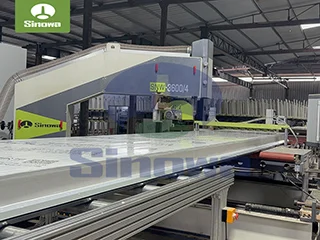
sandwich panel line
The overall structural composition of a rock wool sandwich panel line follows a sequential production logic, with each functional module closely interconnected to form an integrated production chain without redundant mechanical links. The front-end part of the production line is dominated by raw material feeding and pretreatment units, which are mainly responsible for the storage, unwinding and preliminary shaping of metal surface materials and rock wool core materials. Metal coils used for panel surfaces are commonly made of metal alloys with outstanding corrosion resistance and surface flatness, and the feeding device is equipped with tension adjustment components to ensure the metal sheet maintains uniform flat tension during the unwinding process. This tension control function effectively avoids material wrinkling, stretching and lateral deviation, common defects in the initial processing stage. Meanwhile, the rock wool core material feeding area is designed with layered material storage and quantitative conveying structures. Raw rock wool materials, which are processed from volcanic rock minerals through high-temperature melting and fiber forming, are transported to the arrangement unit after density screening and impurity removal. The internal fiber structure of rock wool determines its natural advantages in heat insulation and sound absorption, and the feeding system needs to keep the bulk density of rock wool within a stable range to guarantee the mechanical strength and thermal performance of finished panels.
Following the feeding section is the surface layer forming and rolling unit, which undertakes the task of shaping flat metal sheets into specific structural profiles. Inside this unit, multiple sets of precision rolling rollers are arranged in an orderly gradient. Each group of rollers corresponds to a specific bending and pressing procedure, gradually processing flat metal sheets into metal plates with concave-convex grooves, edge folding structures and connecting notches. The spacing and pressure of the rolling rollers can be adjusted according to the preset dimensional parameters of finished panels, realizing flexible switching of different plate shapes and structural specifications. During the rolling forming process, the mechanical precision of the equipment is strictly controlled, and the tiny deformation error of the metal plate after forming is maintained within a narrow range. This high-precision processing ensures the seamless assembly and splicing of subsequent panels during construction. In addition, the surface of the rolling rollers is treated with smooth and wear-resistant processing technology to prevent scratch damage to the coated layer on the metal surface, thereby preserving the surface integrity and decorative performance of the finished sandwich panels.
The gluing and composite bonding module constitutes the core functional section of the entire rock wool sandwich panel line, determining the bonding firmness and overall structural stability between the metal surface layer and the rock wool core material. Before compounding, the cleaned and shaped metal plates pass through an automatic gluing device, which evenly coats high-strength environmentally friendly adhesives on the inner surfaces of the upper and lower metal plates. The gluing system adopts a quantitative spraying structure to control the coating thickness and coverage of the adhesive accurately. Excessively thin adhesive layers lead to insufficient bonding strength, while overly thick coatings cause adhesive overflow and surface contamination; therefore, precise glue volume control is essential for improving product qualification rates. After the gluing procedure, the rock wool core materials are arranged in an oriented manner. The production line adopts a staggered laying method for rock wool strips, making the fiber direction perpendicular to the upper and lower metal surfaces. This three-dimensional dense laying structure eliminates internal gaps inside the core material and enhances the overall compression resistance and shear resistance of the composite panel. Subsequently, the upper and lower metal plates and the rock wool core material enter the integrated pressing equipment to complete composite bonding under constant temperature and pressure conditions.
Constant temperature treatment is an indispensable auxiliary process in the composite bonding stage. The heating system inside the pressing equipment maintains a stable temperature environment, which accelerates the molecular activity of the adhesive and promotes the solidification reaction of the glue. Under the dual effect of constant pressure and constant temperature, the adhesive fully penetrates into the tiny gaps on the surface of rock wool fibers and metal coatings, forming a tight and durable bonding interface. Unlike manual composite processing methods that rely on natural air drying, the integrated heating and pressing structure of the production line shortens the adhesive curing cycle and eliminates unstable factors such as uneven bonding and easy delamination caused by external temperature changes. The pressure value of the pressing equipment is adjusted according to the thickness and density of the rock wool core material. Low-density rock wool requires relatively low pressing pressure to prevent fiber compression and deformation, while high-density rock wool needs increased pressure to ensure complete fitting between layers. The adaptive pressure adjustment design expands the application range of the production line for different core material specifications.
After the completion of composite bonding and preliminary curing, the integrated semi-finished panels enter the trimming and shaping unit to eliminate irregular edges and surface burrs generated during the composite process. This unit is equipped with high-speed cutting tools and edge trimming components, which perform fixed-width cutting and edge smoothing on both sides of the continuous composite plates. The edge sealing structure of rock wool sandwich panels is completed in this procedure. The edge sealing treatment effectively seals the exposed rock wool fibers at the plate edges, preventing external moisture, dust and corrosive substances from penetrating into the core material. This processing method significantly improves the moisture resistance and service life of the panels, while also optimizing the flatness and aesthetics of the plate edges. In addition, the shaping unit can complete fine processing such as surface flattening and wrinkle elimination, further polishing the overall flatness of the panels to meet the high appearance standards of architectural decoration projects.
The fixed-length cutting system serves as the final forming link of single panels in the production line. This system is equipped with intelligent length sensing and positioning components, which can set arbitrary cutting lengths within the production specification range according to usage requirements. When the continuous composite plate passes through the sensing area, the system automatically records the conveying distance and triggers the cutting device once the preset length is reached. The cutting tool adopts a high-speed cold cutting mode, which avoids thermal deformation of the metal plate and adhesive layer caused by high-temperature cutting. The cutting section maintains smooth and flat without burrs, cracking and other defects, eliminating the need for secondary manual trimming. The conveying speed of the cutting unit maintains synchronous coordination with the upstream composite processing speed, ensuring that the entire production line operates continuously without frequent start-stop actions. This synchronous operation mode reduces mechanical vibration and equipment wear, helping prolong the service life of the production line.
The terminal part of the production line is equipped with finished product conveying, stacking and packaging auxiliary structures. The cut single rock wool sandwich panels are transported to the sorting platform through the roller conveyor line, where qualified products are screened out through simple manual inspection and surface cleaning. The automatic stacking device neatly arranges the finished panels according to fixed stacking specifications, realizing standardized storage of finished products. The stacking mechanism is designed with anti-collision and pressure buffering functions to prevent surface scratch damage and edge extrusion deformation during the stacking process. Meanwhile, the packaging system can complete waterproof film winding and outer wrapping protection for stacked finished products. The sealed packaging structure isolates external moisture and dust, facilitating long-distance transportation and outdoor temporary storage of panels. The integrated setting of stacking and packaging units realizes one-stop processing from raw materials to finished packaged products, reducing intermediate manual handling links and lowering the risk of product damage caused by human factors.
In terms of operating performance, modern rock wool sandwich panel lines have obvious advantages in automation level and production efficiency. The whole production process adopts centralized frequency conversion speed regulation control, and the operating speed of each functional module can be adjusted synchronously. The conventional operating speed range of the production line is capable of meeting the mass production needs of most building material manufacturers. The automated control system simplifies manual operation procedures, and workers only need to set production parameters on the control terminal at the initial stage of production. The equipment can automatically complete feeding, gluing, pressing, cutting and other repetitive operations, reducing the number of on-site operators and lowering labor production costs. In addition, the production line is embedded with an intelligent monitoring system, which can track the operating status of key components such as rolling rollers, glue spraying pumps and cutting tools in real time. Once abnormal conditions such as material jamming and equipment overheating occur, the system will automatically trigger an alarm and perform emergency shutdown protection to avoid equipment failure and material waste.
Structural stability and environmental protection performance are also key optimization directions in the design of rock wool sandwich panel lines. The main frame of the equipment is welded with high-strength steel materials, which has strong compression resistance and vibration resistance. During long-term high-speed continuous operation, the overall frame will not undergo permanent deformation, ensuring long-term processing accuracy of the equipment. For the pollution generated in the production process, the production line is equipped with targeted purification structures. A dust collection device is installed near the rock wool feeding and cutting units to collect floating fiber dust generated during material processing, which effectively reduces dust diffusion in the production workshop and improves the working environment. The noise generated by mechanical operation is reduced through damping structures and silent transmission components, keeping the operating noise within a reasonable range. The adhesives and auxiliary materials used in the production process are low-volatile and environmentally friendly raw materials, which do not produce harmful volatile substances during heating and curing, meeting the green production requirements of the modern building material industry.
The production characteristics of rock wool sandwich panel lines determine the unique performance advantages of finished panels, which in turn expand the application boundaries of such panels in multiple industries. In industrial building construction, rock wool sandwich panels are widely used in the construction of factory workshops, warehouse buildings and industrial enclosures. The integrated composite structure of the panels has light overall weight, which reduces the bearing load of the building foundation; meanwhile, the excellent thermal insulation performance of rock wool core materials can effectively reduce the internal temperature fluctuation of industrial buildings, cutting down the energy consumption of heating and cooling equipment. In commercial buildings such as exhibition halls and shopping malls, the smooth metal surface and diverse appearance specifications of the panels can match different architectural decoration styles, and the sound absorption and noise reduction function of rock wool materials optimizes the internal acoustic environment of buildings.
In special industrial fields with high requirements for fire resistance and anti-corrosion performance, rock wool sandwich panels produced by professional production lines also show outstanding adaptability. Rock wool itself is an inorganic non-combustible material with excellent high-temperature resistance, which can effectively block the spread of flames in case of fire accidents. The metal surface layer undergoes special anti-corrosion treatment, enabling the panels to maintain stable structural performance in humid, salt-spray and corrosive gas environments. Therefore, such panels are commonly used in the construction of chemical plants, food processing workshops and constant-temperature storage warehouses. In addition, the simple assembly and splicing method of sandwich panels shortens the construction cycle of buildings. Compared with traditional concrete and brick wall structures, the installation efficiency is greatly improved, which is especially suitable for temporary buildings and rapid construction projects.
With the continuous upgrading of industrial manufacturing technology, the technological evolution direction of rock wool sandwich panel lines is increasingly clear, focusing on intelligent optimization, energy conservation and consumption reduction, and multi-functional customization. In terms of intelligent upgrading, the production line is gradually combined with digital sensing technology and data analysis systems. The equipment can record production data such as raw material consumption, processing speed and product qualification rate in real time, forming visualized production data reports. Production managers can adjust production parameters and optimize processing procedures based on data feedback to realize refined production management. At the same time, the automatic fault diagnosis function is continuously optimized. The system can independently judge the aging degree and wear state of vulnerable parts, reminding maintenance personnel to replace and maintain components in advance, reducing the downtime loss caused by equipment failure.
In terms of energy saving and emission reduction, the new generation of rock wool sandwich panel lines optimizes the heating circulation structure and power transmission system. The heating unit adopts circulating heat conduction design to reduce heat loss during the curing process of adhesives; the motor transmission part uses high-efficiency energy-saving motors and friction-reducing transmission parts to lower electric energy consumption during equipment operation. In terms of raw material utilization, the production line adds a leftover recycling structure to collect rock wool scraps and metal leftover materials generated in the cutting process. The recycled raw materials are reprocessed and put into production again, improving the comprehensive utilization rate of raw materials and reducing production waste discharge. This series of energy-saving and environmental optimization measures not only reduces the production cost of building material manufacturers but also conforms to the low-carbon development trend of the global construction industry.
The customization capability of production lines is also constantly improved to meet the differentiated market demands. The modernized rock wool sandwich panel line can adjust production parameters flexibly, realizing the processing of panels with different thicknesses, densities and surface patterns. By replacing rolling molds and adjusting core material laying thickness, the equipment can produce thermal insulation panels for low-temperature cold storage, fire-resistant panels for special fire-proof areas and decorative panels for high-standard architectural projects. In addition, the production line can realize composite processing of diversified edge sealing structures. Apart from the conventional flat edge sealing mode, it can also complete reinforced edge sealing and waterproof edge sealing treatment, further enhancing the environmental adaptability of finished panels. The flexible customization feature enables a single production line to cover multiple product specifications, improving the market competitiveness of production enterprises.
In the actual production and operation process, standardized maintenance and operation management are crucial to maintain the long-term stable operation of the rock wool sandwich panel line. Daily maintenance work includes cleaning dust and residual adhesives on the surface of mechanical components, checking the tightness of transmission chains and connecting bolts, and replenishing lubricating oil for rotating parts such as rolling rollers and bearings. Regular maintenance needs to detect the wear degree of cutting tools and sealing parts, replace aging vulnerable parts in a timely manner, and calibrate the precision of positioning and cutting systems to ensure the dimensional accuracy of finished panels. Operators need to master standardized operation procedures, avoid overload operation and parameter misoperation, and record the daily operating status of the equipment. Scientific maintenance management can effectively reduce the failure rate of the production line, extend the service life of the equipment, and maintain stable product quality for a long time.
From the perspective of industrial development, the rock wool sandwich panel line, as important supporting equipment in the building material manufacturing industry, will continue to be promoted and popularized in the context of the vigorous development of prefabricated buildings. Prefabricated buildings require building materials to have the characteristics of standardized production, convenient transportation and rapid assembly, which is highly consistent with the production advantages of rock wool sandwich panels processed by automated production lines. In the future, with the continuous progress of material science and mechanical manufacturing technology, the comprehensive performance of rock wool sandwich panel lines will be further upgraded. The production line will develop towards higher automation intelligence, lower energy consumption, smaller occupied space and stronger customization capability, continuously optimizing the production process of composite panels.
Meanwhile, the continuous improvement of production line technology will also drive the iterative upgrading of rock wool sandwich panel products. The finished panels will make breakthroughs in ultra-thin thermal insulation, high-strength compression resistance, super corrosion resistance and other performances, adapting to more extreme construction environments and complex architectural design requirements. The mutual promotion between production equipment and finished products will form a benign industrial development cycle, promoting the standardized and high-quality development of the composite building material industry. In conclusion, the rock wool sandwich panel line, with its mature production process, stable operating performance and flexible production mode, has become an indispensable key equipment in the modern building material industry. It not only provides reliable high-quality composite panels for the construction field but also injects continuous power into the innovative development and industrial upgrading of the prefabricated building industry, with broad application prospects and long-term industrial development value.
https://www.cnsinowa.com/sandwich-panel-machines/rock-wool-sandwich-panel-line.html