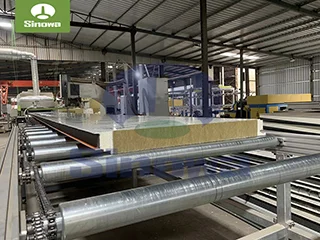
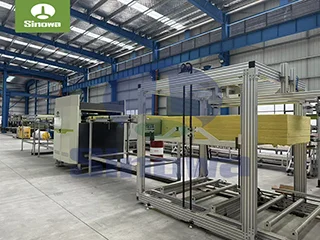
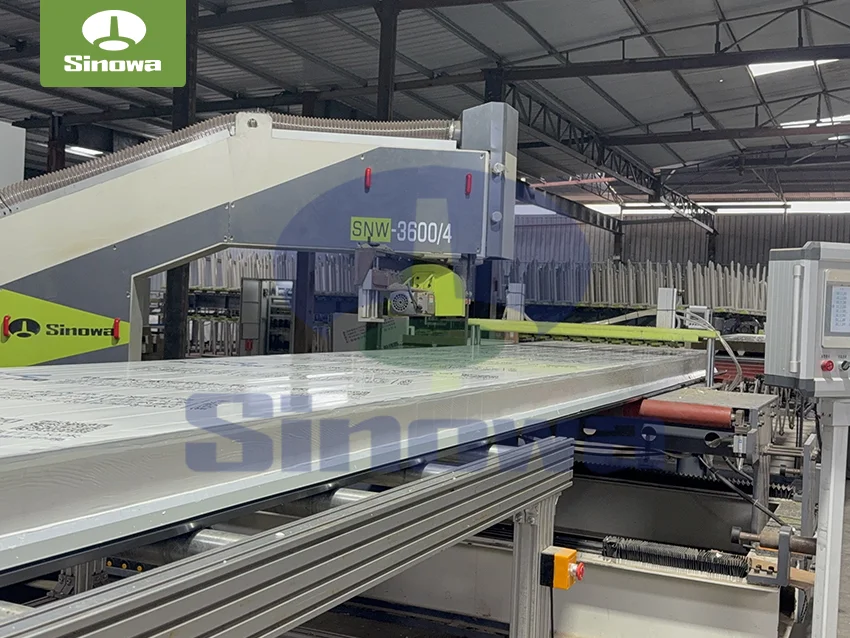
 sandwich panel line
The overall structural layout of the polyurethane sandwich panel production line follows a linear continuous operation logic, with all functional modules connected in an orderly sequence to form a closed and uninterrupted production flow under normal operating conditions. The total length of the entire equipment system can be adjusted within a reasonable range according to production configuration and product specification requirements, realizing flexible layout adaptation for different factory spaces and production capacity planning. Each functional unit of the production line undertakes independent processing tasks while maintaining synchronous linkage operation, avoiding manual intervention errors and production discontinuity caused by segmented processing. The whole production process covers raw material unwinding, surface pretreatment, core material processing, polyurethane proportional mixing and spraying, composite lamination, constant temperature curing, fixed-length cutting, and finished product sorting and stacking, forming a complete automated production loop from raw material input to finished product output.
Raw material pretreatment and feeding serve as the foundation of the entire production process, determining the flatness and composite accuracy of subsequent panel molding. For the metal surface materials used for panel outer layers, the rockwool sandwich panel production line is equipped with an automatic unwinding module, which steadily releases coiled metal materials through adjustable roller sets to ensure continuous and uniform material supply without wrinkles, deviations, or tensile deformation. During the unwinding process, the surface pretreatment device performs fine cleaning and surface adjustment on the metal sheet, removing surface dust, oil stains, and oxide layers that may affect the bonding effect, and optimizing the surface flatness to create optimal conditions for subsequent polyurethane foaming and composite bonding. The tension control system embedded in the unwinding module maintains constant material tension throughout the feeding process, effectively preventing dimensional errors and surface defects of finished panels caused by uneven material stretching.
While the surface metal materials are being conveyed and processed, the rock wool core material undergoes independent pretreatment and feeding procedures to match the synchronous composite rhythm of the rock wool sandwich panel line. Bulk rock wool raw materials are transported to the slitting and shaping device through an automatic lifting and conveying system, which cuts and trims the original rock wool blocks into standard strip structures with uniform thickness and regular edges according to preset product specifications. The thickness of the processed rock wool core material can be adjusted within a wide range to meet the thermal insulation, fireproof, and structural strength requirements of panels used in different building scenarios. After shaping, the rock wool core material will pass through a uniform gluing unit, where the roller-type gluing structure coats a layer of uniform polyurethane adhesive on the upper and lower surfaces of the rock wool material. This treatment effectively enhances the bonding tightness between the rock wool core and polyurethane foam layer, avoiding layered separation problems that may occur in long-term use and improving the overall structural integrity of the composite panel.
The polyurethane foaming and composite lamination module is the core functional unit of the polyurethane sandwich panel line, which directly determines the thermal insulation performance, bonding strength, and overall molding quality of finished sandwich panels. This module relies on a high-precision proportional metering system to realize accurate mixing of polyurethane raw materials, including polyols, isocyanates, and various functional additives. The system can automatically adjust the mixing ratio of raw materials according to production environment temperature, humidity, and product performance requirements, ensuring that the polyurethane raw materials undergo stable chemical foaming reactions. The fully mixed polyurethane liquid is evenly sprayed on the surface of the pre-treated metal sheet through a high-pressure spraying structure, with the spraying thickness and coverage area precisely controlled to form a uniform and dense foam transition layer between the metal surface layer and rock wool core material.
After the completion of polyurethane spraying and rock wool positioning, the multi-layer composite structure enters the continuous lamination and pressing stage. The double-track pressing structure of the PU sandwich panel production line provides stable and constant pressure for the composite material layer, maintaining uniform pressure distribution in all areas of the panel to ensure tight fitting between the metal sheet, polyurethane foam layer, and rock wool core material. The pressing pressure is kept within a stable interval suitable for composite molding, which not only ensures sufficient bonding compactness but also avoids excessive pressure from squeezing out foaming materials and damaging the internal porous structure of polyurethane and rock wool, so as to retain the optimal thermal insulation and sound insulation performance of the materials. At the same time, the pressing unit is equipped with a constant temperature heating system, which provides a stable thermal environment for the polyurethane foaming and curing reaction, accelerating the polymerization and molding speed of polyurethane materials and improving production efficiency while ensuring the uniformity of foam molding.
The constant temperature curing process is a key link to stabilize the comprehensive performance of composite panels. After lamination and pressing, the initially molded panels are continuously conveyed through the constant temperature curing channel, where the internal temperature and conveying speed are precisely matched to complete the full curing of polyurethane materials. In this process, the polyurethane material completes complete foaming and solidification, forming a micro-porous and high-density thermal insulation structure, and forming a firm integrated bonding state with the rock wool core material and metal surface layer. The closed curing environment avoids the influence of external temperature and air flow on the foaming effect, effectively preventing problems such as uneven foaming, local hollowing, and insufficient bonding strength. The length and temperature of the curing channel can be adaptively adjusted according to different panel thicknesses and material formulas, ensuring that all finished products achieve consistent curing quality and stable structural performance.
After full curing and molding, the continuous long-strip composite panels enter the fixed-length cutting and finishing stage. The intelligent cutting system of the rockwool board production line can automatically identify and set cutting parameters according to customized production requirements, realizing precise fixed-length cutting of continuous panels. The cutting tool adopts high-precision structural design, which can complete flat and smooth cutting of multi-layer composite materials without burrs, edge warping, or material layer separation, ensuring the dimensional accuracy and edge integrity of finished panels. In addition to fixed-length cutting, the finishing unit also completes edge trimming and surface fine inspection of the panels, removing residual excess materials on the edges and surface stains generated during the production process, further optimizing the appearance quality of finished products.
The final stage of the production process is finished product conveying, sorting, and automatic stacking. The qualified panels after cutting and finishing are stably conveyed to the stacking area through the roller conveying system, and the automatic stacking device neatly arranges and stacks the finished panels according to fixed specifications. The stacking mechanism has stable bearing capacity and accurate positioning function, which can avoid panel deformation and surface scratch damage during the stacking process, and facilitate subsequent packaging, transportation, and on-site construction and installation. The entire stacking process is automated without manual participation, which greatly improves the neatness and efficiency of finished product collection and reduces the labor cost of finished product sorting.
The core advantages of the polyurethane rock wool sandwich panel machine are reflected in its high integration, automation level, and product performance adaptability. The entire production process realizes continuous unmanned operation from raw material feeding to finished product output, and the centralized control system uniformly adjusts and monitors the operating parameters of each module. Operators only need to set basic production parameters on the control terminal to realize automatic operation of the whole line, which effectively reduces human operation errors and improves production stability and consistency. The linkage control between various functional modules realizes synchronous matching of feeding, foaming, pressing, curing, and cutting speeds, avoiding production stagnation or quality defects caused by mismatched operating rhythms of individual units.
In terms of product performance control, the composite production mode of the equipment perfectly integrates the advantages of two core materials. The rock wool core material provides excellent fire resistance and structural stability for the panel, effectively resisting high-temperature combustion and external structural impact, while the polyurethane foam layer fills the gap between the rock wool and the metal surface layer, forming a dense thermal insulation and sealing structure. This composite structure greatly reduces the overall thermal conductivity of the panel, improves the thermal insulation and energy-saving effect of the building enclosure, and also optimizes the sound insulation and shock absorption performance of the product. The PU sandwich panel line can adjust the material ratio, foaming density, and composite thickness according to different usage scenarios, realizing the diversified production of wall panels, roof panels, and special thermal insulation panels, and meeting the differentiated performance requirements of different construction fields.
In terms of production stability and operational economy, the PU sandwich panel machine adopts optimized mechanical structure and energy-saving design. The closed curing system and circulating heating structure reduce energy consumption in the production process, realizing efficient energy utilization. The wearable parts of the equipment are designed with high-strength structural materials, which reduces the failure rate and maintenance frequency of the equipment during long-term continuous operation and extends the stable service cycle of the production line. The automated continuous production mode greatly improves the single-line output capacity, shortens the production cycle of a single panel, and effectively reduces the unit production cost while ensuring stable product quality, bringing good economic benefits for large-scale batch production.
In terms of quality control, the polyurethane sandwich panel machine is equipped with real-time monitoring systems for key production links, which can track and record core parameters such as polyurethane raw material ratio, foaming temperature, pressing pressure, curing time, and cutting size in real time. Once parameter deviation beyond the preset range is detected, the system will automatically adjust or give an early warning, realizing whole-process quality control from raw material processing to finished product molding. This real-time monitoring and self-correction function ensures that the structural strength, thermal insulation performance, dimensional accuracy, and appearance quality of each batch of finished panels maintain a high consistency, avoiding quality fluctuations caused by manual adjustment differences and environmental changes.
With the continuous upgrading of modern building energy-saving and safety standards, the market demand for high-performance composite thermal insulation panels is constantly improving, and the polyurethane rock wool sandwich panel continuous production line has become an indispensable key equipment in the building material manufacturing industry. Its integrated composite molding technology breaks through the performance limitations of single-material panels, realizing the complementary advantages of different thermal insulation and fireproof materials. The highly automated and intelligent production mode adapts to the large-scale, standardized, and high-quality development trend of the modern building material industry. In practical industrial application, this polyurethane sandwich panel line can efficiently produce high-quality composite panels suitable for industrial plants, cold storage buildings, public venues, and energy-saving building renovation projects, providing reliable material support for the safety, energy saving, and durability of modern buildings.
In the future development of building material manufacturing, the polyurethane rock wool sandwich panel production line will further develop towards higher automation intelligence, lower energy consumption, and stronger product adaptability. The continuous optimization of raw material proportioning technology, foaming molding process, and intelligent control system will further improve the comprehensive performance of finished panels and production efficiency. As the requirements for building energy conservation, fire safety, and environmental protection continue to increase globally, this type of composite continuous sandwich panel line will play a more important role in the field of building enclosure material manufacturing, promoting the iterative upgrading and technological progress of the entire building thermal insulation material industry.
https://www.cnsinowa.com/sandwich-panel-machines/polyurethane-rock-wool-sandwich-panel-line.html