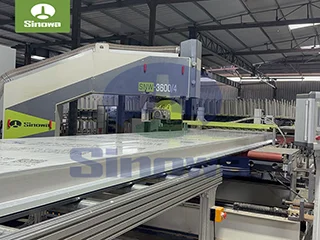
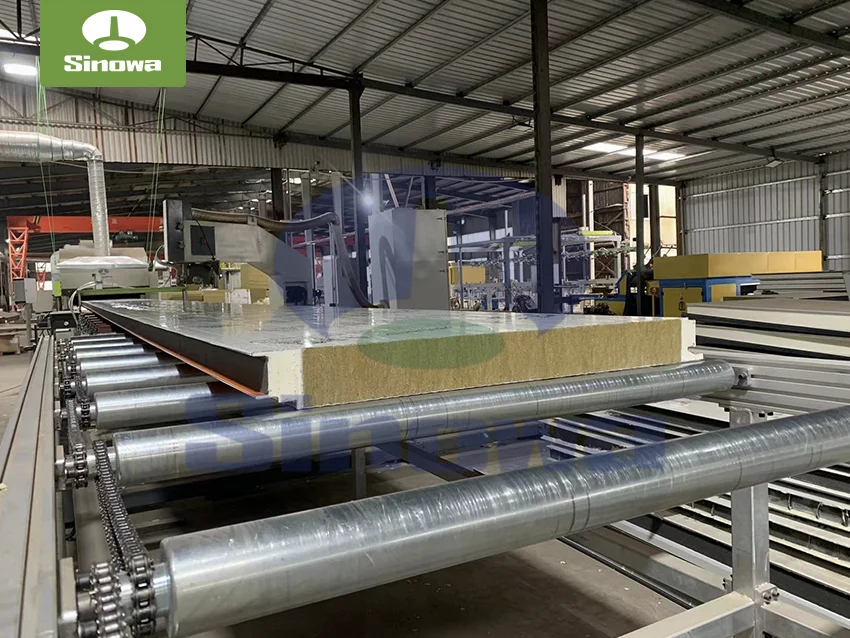
 sandwich panel line
The operational logic of the rock wool sandwich panel production line centers on the perfect combination of metal surface layers and rock wool core materials, relying on coordinated operation of multiple functional units to complete panel forming from raw material input to finished product output. Before formal production, the entire line undergoes systematic debugging of mechanical transmission, electrical control, and hydraulic linkage systems. Technicians adjust the operating speed of each unit, the pressure of composite pressing, the temperature of curing equipment, and the precision of cutting components to match the production specifications of target panels. This pre-production debugging process eliminates potential deviations in continuous operation, ensuring that each production link maintains unified standards and lays a solid foundation for batch production of qualified panels.
Raw material preparation is the primary link that determines the basic performance of finished panels, covering the sorting and pretreatment of metal sheet materials and rock wool core materials. Metal coils used for the upper and lower surfaces of sandwich panels require surface inspection to remove materials with obvious scratches, deformation, or uneven coating. Qualified metal coils are installed on the automatic feeding frame of the rockwool board production line, where the leveling device flattens the coiled metal sheets to eliminate internal stress generated during coiling and storage. Meanwhile, the surface protection film laminating unit operates synchronously to attach protective layers on the metal surface, effectively avoiding surface abrasion and paint damage during subsequent processing, transportation, and installation. The trimmed metal sheets maintain uniform width and flatness, creating qualified surface materials for later composite processing.
The pretreatment of rock wool core materials is equally critical in the entire production process. Rock wool raw materials formed by high-temperature melting and fiber centrifugation need secondary finishing before compounding to meet production requirements. The rockwool sandwich panel production line is equipped with a special core material processing unit that trims the edges of rock wool blocks to ensure consistent overall dimensions, removes loose fibers on the surface, and adjusts the density uniformity of the core layer. Since the structural layout of rock wool fibers directly affects the thermal insulation and mechanical strength of finished panels, the processing unit optimizes the fiber arrangement direction through mechanical adjustment, making the internal fiber structure more compact and orderly. This treatment effectively avoids local hollowing, uneven thickness, and inconsistent density in the finished panels, and significantly improves the overall stability and durability of the core insulation layer.
Gluing treatment is a key procedure to realize firm bonding between metal sheets and rock wool core materials, directly affecting the overall structural integrity and service life of sandwich panels. The rock wool sandwich panel line adopts an automatic precision gluing system that completes uniform glue spraying on the inner surfaces of upper and lower metal sheets. Different from manual gluing, the automated gluing equipment can accurately control the glue output and spraying range according to panel specifications, ensuring that the glue layer covers the entire bonding area without excessive glue accumulation or missing spraying. The glue used in the process has excellent adhesion, weather resistance, and aging resistance, which can form a stable bonding structure after curing, tightly combining the rigid metal surface layer and the fibrous rock wool core layer. In the gluing process, the system also maintains a constant operating temperature to ensure the activity of the glue liquid, avoiding bonding failure caused by temperature fluctuations and guaranteeing the long-term composite stability of the panels in complex application environments.
The core material laying and positioning process follows the gluing operation, requiring high-precision coordination with the metal sheet conveying speed. The rock wool core materials processed in advance are transported to the composite station through a special anti-slip conveying platform. The equipment adopts a staggered laying method for rock wool strips to fill the space between the upper and lower metal sheets, effectively eliminating gaps and splicing dead angles inside the core layer. The automatic positioning device calibrates the left and right margins of the rock wool core material in real time to ensure that the core layer is completely aligned with the metal sheets in width, preventing deviation exposure or partial core material deficiency. This precise laying technology not only optimizes the internal compactness of the panels but also enhances the overall mechanical bearing capacity and anti-deformation performance of the finished products, enabling the panels to maintain stable structural performance under external pressure and temperature changes.
Laminating and constant-temperature curing are the core links of panel forming, determining the bonding firmness and overall molding effect of composite materials. The rock wool sandwich panel machine is equipped with a double-belt composite pressing system, which uses uniform mechanical pressure to fit the upper metal sheet, rock wool core layer, and lower metal sheet tightly together. The pressure value is precisely controlled by the hydraulic system to adapt to different core material thicknesses and density parameters, ensuring sufficient bonding pressure without crushing the rock wool fiber structure. While completing composite pressing, the double-belt system provides a continuous constant-temperature curing environment. Through circulating heating and heat preservation settings, the glue layer inside the panels undergoes a complete curing reaction within a fixed time. The whole curing process is stable and continuous, avoiding incomplete curing or excessive glue aging caused by uneven heating. After curing, the composite structure of the panels achieves the best bonding state, with integrated performance of insulation, fire resistance and structural strength fully realized.
Precision cutting and edge trimming processes are responsible for shaping the finished panels to meet standardized application specifications. The continuously cured integrated panels are transported to the cutting station through the conveying system, and the intelligent sensing device automatically identifies the running length of the panels and triggers the cutting action synchronously. The cutting equipment adopts high-speed and smooth cutting tools to ensure flat and burr-free cutting sections, avoiding fiber scattering and metal edge deformation. After cutting, the edge trimming unit further polishes and finishes the four sides of the panels, calibrates the overall dimensional accuracy, and removes residual glue and floating fibers on the edges. This fine processing ensures that each finished panel has consistent specifications, neat appearance, and convenient on-site assembly and construction, greatly improving the installation efficiency of building enclosure structures.
Automatic stacking and post-processing operations constitute the final stage of the entire production workflow. The cut and trimmed qualified panels are automatically transported to the stacking area, and the mechanical stacking device orderly arranges the panels according to fixed specifications and quantities. During stacking, the equipment maintains stable lifting and placement speed to avoid collision and friction damage between panels. Meanwhile, the system completes residual glue cleaning and surface inspection of the finished panels, screening out individual products with unqualified bonding and surface defects. Qualified finished panels are wrapped with protective films and packaged neatly, which facilitates safe transportation and long-term storage, and effectively prevents dust, moisture and mechanical damage during handling and inventory.
The excellent performance of the rock wool sandwich panel production line stems from its highly automated and integrated structural design, which realizes seamless connection of all production links from raw material feeding to finished product output. The entire production process adopts synchronous frequency conversion speed regulation technology, which can flexibly adjust the production speed according to production demands while maintaining the coordination and consistency of each functional unit. The digital control system realizes real-time monitoring of production parameters such as processing temperature, composite pressure, conveying speed and cutting size. Once abnormal parameter fluctuations occur, the system will automatically trigger adjustment and early warning mechanisms, ensuring the stability and controllability of the production process and greatly reducing the rate of defective products.
In terms of production adaptability, this rockwool insulation board production line has strong flexible production capacity and can meet the manufacturing requirements of panels with different thicknesses, widths and structural parameters. By simply adjusting the equipment parameters and replacing auxiliary positioning parts, the line can switch production specifications quickly, covering the diverse needs of building exterior walls, interior partitions, roof insulation, and special functional enclosure structures. Compared with traditional intermittent production equipment, the continuous production mode of the rock wool sandwich panel production machine greatly shortens the production cycle, reduces manual operation errors and labor costs, and significantly improves production efficiency and batch product consistency.
In practical industrial production applications, the rockwool sandwich panel making machine also shows outstanding advantages in energy saving and stable operation. The heating and curing system adopts circulating heat preservation design, which reduces heat loss and improves energy utilization efficiency. The mechanical transmission structure is optimized and upgraded to reduce operation friction and equipment wear, extending the stable service cycle of the entire line. In addition, the closed production design effectively controls the floating of rock wool fibers during processing, improving the on-site production environment and meeting the standardized operation requirements of modern building material production workshops.
With the continuous upgrading of energy-saving and environmental protection requirements in the construction industry, rock wool sandwich panels have become increasingly widely used in industrial plants, public buildings, cold storage facilities, and modular construction projects due to their excellent fireproof, heat preservation and sound insulation properties. As the core manufacturing equipment, the rock wool sandwich panel manufacturing line continuously optimizes its technological process and structural performance to adapt to the iterative upgrading of building material standards. Its efficient and standardized production capability provides reliable product support for the popularization and application of energy-saving and fireproof building materials, and plays an important role in promoting the high-quality development of the modern construction industry.
https://www.cnsinowa.com/sandwich-panel-machines/sandwich-panel-rock-wool-production-line.html