sandwich panel line
The operational logic of the rockwool foam core sandwich panel line is based on the physical and structural characteristics of rockwool raw materials and composite panel molding principles. The core production idea is to process natural mineral raw materials into fibrous rockwool substrates, compound them with protective surface materials through adhesive bonding and high-pressure molding, and finally form integrated foam panels with excellent thermal insulation, sound absorption, and fire resistance properties. The entire production process follows scientific material deformation and curing rules, with each equipment module cooperating closely to complete raw material pretreatment, fiber forming, cotton collection molding, composite lamination, constant-temperature curing, precision cutting, and finished product finishing. Each link is equipped with adjustable operating parameters, enabling the sandwich panel production line to adapt to different panel thicknesses, structural specifications, and performance requirements, thus meeting the diversified application needs of different engineering scenarios.
Raw material pretreatment serves as the initial and foundational stage of the entire production process, directly determining the basic quality of subsequent finished products. The main raw materials involved in production include mineral raw materials for rockwool fiber formation and surface decorative and protective materials for composite panels. Before formal production, bulk mineral raw materials need to undergo strict screening, crushing, and proportioning treatment to remove impurity components that affect fiber quality and ensure uniform particle size of raw materials. Uniformly proportioned raw materials are transported to the high-temperature melting device through a closed conveying system, where they are heated to a fully molten state under continuous high-temperature conditions. The closed melting environment avoids external impurity pollution and maintains stable melting temperature, which is crucial for forming uniform and fine rockwool fibers. Meanwhile, the surface raw materials used for panel composite molding, usually coiled sheet materials, are processed through uncoiling, leveling, and film laminating procedures. The automatic uncoiling device releases coiled materials at a constant speed, and the multi-group roller leveling structure corrects material deformation, ensuring the flatness and dimensional accuracy of surface materials in subsequent composite processing.
Fiber forming is the key technical link that endows rockwool panels with core insulation and sound absorption performance. After the mineral raw materials are completely melted into a flowing liquid state, they are evenly sent to the centrifugal fiber forming system. Through high-speed centrifugal rotation of professional equipment, the molten liquid is stretched and dispersed into ultra-fine fibrous structures. The diameter and uniformity of fibers are controlled by adjusting the rotating speed of centrifugal equipment and the flow rate of molten materials. Fine and uniform fibers can form a porous internal structure inside the panel, which can effectively lock air and greatly reduce heat conduction and sound transmission efficiency. During the fiber forming process, a small amount of environmentally friendly adhesive components are evenly mixed into the fiber flow, which can enhance the bonding force between fibers and avoid loose internal structure of the panel. The entire fiber forming process is carried out in a closed negative-pressure environment, which not only ensures the neatness of the production environment but also prevents fiber floating and loss, improving the utilization rate of raw materials.
Cotton collection and preliminary molding processes follow fiber forming, undertaking the important task of converting dispersed fibers into continuous preliminary fiber mats. The dispersed rockwool fibers generated by the centrifugal system are evenly collected by the special cotton collection device, which can uniformly distribute fibers in the set width and thickness range to form continuous and flat fiber cotton layers. The thickness uniformity of the cotton layer is precisely controlled by the matching operation speed of the cotton collection equipment and the fiber output volume, avoiding local thickness deviation of the preliminary blank. After preliminary collection, the fiber cotton layer enters the preliminary shaping device for light compression and arrangement, which arranges the disordered fibers in a relatively regular direction, improving the overall compactness and structural uniformity of the fiber mat. This preliminary shaping treatment lays a solid foundation for subsequent composite lamination and curing molding, preventing problems such as uneven internal structure and local hollowing of finished panels.
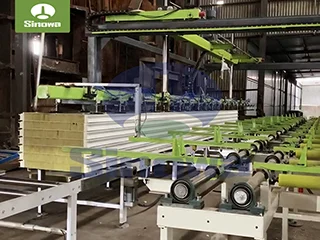
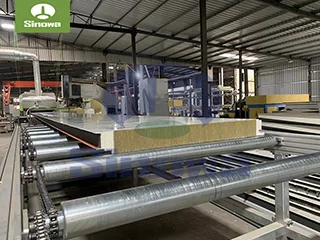
Composite lamination is the core link to realize the integrated structure of rockwool foam panels. The surface materials that have completed uncoiling, leveling and preheating treatment are transported to the composite station synchronously with the shaped rockwool fiber mat. The automatic gluing system evenly sprays high-performance adhesive on the bonding surfaces of the upper and lower surface materials, with the glue application amount and spraying range accurately adjusted according to the panel specification standards to ensure full and uniform bonding without excess glue overflow or local glue shortage. Subsequently, the rockwool fiber mat is accurately laid between the upper and lower surface materials, and the three-layer structure is sent to the double-belt composite pressing device together. The constant-pressure and constant-speed pressing mode of the double-belt equipment enables the surface materials and the core rockwool layer to be closely fitted, eliminating gaps between layers. The pressing strength and operating speed are matched with the material characteristics to ensure that the internal fiber structure is not damaged while realizing tight composite bonding, maintaining the integrity of the porous insulation structure of the rockwool core layer.
Constant-temperature curing and stereotyping processes determine the final structural stability and performance durability of the panels. After composite lamination, the preliminary panel blanks enter the closed constant-temperature curing oven for thermal curing treatment. The internal temperature of the curing oven is kept within a stable scientific range, which can accelerate the curing reaction of the internal adhesive, firmly bond the fibers and the surface materials into an integrated structure, and fix the overall shape of the panel. The hot air circulation system inside the oven realizes three-dimensional uniform heating of the panels, avoiding inconsistent curing degree caused by uneven temperature, and effectively preventing panel deformation, warping or internal bonding failure. The curing time is adjusted according to the panel thickness and structural specifications to ensure thorough curing of the internal adhesive. After curing, the panels enter the automatic cooling system for gradual constant-temperature cooling. The controlled cooling process can effectively release the internal stress generated during high-temperature curing, maintain the dimensional stability of the panels, and avoid structural changes or performance attenuation in subsequent use.
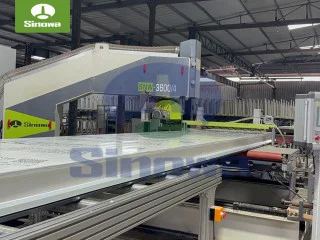
Precision cutting and edge finishing are the final molding links of finished panels. The cooled continuous integral panels are transported to the cutting station through the roller conveying system. The intelligent tracking and cutting device can automatically identify the panel length and perform fixed-size cutting according to preset production parameters. The high-precision cutting structure ensures smooth and flat cutting sections without burrs or irregular edges, realizing high consistency of panel dimensional accuracy. For panels with special edge structure requirements, the rock wool sandwich panel production line is equipped with edge trimming and flanging devices to complete edge finishing treatment, making the panel edges neat and standardized, which facilitates seamless assembly and installation in subsequent engineering applications. After cutting and finishing, unqualified products with dimensional deviation or surface defects are screened out through the automatic detection system, and qualified finished panels are sent to the stacking station through the conveying device.
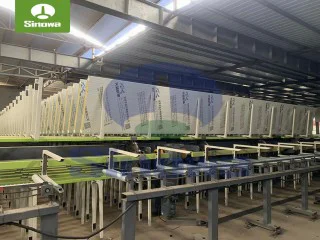
Automatic stacking and packaging systems realize the standardized storage and transportation of finished products. The intelligent stacking device uses suction cup grabbing and mechanical positioning technology to neatly stack finished panels according to fixed specifications, with stable stacking accuracy and orderly arrangement, which avoids panel surface friction damage and structural extrusion deformation. The stacked finished panels are sent to the packaging station, where automatic packaging equipment completes winding and sealing treatment. The packaging process can effectively isolate dust, moisture and external mechanical damage during transportation and storage, maintain the surface flatness and internal structural stability of the panels, and ensure that the product performance remains intact before use. The entire stacking and packaging process is automated, which greatly improves production efficiency and reduces manual packaging errors and labor costs.
The overall structural design and operating characteristics of the rockwool sandwich panel production line endow it with significant advantages in modern industrial production. First of all, the fully continuous automated production mode realizes seamless connection of all production links, effectively improves production efficiency, and meets the requirements of large-scale and batch production. The whole production process adopts closed operation and automatic control, which reduces manual operation links, lowers the impact of human factors on product quality, and realizes stable output of high-consistency products. Secondly, the rock wool sandwich panel line has strong production flexibility, with adjustable operating parameters, which can adapt to the production of panels with different thicknesses, widths and structural types, and can quickly respond to the personalized customization needs of the market.
In terms of product performance control, the precise parameter control system of the rock wool sandwich panel machine can stably maintain the internal structural compactness, fiber uniformity and bonding firmness of the panels. The rockwool foam panels produced by this line have uniform internal porous structures, excellent thermal insulation performance, and can effectively block heat transfer, reducing building and industrial equipment energy consumption. At the same time, the integrated composite structure formed by high-pressure curing and bonding has high structural strength, good compression resistance and bending resistance, and can adapt to complex installation and use environments. In addition, the raw materials used in the production process are environmentally friendly and pollution-free, and the production process realizes clean production with low emission and low noise, which conforms to the development trend of green building materials industry.
In actual production operation, the rockwool sandwich panel making machine is equipped with a complete intelligent monitoring and fault feedback system. The real-time monitoring modules are installed in each key link of raw material conveying, temperature control, pressing molding and cutting, which can collect operating data in real time, judge the operating status of the equipment, and timely feed back and adjust abnormal parameters. The intelligent adjustment function can automatically correct the deviation of operating speed, temperature and pressure during production, ensuring that the production process is always in a stable state. Meanwhile, the modular equipment structure design facilitates daily maintenance and later upgrading of the rockwool insulation panel production line. Each functional module is relatively independent, which can realize targeted maintenance and replacement of components, reduce equipment failure rate and maintenance cost, and improve the overall service life and operation stability of the production line.
With the continuous improvement of energy-saving and environmental protection requirements in the construction industry and industrial manufacturing field, the market demand for high-performance rockwool foam panels is constantly increasing, which also promotes the continuous optimization and upgrading of rockwool foam board production line technology. Modern production lines are developing towards higher automation intelligence, more precise parameter control and more energy-saving and environmentally friendly production modes. By optimizing the internal structure of equipment, upgrading the intelligent control system and improving the raw material utilization rate, the rockwool sandwich panel machine further reduces production energy consumption, improves product performance stability, and enriches product application types. As an important supporting equipment for green energy-saving building materials, the rockwool foam panel production line will continue to play a key role in architectural thermal insulation, industrial anti-corrosion insulation, clean workshop construction and other fields, providing reliable equipment support for the high-quality development of the building material industry and energy-saving and emission reduction work of various industries.
https://www.cnsinowa.com/sandwich-panel-machines/rockwool-foam-panel-production-line.html