Roof and Wall Panel Production Line
Apr 30, 2026
Roof and Wall Panel Production Lines are important components of modern building industrialization, each responsible for producing high-performance and environmentally friendly building materials.
Roof and Wall Panel Production Lines are important components of modern building industrialization, each responsible for producing high-performance and environmentally friendly building materials.
The roof panel production line is dedicated to producing various types of roof materials, such as tiles, waterproofing membranes, insulation boards, etc. These materials usually have excellent waterproof, thermal insulation, thermal insulation, and durability, which can meet the needs of different buildings. The automation level of rooftop production lines is usually high, which can achieve full process automation from raw material input to finished product packaging, thereby significantly improving production efficiency and reducing labor costs.
The wall panel production line is an automated industrial equipment used for producing various lightweight partition panels, mainly applied in the fields of prefabricated buildings and indoor and outdoor decoration. Its core raw materials include stone powder, plant fibers, inorganic binders, and PVC composite materials. After precise measurement and proportioning, these raw materials are thoroughly mixed in the mixing and stirring system. The mixture is then fed into a molding and pressing system, where high-precision molds and pressing processes are used to form wall panels with specific shapes and sizes.
Efficient automation: The entire production line adopts advanced automation technology to achieve full automation operations from raw material input to finished product packaging, significantly improving production efficiency.
Standardized production: The production line adopts standardized production processes and mold design to ensure uniform size and stable quality of the wall panels. By adjusting parameters such as raw material ratio and mold size, wall panels of different colors, textures, and properties can be produced to meet diverse architectural design and decoration needs.
Energy conservation and environmental protection: The wall panel production line focuses on energy conservation and environmental protection, using low-energy production processes and environmentally friendly materials to reduce energy consumption and emissions during the production process. At the same time, wall panel products themselves also have excellent insulation, thermal insulation, fire resistance and other properties, which help improve the energy efficiency and environmental protection level of buildings.
The lightweight partition panels produced by the wall panel production line have characteristics such as lightweight, sound insulation, and fire resistance, and are widely used in various buildings such as villas, buildings, industrial plants, warehouses, and cold storage. These wall panels not only accelerate construction speed and reduce labor intensity, but also shorten the construction period and lower the project cost.
Technological innovation: With the deepening of green building concepts and the rapid development of the construction industry, new technologies and materials are constantly being adopted in roof and wall panel production lines to improve product quality and performance. For example, using an intelligent temperature control maintenance system to shorten the maintenance cycle, and adopting group formwork technology to improve production efficiency.
Customized services: Roof and wall panel production lines usually provide customized services, which can produce building materials that meet the specific needs and architectural design requirements of customers. This flexibility enables the production line to meet the needs of different markets and customers.
Market Expansion: With the continuous expansion of the prefabricated building and green building materials markets, roof and wall panel production lines have broad market prospects. These production lines can not only meet the needs of the domestic market, but also expand to the international market and participate in global competition.
The roof and wall panel production line, as an important component of modern building industrialization, provides high-performance and environmentally friendly building materials for modern buildings with its advantages of efficient automation, standardized production, energy conservation and environmental protection. With the deepening of the green building concept and the rapid development of the construction industry, these production lines will usher in broader development prospects.
Roof and wall panel production lines represent the core industrial manufacturing systems dedicated to the continuous and standardized fabrication of building envelope panels that serve as the fundamental protective and structural components for all types of modern construction projects. As the construction industry globally shifts toward prefabrication, modularization, and high-efficiency green building development, these production systems have evolved from simple mechanical forming equipment into integrated industrial manufacturing units that integrate material processing, structural shaping, functional compounding, and finished product molding in one continuous workflow. The inherent structural performance of the production line directly determines the dimensional stability, mechanical bearing capacity, long-term durability, and environmental adaptability of the final roof and wall panels, while different structural configurations and equipment combinations divide the production lines into multiple distinct types, each tailored to meet the diverse construction needs of industrial plants, commercial complexes, public facilities, residential buildings, and special functional architectural spaces. Understanding the intrinsic connection between the structural performance characteristics, classification attributes, and practical application scenarios of roof and wall panel production lines is essential for optimizing manufacturing processes, improving finished panel quality, and matching production equipment with actual construction project demands, which also lays a solid foundation for promoting the sustainable development of the prefabricated building industry and upgrading traditional construction engineering construction modes.
The overall structural performance of a complete roof and wall panel production line is the comprehensive embodiment of the mechanical coordination, operational stability, structural rigidity, and processing precision of all its constituent mechanical parts and transmission systems, and it acts as the core guarantee for long-term uninterrupted mass production of qualified building panels. The main frame structure of the production line, as the primary load-bearing and supporting component, is designed with high overall rigidity and anti-deformation performance, effectively resisting the mechanical vibration, extrusion pressure, and rotational torque generated during the high-speed continuous operation of rolling, pressing, bonding, and cutting processes. In the actual production process, the continuous feeding of raw metal sheets, insulation core materials, and composite surface materials will produce continuous dynamic load impact on the production line frame; therefore, the structural design of the main body must maintain overall structural balance under long-term cyclic load conditions, avoiding local structural deformation, frame shaking, or component displacement that may cause deviations in panel size and shape. The transmission and conveying structure of the production line adopts a synchronous linkage design for each processing station, ensuring that the raw materials move at a constant and coordinated speed in each production link from initial material unwinding, surface leveling, precise rolling forming, core material filling and compounding, hot pressing or cold pressing shaping, to final fixed-length cutting and finished product output. This synchronous structural coordination performance eliminates material stretching, wrinkling, or misalignment between layers during the panel forming process, ensuring that each produced roof and wall panel maintains consistent thickness, uniform structural density, and accurate overall dimensions, which are the basic prerequisites for the panels to exert stable structural and thermal insulation performance in subsequent building installation and long-term use.
In addition to the overall frame and transmission linkage performance, the key functional processing structures of the roof and wall panel production line also have unique targeted structural performance characteristics that directly affect the core quality attributes of the finished panels. The rolling forming structure, as the core shaping component of single-layer metal roof and wall panels, is designed with multi-group continuous rolling roller sets with high machining accuracy and wear resistance. The structural layout of the roller sets follows the mechanical principle of gradual bending and forming, enabling flat raw metal sheets to be gradually rolled into various corrugated, profiled, and ribbed structural shapes without damaging the internal mechanical properties of the metal materials. This gradual forming structural design ensures that the formed panels have uniform internal stress distribution, strong external pressure resistance, and good structural flexibility, preventing panel cracking, edge warping, and local stress concentration during forming and later installation. For composite sandwich roof and wall panel production lines, the core functional structure focuses on efficient composite bonding and integral shaping performance. The glue coating and composite pressing structure of such production lines has uniform pressure distribution and stable temperature control structural characteristics, which can tightly bond the outer protective surface layer and the internal thermal insulation and support core layer into an integral composite structure. The structural design of the pressing area ensures that the bonding force between each layer of the panel is uniform and lasting, avoiding delamination, hollowing, or poor bonding firmness between layers, so that the composite panel can maintain overall structural integrity under the influence of external temperature changes, building structural settlement, and natural wind load for a long time.
The dimensional control and cutting positioning structure of the production line also occupies an important position in the overall structural performance system, providing accurate size guarantee for the standardized application of roof and wall panels in building construction. The fixed-length cutting and edge trimming structures are designed with high-precision positioning and anti-shake structural forms, which can complete fixed-size cutting and precise edge finishing of continuous formed panels according to different construction design requirements. The structural stability of the cutting part ensures that the cutting section of the panel is flat and smooth without burrs or deformation, and the dimensional error of each finished panel is controlled within a very small range. This high-precision structural control performance enables the roof and wall panels produced in batches to achieve seamless docking and rapid assembly during on-site building installation, reducing the difficulty of on-site construction, shortening the construction cycle, and improving the overall sealing and structural stability of the building envelope. Moreover, the overall structural fatigue resistance and corrosion resistance of the production line itself are also important parts of its structural performance. The production line operates in a continuous industrial production environment for a long time, and its structural components need to resist long-term mechanical friction, material impact, and environmental humidity and dust erosion. The optimized structural material selection and surface protection design enable the production line to maintain stable operating performance and low failure rate for a long service life, reduce equipment maintenance frequency and production downtime, and improve the overall continuous production efficiency of the entire panel manufacturing process.
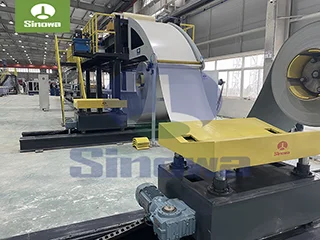
According to different structural composition forms, processing technological principles, and finished panel structural characteristics, roof and wall panel production lines can be divided into two main core categories: single-layer profiled panel production lines and composite sandwich panel production lines, and each category can be further subdivided into multiple sub-types according to different processing functions and panel structural design requirements. Single-layer profiled roof and wall panel production lines are the most basic and traditional type of production equipment, with a relatively simple overall structural composition, mainly composed of raw material unwinding devices, leveling structures, multi-pass rolling forming structures, fixed-length cutting structures, and finished product stacking and discharging structures. The structural design of this type of production line focuses on high-speed continuous forming and dimensional precision control, without complex composite bonding and thermal processing links, and the produced panels are single-layer homogeneous structural plates made of a single metal or other building sheet material. The internal structural performance of the production line is concentrated on the rolling forming capacity and transmission stability, which can efficiently produce various corrugated plates, profiled steel plates, and ribbed wall panels with different wave heights, groove widths, and structural thicknesses. The structural characteristics of the production line determine that the single-layer panels produced have light weight, high structural hardness, and good wind and pressure resistance, and the production line itself has the advantages of simple operation, low production cost, small equipment occupation space, and flexible production and processing.
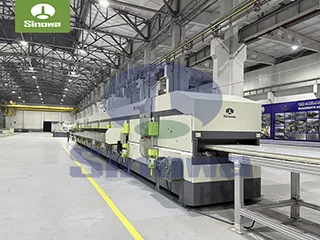
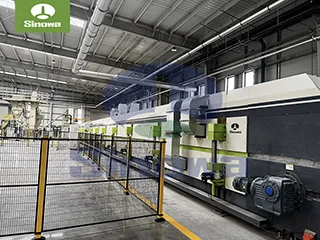
Composite sandwich roof and wall panel production lines are multi-functional integrated production equipment developed to meet the higher thermal insulation, heat preservation, fireproofing, and sound insulation requirements of modern buildings, with a more complex internal structural system and more diversified processing functional modules. The structural composition of this type of production line adds core material feeding and laying structures, automatic glue spraying and bonding structures, high-temperature or normal-pressure composite pressing structures, and integral curing and shaping structures on the basis of the basic forming structure. The overall structural coordination requirements of the production line are higher, and each processing station needs to achieve precise synchronous matching in speed, pressure, and time to ensure the composite quality of multi-layer materials. According to the different types of internal core materials, composite sandwich panel production lines can be subdivided into thermal insulation foam core composite production lines, inorganic lightweight core composite production lines, and fiber reinforced composite core production lines. Each subdivided production line has targeted structural adjustment in the pressing pressure, bonding process, and material conveying link according to the physical and chemical characteristics of different core materials. The structural performance advantages of composite sandwich panel production lines are that they can integrate the structural protection performance of the outer surface layer and the functional thermal insulation and support performance of the inner core layer into one panel in one production process, and the produced composite panels have both structural bearing capacity and multiple building energy-saving and environmental protection functions, which is an indispensable key equipment for the production of high-performance building envelope panels.
In addition to the above two main classification types, roof and wall panel production lines can also be classified into fixed conventional production lines and mobile integrated production lines according to different structural layout and production operation modes. Fixed conventional production lines adopt a long linear fixed structural layout, with each processing station fixedly installed in the factory production workshop, realizing large-scale, batch, and centralized production of roof and wall panels. The structural design of this type of production line emphasizes overall stability and high-efficiency mass production capacity, with large production output and stable product quality, and is suitable for large-scale panel manufacturing enterprises and long-term stable panel production and supply needs. Mobile integrated production lines adopt a modular assembled structural design, integrating all core processing functional structures into a movable overall frame, which can be transported to the vicinity of construction projects for on-site real-time panel production. The structural characteristics of mobile production lines are compact layout, convenient disassembly and assembly, and flexible transportation and movement. Although the single-time production efficiency is slightly lower than that of fixed production lines, they can effectively avoid the transportation cost and panel damage risk caused by long-distance transportation of finished panels, and are very suitable for remote construction projects, temporary building construction, and engineering projects with urgent panel supply needs. Different structural layout types of production lines have their own unique structural performance advantages and applicable production scenarios, providing diversified production choices for panel manufacturing enterprises and construction engineering contractors.
Different types of roof and wall panel production lines with varying structural performance and structural types correspond to distinct practical application scenarios in the construction field, covering almost all types of new construction, renovation, and expansion projects in the construction industry. Single-layer profiled panel production lines and the single-layer panels they produce are widely used in the construction of industrial production plants, logistics warehouses, temporary construction facilities, and simple light steel structure buildings. The simple and efficient structural performance of the production line enables rapid mass production of single-layer panels with strong structural durability and low maintenance cost. These panels are used as roof waterproof and windproof structural layers and external wall protective layers of industrial buildings, bearing external wind load, rainwater erosion, and solar radiation, and providing basic structural protection and enclosure functions for industrial production and storage spaces. For some temporary construction sites, temporary office buildings, and simple storage sheds, the panels produced by single-layer panel production lines can realize rapid installation and quick construction completion, meeting the short-term use needs of temporary buildings, and the production line can quickly adjust panel forming specifications according to the simple structural design requirements of temporary buildings, with strong production flexibility and adaptability.
Composite sandwich panel production lines and their finished composite panels are mainly applied in commercial buildings, public service facilities, cold storage and constant temperature warehouses, and high-standard prefabricated residential buildings, which have high requirements for building energy conservation, thermal insulation, sound insulation, and comfort. The excellent composite structural performance of the production line ensures that the produced sandwich panels have good thermal insulation and heat preservation effects, effectively reducing the energy consumption of building heating and cooling, and meeting the green building energy-saving design standards. In large shopping malls, exhibition halls, office buildings, and school and hospital buildings, composite roof and wall panels produced by professional composite production lines are used as building exterior wall enclosure systems and roof thermal insulation waterproof structures, which not only ensure the structural stability and safety of the building envelope, but also improve the indoor living and working comfort environment, reducing the impact of external temperature changes and environmental noise on the indoor space. In special functional buildings such as cold storage, constant temperature workshops, and food processing plants, the composite panels produced by targeted composite panel production lines have ultra-high thermal insulation and sealing performance, which can maintain the stability of the internal temperature of the building, reduce the operation energy consumption of refrigeration and temperature adjustment equipment, and create a stable internal production and storage environment.
Mobile integrated roof and wall panel production lines are mostly used in remote infrastructure construction, outdoor engineering temporary facilities, and emergency rescue and disaster relief temporary building construction projects. Many remote construction projects such as highway and railway engineering construction, remote mining area construction, and rural infrastructure upgrading lack supporting professional panel processing factories, and long-distance transportation of finished panels will increase engineering costs and easily cause panel damage during transportation. The mobile production line with compact and flexible structural performance can be directly transported to the construction site to produce roof and wall panels on demand, realizing on-site production and on-site installation, greatly saving engineering transportation costs and shortening project construction cycle. In emergency disaster relief and post-disaster reconstruction work, mobile panel production lines can quickly put into production operation, rapidly producing a large number of roof and wall panels for temporary resettlement houses and emergency rescue facilities, providing fast and effective building material support for disaster relief work, and reflecting the flexible applicability and practical value of special structural types of production lines in special engineering scenarios.
With the continuous advancement of building industrialization and prefabrication technology, the structural performance of roof and wall panel production lines is constantly optimized and upgraded, and the types of production lines are gradually enriched and refined, and their application scope in the construction industry is also constantly expanding and deepening. In the future development process, roof and wall panel production lines will further develop in the direction of higher processing precision, stronger structural stability, more diversified functional integration, and more intelligent production operation. The continuous improvement of the overall structural performance of the production line will further improve the production quality and production efficiency of roof and wall panels, and the continuous innovation of production line types will better meet the personalized and diversified construction needs of different types of buildings and different functional scenarios. As the core manufacturing equipment for prefabricated building envelope components, roof and wall panel production lines will continue to play an irreplaceable important role in promoting the transformation and upgrading of the construction industry, accelerating the construction of green and energy-saving buildings, and improving the overall construction level and development quality of the modern construction industry.
https://www.cnsinowa.com/sandwich-panel-machines/roof-and-wall-panel-production-line.html



Any Questins About Continuous Sandwich Panel Production Lines or Other Products
Email us with inquiries or use our contact infomations