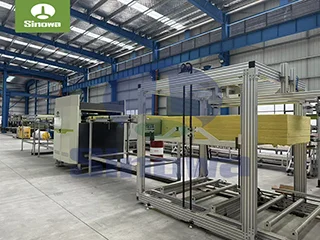
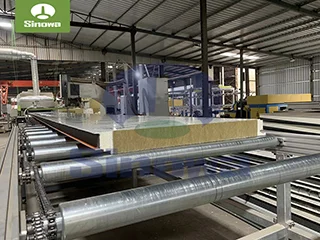
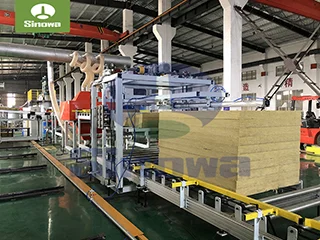
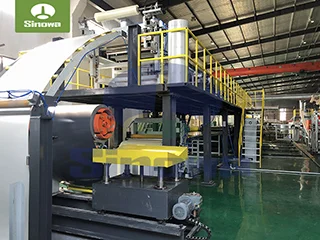
sandwich panel line
The overall structural composition of a complete rock wool sandwich panel manufacturing line follows the sequential logic from raw material input, preliminary processing, core material treatment, surface material forming, composite bonding, solidification shaping to finished product cutting, conveying and stacking, and each functional unit is designed and configured according to the continuous production rhythm and panel forming process requirements. The front-end part of the entire production line is mainly responsible for the storage, unwinding, leveling and preliminary surface pretreatment of the two key raw materials required for panel production, namely metal coil surface materials and rock wool core raw materials. Metal coils used for the upper and lower surface layers of rock wool sandwich panels are usually color-coated metal materials with anti-corrosion and decorative properties, which need to be placed on professional unwinding equipment to achieve stable and continuous unwinding work in the initial production stage. The unwinding equipment is equipped with stable tension adjustment structures and material guiding auxiliary components, which can effectively avoid problems such as material deviation, coil loosening and uneven feeding speed during the unwinding process of metal coils. After the metal coil is unwound into a flat metal plate material, it will be immediately sent to the leveling and trimming unit through the power conveying roller way. The core function of the leveling unit is to eliminate the internal stress of the metal plate formed during coil winding and long-term storage, smooth out subtle bending deformation and surface unevenness on the surface of the metal plate, and ensure that the subsequent roll forming and composite processing can be carried out on the basis of flat and stable plate materials. The trimming process is responsible for cutting off the irregular edges and excess leftover materials on both sides of the metal plate, unifying the width specification of the surface metal plate, and laying a foundation for the consistent overall dimension and neat edge sealing effect of subsequent sandwich panels. In addition to the processing of metal surface materials, the front-end area of the production line is also equipped with a special rock wool core material preparation and feeding system, which undertakes the storage, cutting, sorting and quantitative conveying of rock wool raw materials. Rock wool core materials, as the core functional layer of sandwich panels bearing thermal insulation, fire prevention and sound insulation functions, are made of inorganic fiber materials formed by high-temperature melting and spinning of natural mineral raw materials, and their fiber arrangement density, thickness uniformity and overall compactness directly affect the core performance of finished panels. The rock wool core material preparation unit will cut the original rock wool wool blocks into core materials that meet the production thickness and width requirements according to the production specifications of different sandwich panels, sort out the scattered fibers and unqualified defective materials on the surface, and ensure that each piece of rock wool core material put into the composite process has uniform specifications and stable quality.
After the preliminary processing of metal surface materials and rock wool core materials is completed, the production process enters the key roll forming and surface preheating stage of the production line. The flat metal plate after leveling and trimming will be continuously sent to the roll forming unit composed of multiple groups of precision forming roller sets. The roll forming unit adopts gradual forming design, and each group of forming rollers carries out gradual bending, pressing and shaping processing on the metal plate according to the preset panel section structure design requirements. This gradual processing method can effectively avoid local stress concentration and surface coating damage caused by one-time strong bending of the metal plate, protect the integrity of the anti-corrosion and decorative coating on the surface of the color-coated metal plate, and ensure that the formed metal surface plate has accurate section size and stable structural shape. Different production lines can adjust the gap and position of the forming rollers according to the production needs of roof panels, wall panels and other different types of rock wool sandwich panels, realizing the flexible switching of various panel forming specifications. After the completion of roll forming, the upper and lower metal surface plates will be transported to the preheating treatment area respectively. The preheating system adopts hot air circulation heating mode to heat the surface of the formed metal plate to a stable and appropriate temperature range. This preheating treatment is a key prerequisite process for subsequent adhesive bonding and composite pressing. Appropriate temperature can effectively activate the bonding activity of the adhesive applied later, accelerate the initial bonding reaction speed between the adhesive and the metal surface, improve the uniformity of adhesive spreading, and avoid the problems of poor bonding effect and easy degumming and layering of panels caused by low surface temperature and slow adhesive curing speed in the subsequent composite process. While the metal surface plates are preheated, the rock wool core material conveying unit will orderly arrange the cut and shaped rock wool core materials and transport them to the glue spraying station synchronously with the rhythm of metal plate processing, realizing the synchronous matching feeding of surface materials and core materials and ensuring the continuity and coordination of the overall production process.

Adhesive spraying and core material assembly alignment are the core intermediate links in the entire rockwool sandwich panel production line process, and also the key steps to determine the bonding firmness and overall structural integrity between the metal surface layer and the rock wool core layer. The production line is equipped with an automatic precise glue spraying system, which can quantitatively and uniformly spray special structural adhesive on the inner bonding surfaces of the upper and lower metal surface plates and the upper and lower contact surfaces of the rock wool core material respectively. The glue spraying system is designed with multi-nozzle uniform discharging and adjustable glue supply flow structure, which can adjust the glue application amount and spraying range according to the thickness of the rock wool core material, the production speed of the panel and the actual application environment temperature. Excessive glue application will cause adhesive overflow and waste of production raw materials, and also lead to uneven surface of finished panels and subsequent cleaning difficulties; too little glue application will result in insufficient bonding strength between layers, easy separation of the surface layer and the core layer during the use of the panel, and affect the structural stability and service life of the product. Therefore, the automatic glue spraying equipment needs to maintain a stable glue supply pressure and uniform spraying state at all times during the production process, and production operators need to regularly check the glue spraying condition to avoid missing spraying, uneven spraying and glue blockage. After the completion of glue spraying, the upper and lower metal surface plates and the rock wool core material will enter the automatic alignment assembly unit together. The alignment unit adopts precise positioning and guiding structures to accurately clamp and position the metal plates and rock wool core materials, ensure that the upper and lower surface materials and the middle core material are completely aligned in the horizontal and vertical directions, no deviation or dislocation occurs, and the overall thickness and edge size of the assembled sandwich blank meet the preset production standards. The accurate alignment effect directly affects the appearance flatness and dimensional accuracy of the final finished panel, and also avoids the problem of local stress imbalance caused by material dislocation after composite pressing, which leads to panel deformation.
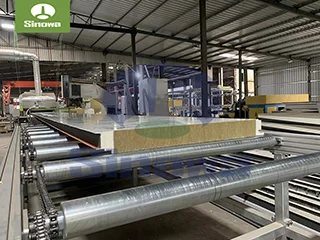
Composite pressing and constant-temperature curing shaping are the most critical core process links in the rock wool sandwich panel production machine, which directly determine the overall bonding strength, structural compactness and shape stability of the sandwich panel. The assembled sandwich blank after glue spraying and alignment will be continuously sent to the double-belt composite pressing machine, which is the core host equipment of the entire production line. The double-belt pressing structure can provide continuous and uniform pressing force for the sandwich blank, and the pressing pressure can be adjusted according to the thickness of the panel, the density of the rock wool core material and the performance requirements of the finished product. During the pressing process, the rock wool core material is fully compacted, the gap between internal fibers is reasonably adjusted, and the adhesive between the metal surface layer and the core layer is fully squeezed and evenly spread, so that the adhesive can fully infiltrate the contact surface of the materials and form a stable bonding structure. At the same time, the composite pressing machine is equipped with a constant-temperature circulating heating system inside, which maintains a stable curing temperature environment during the pressing process. The synergistic effect of appropriate pressing pressure and constant curing temperature can accelerate the curing and solidification reaction of the structural adhesive, make the bonding layers form stable bonding strength in a short time, and realize the preliminary shaping and structural fixing of the sandwich panel. The duration of pressing and curing is matched with the production speed of the entire production line, ensuring that the panel can complete the bonding and shaping work during the continuous conveying process without staying, realizing continuous assembly line production. In this process, the internal fiber structure of the rock wool core material is closely combined with the metal surface layer through the adhesive, forming an integrated composite structure with both the structural strength of metal materials and the thermal insulation and fireproof performance of rock wool materials. After composite pressing and curing, the overall structure of the sandwich panel tends to be stable, and there will be no layering, deformation and loose bonding during subsequent cutting, conveying and use.
After the composite pressing and curing process is completed, the continuous long-strip sandwich panel semi-finished product will enter the fixed-size cutting and edge trimming processing link of the production line. The production line is equipped with an automatic tracking and cutting system, which can set the cutting length according to the actual order requirements and engineering use specifications. The cutting system has an automatic induction and tracking function, which can synchronously track the conveying speed of the sandwich panel, realize dynamic following cutting, ensure that the cutting size of each panel is accurate and consistent, and avoid size errors caused by inconsistent conveying speed and cutting synchronization deviation. The cutting equipment adopts high-precision cutting tools, which can complete the cutting of the metal surface layer and the internal rock wool core material at one time, with neat cutting sections, no burrs, no fiber scattering and no damage to the edge structure of the panel. After fixed-size cutting, the single-piece rock wool sandwich panel will be sent to the edge trimming and finishing unit for subsequent fine processing. The edge trimming process mainly trims the tiny burrs and residual adhesive overflow parts on the cutting edge of the panel, polishes the edge position to make the edge of the panel smooth and neat, and avoids the problems of scratch damage during subsequent stacking, transportation and installation construction. At the same time, the finishing unit will also carry out simple sorting and inspection on the appearance of the panel, preliminarily screening out individual panels with obvious appearance defects such as surface scratches, edge deformation and uneven bonding, to prevent unqualified products from entering the finished product stacking link. This cutting and finishing link plays a vital role in ensuring the appearance quality and installation adaptability of finished rock wool sandwich panels, making the panels more convenient and efficient in actual building installation and assembly construction.
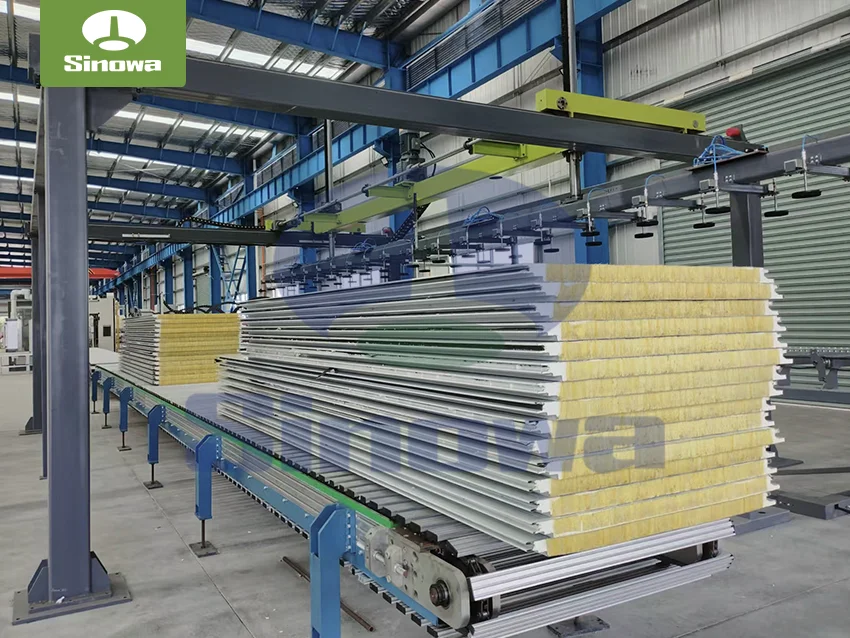
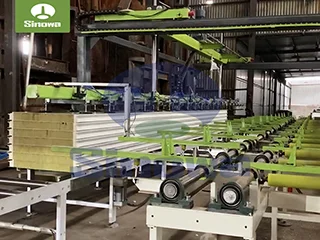
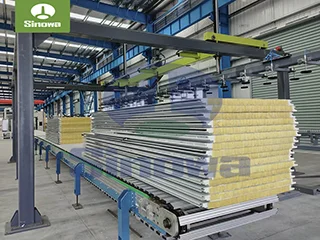
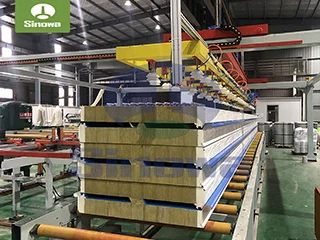
The final stage of the rock wool sandwich panel production equipment is automatic stacking, finished product inspection and packaging and warehousing operations, which are important links to ensure the standardized storage and safe transportation of finished panels. The finished sandwich panels after cutting and finishing will be transported to the automatic stacking machine through the conveying roller way. The stacking machine adopts mechanical automatic grabbing and stacking structure, which can neatly stack the single panels according to the set stacking quantity and stacking specifications. The automatic stacking method can not only improve the efficiency of finished product handling and stacking, but also avoid panel surface damage and edge collision deformation caused by manual handling, and maintain the good appearance and structural integrity of finished panels. During the stacking process, the production line is equipped with a real-time quality sampling inspection mechanism. Special quality inspection personnel will conduct random sampling inspection on the stacked finished panels, focusing on detecting the overall dimensional accuracy, surface flatness, bonding tightness between layers, cutting section quality and appearance integrity of the panels. For the sampled panels, simple manual bonding inspection and dimensional measurement are carried out to confirm that the product quality meets the basic production and use requirements. After passing the inspection, the finished rock wool sandwich panels will be automatically wrapped and packaged by the packaging equipment. The packaging work can protect the surface coating of the panels from dust pollution, scratch damage and moisture erosion during long-distance transportation and long-term storage, and also facilitate the overall loading, unloading and transportation management of the panels. The packaged finished panels will be transported to the finished product warehouse by handling equipment for centralized storage, waiting for subsequent delivery and engineering supply, completing the whole process operation from raw material input to finished product warehousing of rock wool sandwich panels.
In the actual long-term industrial production process, the stable operation and efficient production of the rock wool sandwich panel production machinery are inseparable from scientific daily operation management and standardized equipment maintenance and upkeep work. The production line involves multiple mechanical transmission parts, electrical control systems, hydraulic power components and heating and gluing auxiliary systems, and the normal operation of each component is the basis for ensuring continuous production. In terms of daily operation management, production enterprises need to formulate standardized operation procedures for the production line, clarify the operation responsibilities and operation specifications of each post operator, require operators to carry out equipment startup inspection, production parameter debugging and real-time production state monitoring in strict accordance with the process requirements, and timely adjust the production line operating parameters according to changes in raw material quality, ambient temperature and production order requirements to ensure the stability of the production process. Before the official startup of the production line every day, it is necessary to check the tension state of the unwinding equipment, the wear degree of the forming rollers, the smoothness of the glue spraying system, the operating pressure of the composite pressing machine and the sensitivity of the cutting system, and eliminate potential equipment faults and hidden dangers in advance. During the continuous production process, operators need to regularly patrol the operating state of each unit of the production line, observe whether there is material deviation, abnormal equipment noise, uneven glue spraying and unqualified pressing forming, and deal with abnormal problems in a timely manner to avoid large-scale unqualified product production and production line shutdown and maintenance.
Equipment maintenance and regular maintenance are key measures to extend the service life of the rock wool sandwich panel making machine and maintain long-term stable production efficiency. The mechanical transmission parts such as conveying roller ways and forming roller sets of the production line need regular lubrication and oiling maintenance to reduce mechanical friction loss, avoid part wear and failure, and ensure the flexibility and stability of material conveying and forming processing. The glue spraying system needs regular cleaning and dredging work to prevent adhesive solidification and blockage of the nozzle and pipeline, ensure the smooth glue supply and uniform spraying effect, and avoid affecting the bonding quality of panels. The heating and pressing components of the composite pressing machine need regular temperature calibration and pressure detection to ensure that the curing temperature and pressing pressure are always within the reasonable range required by the process, and avoid product quality problems caused by parameter deviation. The electrical control system and automatic sensing components need regular circuit inspection and equipment debugging to ensure the accuracy of automatic control and induction positioning, and maintain the automatic operation efficiency of the production line. For some easily worn vulnerable parts, regular inspection and replacement arrangements should be made to avoid production line shutdown caused by sudden damage of vulnerable parts and affect the production progress. Good maintenance work can not only reduce the failure rate of the production line and reduce production and maintenance costs, but also ensure the stable and consistent quality of produced rock wool sandwich panels and improve the comprehensive production benefit of the enterprise.

With the continuous upgrading of the construction industry's requirements for building energy conservation, fire safety and building material durability, the rock wool sandwich panel production line is also constantly developing and optimizing in the direction of intelligent operation, energy-saving production and diversified product processing. The modern rock wool sandwich panel production line has gradually realized the integrated control of the whole production process through the intelligent electrical control system, and the operators can complete the parameter setting, production adjustment and equipment monitoring of the whole production line through the central control operation platform, which simplifies the operation process, improves the production automation level, and reduces the labor input in the production process. At the same time, the optimized design of the production line in terms of power consumption and heat energy utilization effectively reduces the energy consumption in the production process, realizes energy-saving and environmentally friendly production, and meets the current social development requirements for green manufacturing in the building materials industry. In terms of product processing adaptability, the upgraded rock wool sandwich panel production line can not only produce conventional standard specification sandwich panels, but also adjust the process parameters and equipment configuration according to the special needs of different building projects, produce sandwich panels with different thicknesses, different surface shapes and different functional enhancements, and meet the diversified application needs of industrial construction, public buildings, special purification workshops and other different scenarios.
In summary, the continuous rock wool sandwich panel production line is a highly integrated and systematically coordinated modern industrial production system, which covers multiple complex process links from raw material pretreatment, forming processing, composite bonding, curing shaping to cutting finishing and finished product storage. Every equipment unit and every production process in the production line is interrelated and mutually influential, and the standardized operation, scientific parameter debugging and regular maintenance management are important guarantees for efficient production and high-quality product output. The rock wool sandwich panels produced by the production line rely on excellent fire resistance, thermal insulation performance, sound insulation effect and structural stability, and have been widely used in various modern building engineering fields. With the continuous development of the construction industry and the continuous improvement of building energy-saving and safety standards, the fully automatic rock wool sandwich panel production line will continue to carry out technological innovation and process optimization, continuously improve production efficiency and product processing quality, and provide reliable basic equipment support and high-quality building material products for the steady development of the modern construction industry and the construction of high-quality building projects.
https://www.cnsinowa.com/sandwich-panel-machines/rock-wool-sandwich-panel-production-line.html