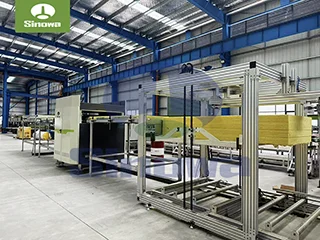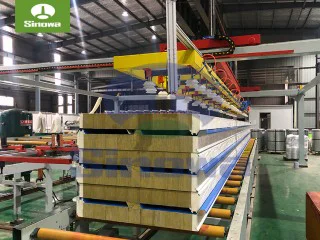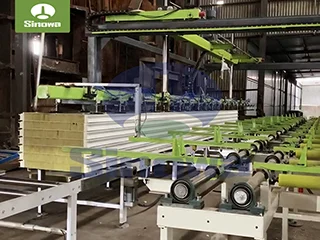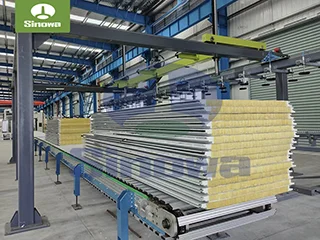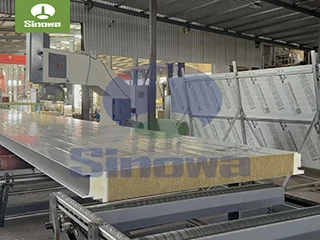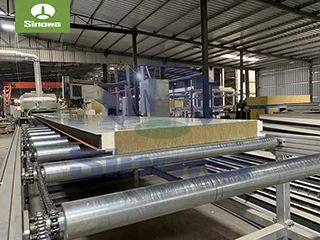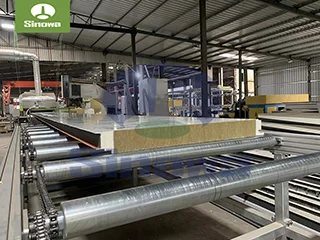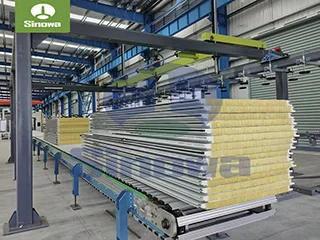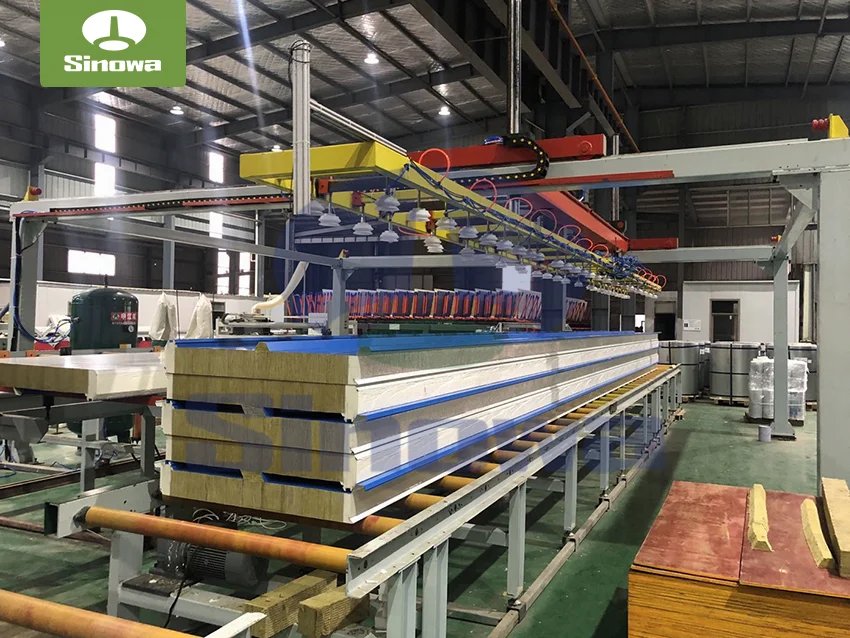
The overall structural design of the sandwich panel production line follows the logic of streamlined manufacturing, with all functional units arranged in a linear and synchronous linkage layout to eliminate production gaps and manual intervention delays in conventional equipment. The complete production system covers raw material pretreatment, surface plate forming, adhesive and polyurethane material spraying, rock wool core laying and positioning, composite lamination, thermal curing, fixed-length cutting, edge finishing, and automatic stacking, forming an independent and complete industrial production chain. Each functional module is equipped with a synchronous transmission system to ensure unified operating speed and coordinated action, which effectively avoids product deformation, uneven bonding, and dimensional errors caused by asynchronous operation of different equipment units. The mechanical structure of the sandwich panel line is optimized for long-term continuous operation, with key load-bearing and processing components made of high-strength structural materials to reduce equipment wear and vibration during high-speed operation, laying a solid foundation for long-term stable production.
The initial stage of production focuses on the pretreatment and forming of color steel surface sheets, which determines the flatness and structural accuracy of the final sandwich panels. Coiled color steel raw materials are steadily released through automatic uncoiling devices, with a precision tension control system maintaining constant feeding speed and uniform tension throughout the uncoiling process to prevent steel sheet wrinkling, stretching or offset deviation. After uncoiling, the steel sheets enter the leveling and cleaning unit, where multiple groups of precision leveling rollers calibrate the flatness of the steel sheets to eliminate the internal stress and surface unevenness generated during coiling and storage. Meanwhile, the automatic cleaning device removes surface dust, oil stains and other contaminants, thoroughly optimizing the surface condition of the steel sheets. This pretreatment process is crucial for enhancing the bonding force between the steel sheet and the intermediate core material and polyurethane adhesive, as clean and flat metal surfaces can achieve tighter molecular combination with bonding materials, effectively improving the overall structural stability and service life of composite panels.
Subsequent to steel sheet pretreatment is the precision spraying and gluing process, a core link that guarantees the composite integrity of sandwich panels. The polyurethane sandwich panel production line is equipped with a two-component polyurethane metering and spraying system, which accurately proportionates polyol and isocyanate raw materials through high-precision pumping equipment. The fully automated mixing mechanism realizes uniform stirring of raw materials in strict accordance with technological ratios, avoiding material segregation or uneven mixing that may affect bonding and foaming effects. The spraying operation adopts high-pressure atomization technology, which forms a thin, uniform and continuous adhesive layer on the inner surface of upper and lower color steel sheets. Different from traditional manual gluing or simple roller coating processes, the automatic spraying system can precisely control the glue application amount and coverage range according to production specifications, ensuring no missing coating or excessive glue accumulation on the steel sheet surface. In addition to surface bonding glue spraying, the rockwool sandwich panel production line is integrated with a polyurethane foam edge sealing function. After the rock wool core material is positioned, the system injects well-mixed polyurethane raw materials into the edge cavities of the panel through high-pressure foaming equipment. The materials undergo rapid foaming and curing to form dense and seamless edge sealing structures, which effectively solves the problem of loose edges and poor air tightness of traditional rock wool sandwich panels, and significantly improves the overall waterproof, dustproof and thermal insulation performance of the panels.
The rock wool core material laying and positioning process directly affects the insulation and mechanical properties of finished panels. The rock wool sandwich panel production line is equipped with an automatic rock wool paving system, which realizes continuous and uniform laying of rock wool materials through intelligent feeding and spreading equipment. The system can adapt to rock wool core materials of different densities and thicknesses, and adjust the paving speed and arrangement density in real time according to production parameters to ensure the overall uniformity and compactness of the core material layer. During the laying process, the precision positioning device uses photoelectric sensing and encoding technology to monitor the laying position of rock wool in real time, correcting material offset and stacking deviation instantly. This precise positioning technology ensures that the rock wool core material is completely aligned with the upper and lower color steel sheets, avoiding local hollowing or inconsistent core thickness. The rock wool core material with uniform laying density can give full play to its excellent fire resistance, thermal insulation and sound absorption characteristics, while the overall flat structure provides stable support for the outer steel sheets, enabling the composite panel to bear uniform external force and avoid local deformation under load.
The composite lamination and constant-temperature thermal curing stage is the key to realizing the integrated molding of sandwich panels. After the completion of glue spraying and core material laying, the upper and lower color steel sheets with rock wool core materials enter the double-belt lamination unit synchronously. The lamination unit adopts a full-section constant-pressure pressing structure, which applies uniform and stable pressing force to the composite panel from top to bottom. The pressure value is intelligently adjustable according to panel thickness and material characteristics, ensuring that each layer of the composite structure is closely bonded without causing core material crushing or steel sheet deformation. Equipped with an intelligent constant-temperature heating system, the lamination unit maintains a stable curing temperature environment inside the equipment. The precise temperature control system eliminates local overheating or insufficient curing temperature, enabling the polyurethane adhesive and foaming materials to complete full cross-linking curing reaction within the set time. The thermal curing process lasts for a fixed period of synchronous conveying, allowing the bonding materials to form high-strength molecular bonds between steel sheets and rock wool core materials. After curing, the three-layer structure of color steel, polyurethane bonding layer and rock wool core forms an integrated whole, with greatly improved overall structural strength, peeling resistance and compression resistance of the panel.
The post-processing stage of the PU sandwich panel production line includes fixed-length cutting, edge finishing and automatic stacking, which realizes the final shaping and standardized collection of finished panels. The automatic cutting system is equipped with high-precision positioning sensors and servo-driven cutting actuators, which can automatically identify production specifications and complete fixed-length cutting of continuous composite panels. The cutting process features smooth incision, no burrs and no material fragmentation, ensuring the dimensional accuracy and edge flatness of each finished panel. The intelligent control system can flexibly switch cutting lengths to meet the customized production requirements of panels of different specifications. After cutting, the edge finishing device trims and polishes the panel edges to remove residual adhesive and tiny burrs generated during cutting and foaming, further optimizing the appearance quality and assembly performance of the panels. Finally, the finished panels are conveyed to the automatic stacking unit, which completes orderly stacking and arrangement of panels through mechanical transmission and positioning devices. The automatic stacking mode replaces manual handling, effectively avoiding surface scratches and panel damage caused by manual operation, while greatly improving production efficiency and finishing the standardized collection of finished products.
The core advantages of the polyurethane color steel rock wool sandwich panel machine are reflected in its high automation level, stable product quality and flexible production adaptability. The entire production process from raw material feeding to finished product stacking is completed by synchronous automated equipment, with minimal manual participation, which not only reduces labor cost and operational errors, but also significantly improves production continuity and output efficiency. The integrated technological design of polyurethane bonding and edge sealing makes up for the structural defects of traditional rock wool sandwich panels, effectively improving the air tightness, water tightness and structural durability of the products. The intelligent parameter adjustment system enables the production line to adapt to the production of panels with different thicknesses, core material densities and surface specifications, with strong production flexibility to meet the diversified application needs of different building scenarios.
In terms of production quality control, the rock wool board production line adopts whole-process real-time monitoring technology. Multiple groups of sensing devices are installed in each key processing link to monitor equipment operating speed, curing temperature, pressing pressure, material spraying volume and product dimensional parameters in real time. Once abnormal parameter fluctuations are detected, the system will automatically perform fine adjustment and calibration to ensure that all production links are always within the standard technological range. This whole-process monitoring and self-correction mechanism realizes precise control of production quality, ensuring that every batch of finished panels has consistent structural performance, dimensional accuracy and appearance quality. The panels produced by this production line integrate the advantages of metal material durability, rock wool fire insulation and polyurethane bonding sealing, featuring light weight, high strength, excellent thermal insulation, sound insulation and fire resistance, as well as convenient installation and long service life.
With the continuous development of energy-saving and green building industries, the market demand for high-performance composite insulation panels keeps growing, which further highlights the application value of the polyurethane color steel rock wool sandwich panel manufacturing line. As a professional and efficient building material manufacturing equipment, it provides reliable technical and equipment support for the standardized and large-scale production of high-quality enclosure and insulation materials for industrial plants, public buildings, special clean spaces and energy-saving buildings. The continuous optimization and upgrading of the production line's technology and structure also promote the iterative upgrading of composite panel products, driving the development of the building material industry towards higher efficiency, better performance and greener production. While ensuring stable production efficiency and product quality, the sandwich panel production equipment energy-saving operation design reduces unnecessary energy consumption in the production process, conforming to the development trend of modern green industrial production and bringing stable production benefits for building material manufacturing enterprises.


Any Questins About Continuous Sandwich Panel Production Lines or Other Products
Email us with inquiries or use our contact infomations