sandwich panel line
The overall operation logic of the rock wool board assembly line follows a linear and closed-loop production sequence, with each functional module operating in synchronous linkage to form an independent and complete production system. The whole line can be divided into multiple core functional sections including raw material processing and feeding, high-temperature melting, centrifugal fiber forming, fiber treatment and lapping, pressing and curing, precision cutting and trimming, as well as finished product conveying and stacking. Each section is equipped with professional mechanical execution structures and sensing detection components, which can dynamically adjust operating parameters according to production status, ensuring the continuity and stability of the entire production process. Different from traditional intermittent production equipment, the integrated assembly line realizes continuous feeding, continuous processing, and continuous discharging, greatly improving production efficiency while maintaining the consistency of product quality in each batch.
Raw material pretreatment and automatic feeding serve as the initial link of the entire sandwich panel assembly line operation, which directly determines the stability of subsequent production processes and the quality of finished products. The main raw materials adopted by the production line are natural inorganic mineral materials with stable chemical properties and excellent high-temperature resistance. Before entering the melting stage, all raw materials need to undergo strict screening, crushing, and impurity removal treatment to eliminate large particle impurities and non-qualified raw material blocks that may affect melting efficiency and fiber quality. After pretreatment, the raw materials are transported to the automatic feeding system through closed conveying equipment. The feeding system adopts quantitative and uniform feeding design, which can stably deliver raw materials to the high-temperature melting furnace according to the set operating speed. This automated feeding mode avoids the uneven feeding problem caused by manual operation, effectively prevents the fluctuation of furnace temperature and melting state, and creates a stable material basis for subsequent fiber forming processing.
High-temperature melting is a key thermodynamic link that determines the basic material characteristics of rock wool boards. The rock wool sandwich panel line is equipped with a high-efficiency sealed melting furnace, which can heat the pretreated mineral raw materials to an extreme high temperature of about 1500 degrees Celsius to completely melt the solid raw materials into uniform and viscous liquid melt. The melting process consumes a certain amount of thermal energy, so the assembly line is equipped with an intelligent temperature regulation system, which can dynamically adjust the heating power and heat supply according to the real-time feeding amount, melt fluidity, and furnace temperature changes. This intelligent regulation mode not only ensures that the raw materials are fully melted without incomplete melting or overheating deterioration, but also effectively optimizes energy utilization efficiency and realizes energy-saving and stable operation of the melting link. The sealed furnace body design can isolate external air interference, avoid material oxidation deterioration at high temperature, and ensure the purity and stability of the molten liquid.
After completing high-temperature melting, the homogeneous liquid melt flows steadily into the fiber forming section, which is the core procedure that shapes the microscopic structure and core performance of rock wool boards. The assembly line adopts advanced high-speed centrifugal fiber forming technology to process the liquid melt. The molten liquid is evenly guided to the surface of high-speed rotating centrifugal rollers, and under the action of strong centrifugal force generated by high-speed operation, the viscous melt is continuously stretched, split, and refined into slender and uniform inorganic fiber filaments. The rotating speed of the centrifugal rollers is precisely controlled by the intelligent control system, which can stably adjust the fiber diameter and length range, ensuring that the fiber structure of each batch of products maintains high consistency. Compared with traditional fiber forming processes, the centrifugal forming technology of the rock wool sandwich panel production line can produce fibers with softer texture, more uniform fineness, and more orderly distribution, which endows rock wool boards with better thermal insulation, sound absorption, and structural toughness.
In the continuous fiber forming process, the rock wool board production line is equipped with an automatic spraying system, which can evenly spray a quantitative amount of thermosetting adhesive and water-repellent auxiliary agents on the surface of newly formed fibers. These auxiliary agents play a crucial role in improving the overall performance of rock wool boards. The thermosetting adhesive can bond scattered single fibers into an integral fiber network structure, effectively enhancing the structural compactness and mechanical strength of the rock wool blank, preventing fiber shedding and structural loose problems in subsequent use. The water-repellent agent can form a protective film on the fiber surface, endowing the finished rock wool board with excellent water resistance and moisture resistance, avoiding the decline of thermal insulation performance caused by moisture absorption in humid environments. The automatic spraying system can accurately control the spraying dosage and uniformity, ensuring that the auxiliary agents are evenly distributed on each fiber, avoiding local performance differences of products.
The fiber lapping and blank forming section is responsible for converting scattered fiber materials into continuous and uniform rock wool blanks with stable thickness and density. The fibers sprayed with adhesives are collected by the airflow circulation system and evenly fall on the circulating conveyor belt to form preliminary fiber layers. In order to ensure the uniformity of the blank structure, the assembly line adopts a reciprocating pendulum lapping technology, which makes the fiber layers overlap and stack uniformly in multiple directions. This multi-layer cross lapping mode avoids the directional arrangement of single fibers, effectively improves the structural uniformity and three-dimensional stability of the rock wool blank, and enables the finished board to maintain consistent mechanical and thermal performance in all directions. The lapping system can adjust the lapping times and stacking thickness according to the production requirements of different specifications of rock wool boards, flexibly adapting to the production demands of products with different thicknesses and densities.
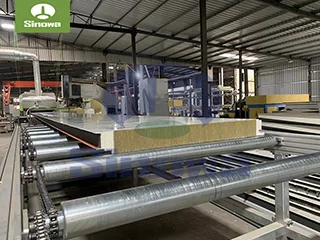
After lapping and preliminary forming, the rock wool blank is transported to the pressing and curing section through the synchronous conveyor system, which is a key link to finalize the product structure and stabilize performance. The loose fiber blank with certain thickness is sent to the constant-temperature pressing equipment, where it is pressed to the standard thickness and density through uniform mechanical pressure. The pressing process adopts graded pressure regulation, which can avoid fiber breakage and structural damage caused by excessive instantaneous pressure, while ensuring that the internal fiber structure of the blank is compact and uniform. Subsequently, the pressed semi-finished product enters the high-temperature curing chamber for constant-temperature drying and curing treatment. The stable high-temperature environment in the curing chamber can fully activate the thermosetting adhesive, promote the complete curing and bonding between fibers, evaporate the residual moisture in the blank at the same time, and fundamentally stabilize the internal structure of the rock wool board. Through curing treatment, the rock wool board obtains stable shape, reliable structural strength, and durable comprehensive performance, avoiding deformation, shrinkage, or loose structure in long-term use.
The precision cutting and trimming section undertakes the task of shaping semi-finished products into standard specification finished boards. After high-temperature curing and cooling, the continuous whole-piece rock wool board is transported to the intelligent cutting unit. The rockwool board production line is equipped with integrated longitudinal and transverse cutting equipment, which can automatically complete fixed-length cutting, edge trimming, and corner finishing according to preset specification parameters. The high-precision transmission and positioning system ensures that the cutting size error is controlled within a tiny range, and the cut board has flat and smooth edges without burrs or irregular defects. In the cutting process, the supporting dust removal and slag removal system operates synchronously, which can timely collect and process the fiber debris and residual impurities generated by cutting, clean the surface of finished boards, and ensure the surface cleanliness of products. At the same time, the recycled fiber debris can be reprocessed and utilized, realizing efficient resource recycling and reducing production waste.
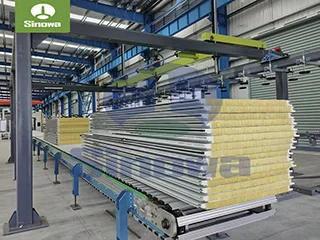
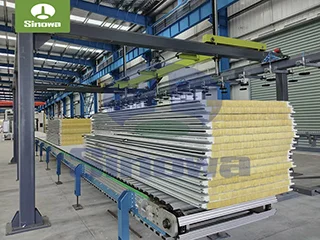
The final stage of the assembly line operation is finished product conveying, sorting, and automatic stacking. The cut standard rock wool board finished products are screened and inspected by the online detection device, which automatically distinguishes qualified products and slightly defective products. Qualified products are stably transported to the stacking area through the conveyor belt, and the automatic stacking equipment neatly stacks the finished boards according to fixed specifications and quantities, which is convenient for subsequent transportation and storage. The entire post-processing link realizes unmanned automatic operation, which not only improves production efficiency but also avoids product damage and pollution caused by manual handling. The stacked finished rock wool boards have regular shapes, stable structures, and uniform specifications, fully meeting the standardized application requirements of engineering construction and industrial production.
The core advantages of the modern rock wool sandwich panel making machine are reflected in its high integration, intelligent regulation, and stable production capacity. The entire production process is controlled by a central intelligent control system, which can monitor and adjust the operating parameters of each functional module in real time, including furnace temperature, rotating speed of centrifugal equipment, feeding speed, pressing pressure, curing temperature and time, cutting specifications, and other key indicators. The system can realize synchronous linkage adjustment of all links, once a certain parameter fluctuates, the associated equipment will automatically make adaptive adjustments to ensure the overall coordination of the production line. This intelligent control mode completely changes the shortcomings of traditional production equipment such as single function, large manual dependence, and unstable product quality, and realizes full-process automated production from raw material input to finished product output.
In terms of production performance, the integrated sandwich panel line shows excellent stability and consistency. The standardized and automated processing procedure enables the fiber fineness, structural density, thickness uniformity, and bonding strength of each batch of rock wool products to maintain a high degree of consistency. The rock wool boards produced by the assembly line have uniform internal fiber network structure, stable thermal insulation performance, excellent sound absorption and noise reduction effect, and outstanding high-temperature fire resistance. These stable and reliable comprehensive properties make the products widely applicable in building exterior wall thermal insulation, interior fireproof partition, industrial pipeline thermal insulation, equipment sound insulation and noise reduction, and other fields. At the same time, the assembly line has flexible production adaptability, which can quickly switch production parameters according to different market and engineering needs, and produce rock wool boards of different thicknesses, densities, and performance types to meet diversified application demands.
In terms of energy conservation and environmental protection, the optimized structural design of the rock wool insulation board production line effectively reduces energy consumption and production pollution. The sealed melting furnace and circulating heating system improve thermal energy utilization efficiency and reduce invalid heat loss. The closed conveying and processing structure avoids fiber dust leakage during production, improving the on-site production environment. The supporting waste recycling system can recycle and reprocess the fiber waste and defective products generated in the production process, realizing full utilization of raw materials and reducing resource waste. The entire production process does not produce harmful pollutants and toxic emissions, which conforms to the green and environmentally friendly development concept of modern industrial production, and the produced rock wool boards are inorganic environmentally friendly materials, which will not release harmful substances during use, with high safety and environmental protection.
With the continuous upgrading of industrial manufacturing technology, the rock wool board assembly line is constantly developing towards higher intelligence, higher efficiency, and more precise production. The continuous optimization of mechanical structure and control system further improves the automation level and production stability of the equipment, reduces manual operation links and human error interference, and improves product yield and production efficiency. The upgraded detection and sensing technology realizes real-time online monitoring of product microscopic structure and performance indicators, which can timely find and adjust abnormal production states, further improving the overall quality level of products. As the key core equipment of the rock wool material industry, the advanced sandwich panel machinery provides strong technical and equipment support for the large-scale, standardized, and high-quality development of the rock wool board manufacturing industry, and also promotes the popularization and application of high-performance thermal insulation and fireproof materials in the fields of construction and industrial energy conservation.
https://www.cnsinowa.com/sandwich-panel-machines/rock-wool-board-assembly-line.html