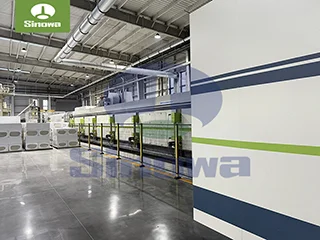
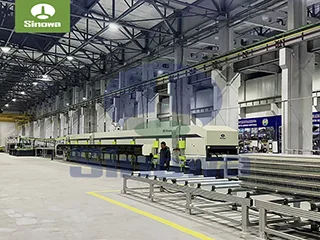
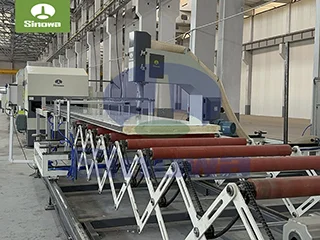
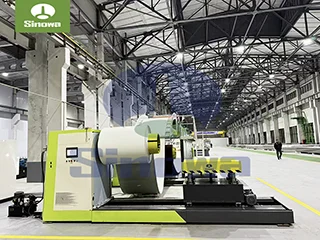
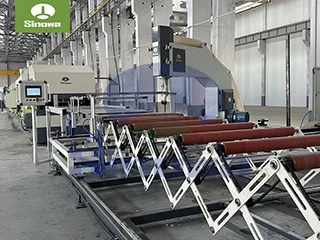
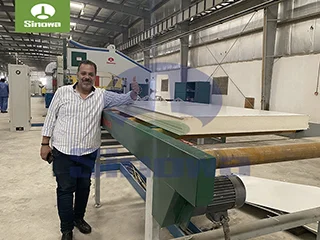
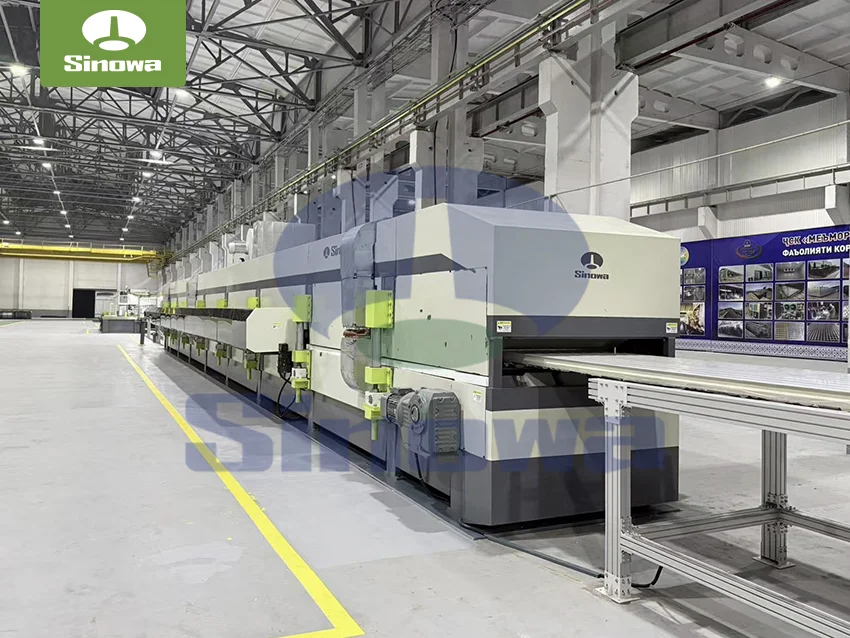
 sandwich panel line
The basic chemical principle supporting the operation of a PU foam production line remains consistent across different production models, relying on the exothermic polymerization reaction between liquid raw materials. The two primary raw materials consist of polyol as the base component and isocyanate as the curing component, and their molecular groups undergo cross-linking reactions under specific temperature and pressure conditions to form stable carbamate bonds. During this chemical reaction, foaming agents added in advance generate a large number of tiny and uniform bubbles inside the mixed liquid, which gradually expand and solidify to form the porous structure inherent to PU foam. Auxiliary additives such as catalysts, foam stabilizers and chain extenders play indispensable regulatory roles in the entire reaction process. Catalysts effectively adjust the reaction rate to avoid defects such as uneven foaming caused by excessively fast reaction or low molding efficiency caused by slow reaction; foam stabilizers maintain the uniformity of bubble structures and prevent bubble merging and collapse during the expansion stage; chain extenders optimize the molecular chain arrangement of polyurethane, thereby enhancing the mechanical strength and dimensional stability of finished foam products. The reasonable proportion of all raw materials is the primary prerequisite for the stable operation of the production line, and any slight deviation in the ratio may lead to fluctuations in foam density, poor elasticity or incomplete curing.
A complete PU sandwich panel production line follows a standardized and sequential production process, starting with raw material pretreatment and storage, followed by metering and conveying, high-pressure mixing, foaming molding, curing and shaping, cutting and post-processing, and ending with finished product output and stacking. Each link is closely connected with precise mechanical transmission and intelligent parameter control systems to ensure the continuity and stability of production. In the raw material storage stage, the production line is equipped with sealed storage tanks for different liquid raw materials. These tanks are designed with thermal insulation structures to maintain a constant internal temperature, effectively preventing raw material deterioration, viscosity change and component stratification caused by ambient temperature fluctuations. Since both polyol and isocyanate have strict requirements on storage environment humidity, the storage area of the production line is equipped with dehumidification devices to keep the internal air dry, avoiding chemical deterioration of raw materials due to moisture absorption. Meanwhile, independent storage spaces are adopted for different raw materials to prevent cross-contamination between components, and circulating filtering devices are installed at the outlets of the storage tanks to filter out tiny impurities mixed in the raw materials, ensuring the purity of materials entering the subsequent production links.
The metering and conveying system is one of the core functional modules of the PU sandwich panel line, determining the mixing accuracy of raw materials and laying the foundation for consistent product quality. This system is mainly composed of high-precision metering pumps, flow monitoring sensors and closed conveying pipelines. According to the preset production formula, the metering pumps accurately extract polyol, isocyanate and various auxiliary additives from the storage tanks at a stable flow rate. All conveying pipelines are made of corrosion-resistant alloy materials to adapt to the chemical characteristics of polyurethane raw materials and avoid pipeline corrosion and raw material leakage during long-term operation. In the conveying process, real-time flow data is fed back to the central control module through sensors, and the system automatically fine-tunes the operating frequency of the metering pumps to eliminate flow errors caused by raw material viscosity changes and pipeline pressure fluctuations. The entire metering and conveying process is carried out in a fully enclosed space, which not only reduces the volatilization loss of raw materials but also avoids the impact of external dust and impurities on the raw material purity. For production lines that need to produce multi-specification foam products, the metering system supports one-click switching of formula parameters to realize flexible adjustment of raw material ratios and meet the production requirements of foam with different hardness and density.
High-pressure mixing is the key link to trigger the polyurethane foaming reaction, and the mixing quality directly affects the internal pore structure and surface flatness of finished foam. The mixing unit of the production line adopts a high-pressure impact mixing structure, where multiple groups of raw materials transported by the metering system are injected into the mixing chamber at a high flow rate. The strong turbulence generated by high-speed impact realizes instantaneous and uniform mixing of different components without relying on mechanical stirring blades, effectively avoiding residual dead angles in the mixing process. The internal structure of the mixing chamber is polished smoothly to reduce raw material adhesion and ensure that each mixing cycle can complete rapid material replacement. In order to stabilize the reaction state, the mixing chamber is equipped with an embedded temperature control module to keep the mixing temperature within the optimal reaction range. After sufficient mixing, the homogeneous liquid mixture is quickly transported to the molding unit. The whole mixing process is completed in a short time, which not only ensures the timeliness of the chemical reaction but also prevents premature foaming and solidification of the mixture in the pipeline, avoiding pipeline blockage and production interruption.
Foaming molding is the stage where the liquid mixture transforms into solid foam products, and the production line is divided into continuous flat plate molding and intermittent mold molding according to different product forms. Continuous flat plate molding is mostly used for the mass production of sheet-like foam materials such as thermal insulation foam boards and packaging foam gaskets. After the mixed liquid is evenly poured on the continuously moving conveyor belt, the liquid gradually expands and foams under the set temperature environment. The upper and lower limit pressing structures of the production line control the expansion thickness of the foam to ensure uniform thickness of the flat foam. The conveyor belt is made of high-temperature resistant and non-stick materials to prevent the uncured foam from adhering to the equipment surface. Intermittent mold molding is suitable for customized special-shaped foam products such as automotive seat cushions and daily-use foam accessories. The mixed liquid is quantitatively injected into closed metal molds, and the molds are heated by circulating heating components to accelerate the cross-linking curing reaction of polyurethane. During the molding process, the internal pressure of the mold is kept stable to make the foam fully fill every corner of the mold cavity, ensuring complete and smooth product contours. Different molding methods are equipped with independent temperature and pressure regulation systems to adapt to the foaming characteristics of soft foam and hard foam respectively.
Curing and shaping is an essential post-molding processing link to optimize the physical properties of PU foam. Although the foam has initially formed a solid structure after foaming, the internal molecular cross-linking reaction is not completely finished, and the product has problems such as unstable size and insufficient hardness. The production line is equipped with an independent constant-temperature curing area, where the initially molded foam is transported by the conveying system and placed in a dry and constant-temperature environment for standing curing. The curing time is adjusted according to the foam density and thickness, and low-density soft foam requires a shorter curing cycle, while high-density hard foam needs longer standing time to complete deep molecular cross-linking. In the curing process, the residual heat generated by the reaction is gradually dissipated, the internal bubble structure tends to be stable, and the product undergoes slight natural shrinkage to achieve the optimal dimensional stability. Meanwhile, the volatile substances remaining inside the foam are slowly volatilized in the ventilated curing space, reducing the peculiar smell of finished products and improving the safety of material use. The curing area of modern production lines is equipped with intelligent temperature and humidity monitoring equipment to automatically adjust environmental parameters and avoid curing defects caused by excessive humidity or temperature deviation.
The cutting and finishing processing unit undertakes the task of refining semi-finished foam products to meet the specifications of commercial products. For continuously produced flat foam plates, the production line is equipped with multi-axis numerical control cutting devices, which cut the foam into fixed-length and fixed-width finished plates through high-speed rotating cutting blades. The cutting blades are made of wear-resistant sharp materials to ensure smooth cutting sections without burrs and bubble damage. For special-shaped foam products formed by molds, redundant flash and edge materials generated during mold closing are removed by trimming equipment. In addition to basic cutting operations, the finishing unit also includes surface smoothing and pore inspection procedures. Mechanical grinding is used to polish the uneven parts of the foam surface, and visual detection equipment automatically screens products with defective pore structures such as broken bubbles and hollow cavities to eliminate unqualified products from the production line in a timely manner. Some production lines supporting deep processing are also equipped with grooving and punching modules to complete secondary processing according to the usage needs of downstream industries and improve the application adaptability of foam products.
The automatic conveying and stacking system runs through the polyurethane sandwich panel production line, realizing the seamless connection of each processing link and reducing manual intervention. The conveying equipment adopts modular design, which can be adjusted in length and angle according to the production layout. The surface of the conveying mechanism is equipped with anti-slip and buffer structures to prevent extrusion deformation of fragile foam products during transportation. After finishing cutting and finishing, qualified finished products are automatically sorted by the conveying system and sent to the stacking area. The stacking device adopts mechanical arm positioning technology to neatly stack foam products according to fixed layers, realizing standardized storage of finished products. The whole conveying and stacking process is controlled by the central system, which can automatically adjust the conveying speed and stacking density according to the production output, effectively improving the overall production efficiency and reducing the labor cost of finished product sorting.
Intelligent parameter control is the core advantage of modern polyurethane sandwich panel line, distinguishing it from traditional simple foaming equipment. The entire production line is equipped with a centralized control terminal, which integrates all operation data such as raw material metering ratio, mixing pressure, molding temperature, curing time and conveying speed into a unified data interface. Production technicians can set production formulas and process parameters through the terminal, and the system automatically executes production procedures without repeated manual debugging. During the production operation, various sensors distributed in each link of the production line collect real-time operating data and feed it back to the control system. Once parameter deviation exceeding the safe range is detected, the system will automatically trigger fine-tuning instructions to correct abnormal parameters. In case of irreversible faults such as pipeline blockage and equipment overload, the system will start an emergency stop mechanism and send fault prompt information to avoid equipment damage and mass production of defective products. The data storage function of the control terminal can record the production parameters of each batch of products, providing data support for subsequent production optimization and product quality traceability.
Energy consumption control and environmental protection design are important parts of the structural optimization of PU foam production lines. In terms of energy saving, the production line adopts circulating heating technology, and the heat generated by the chemical reaction is recycled and reused in the molding and curing links through heat exchange components, reducing the energy consumption of external heating equipment. All driving motors of the equipment are frequency-conversion energy-saving motors, which automatically adjust the operating power according to the production load to avoid energy waste caused by no-load operation. In terms of environmental protection, the production line is equipped with sealed waste gas collection devices to collect volatile organic gases generated during raw material reaction and curing. The collected waste gas is purified by adsorption and filtration processes to meet safe emission standards. For waste materials such as cutting scraps and unqualified defective products generated in the production process, the production line is equipped with an independent waste recovery channel to collect waste materials in a centralized manner for subsequent professional recycling and reprocessing, realizing resource recycling and reducing production waste discharge. In addition, the fully enclosed production structure effectively reduces raw material leakage and dust diffusion, improving the cleanliness of the production working environment.
Different types of PU foam core sandwich panel line has differentiated structural designs to adapt to the production requirements of soft foam and hard foam. Soft PU foam is widely used in furniture cushions, automotive interior parts and daily necessities, and its production line is optimized for low-density and high-elasticity characteristics. The mixing system adopts low-pressure uniform mixing to avoid excessive bubble rupture caused by high pressure, and the molding conveyor belt is equipped with elastic buffer structures to protect the soft foam matrix from extrusion deformation. The curing temperature of soft foam production lines is relatively low, and the ventilation frequency of the curing area is increased to accelerate the volatilization of residual additives. Hard PU foam is mainly used for building thermal insulation, pipeline anti-freezing protection and industrial packaging support, featuring high density and high compression resistance. Its production line is equipped with high-pressure molding molds, and the internal temperature of the molds is increased to enhance the cross-linking degree of molecular chains. The cutting equipment of hard foam production lines adopts high-hardness cutting tools to cope with the high-density rigid structure of hard foam and ensure cutting flatness.
In the actual production and operation process, the daily maintenance and parameter optimization of the PU foam production line determine its service life and production stability. Daily maintenance work includes regular cleaning of the mixing chamber and conveying pipelines to prevent raw material residue from solidifying and blocking the pipeline; regular inspection of the sealing performance of raw material storage tanks to avoid moisture intrusion and raw material deterioration; periodic lubrication of mechanical transmission components to reduce equipment wear and operation noise. In terms of parameter optimization, production technicians need to adjust the formula ratio and reaction temperature according to seasonal ambient temperature changes. In low-temperature environments, appropriately increasing the preheating temperature of raw materials can improve the mixing uniformity; in high-temperature environments, reducing the catalyst dosage can avoid excessive foaming reaction. Long-term production operation data shows that standardized maintenance and reasonable parameter optimization can effectively reduce the equipment failure rate, extend the service life of the production line, and maintain the stability of product quality in long-cycle continuous production.
With the continuous development of downstream application industries, the market demand for PU foam is showing a diversified and high-performance development trend, which promotes the continuous technological upgrading of PU foam production lines. In terms of production efficiency, the new generation of production lines shortens the reaction cycle through optimized mixing structures and temperature control logic, realizing faster molding speed and higher hourly output. In terms of product performance customization, the intelligent formula switching system can quickly adjust the foam pore fineness, elasticity and hardness to meet the personalized needs of different industries. In terms of intelligent manufacturing, some advanced production lines are embedded with artificial intelligence identification modules, which can automatically identify product defects and classify unqualified products, further improving the level of production automation. In addition, driven by the concept of green manufacturing, the production line is gradually developing toward low-carbon and low-pollution, adopting environmentally friendly foaming agents and non-toxic auxiliary additives to reduce the environmental impact of the production process, and continuously optimizing the waste gas and waste residue recycling system to improve the resource utilization rate.
In conclusion, the PU foam production line is a comprehensive industrial production system integrating chemical reaction technology, mechanical transmission technology and intelligent control technology. It realizes the efficient transformation from liquid chemical raw materials to porous foam materials through standardized and automated production processes. Each functional module of the production line restricts and cooperates with each other, jointly ensuring the stability of production process and the consistency of finished product quality. From raw material storage and precise metering to high-pressure mixing and foaming molding, and then to curing finishing and finished product output, every production link contains exquisite mechanical design and scientific parameter control. With the continuous progress of industrial technology, PU foam production lines will further develop in the direction of higher automation, lower energy consumption and stronger customization capabilities, providing more reliable production support for the widespread application of PU foam materials in construction, automobile, packaging, daily necessities and other fields, and continuously releasing the application potential of this versatile polymer material in modern industrial society.
https://www.cnsinowa.com/sandwich-panel-machines/pu-foam-production-line.html