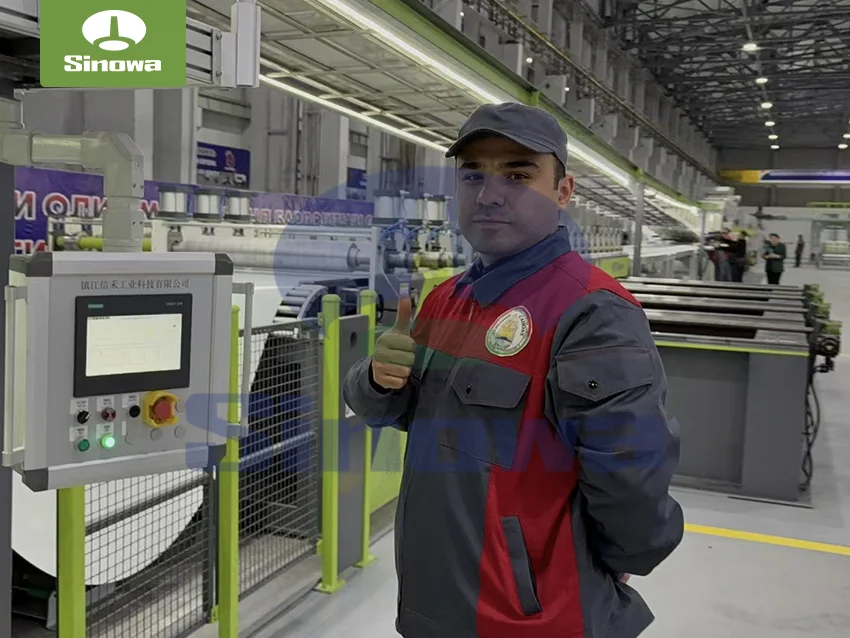
 sandwich panel line
The core design logic of the adjustable-thickness PUR sandwich panel production line lies in the integrated optimization of mechanical structure transmission, intelligent parameter control, and foaming molding coordination. Unlike conventional production lines that rely on fixed die spacing and single lamination stroke to determine panel thickness, this advanced production system adopts a fully adjustable double-belt lamination structure and synchronous parameter linkage control modules. The entire production process realizes dynamic matching of mechanical spacing, material feeding volume, foaming pressure, and curing parameters, ensuring that panels of different thickness specifications can complete continuous, integrated, and standardized production without frequent equipment disassembly, die replacement, or long-term parameter debugging. This fundamental structural upgrade fundamentally solves the pain points of traditional equipment such as single production specification, cumbersome specification switching, long downtime adjustment, and unstable product consistency after parameter modification.
The overall operation flow of the PUR sandwich panel line covers full-process automated operation from surface material pretreatment to finished panel stacking, with each functional module closely coordinated and synchronously operated to adapt to thickness adjustment requirements. In the initial feeding and pretreatment stage, the system is equipped with an automatic unwinding and positioning device for surface materials, which can stably convey metal or non-metal surface materials of different thicknesses and textures. The built-in deviation correction and positioning sensing components monitor the material conveying trajectory in real time, ensuring the upper and lower surface materials maintain accurate alignment during operation, which lays a foundation for uniform core material filling and consistent thickness of finished panels. Meanwhile, the surface pretreatment unit completes cleaning, preheating, and surface activation treatment of the panel surface materials. This process effectively enhances the bonding tightness between the surface material and the PUR foam core layer, avoids degumming and delamination caused by uneven bonding force during thickness switching, and improves the overall structural durability of the sandwich panels.
The PUR raw material metering and mixing system is a key link to guarantee the quality of adjustable-thickness panels. The system adopts high-precision metering pump groups to deliver two-component polyurethane raw materials according to dynamically adjusted proportion parameters. When the production thickness specification changes, the intelligent control system automatically calculates and adjusts the raw material feeding volume, mixing speed, and material output density in real time based on the set thickness value. Thicker panel specifications require a larger filling volume of foam raw materials, while thinner panels need precise reduction of material supply to avoid excessive foaming or insufficient filling. The high-speed mixing head ensures that the polyurethane raw materials and auxiliary materials are fully and evenly mixed in an instant, eliminating local density differences of the foam core layer. Even when switching multiple thickness specifications continuously, the system can maintain stable mixing uniformity, ensuring that the foam core layer of each panel has consistent cellular structure and physical performance, avoiding quality defects such as hollowing, uneven density, and local bulging.
The adjustable double-belt lamination and foaming curing system is the core functional module for realizing panel thickness adjustment. The upper and lower chain plate structures of the laminating machine are equipped with electric hydraulic spacing adjustment devices, which can achieve stepless and precise adjustment of the internal molding spacing of the equipment. The adjustment range covers the common thickness specifications of industrial and building sandwich panels, meeting the production needs of thin decorative insulation panels and thick load-bearing thermal insulation panels. In the production process, the system not only adjusts the mechanical spacing of the laminating machine according to the target thickness, but also synchronously links the foaming pressure, conveying speed, and curing temperature parameters. When producing thick panels, the PUR sandwich panel machine appropriately reduces the operating speed to extend the foaming and curing time of the core material, ensuring that the PUR foam fully expands and fills the molding space without collapse or incomplete curing. For thin panel production, the conveying speed is increased moderately, and the foaming pressure is optimized to prevent excessive foam extrusion and surface material deformation, maintaining the flatness and dimensional accuracy of the panel surface.
The curing system of the PU sandwich panel production line is designed with adaptive temperature and time adjustment functions, which cooperates with thickness switching to complete the final shaping and performance stabilization of the panels. After the preliminarily molded composite panels leave the laminating machine, they enter the long-distance curing tunnel to complete the cross-linking reaction and solidification molding of the PUR foam material. Different panel thicknesses correspond to different heat conduction efficiencies and curing cycle requirements. The intelligent temperature control module of the curing tunnel can automatically adjust the internal temperature gradient and material residence time according to real-time thickness parameters. Thick panels require a longer low-temperature constant-temperature curing process to ensure that the internal core material is completely cured and the internal stress is fully released, preventing subsequent panel deformation and performance attenuation. Thin panels adopt a relatively efficient curing mode to balance production efficiency and product quality, avoiding over-curing that leads to reduced foam toughness and brittle panel texture. This adaptive curing mode ensures that panels of all thickness specifications can achieve stable mechanical strength, excellent thermal insulation performance, and reliable structural adhesion after molding.
The post-processing modules of the polyurethane sandwich panel production line, including trimming, fixed-length cutting, and surface finishing, also realize adaptive matching with adjustable thickness production. The edge trimming device on both sides of the equipment can automatically adjust the trimming range and pressure according to the panel thickness, accurately removing the excess foam and edge burrs generated in the molding process to ensure consistent panel width and neat edge structure. The fixed-length cutting system uses high-precision sensing and servo control technology to identify panel thickness and operating speed in real time, dynamically adjusting the cutting speed and blade pressure to avoid problems such as plate edge collapse, foam peeling, and uneven cutting sections caused by mismatched cutting parameters. After cutting and shaping, the finished panels enter the automatic sorting and stacking unit, which can stably complete stacking and arrangement of panels of different thicknesses, realizing standardized output of finished products and facilitating subsequent transportation and storage.
The intelligent centralized control system runs through the entire production process, providing core technical support for stable and efficient adjustable-thickness production. The system integrates parameter storage, one-click specification switching, real-time data monitoring, and automatic fault correction functions. Operators only need to input the target panel thickness and production parameters through the human-machine interaction interface, and the system will automatically synchronize and adjust all linked modules including feeding volume, lamination spacing, operating speed, curing parameters, and post-processing parameters. It avoids errors and quality fluctuations caused by manual parameter debugging, greatly reducing the technical threshold of equipment operation. In the continuous production process, the system monitors key data such as equipment operating status, material mixing parameters, and panel molding dimensional accuracy in real time. Once slight parameter deviation is detected, it will automatically perform fine adjustment and calibration to ensure long-term stable and consistent production quality.
Compared with traditional fixed-specification PUR sandwich panel production line, the adjustable-thickness production line has prominent comprehensive advantages in production flexibility, cost control, and market adaptability. For manufacturing enterprises, the equipment eliminates the need to purchase multiple production lines for different thickness specifications, greatly reducing equipment investment costs and factory space occupation. The rapid switching of production specifications realizes flexible response to small-batch, multi-variety, and customized order demands, effectively improving the utilization rate of production equipment and production line operation efficiency. In actual production, the equipment can complete seamless switching between different thickness specifications in a short time without long shutdown and debugging processes, greatly reducing production downtime loss and improving the overall production capacity of the enterprise.
In terms of product performance stability, the linkage adjustment design of the adjustable-thickness production line ensures that all physical indicators of the panels remain excellent under different thickness specifications. The uniformly foamed PUR core layer has fine and closed cellular structure, which endows the panels with low thermal conductivity, good heat and cold resistance, and excellent sound insulation effect. The integrated lamination and curing process enables the surface material and core layer to form an integral composite structure with high bonding strength, strong peel resistance, and no easy delamination. Panels of different thicknesses produced by this line can maintain stable compressive strength, bending resistance, and weather resistance, adapting to complex and changeable application environments such as high temperature, low temperature, and high humidity.
This adjustable-thickness PUR sandwich panel line has a wide range of application scenarios, covering multiple fields of industrial construction and civil engineering. Thin-specification panels are suitable for interior decoration partitions, factory interior insulation, and ordinary building enclosure structures, meeting the lightweight and aesthetic production requirements of decorative insulation materials. Medium-thickness panels are widely used in factory workshop enclosure walls, roof insulation, and public building energy-saving transformation, balancing structural strength and thermal insulation performance. Thick-specification panels are dedicated to cold storage, refrigeration engineering, constant-temperature workshops, and special industrial insulation projects, providing ultra-high thermal insulation efficiency and stable structural bearing capacity. The diversified thickness production capacity enables the equipment to meet the one-stop procurement and production demands of different engineering projects, greatly improving the market competitiveness of panel manufacturing products.
In terms of production energy consumption and environmental protection, the optimized structural design and intelligent parameter adjustment mode of the equipment also bring significant advantages. The accurate quantitative feeding system avoids raw material waste caused by excessive feeding in traditional fixed production modes, improving the utilization rate of PUR raw materials. The adaptive speed and temperature adjustment mechanism effectively reduces invalid energy consumption in the production process, realizing energy-saving production while ensuring product quality. The whole production process adopts closed foaming and curing design, with no overflow of raw materials and no harmful substance volatilization, meeting the green and environmentally friendly production standards of modern manufacturing industry. The finished panels produced have stable performance, long service life, and no aging and deterioration problems in long-term use, reducing the material replacement frequency and comprehensive use cost of engineering projects.
With the continuous upgrading of the construction industry towards energy conservation, environmental protection, and customization, the market demand for flexible and intelligent sandwich panel production equipment is constantly increasing. The adjustable-thickness PUR sandwich panel production line, as a high-efficiency and versatile production equipment, breaks through the limitations of traditional single-function equipment, realizes the organic combination of flexible production and high-quality manufacturing, and provides a reliable technical guarantee for the standardized and diversified production of PUR sandwich panels. In the future, with the further optimization of intelligent control technology and mechanical structure design, this type of production line will achieve higher adjustment accuracy, faster specification switching speed, and more stable production performance, and will be more widely used in modern industrial manufacturing and energy-saving building construction, promoting the iterative upgrading and high-quality development of the entire sandwich panel manufacturing industry.
https://www.cnsinowa.com/sandwich-panel-machines/pur-sandwich-panel-line-with-adjustable-panel-thickness.html






