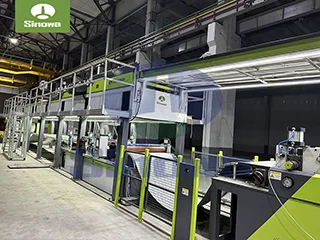
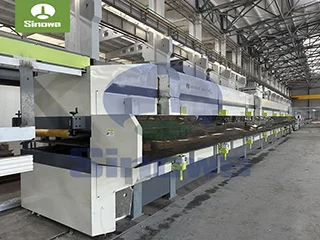
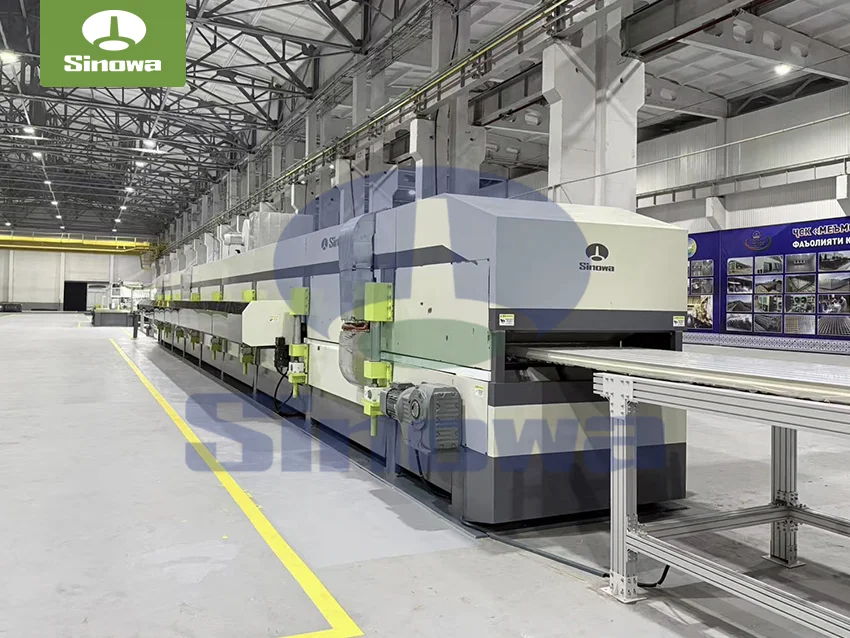
 sandwich panel machine
The fundamental design logic of the PU sandwich panel machine centers on realizing integrated composite molding of multi-layer building materials. The finished panels produced by the equipment adopt a typical sandwich structure, with rigid polyurethane foam as the core insulation layer and metal sheets as the outer protective layers on both sides. Unlike discrete manual or semi-mechanical production modes, the full-process automated production line completes all manufacturing procedures in a continuous linear operation, eliminating intermittent production gaps and human-induced quality fluctuations. The overall operational logic starts from raw material feeding, covering sheet forming, precise PU material mixing and injection, layered lamination, constant-temperature curing, fixed-length cutting, and automatic stacking, forming a closed-loop production system that requires minimal manual intervention throughout the entire process.
Raw material feeding and pre-forming constitute the initial stage of the entire production workflow, laying a solid foundation for consistent finished product quality. The PU sandwich panel equipment is equipped with automatic unwinding units that steadily release continuous metal sheet coils, which serve as the outer surface materials for roof and wall panels. These metal sheets undergo multi-stage rolling and pressing through precision roller sets inside the machine, gradually forming standardized profiles that meet the structural requirements of building roofs and walls. The rolling system is precisely calibrated to ensure uniform stress on the sheet surface, consistent bending angles, and smooth overall profiles, effectively avoiding surface wrinkles, deformation, or dimensional deviations that often occur in traditional processing methods. Meanwhile, the equipment supports continuous feeding of auxiliary protective films, which are automatically attached to the surface of metal sheets during the forming process to prevent scratches and corrosion during subsequent production, transportation, and installation, further improving the surface finish and service durability of finished panels.
The PU foam injection and composite bonding stage is the core functional module that determines the insulation performance and structural stability of finished panels. The polyurethane sandwich panel machine is equipped with a high-precision metering and mixing system dedicated to polyurethane raw materials, which accurately proportion two-component liquid chemical materials according to fixed process parameters. After full high-pressure mixing in the professional mixing head, the homogeneous liquid PU mixture is evenly and continuously injected between the upper and lower formed metal sheets. The injected liquid material quickly undergoes chemical reaction, gradual foaming, and uniform expansion in the closed molding space. Relying on the excellent adhesion characteristics of polyurethane materials, the foaming core layer forms a firm integrated bond with the inner surfaces of the upper and lower metal sheets without the need for additional adhesive agents, simplifying the production process while enhancing the overall structural integrity of the panel.
The double-belt lamination and constant-temperature curing system is a key structure to ensure uniform panel thickness and stable foaming quality. After the completion of PU material injection, the semi-finished panels are sent to the long-distance double-belt conveyor pressing system. This system maintains stable and balanced pressure and constant temperature throughout the operation process, effectively constraining the free expansion of PU foam and ensuring that the foam core layer forms a dense, uniform, and pore-free internal structure. The long-distance curing design provides sufficient time for the polyurethane chemical reaction to proceed completely, enabling the foam to fully solidify and stabilize. This process avoids quality defects such as uneven core density, local hollowing, or inconsistent thickness, ensuring that every position of the panel maintains consistent thermal insulation performance and mechanical strength. Whether producing flat wall panels or profiled roof panels with special structural grooves, the lamination system can adapt to corresponding molding requirements to achieve standardized composite molding.
The final stage of production includes automatic fixed-length cutting, finishing, and stacking, realizing fully automated unmanned output of finished products. After complete curing and shaping, the continuous integrated panel is transported to the precision cutting unit, which completes fixed-length cutting according to preset parameter settings. The cutting process operates synchronously with the continuous sandwich panel production line without shutdown interruption, effectively improving overall production efficiency. The cut finished panels have neat and smooth end surfaces without burrs or deformation, meeting the fine installation requirements of building enclosure structures. Subsequently, the automatic sorting and stacking system arranges the finished panels in order, realizing standardized collection of finished products and facilitating subsequent packaging, transportation, and on-site construction and installation.
Compared with traditional semi-automatic production equipment, the modern PU sandwich panel making machine boasts prominent advantages in production efficiency and quality stability. The fully automated continuous production mode breaks through the speed limitations of manual-assisted production, achieving stable and efficient output of finished products. The equipment can support long-term uninterrupted 24-hour cyclic operation, which is highly suitable for large-scale, batch production demands in engineering construction projects. More importantly, the entire production process is controlled by integrated digital systems, with all key parameters including material proportion, foaming density, lamination pressure, curing temperature, and cutting length precisely regulated by programs. This intelligent control mode completely eliminates random errors caused by manual operation, ensuring that each batch of finished panels maintains consistent thickness, core density, bonding strength, and appearance quality, with a far higher product qualification rate than traditional production modes.
In terms of product performance, the panels produced by this professional equipment fully adapt to the diverse usage requirements of building roofs and walls. The rigid polyurethane foam core layer has extremely low thermal conductivity, endowing the finished panels with excellent thermal insulation and heat preservation performance. This performance can effectively isolate indoor and outdoor heat exchange, maintain stable indoor temperature, and significantly reduce the energy consumption of building heating and cooling systems, delivering outstanding energy-saving effects for various buildings. Meanwhile, the composite structure of metal sheet and PU foam gives the panels a high strength-to-weight ratio. The overall weight of the panel is light, which reduces the load-bearing pressure on the building’s main steel structure, while the integrated composite structure provides strong bending resistance and impact resistance, adapting to the external wind pressure and gravity load faced by building roofs and walls in daily use.
The equipment features strong production flexibility and can switch production specifications according to different building scenarios to meet differentiated application demands. By adjusting the operating parameters of the rolling system, foaming system, and cutting system, the machine can produce wall panels suitable for building outer walls, inner partition walls, and special enclosure spaces, as well as professional roof panels with waterproof, drainage, and wind-resistant structural designs. The produced roof panels have reasonable structural grooves and lap structures, which can effectively prevent rainwater penetration and improve the overall waterproof and wind-resistant performance of the building roof. Wall panels feature flat and neat surfaces, convenient splicing and installation, and good decorative adaptability, which can be directly used for building wall enclosure and decoration, simplifying the on-site construction process and shortening the project cycle.
In terms of production cost and energy consumption control, the optimized structural design of the PU sandwich panel production machine brings significant economic and environmental benefits. The precise metering and injection system of PU raw materials avoids material waste caused by manual proportioning deviation, improving the utilization rate of raw materials. The efficient curing system adopts moderate-temperature rapid curing technology, which reduces energy consumption during the production process compared with high-temperature curing processes required by other insulation core materials. In addition, the fully automated production mode greatly reduces the demand for on-site operating personnel, lowering labor costs in the production process. The stable product quality also reduces the rework and waste loss caused by defective products, further improving the comprehensive economic benefits of panel production.
From the perspective of construction application, the standardized panels produced by professional PU sandwich panel manufacturing machine greatly promote the development of prefabricated building construction modes. Traditional building enclosure construction requires multiple processes such as on-site masonry, plastering, and insulation layer laying, which are affected by weather and manual technology, with long construction cycles and unstable quality. In contrast, prefabricated PU sandwich panels can be directly installed on the building’s main structure through on-site splicing and fixing. The installation process is simple and efficient, not restricted by seasonal and weather conditions, and can greatly shorten the construction period of building enclosure projects. At the same time, the integrated structure of the panels integrates insulation, waterproofing, decoration, and enclosure functions, eliminating the need for multiple auxiliary construction processes on the building wall and roof, realizing one-time molding of building enclosure structures, and improving the overall construction efficiency and engineering quality.
In terms of environmental protection performance, the production process and finished products of the PU sandwich panel line conform to the current global green building development trend. The polyurethane foam material used in production has stable chemical properties, no volatile harmful substances, and no pollution to the indoor and outdoor building environment after long-term use. The automated closed production system avoids material leakage and dust pollution during the production process, realizing clean and environmentally friendly production. Moreover, the excellent thermal insulation performance of the panels can long-term reduce the energy consumption of building operation, lower the emission of heat energy consumption, and provide strong support for building energy conservation and emission reduction. In addition, the panels have a long service life and can be recycled and reused after the demolition of old buildings, reducing the generation of construction waste and realizing sustainable utilization of building materials.
With the continuous upgrading of building industrialization and the continuous improvement of energy-saving building standards, the market demand for high-performance PU sandwich panels is constantly expanding, which also puts forward higher requirements for the performance and intelligence level of corresponding production equipment. Continuous PU sandwich panel machine is gradually developing towards higher intelligence, stronger stability, and more diversified production. The introduction of remote parameter adjustment, real-time equipment operation monitoring, and automatic fault diagnosis functions further improves the convenience of equipment operation and maintenance. The optimized mechanical structure design enhances the stability and durability of long-term continuous operation, reduces equipment failure rates and maintenance costs, and ensures the continuity and stability of industrial production.
In practical industrial production and engineering applications, the PU sandwich panel production line has become a key driving force for the standardized and large-scale development of the sandwich panel industry. It solves the problems of inconsistent product quality, low production efficiency, and high comprehensive cost in traditional manual and semi-mechanical production modes, provides high-quality, stable, and cost-effective enclosure materials for various industrial plants, commercial buildings, cold storage buildings, and prefabricated temporary buildings. Whether it is the large-scale material supply demand of large industrial construction projects or the standardized supporting demand of small and medium-sized prefabricated buildings, this sandwich panel production equipment can complete efficient production matching, showing extremely high market adaptability and industrial application value.
In conclusion, the PU sandwich panel machinery dedicated to roof and wall panel production is a highly integrated, efficient, and environmentally friendly modern building material production equipment. It realizes precise control and standardized molding of the entire process from raw material processing to finished product output through automated and intelligent mechanical systems. The produced panels have excellent thermal insulation, structural stability, and construction convenience, fully meeting the diverse performance requirements of modern building roofs and walls. With the continuous advancement of building industrialization and green building concepts, this equipment will continue to play an important role in the field of prefabricated building material production, continuously promoting the upgrading of construction methods and the improvement of building energy-saving levels, and providing solid technical and equipment support for the high-quality development of the global construction industry.
https://www.cnsinowa.com/sandwich-panel-machines/pu-sandwich-panel-machine-for-roof-and-wall.html