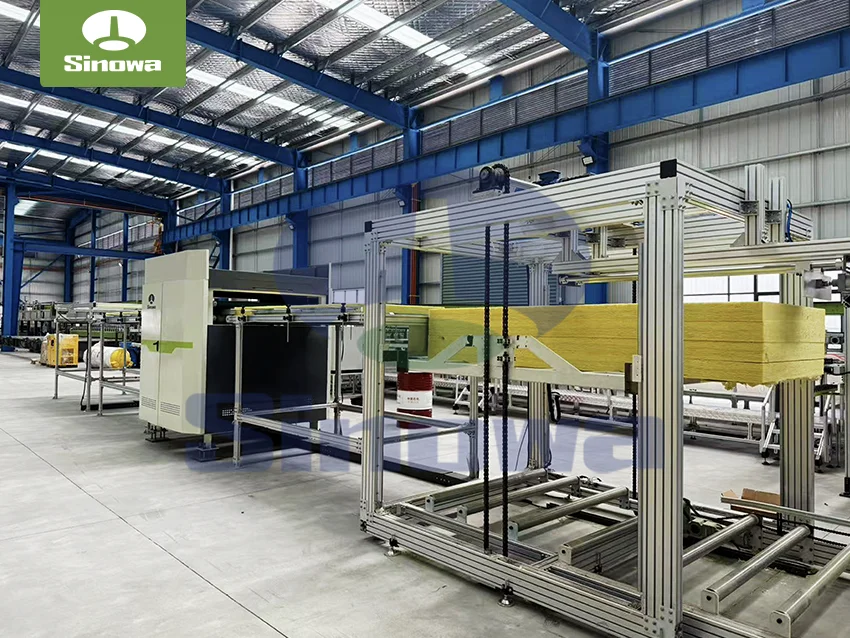
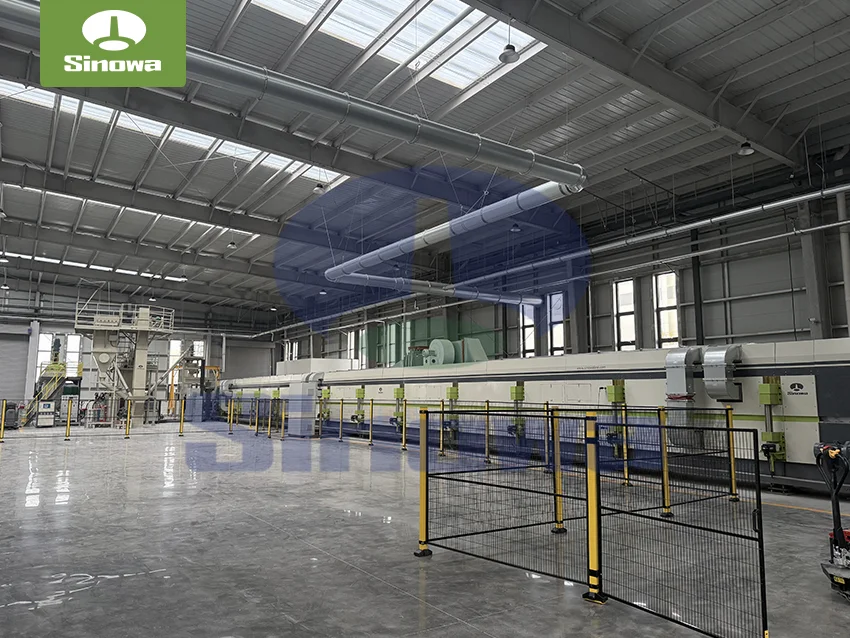
sandwich panel machine
A mineral wool sandwich panel machine is a complete set of automated production equipment specially used for compounding metal surface materials and mineral wool core materials into integrated sandwich panels. Different from single processing machinery, this machine integrates multiple functional units to complete a continuous production chain from raw material feeding to finished product stacking. The core processing objects of the equipment include mineral wool core materials with fibrous porous structures and metal sheet surface layers with high structural strength. The mineral wool core materials are processed from natural mineral raw materials through high-temperature melting and fiber forming, featuring low thermal conductivity, non-combustibility and sound absorption performance, while the metal surface layers provide mechanical protection, surface flatness and corrosion resistance for the panels. The fundamental design logic of the machine is to realize stable bonding, precise molding and fixed-size cutting of surface layers and core materials through mechanical transmission, automatic gluing, constant-temperature pressing and intelligent control technologies, so as to produce sandwich panels with uniform thickness, stable structure and consistent performance. In the actual industrial production process, this type of machine can adapt to different raw material specifications, adjust production parameters according to production requirements, and complete continuous and uninterrupted production tasks, which lays a solid foundation for large-scale industrial manufacturing of mineral wool sandwich panels.
The overall structure of a mature mineral wool sandwich panel machine consists of multiple interconnected functional modules, each undertaking independent processing tasks and cooperating with each other to form a closed-loop production system. The raw material feeding module is the starting part of the entire production line, mainly responsible for the orderly supply of metal sheets and mineral wool core materials. The metal sheet feeding unit is equipped with unwinding and leveling devices, which can release coiled metal raw materials at a constant speed and eliminate the bending deformation and internal stress of metal sheets generated during coiling. The structural design of the leveling unit focuses on precision control, using multiple groups of parallel pressure rollers to perform repeated flattening treatment on metal sheets, ensuring that the flatness of the surface materials meets the composite processing standards. The mineral wool feeding unit adopts a quantitative conveying structure, which can evenly spread strip-shaped mineral wool raw materials on the conveying platform. During the laying process, the equipment can adjust the laying density and arrangement direction of mineral wool strips to optimize the internal fiber structure of the finished panels, thereby improving the overall compression resistance and bonding firmness of the sandwich panels. The coordination speed of the two feeding units is precisely matched by the intelligent control system to avoid production defects such as material deviation and feeding interruption caused by inconsistent transmission speeds.
Following the feeding module is the surface treatment and gluing module, which is a key link to determine the bonding strength between the surface layer and the core material. Before compounding, the metal sheets need to go through surface cleaning and activation treatment to remove dust, oil stains and oxide layers attached to the surface. This treatment process enhances the adhesion between the metal surface and the adhesive, preventing the problems of delamination and peeling of sandwich panels during long-term use. The automatic gluing system adopts a rolling gluing structure, which can evenly coat high-strength adhesive on the inner surfaces of upper and lower metal sheets. The gluing amount and coating uniformity are controlled by mechanical adjusting components, which can make real-time fine adjustments according to the thickness of raw materials and production speed. Different from manual gluing, the mechanical gluing method avoids uneven glue accumulation and missing coating, ensuring that each contact area between the metal sheet and mineral wool is fully covered by the adhesive. Meanwhile, the gluing module is equipped with a constant-temperature heating auxiliary device, which can maintain the activity of the adhesive in different ambient temperatures and accelerate the initial curing speed of the adhesive, creating favorable conditions for subsequent composite pressing processing.
The composite pressing and curing module is the core functional area of the entire production machine, undertaking the tasks of laminating, pressing and preliminary shaping of raw materials. After the glued metal sheets and mineral wool core materials are accurately aligned, they are sent to the pressing unit through a synchronous conveying mechanism. The pressing unit is composed of multi-group high-strength pressure rollers and constant-temperature heating plates, which can provide stable and uniform pressing force for the composite materials. The pressure value inside the pressing area can be adjusted according to the density of mineral wool and the thickness of metal sheets, so as to ensure that the mineral wool core materials are closely combined with the metal surface layers without excessive compression deformation of the internal fiber structure. The internal temperature of the curing area is maintained within a reasonable constant-temperature range through an intelligent temperature control system, which promotes the cross-linking reaction of the adhesive and realizes rapid curing bonding between layers. In order to improve the structural uniformity of finished panels, the pressing process adopts segmented gradual pressure control. The low-pressure pre-fitting stage eliminates the gap between raw materials, and the high-pressure curing stage strengthens the bonding strength, effectively avoiding hollowing and layering defects inside the panels. The entire pressing and curing process runs continuously without manual intervention, maintaining consistent processing parameters for each batch of products.
The fixed-size cutting and edge trimming module is responsible for shaping the continuously produced composite semi-finished products into standard-sized panels. After curing and molding, the long strip composite materials are transmitted to the cutting unit at a constant speed. The cutting system adopts high-precision servo driving components and sharp alloy cutting blades, which can complete transverse fixed-length cutting according to preset dimensional parameters. The positioning accuracy of the cutting mechanism is controlled within a tiny error range, ensuring that the length error of each finished panel is kept to a minimum. In addition to transverse cutting, the edge trimming device on both sides of the production line can trim the irregular edges of composite materials generated during the feeding and compounding process to make the edge flat and smooth. The edge trimming treatment not only improves the appearance quality of finished panels but also eliminates the potential safety hazards of burrs scratching operators during installation and use. The waste materials generated by cutting and edge trimming are automatically collected by the auxiliary recycling device of the equipment, realizing centralized processing of waste materials and reducing raw material waste in the production process.
The final part of the production line is the finished product conveying and stacking module. The cut standard mineral wool sandwich panels are transported to the stacking platform through the low-speed conveying mechanism. The automatic stacking device is equipped with servo positioning and alignment structures, which can accurately adjust the placement position of each panel. During the stacking process, the equipment carries out layered and orderly stacking according to the set number of panels, ensuring that the stacked panels are neat and flat without displacement and inclination. The optimized mechanical arm and stacking baffle structure avoid surface scratches and collision deformation of panels during stacking. After the stacking quantity reaches the preset standard, the equipment sends out a prompt signal to remind operators to carry out material handling and transfer. This automated stacking mode replaces traditional manual carrying and sorting, greatly reducing labor intensity, improving production efficiency, and maintaining the intact surface quality of finished panels. Each functional module of the entire mineral wool sandwich panel machine is connected by synchronous transmission components, and the operation rhythm is uniformly scheduled by the central control system to realize seamless connection of all production links.
From the perspective of working principle, the operation logic of mineral wool sandwich panel machines is based on mechanical transmission, physical pressing and chemical curing principles, realizing the organic combination of heterogeneous materials. The power drive system of the equipment takes motor components as the power source, and transmits power to each functional module through gearboxes, transmission chains and synchronous belts, maintaining the stable operation of mechanical components. The intelligent control core adopts programmable logic control technology, which integrates the operation parameters of feeding speed, gluing amount, pressing pressure, curing temperature and cutting size into a unified control interface. Operators can input production parameters according to product requirements, and the system automatically adjusts the operating state of each module to realize standardized production. In terms of material combination, relying on the high-viscosity adhesive and constant-temperature pressing environment, physical adsorption and chemical bonding are formed between metal sheets and mineral wool fibers. The adhesive penetrates into the porous fiber structure of mineral wool to form a stable bonding layer, which greatly improves the interlayer peeling resistance and shear resistance of the sandwich panels. In terms of structural optimization, the equipment can adjust the laying direction of mineral wool fibers to make the fibers vertically distributed between the upper and lower metal plates, which gives full play to the compression resistance and thermal insulation performance of mineral wool materials and optimizes the overall mechanical properties of finished panels.
Modern mineral wool sandwich panel machines have obvious technical advantages in structural design and performance optimization compared with traditional processing equipment. In terms of automation level, the upgraded equipment realizes full-process automatic control from raw material feeding to finished product output. Except for regular parameter setting and equipment inspection by operators, no manual auxiliary operation is required in the production process. The highly automated production mode effectively reduces human error interference, improves product qualification rate, and lowers labor input costs for enterprises. In terms of precision control, the equipment is equipped with high-sensitivity sensing components, which can monitor the operating status of each module in real time. Once abnormal conditions such as material deviation, excessive temperature and pressure fluctuation occur, the system will automatically trigger an early warning mechanism and make adaptive adjustments to ensure production stability. In terms of raw material adaptability, the machine can match metal sheets of different thicknesses and mineral wool core materials of different densities. By adjusting the running parameters, it can produce sandwich panels with different thermal insulation grades and mechanical strengths, meeting the customized production needs of diverse engineering projects.
In terms of operational energy consumption and environmental protection performance, the optimized mineral wool sandwich panel machine adopts energy-saving transmission structures and constant-temperature heating technology. The heating system can realize intelligent temperature adjustment, automatically reduce heating power during equipment standby, and avoid long-term high-power operation causing energy waste. The sealing design of the production line effectively reduces the volatilization of adhesive gas during the production process, and the built-in dust removal device can collect fine mineral wool fiber dust generated during material cutting, improving the production workshop environment and complying with modern industrial environmental protection production standards. In addition, the mechanical structure of the equipment is made of high-strength wear-resistant alloy materials, which can resist vibration friction and material impact during long-term operation, reduce component wear rate, extend the overall service life of the equipment, and lower the long-term operation and maintenance costs of production enterprises.
Scientific and standardized daily maintenance is crucial to maintain the stable operation and prolonged service life of mineral wool sandwich panel machines. The daily maintenance work mainly includes surface cleaning, component inspection and lubrication maintenance. After daily production is completed, operators need to clean the residual adhesive, mineral wool debris and metal dust on the surface of the equipment, especially the pressure rollers, cutting blades and conveying tracks, to prevent residual impurities from affecting the processing accuracy of subsequent production. Regular inspection of vulnerable parts such as transmission bearings, sealing gaskets and sensing probes is required to timely replace aging and damaged components and avoid production failures caused by component failure. The transmission and rotating parts of the equipment need to be regularly coated with high-quality lubricating oil to reduce mechanical friction resistance, ensure flexible component operation, and reduce vibration and noise during equipment operation.
In addition to daily maintenance, regular deep maintenance should be carried out according to the service cycle of the equipment. It is necessary to calibrate the cutting size, pressing pressure and gluing uniformity of the machine regularly to ensure that the production parameters remain within the standard range. The internal circuit and control system of the equipment need to be inspected periodically to clean dust accumulated in electrical components and check the stability of line connections, so as to prevent circuit failures from causing equipment shutdown. For the heating and curing system, the heating plates and temperature sensing elements should be detected regularly to eliminate hidden dangers such as uneven heating and temperature sensing deviation. Meanwhile, enterprises need to formulate complete equipment operation specifications, conduct professional training for operators, standardize operation procedures, and avoid equipment damage caused by misoperation. Reasonable maintenance management can not only maintain the stable production capacity of the machine but also reduce the failure rate, shorten the downtime maintenance cycle, and create more stable economic benefits for production enterprises.
Mineral wool sandwich panels produced by professional machines have excellent comprehensive performance, making them widely used in multiple industrial and civil construction fields. In industrial plant construction, such panels are used for factory wall enclosures and roof structures. Their good fire resistance can effectively block the spread of open fire, and the thermal insulation performance reduces the temperature fluctuation inside the factory building, improving the production environment of industrial workshops. In public buildings such as exhibition halls and stadiums, the lightweight characteristics of mineral wool sandwich panels can reduce the self-weight of building structures, and the sound absorption performance can optimize the indoor acoustic environment, meeting the usage needs of large public spaces. In cold storage and constant-temperature storage buildings, the low thermal conductivity of mineral wool core materials effectively reduces internal and external heat exchange, maintains the stable internal temperature of the cold storage, and reduces energy consumption for refrigeration operation.
In addition, in special engineering fields such as chemical plants, power stations and tunnel projects, mineral wool sandwich panels can resist high-temperature corrosion and external impact, adapting to harsh construction environments. The smooth metal surface of finished panels is easy to clean and maintain, and the diversified surface color and texture options can meet the aesthetic decoration needs of different buildings. All these application advantages are derived from the precise processing capability of mineral wool sandwich panel machines. The equipment realizes stable control of panel density, thickness and bonding strength in the production process, ensuring that each batch of finished products has consistent performance, which provides reliable material guarantee for engineering construction. With the continuous improvement of building energy-saving standards and safety requirements, the market demand for high-quality mineral wool sandwich panels will continue to expand, which in turn drives the continuous upgrading of supporting production machines.
Looking at the current global industrial development trend, mineral wool sandwich panel machines are evolving towards intelligent integration, energy conservation and environmental protection, and flexible customization. In terms of intelligent upgrading, the equipment will be combined with digital monitoring and remote control technology to realize real-time data upload of production parameters, remote fault diagnosis and intelligent operation scheduling. The introduction of artificial intelligence algorithms can enable the equipment to automatically identify raw material defects and adjust processing parameters independently, further improving production intelligence and product qualification rate. In terms of energy-saving optimization, the new generation of equipment will adopt more efficient heating and power transmission technologies, optimize the internal thermal insulation structure of the curing area, reduce heat loss in the production process, and realize low-energy consumption and low-carbon production.
In terms of flexible production, the structural design of the machine will be more modularized. The quick disassembly and replacement of functional modules can realize rapid switching of different panel specifications, shorten the mold change cycle, and meet the small-batch and diversified customized production needs of the market. At the same time, with the continuous innovation of new building materials, mineral wool sandwich panel machines will also be compatible with more types of surface and core materials, expand the product production range, and enhance the comprehensive applicability of the equipment. In terms of safety production, the equipment will add more intelligent protection mechanisms, such as anti-clamping protection, overload power-off and dust purification systems, to further optimize the operating safety of the production line and improve the working environment of operators.
In conclusion, mineral wool sandwich panel machines are important processing equipment connecting mineral wool raw materials and building composite panels, with irreplaceable core status in the building insulation material manufacturing industry. Through the collaborative operation of multiple functional modules, the equipment realizes automated, standardized and high-efficiency production of sandwich panels, and the processed finished products have excellent fire resistance, thermal insulation, sound absorption and structural stability. From structural composition, working principle to operation and maintenance, every link of the machine embodies the integration of mechanical manufacturing technology and material processing technology. With the continuous development of the construction industry and the improvement of environmental protection and energy-saving requirements, the market demand for mineral wool sandwich panels will keep growing, which promotes the continuous technological innovation and performance optimization of production machines. In the future, mineral wool sandwich panel machines will develop in the direction of higher intelligence, lower energy consumption and stronger flexibility, continuously improve production efficiency and product quality, provide more high-quality composite building materials for global construction projects, and make important contributions to the high-quality development of the modern construction industry and the realization of green building energy-saving goals.
https://www.cnsinowa.com/sandwich-panel-machines/mineral-wool-sandwich-panel-machine.html