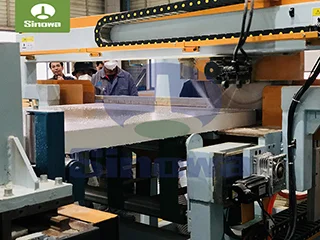
sandwich panel line
The raw material selection and pretreatment link constitutes the primary foundation of the entire phenolic air duct panel line, and the rational collocation of raw materials directly affects the basic performance of finished panels. The core raw material of phenolic air duct panels is modified phenolic resin, which is synthesized through the polycondensation reaction of phenol and formaldehyde under specific catalytic conditions. Different from ordinary phenolic resin used in industrial adhesives, the resin applied to air duct panels needs to be modified to optimize toughness, curing efficiency and anti-aging performance. In the raw material preparation area of the phenolic insulation board production line, workers conduct precise proportioning of phenolic resin, foaming agents, curing agents, flame retardant additives and flexible modifiers. The introduction of nano-scale inorganic colloids and polyether polyols into the resin formula can effectively improve the brittleness defect of traditional phenolic foam, enhance the bending resistance and impact resistance of the substrate, and avoid edge cracking and surface damage during transportation and subsequent processing. Before entering the foaming process, all liquid raw materials need to be filtered and stirred evenly in a sealed constant-temperature tank to eliminate impurity particles and ensure the uniformity of the mixed material system. Solid auxiliary materials such as reinforcing fibers are subjected to dust removal and crushing treatment to make the particle size meet the production standard, which is conducive to uniform dispersion in the foaming matrix. The entire raw material pretreatment area adopts a closed structure to prevent volatile substances from escaping into the external environment, realizing clean and low-consumption material preparation.
Foaming and curing is the core technical link of the phenolic air duct sandwich panel line, which determines the internal pore structure, density stability and thermal insulation performance of the phenolic foam substrate. Modern production lines mostly adopt negative-pressure continuous foaming technology, which is different from the intermittent foaming method of traditional small-scale equipment. The mixed raw materials are quantitatively transported to the foaming mold through a high-precision pumping system, and the internal pressure of the mold is stably controlled within a fixed negative-pressure range. This pressure control mode can make the foam cells expand evenly, form a closed-cell structure with uniform size, and effectively reduce the internal air void rate of the substrate. During the foaming process, the gradient temperature control system runs synchronously. The temperature of each section of the mold is adjusted in real time according to the foaming reaction rate, so that the curing temperature of phenolic resin is maintained in an efficient and stable interval. The optimized temperature control technology can reduce the curing energy consumption while ensuring the complete curing of the resin, and avoid the performance degradation caused by incomplete curing or excessive high-temperature aging of the material. In this process, the density of the foam substrate is accurately controlled within a narrow fluctuation range, which ensures that the thermal resistance of each batch of panels remains consistent and lays a reliable foundation for the uniform thermal insulation effect of the air duct system in later use. After foaming and preliminary curing, the semi-finished foam panels are automatically transported to the constant-temperature curing chamber for standing and aging. The low-speed air circulation system in the chamber maintains a stable temperature and humidity environment, eliminating the internal stress generated during foaming, improving the dimensional stability of the panels, and preventing deformation and warping in the subsequent compounding and installation processes.
Surface compounding treatment is an indispensable process to enhance the practical performance of phenolic air duct panels, and the compounding system in the phenolic panel production line realizes the firm combination between the foam substrate and the surface protective layer. Common surface composite materials include aluminum foil and color steel plates, which are selected according to different application scenarios to meet the requirements of anti-corrosion, dust prevention and structural strength. Before compounding, the surface of the phenolic foam substrate needs plasma activation treatment. This physical treatment method can change the surface molecular structure of the substrate, increase the surface adhesion, and form a stable chemical bonding interface with the special water-based adhesive. The adhesive coating equipment in the production line adopts roller uniform coating technology to control the coating thickness evenly without overflow or missing coating, ensuring the bonding firmness between the substrate and the surface layer. In the formal compounding stage, the substrate and the surface layer are sent to the hot-press compounding equipment together. Under the dual action of constant temperature and fixed pressure, the adhesive is rapidly cured, and the composite structure is formed in one step. For aluminum foil composite panels, the hot-press temperature is kept at a low and stable level to avoid aluminum foil oxidation and ensure the flatness and luster of the surface; for color steel composite panels, the pressure parameters are appropriately increased to enhance the bite force between the steel plate and the foam substrate and improve the overall structural rigidity of the panel. After compounding, the panels pass through the cooling shaping section to quickly reduce the surface temperature, lock the composite structure, and avoid delamination and bubbling caused by residual temperature stress. The composite panels processed by this process can maintain stable bonding performance after long-term temperature and humidity cycle changes, without peeling and separation, and extend the service life of the finished air duct.
Precision cutting and edge finishing processes endow phenolic air duct panels with standardized specifications and assembly-friendly structural characteristics. The raw composite panels have a large overall size, which cannot be directly applied to air duct processing, so the phenolic foam production line is equipped with multi-axis automatic cutting equipment. Before cutting, the intelligent control system inputs the required panel specifications, and the equipment automatically completes marking and positioning according to the set dimensions. The fine-tooth cutting tool is used to process the panels, which can reduce the burrs and cracks on the cutting section and ensure the flatness of the cutting surface. In order to meet the assembly requirements of air duct production, the edge of each cut panel needs to be processed into an oblique angle structure. The precise angle control module in the production line controls the edge cutting angle within a fixed range, so that the gap between the panels is minimized during assembly. After cutting and angle trimming, the panels enter the edge finishing process. The equipment polishes the sharp edges and corners of the panels to eliminate potential damage risks caused by hard edges during transportation and construction. At the same time, the residual adhesive and foam debris on the panel surface are cleaned by an automatic dust removal device to keep the panel surface smooth and clean. The entire cutting and finishing process is automatically completed by mechanical equipment, which not only improves the dimensional accuracy of finished products and reduces material loss, but also avoids the dimensional deviation caused by manual operation, ensuring the interchangeability of panels of the same specification.
The quality detection and intelligent control system runs through the entire operation process of the phenolic air duct sandwich panel production line, realizing real-time monitoring and precise adjustment of production parameters. Modern production lines are equipped with programmable logic control modules, which collect data such as raw material flow, foaming temperature, hot-press pressure and cutting size through multiple sensors arranged in each process section. The collected data is transmitted to the central control terminal for real-time analysis. Once the parameter fluctuation exceeds the preset safe range, the system will automatically send an early warning and adjust the operating parameters of the equipment to ensure the consistency of product quality. In the offline detection link, professional testing equipment is used to sample and inspect the physical properties of finished panels, including bending strength, shear strength, thermal conductivity and closed-cell rate. The panels with unqualified detection indicators will be automatically screened out and sent to the reprocessing area to avoid defective products from entering the market. In terms of environmental control, the production line is equipped with waste gas collection and purification devices to treat the volatile organic compounds generated during resin curing, realizing harmless emission of waste gas. The waste materials generated in the cutting process are recycled and crushed to be used as auxiliary raw materials for low-density foam products, which improves the utilization rate of raw materials and reduces production costs. The intelligent management mode not only reduces the dependence on manual labor, lowers the labor cost of production enterprises, but also stabilizes the product quality and improves the overall operational efficiency of the production line.
The finished phenolic air duct panels produced by standardized production lines have excellent comprehensive performance and show unique advantages compared with traditional galvanized iron sheet air ducts and single-layer thermal insulation air ducts. In terms of thermal insulation performance, the high-density closed-cell foam structure endows the panels with extremely low thermal conductivity, which can effectively reduce the heat transfer loss of the air duct system during operation. Compared with traditional metal air ducts with additional thermal insulation layers, the integrated composite structure of phenolic panels simplifies the thermal insulation structure and reduces the overall heat loss of the ventilation system. In terms of fire resistance, the modified phenolic resin matrix has excellent flame retardant characteristics, which can inhibit the spread of flames and avoid a large amount of toxic smoke generation when encountering open fire, meeting the fire safety requirements of various building spaces. In terms of structural performance, the lightweight composite structure reduces the self-weight of the air duct. When applied to high-rise buildings and large public buildings, it can reduce the load pressure on the building structure and save the construction cost of structural reinforcement. In addition, the smooth surface of the composite layer is not easy to accumulate dust and breed bacteria, which is convenient for daily cleaning and maintenance, and is suitable for clean environments such as medical institutions and electronic workshops. The chemical stability of phenolic materials enables the panels to resist the erosion of humid air and corrosive gases, adapt to high-humidity environments such as underground tunnels and coastal buildings, and maintain stable performance in long-term service.
The application scope of phenolic air duct panels covers multiple fields of the construction industry, and the diversified production modes of the phenolic insulation panel production line meet the customized production needs of different scenarios. In commercial buildings such as shopping malls, office buildings and hotels, ordinary aluminum foil composite phenolic panels are widely used in central air-conditioning ventilation systems. Their lightweight characteristics simplify the hoisting and installation process of air ducts, shorten the construction cycle, and reduce the noise generated by the vibration of the air duct system. In medical and pharmaceutical clean workshops, the production line optimizes the surface treatment process of panels to reduce dust generation and improve anti-static performance, creating a clean and sterile air circulation environment. In industrial plants with high humidity and corrosive gas emission, color steel composite phenolic panels are selected. The metal surface layer enhances mechanical protection and anti-corrosion ability to adapt to harsh industrial production environments. In transportation infrastructure such as subways and tunnels, the production line adjusts the formula ratio of foam substrates to enhance the vibration resistance and compression resistance of panels, ensuring the stable operation of air ducts in long-term vibration environments. For special buildings with complex spatial structures, the production line supports non-standard customized cutting to produce special-shaped panels matching curved and irregular air ducts, realizing the seamless connection of the ventilation system and improving the sealing performance of the air duct.
With the continuous improvement of building energy conservation standards and environmental protection requirements, the technological upgrading direction of phenolic air duct panel production line is increasingly clear. In terms of raw material optimization, production lines will further promote the application of bio-based modified phenolic resin, replace part of petrochemical raw materials with renewable raw materials, reduce the carbon emission of the production process, and improve the environmental protection attribute of products. In terms of production intelligence, the production line will realize full-process unmanned operation through the upgrading of automation equipment, and the intelligent scheduling system will automatically complete raw material feeding, parameter adjustment and product sorting to further improve production efficiency and product consistency. In terms of energy saving and consumption reduction, the waste heat generated by the foaming and hot-pressing processes is recycled and reused through the heat exchange system to reduce the energy consumption of heating equipment. At the same time, the low-temperature curing process is popularized to lower the reaction temperature of resin curing and reduce the comprehensive energy consumption of unit products. In addition, aiming at the special needs of extreme environments such as high temperature, low temperature and strong corrosion, the production line will develop multi-functional composite panels with high temperature resistance and chemical corrosion resistance to expand the application boundary of phenolic air duct products.
In the current context of the vigorous development of the global green building industry, phenolic air duct panel manufacturing line as important production equipment for energy-saving and environmental protection ventilation materials, have irreplaceable industrial value. From raw material pretreatment to finished product packaging, each process link of the production line follows the principles of high efficiency, environmental protection and stability, and completes the standardized manufacturing of composite panels through scientific process design and intelligent control means. The excellent thermal insulation, flame retardant, anti-corrosion and lightweight properties of phenolic air duct panels are derived from the precise control of each production link of the insulation sandwich panel machine, providing reliable material support for the safe and efficient operation of building ventilation systems. With the continuous progress of material modification technology and intelligent manufacturing technology, the technological level of phenolic air duct panel lines will continue to improve, and the product performance will be further optimized. It is foreseeable that phenolic air duct panels will occupy a larger market share in the field of building ventilation, and the continuous upgrading of production lines will also inject lasting power into the sustainable development of the ventilation material manufacturing industry, promoting the entire industry to move towards a more efficient, green and intelligent development direction.
https://www.cnsinowa.com/sandwich-panel-machines/phenolic-air-duct-panel-line.html