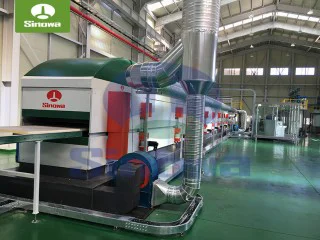
The operational logic of the phenolic sandwich panel production line is rooted in the precise control of phenolic resin foaming reaction and composite bonding technology. Phenolic foam, as the core functional layer of the sandwich panel, features a closed-cell microscopic structure, outstanding flame retardancy, low smoke density, low thermal conductivity, and stable chemical inertness, which endows the finished panel with irreplaceable advantages over other insulation composite materials. The entire production process realizes seamless connection from raw material pretreatment to finished product packaging, with all procedures completed under automated mechanical coordination and intelligent parameter regulation. The core production principle lies in quantitatively mixing phenolic resin, curing agents, foaming agents, and auxiliary additives according to fixed process ratios, triggering controllable foaming and cross-linking curing reactions to form a uniform and dense phenolic foam core layer, and then tightly compounding the core layer with different surface protective materials through high-pressure lamination and constant-temperature curing, ultimately forming integrated sandwich panel products with stable structural performance and consistent quality.
Raw material pretreatment and intelligent feeding constitute the initial key link of the entire production flow, which directly determines the uniformity and stability of subsequent product quality. The phenolic insulation board production line is equipped with fully enclosed automated conveying and storage systems to isolate raw materials from the external environment, effectively avoiding dust contamination, moisture absorption, and resin deterioration that may affect product performance. Thermostatic and humidistatic storage modules maintain raw materials in the optimal storage state, ensuring the activity of phenolic resin and the stability of auxiliary chemical components. In the feeding stage, all raw materials are transported through precision metering pipelines, with intelligent sensing devices real-timely monitoring the feeding volume and proportion of each component. The system automatically adjusts feeding parameters according to preset process formulas to ensure the accurate matching of resin, curing agent, foaming agent, and stabilizer ratios. This precise batching mode avoids the reaction deviation caused by manual proportioning errors, ensuring that each batch of phenolic foam core materials maintains consistent cellular structure density and curing degree. Meanwhile, the surface layer substrates, including color steel plates, aluminum foils, and fireproof decorative boards, undergo unified pretreatment such as leveling, deviation correction, and surface dedusting to remove surface impurities and oxide layers, enhancing the bonding firmness between the surface layer and the foam core layer.
Resin mixing and continuous foaming are the core technological stages that determine the functional performance of phenolic sandwich panels. Different from the intermittent foaming mode of traditional equipment, modern phenolic sandwich panel line adopts continuous dynamic mixing and closed foaming technology. The proportioned raw materials are delivered to a high-speed stirring and mixing unit, where multi-dimensional circulating stirring enables full fusion of all chemical components and uniform dispersion of foaming components. The mixed resin slurry is evenly sprayed and laid on the flat surface layer substrate through an automatic distributor, with the spraying thickness and laying width precisely controlled by the system to match the production specifications of target panels. In the sealed foaming area, the resin slurry undergoes gradual foaming and primary cross-linking reactions under set temperature and pressure conditions. The closed foaming environment effectively isolates external temperature and air interference, avoiding local excessive foaming or insufficient foaming problems. With the progress of the chemical reaction, the phenolic resin gradually expands to form a uniform closed-cell foam structure, completing the preliminary molding of the sandwich panel core layer. This continuous foaming process enables the foam core layer to form an integral long-plate structure without intermediate joints, thoroughly solving the heat leakage and structural cracking defects caused by splicing of segmented small plates in traditional production processes.
Composite lamination and constant-temperature curing are critical links to realize the integrated molding of phenolic sandwich panels. After the primary foaming of the core layer is completed, the phenolic panel production line automatically completes the laying and fitting of the upper surface layer substrate, and then sends the semi-finished panel into the double-belt composite pressing system. The double-belt conveyor structure provides continuous and uniform static pressure for the composite panel, ensuring zero-gap bonding between the surface layer and the foam core layer without local hollowing or delamination. The pressure value of the pressing system can be intelligently adjusted according to different surface layer materials and panel thickness specifications, adapting to the composite molding requirements of diversified products. Subsequently, the composite panel enters the constant-temperature curing zone for staged thermosetting treatment. The curing zone adopts segmented temperature control technology, with the temperature gradient reasonably set according to the cross-linking curing characteristics of phenolic resin. Low-temperature preliminary curing stabilizes the foam cellular structure, and medium-temperature deep curing promotes full cross-linking of resin molecules, effectively improving the structural strength, compression resistance, and bonding durability of the panel. The whole curing process realizes unmanned intelligent control, with real-time monitoring of temperature, time, and pressure parameters to ensure that each panel achieves the optimal curing effect and eliminates quality differences caused by unstable curing conditions.
Cooling shaping, precision cutting and edge trimming processes further optimize the dimensional accuracy and surface quality of finished panels. After high-temperature curing, the panels are sent to the constant-temperature cooling zone for natural and uniform cooling, which relieves the internal stress generated during the thermosetting process and prevents panel warping, deformation or surface wrinkling. The cooling speed and air circulation state are precisely regulated to ensure synchronous cooling of the inner core and outer surface of the panel, maintaining the flatness and structural stability of the product. After cooling and shaping, the continuous long-strip panel enters the automatic fixed-length cutting system. Equipped with high-precision servo positioning and cutting devices, the system can complete fixed-length cutting according to customized specification requirements, with extremely high dimensional tolerance control accuracy. The subsequent edge trimming and dust removal procedures remove residual burrs, excess foam edges and surface dust on the panel edges, making the panel edges neat and smooth, while further optimizing the overall flatness of the product. This refined processing procedure not only improves the appearance quality of the panel but also ensures the assembly accuracy of the product in actual engineering installation.
Intelligent control system and online quality detection technology run through the entire production process, becoming the core guarantee for stable product quality and efficient production. The phenolic insulation panel production line is centrally controlled by a PLC programmable logic system and human-machine touch screen interface, realizing one-key switching of production formulas, real-time monitoring of all process parameters, automatic fault detection and early warning, and remote operational diagnosis. The system records all production data in real time, including raw material ratio, foaming temperature, curing time, pressing pressure, and cutting specifications, forming a complete production data traceability system. In the online detection link, multi-dimensional sensing devices real-timely monitor the core layer density, panel thickness, bonding strength, and surface flatness of products. Once unqualified parameter deviations are detected, the system will automatically issue an early warning and fine-tune process parameters in real time, or mark and isolate defective products to prevent unqualified products from entering the next process. This intelligent quality control mode replaces traditional manual sampling inspection, realizing full coverage of product quality detection and greatly improving the qualification rate and stability of batch products.
Automatic stacking and packaging procedures realize the final standardized finishing of products and improve production efficiency. The finished panels after detection and trimming are automatically conveyed to the stacking platform, where the mechanical arm completes orderly stacking according to set specifications, realizing unmanned stacking operation and avoiding panel surface scratches and corner damage caused by manual handling. The stacked finished products enter the automatic packaging unit, which wraps and seals the panels with protective films and packaging materials to prevent dust pollution, moisture erosion and mechanical damage during transportation and storage. The whole post-processing process is highly automated, which greatly reduces labor investment, shortens the production cycle, and realizes seamless docking between production and warehousing and transportation links.
Compared with traditional manual and semi-automatic production equipment, the integrated phenolic sandwich panel production machine has significant advantages in production efficiency, product performance consistency, and production safety. In terms of production efficiency, the continuous assembly line operation mode eliminates intermediate manual transfer and waiting links, realizing uninterrupted continuous production, with a substantial increase in single-line output and production capacity. In terms of product performance, precise parameter control and integrated molding technology ensure that the finished panels have uniform closed-cell structure, stable thermal insulation performance, excellent fireproof and flame-retardant effects, and high structural bonding strength. The products have the characteristics of low water absorption, corrosion resistance, aging resistance, and long service life, which can adapt to complex and harsh engineering environments. In terms of production safety, the fully enclosed production design reduces the volatilization of chemical raw materials, and the intelligent fault early warning and emergency stop system effectively avoids mechanical operation risks and chemical reaction safety hazards, realizing safe and environmentally friendly production.
With the continuous upgrading of industrial energy-saving and environmental protection standards and construction safety specifications, the application market of phenolic sandwich panels is expanding continuously, covering building exterior wall insulation, roof heat preservation, HVAC ventilation duct insulation, clean workshop partition walls, industrial equipment heat insulation and fire protection, and other fields. As the core production equipment, the phenolic sandwich panel production line is also constantly evolving towards high intelligence, energy conservation, environmental protection, and multi-functional integration. Modern production lines adopt energy-saving heating and circulating heat preservation technologies, reducing energy consumption in the production process and realizing green and low-carbon production. At the same time, the equipment retains flexible formula adjustment and specification switching functions, which can meet the customized production needs of panels with different thicknesses, surface materials, and performance indicators, and adapt to the diversified market demand of different industries and engineering scenarios.
In the future, with the continuous progress of composite material technology and intelligent manufacturing technology, the phenolic sandwich panel manufacturing line will further realize technological innovation and functional upgrading. The deep integration of artificial intelligence and production equipment will realize predictive maintenance of equipment, intelligent optimization of process parameters, and unmanned full-process production. The upgrading of raw material reaction technology and molding technology will further improve the thermal insulation, fire resistance, and environmental protection performance of phenolic sandwich panel products. As an important supporting equipment for the new energy-saving and fireproof composite material industry, the phenolic sandwich panel production line will continue to play a key role in promoting the standardized, large-scale, and high-quality development of the industry, providing reliable product support for high-quality construction engineering and industrial energy-saving transformation.
https://www.cnsinowa.com/sandwich-panel-machines/sandwich-panel-phenolic-production-line.html



Any Questins About Continuous Sandwich Panel Production Lines or Other Products
Email us with inquiries or use our contact infomations