Blockage Of Feeding System In Phenolic Board Production Line
Sep 17, 2026
Feeding system blockage is a common and disruptive fault in phenolic board production lines, severely undermining production continuity and product stability.
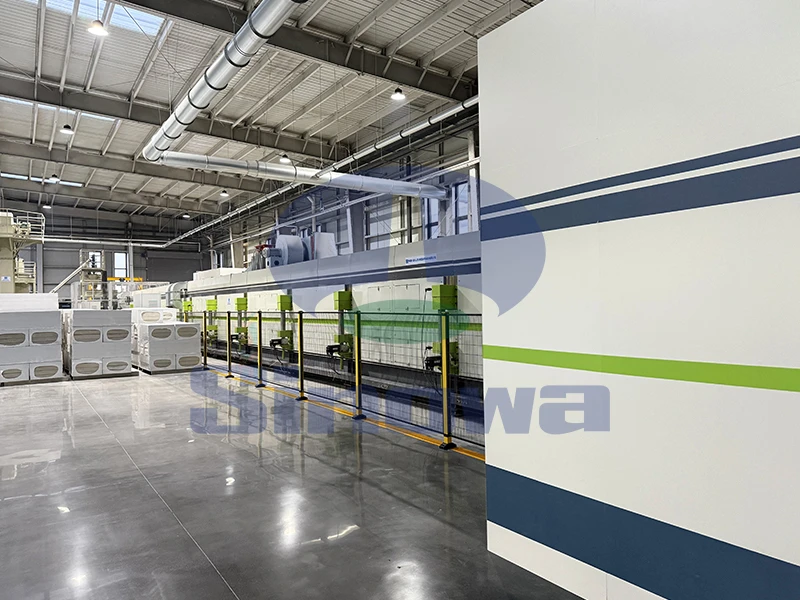
The feeding system serves as the core material conveying link of the entire phenolic board production line, responsible for the continuous and quantitative delivery of phenolic resin powder, wood flour, curing agents and other raw materials to the mixing and pressing processes. Blockage failures in this system mainly stem from the physical characteristics of raw materials and abnormal operating states of equipment, with raw material agglomeration being the most primary inducing factor. Phenolic board production raw materials mostly feature fine particle size and strong hygroscopicity; when the production environment has excessive humidity or raw materials are stored for an extended period without sealing treatment, fine particles will absorb moisture in the air and adhere to each other to form large agglomerated blocks. These agglomerates cannot pass smoothly through the feeding hopper, screw conveyor and screening devices, and will gradually accumulate at narrow material passages to form complete blockages. In addition, uneven raw material mixing in the pre-feeding stage will also lead to local material density differences. Partial high-viscosity mixed materials are prone to adhering to the inner wall of conveying equipment, and long-term accumulation will narrow the effective conveying space and eventually trigger blockage faults. Unreasonable manual feeding operation is also a non-negligible cause. Rapid and excessive feeding in a short time will exceed the rated conveying capacity of the feeding system, resulting in material stacking and blockage at the feeding port, which often occurs in the start-up and peak production stages of the production line.
Equipment structural abnormalities and operational failures are key mechanical factors leading to feeding system blockage in phenolic board production. Long-term continuous operation will cause wear and deformation of core conveying components of the feeding system. The screw blade of the screw conveyor is the most vulnerable part; after long-term friction with raw materials, the blade edge will be worn and flattened, reducing the material pushing and conveying efficiency. Partial material cannot be smoothly transported forward and will deposit at the bottom of the conveyor shell, and continuous deposition will gradually form blockages. Meanwhile, aging and loosening of the equipment sealing structure will lead to material leakage and dust accumulation. The scattered fine materials will adhere to the rotating bearing and guide rail components of the feeding system, causing component jitter and stuck operation, which further hinders normal material conveying and induces secondary blockage. In addition, abnormal parameter setting of feeding equipment will also cause blockage problems. If the operating speed of the feeding conveyor is mismatched with the subsequent processing speed, the material conveying rate will be too fast to keep up with the processing progress, resulting in material backlog at the conveying terminal. Conversely, too low operating speed will cause material stagnation in the pipeline, and long-term stagnant materials will solidify and block the passage. The failure of the material stirring device in the feeding hopper is also an important mechanical cause; once the stirrer breaks down and stops running, raw materials in the hopper will stratify and compact, forming hard material piles that cannot be conveyed normally.
Feeding system blockage brings multiple adverse impacts on the overall operation of phenolic board production lines and product quality, forming a series of chain reaction problems. First of all, blockage directly interrupts continuous production, forcing the production line to stop for manual dredging and fault maintenance. Each blockage fault requires a certain amount of shutdown processing time, and frequent blockages will greatly reduce production efficiency, lead to insufficient daily output, and affect the overall production schedule arrangement. Secondly, material blockage will cause uneven material supply in the subsequent production processes. The mixing process cannot obtain stable and quantitative raw materials, resulting in uneven mixing ratio of phenolic resin and filler, which directly affects the curing degree, density and surface flatness of finished phenolic boards. Unstable material supply will lead to a large number of defective products with inconsistent hardness and easy delamination, increasing the product defective rate and production waste. In addition, long-term material blockage and accumulation in the equipment will cause local overheating of the feeding system. A large amount of accumulated materials cannot be conveyed in time, and friction heat generated by equipment operation cannot be dissipated, which may cause partial curing and deterioration of phenolic raw materials in the equipment. The deteriorated materials will adhere firmly to the equipment wall, increasing the difficulty of later cleaning and maintenance, and even cause repeated blockage failures in subsequent production. Moreover, frequent fault shutdown and restart will increase the loss of mechanical equipment components, shorten the service life of the feeding system, and indirectly increase production and maintenance costs.
Timely and scientific emergency treatment measures are essential to quickly eliminate feeding system blockage and restore normal production of phenolic board lines. When equipment monitoring data shows abnormal material conveying speed, current surge and material backlog signals, the production line should be decelerated and stopped in time to avoid more serious material accumulation and blockage. After shutdown, workers need to cut off the equipment power supply to ensure operation safety, and then conduct segmented inspection of the feeding hopper, screw conveyor, screening pipeline and other key parts to accurately locate the blockage position and judge the blockage degree. For loose accumulated materials and small agglomerates, high-pressure air blowing and manual auxiliary dredging can be adopted to clean the blocked passages and restore material conveying smoothness. For hard solidified material blocks that are difficult to clean, professional tools should be used for gentle chiseling and cleaning to avoid damaging the equipment inner wall and conveying components. After completing the dredging work, it is necessary to thoroughly clean the residual adhered materials on the equipment inner wall to prevent residual materials from causing secondary blockage. Before restarting the production line, no-load trial operation of the feeding system must be carried out to check whether the equipment operates stably and whether the material conveying is uniform and smooth. The formal production can only be resumed after confirming that all fault points are completely eliminated and the equipment operating parameters return to normal.
To fundamentally reduce the occurrence of feeding system blockage, standardized daily operation and targeted equipment maintenance management must be implemented in phenolic board production. In terms of raw material management, a closed storage environment should be equipped to isolate raw materials from humid air, and regular turning and stirring of stored raw materials should be carried out to prevent moisture absorption and agglomeration. Before feeding, raw materials need to be pre-screened and crushed to remove large agglomerated blocks, ensuring that the particle size of feeding materials is uniform and meets the conveying requirements. In terms of operation management, standardized feeding procedures should be formulated to avoid rapid overfeeding and intermittent feeding, and keep the feeding rate matched with the operating speed of subsequent processing equipment to maintain stable material conveying. For equipment maintenance, regular inspection and maintenance of the feeding system should be arranged, including checking the wear degree of screw blades, the flexibility of stirring devices and the tightness of sealing structures. Worn and aging components should be replaced in a timely manner to ensure the mechanical performance of the equipment is stable. Meanwhile, a daily equipment cleaning system should be established to clean residual materials in the feeding pipeline and hopper after daily production is completed, avoiding long-term material adhesion and solidification. In addition, production operators should receive professional skill training to improve their ability to identify early blockage signs and master standardized operation and emergency disposal methods.
Long-term optimization and technological upgrading of the feeding system is an effective way to completely solve the blockage problem and improve the intelligent and stable level of phenolic board production. On the basis of traditional manual feeding, intelligent monitoring and adjusting devices can be installed in the feeding system, including material level sensors, flow monitors and automatic speed regulation modules. These devices can real-timely monitor the material conveying state, automatically adjust the feeding speed and conveying flow according to the subsequent production demand, and avoid material backlog and blockage caused by mismatched conveying speed. The internal structure of the feeding equipment can also be optimized appropriately; polishing treatment on the equipment inner wall can reduce material adhesion, and improving the structural radian of the feeding hopper and pipeline can avoid material dead corners and reduce residual accumulation. In addition, adding a secondary screening and buffering device at the front end of the feeding system can effectively intercept large material blocks and impurities, prevent them from entering the conveying pipeline and causing blockage. Enterprises can also optimize the raw material proportioning process, add appropriate anti-caking auxiliary materials on the premise of ensuring product quality, improve the fluidity of mixed raw materials, and fundamentally reduce the probability of material agglomeration and blockage. Through the combination of daily maintenance, standardized operation and technological optimization, the feeding system can maintain long-term stable operation, effectively reduce fault shutdown frequency, and provide reliable guarantee for efficient and high-quality production of phenolic boards.
https://www.cnsinowa.com/faqs/blockage-of-feeding-system-in-phenolic-board-production-line.html
Main Products
-

Continuous PU Sandwich Panel Production Line
This continuous PU sandwich panel production line is an integrated automatic equipment. It covers uncoiling, forming, foaming, curing and cutting processes. With automatic raw material proportioning and precise temperature & pressure control, PIR sandwich panel production line continuously composites panels with double skins. Polyurethane sandwich panel production line stably produces steel and aluminum sandwich panels. Featuring high automation, the line makes fireproof and thermal-insulation panels for building enclosure and cold storage. -

Rock Wool Sandwich Panel Production Line
Continuous rockwool sandwich panel production line is an automatic integrated production equipment, consisting of uncoiling, forming, gluing and compounding, heating curing, fixed-length cutting, automatic stacking and other modules. The mineral wool sandwich panel production line continuously conveys color steel plates and rock wool core materials to automatically complete lamination and curing, which can produce fireproof and thermal insulation sandwich panels. Featuring high automation degree and stable operation, this production line is suitable for mass production of panels used for building walls, roofs and other scenarios. -

Phenolic Insulation Board Production Line
This integrated automatic production line continuously manufactures PU and phenolic insulation boards. The insulation board production line covers raw material proportioning, high-pressure foaming, laminating, curing and fixed-length cutting. Featuring high automation and stable molding, the insulation panel production line supports various surface materials. PU boards offer excellent thermal insulation, while phenolic boards have superior fire resistance. These products are widely used in construction, cold chain, ventilation ducts and other thermal insulation fields.