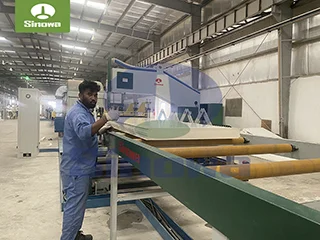
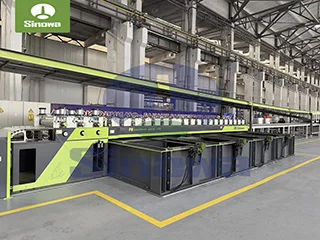
sandwich panel machine
The overall structural composition of a complete PIR sandwich panel machine follows a sequential production logic, and each functional unit is closely connected through an intelligent transmission system to form an uninterrupted production flow. The front-end part of the production line is equipped with raw material unwinding and leveling mechanisms, which are responsible for storing and releasing metal sheet coils used as panel outer layers. During the operation, the coiled metal raw materials are steadily output under the control of a tension adjusting system, and multiple groups of flattening rollers eliminate the internal stress and surface waviness of the sheets, ensuring that the metal substrates maintain a flat and smooth state in the subsequent processing links. This part of the mechanism is designed with flexible stroke adjustment components, which can adapt to metal sheets of different thicknesses and hardness, and the running speed can be matched with the overall production rhythm through a frequency conversion driving system to avoid material accumulation or transmission interruption. After the leveling process, the metal sheets enter the edge sealing and pre-forming unit, where mechanical grooving and edge curling operations are completed through customized dies. The pre-treatment of sheet edges can effectively enhance the sealing performance of the finished panels, prevent the internal thermal insulation core from being eroded by external moisture and air, and improve the overall structural tightness of composite panels.
The raw material mixing and foaming feeding unit is the core functional module of the PIR sandwich panel machine, which undertakes the proportioning, mixing and uniform spraying of polyurethane chemical raw materials. This unit is equipped with two independent raw material storage tanks for storing resin materials and curing agents respectively. Each storage tank is matched with a high-precision metering pump driven by an independent variable frequency motor. The rotating speed of the metering pump can be adjusted according to the production process parameters, so as to accurately control the output flow of different raw materials and ensure that the chemical components are mixed in the optimal reaction ratio. Before raw material mixing, the internal temperature of the storage tanks is kept within a constant range by a circulating temperature control system, which avoids the viscosity change of chemical raw materials caused by ambient temperature fluctuation and ensures the stability of the foaming reaction. The mixed raw materials are transported to the mobile material distribution mechanism through sealed pipelines, and the reciprocating moving nozzle evenly sprays the foaming materials on the surface of the lower metal substrate. The moving speed and spraying range of the nozzle can be intelligently adjusted to realize uniform distribution of foaming materials in the horizontal direction of the panels, laying a foundation for the consistency of the internal core structure of finished products.
After the completion of raw material spraying, the semi-finished products enter the heating composite and pressure shaping area, which is a key link to realize the bonding and solidification of metal substrates and PIR foaming cores. The equipment is equipped with a fully enclosed heating tunnel structure, and the internal heating elements can form a stable and uniform temperature field. According to the chemical curing characteristics of PIR materials, the temperature in the tunnel is accurately controlled within the scientific reaction range to accelerate the foaming and curing process of polyurethane components. At the same time, the upper and lower pressure roller groups apply continuous and stable mechanical pressure to the composite materials. The pressure value can be adjusted according to the thickness specification of the panels, so that the foaming materials are closely bonded with the metal sheets without gaps or delamination. The internal space of the heating tunnel is designed with adjustable height, which can meet the production requirements of panels with different thickness ranges. During the pressure compounding process, the guiding rollers on both sides limit the lateral deviation of the sheets, ensuring that the composite materials always maintain a straight conveying track and avoiding dimensional deviation caused by position offset. The integrated design of heating and pressure greatly shortens the curing cycle of foaming materials and improves the overall continuous production capacity of the equipment.
The fixed-length cutting and post-processing unit is arranged at the rear end of the production line, responsible for cutting the continuously produced long-strip composite plates into finished products of specified sizes. This unit is equipped with a high-precision length sensing and counting system, which can automatically record the conveying distance of the plates and trigger the cutting mechanism when reaching the preset size parameters. The cutting tool adopts an optimized blade structure, and the relative position of the upper and lower cutting blades can be finely adjusted within a fixed range through a scale indicating device, so as to ensure flat and burr-free cutting sections of the plates. After cutting, the edge trimming mechanism performs secondary finishing on the plate edges to remove residual foaming materials and metal burrs generated during cutting, further optimizing the appearance quality of finished products. In order to meet the storage and transportation requirements of finished products, the tail of the production line is equipped with an automatic stacking mechanism. The qualified finished plates are neatly stacked on the material rack through mechanical transmission, which reduces manual handling links and improves the automation level of the entire production process. All operating parameters of the cutting and stacking links can be centrally set through the control terminal, realizing one-key switching of different production specifications.
The intelligent control system runs through all functional modules of the PIR sandwich panel machine, which is the brain to coordinate the synchronous operation of various mechanical structures. The system adopts a programmable logic control mode, with an intuitive human-computer interaction interface. Operators can set production parameters such as plate thickness, processing speed, raw material ratio and cutting size on the touch screen. The internal data acquisition module can monitor the operating status of key components in real time, including the rotating speed of the metering pump, the internal temperature of the heating tunnel, the transmission tension of the sheet and the operating pressure of the compression roller. When abnormal data such as temperature deviation, material interruption and mechanical jamming occurs, the system will automatically send out early warning signals and trigger the emergency stop protection mechanism to avoid equipment damage and product quality problems caused by abnormal operation. In addition, the control system has a parameter storage function, which can save the production parameters of conventional specification plates. When switching production batches, operators can directly call the stored parameters to realize rapid debugging of the equipment and shorten the production preparation cycle.
Compared with other types of composite panel production equipment, the PIR sandwich panel machine has prominent technical advantages in material adaptation and product performance control. In terms of foaming technology, the equipment adopts a high-precision mixing and distributing mode, which makes the internal cell structure of PIR foaming cores uniform and dense. This structural feature endows the finished panels with low thermal conductivity, effectively reducing the heat transfer efficiency and improving the energy-saving insulation effect of building envelopes. In terms of structural optimization, the equipment is equipped with a multi-stage tension balancing system, which can keep the metal sheets in a stable stress state during high-speed transmission, prevent plate deformation and warping caused by uneven tension, and ensure the flatness consistency of large-area finished panels. In terms of production flexibility, the modular structural design enables the equipment to realize rapid switching of different plate specifications. The adjustable range of the equipment thickness meets the production needs of building enclosure plates with different thermal insulation requirements, and the mold replacement process is simple and convenient without complex mechanical disassembly.
The application scenarios of products produced by PIR sandwich panel machines cover multiple fields of the construction industry, and the performance advantages of the equipment are highly matched with the market demand of terminal products. In cold storage and constant-temperature storage projects, the low thermal conductivity of PIR materials can effectively isolate external temperature changes, reduce the energy consumption of refrigeration equipment, and the equipment ensures the compact internal structure of the plates, avoiding cold bridge phenomenon and moisture condensation. In industrial factory buildings and temporary building projects, the composite plates have high structural strength and weather resistance, and the stable bonding performance realized by the production equipment can resist the influence of external wind pressure and temperature difference, preventing plate delamination and damage in long-term use. In high-standard fire-proof building projects, the foaming formula optimized by the production process improves the flame retardant grade of the plates. The processing technology of the equipment ensures that the chemical components of the core materials are evenly distributed, so that all parts of the finished plates have consistent fire resistance. In addition, the lightweight characteristics of the plates reduce the bearing pressure of the building foundation, and the neat cutting and forming effect simplifies the on-site installation process, shortening the construction cycle of the project.
In the daily operation of the PIR sandwich panel machine, standardized operation and scientific maintenance are important prerequisites to maintain stable production efficiency and extend the service life of the equipment. Before starting the equipment, operators need to conduct comprehensive inspection on all functional units, clean residual sundries on the transmission rollers and cutting tools, check the tightness of raw material delivery pipelines, and confirm whether the temperature control system and pressure adjusting system are in normal working condition. During the equipment operation, it is necessary to continuously monitor the raw material consumption and the operating state of the transmission system, timely supplement chemical raw materials and metal coils, and avoid production interruption caused by material shortage. For the heating and foaming modules running in high-temperature environment, regular dust removal and heat dissipation detection are required to prevent equipment aging caused by long-term high-temperature operation. After the daily production is completed, the residual foaming materials in the mixing pipeline and distributing nozzle should be cleaned to avoid material solidification blocking the pipeline. The transmission bearings and movable hinge parts need to be regularly coated with lubricating oil to reduce mechanical friction loss and keep the transmission operation smooth.
With the continuous improvement of global building energy conservation standards and environmental protection requirements, the technological upgrading of PIR sandwich panel machines is also advancing in the direction of intelligence, energy conservation and high efficiency. In terms of intelligent optimization, the new generation of equipment is equipped with an automatic detection and identification module, which can intelligently identify defective products such as uneven foaming and incomplete bonding during the production process, and automatically sort out unqualified products to reduce manual detection costs. In terms of energy saving and consumption reduction, the heating system adopts circulating heat preservation technology to reduce heat loss in the production process, and the frequency conversion driving mechanism adjusts the operating power according to the production load, effectively reducing the energy consumption per unit product. In terms of environmental protection improvement, the equipment is equipped with a closed waste gas recovery device to collect and treat the volatile gas generated in the foaming reaction process, avoiding the impact of harmful gas on the production environment. In addition, the modular assembly design simplifies the equipment maintenance process, and the damaged components can be quickly disassembled and replaced, reducing the downtime maintenance cost of the production line.
In the international building material manufacturing market, the market competitiveness of PIR sandwich panel manufacturing machine is reflected in stable production performance and wide material adaptability. The equipment can be compatible with metal substrates of different textures and thicknesses, and can also adjust the foaming density and core material thickness according to the usage environment of finished plates, meeting the customized production needs of different customers. The fully automated production mode reduces the dependence on manual labor, lowers the labor cost in the production process, and the continuous processing mode greatly improves the daily output of composite plates. The finished plates produced by the equipment have excellent dimensional tolerance control, and the flatness and straightness of the plates meet the construction installation standards, which can realize seamless assembly on the construction site and improve the overall sealing performance of the building enclosure structure. In the harsh use environment such as high temperature, low temperature and high humidity, the finished plates can maintain stable physical properties, which is inseparable from the precise process control of the production equipment.
Although the PIR sandwich panel making machine has mature application technology, there are still some key points that need attention in the production and application process. In terms of raw material matching, different batches of polyurethane raw materials have slight differences in viscosity and reaction activity, and operators need to fine-tune the metering ratio and heating temperature of the equipment according to the raw material characteristics to ensure the consistency of foaming effect. In terms of equipment debugging, the pressure matching degree of the upper and lower compression rollers directly affects the bonding tightness of the plates. Excessive pressure will cause the foaming core to be excessively compressed and reduce the thermal insulation performance, while too little pressure will lead to unstable bonding and easy delamination of the plates. In terms of production environment, the foaming reaction of PIR materials is sensitive to ambient temperature and humidity. It is necessary to keep the production workshop well-ventilated and the temperature within a reasonable range to avoid the fluctuation of product quality caused by environmental changes. In addition, the long-term high-load operation of the equipment will cause slight wear of the cutting tools and transmission rollers, and regular precision calibration is required to ensure the dimensional accuracy of the finished plates.
Looking into the future, the development trend of PIR sandwich panel production machine will be more closely combined with green building and intelligent manufacturing concepts. With the popularization of low-carbon building standards, the equipment will further optimize the foaming formula and production process, reduce the carbon emission in the production link, and develop more energy-saving and environmentally friendly production technologies. The intelligent monitoring system will realize data interconnection with the production management platform, automatically count production output, raw material consumption and equipment failure rate, provide data support for enterprise production scheduling and cost control. At the same time, the equipment will develop towards a more compact structural layout, saving the floor space of the production workshop and optimizing the production line transportation path to improve the space utilization rate. In the field of product diversification, the upgraded equipment will be able to produce composite plates with special functional coatings, meeting the customized use requirements of anti-corrosion, anti-radiation and high-strength building enclosures.
In conclusion, the PIR sandwich panel machine is an indispensable key device in the modern thermal insulation composite panel manufacturing industry. Relying on reasonable structural design, precise process control and efficient automatic operation mode, the equipment realizes standardized and large-scale production of high-performance PIR sandwich panels. From raw material unwinding to finished product stacking, each processing link is closely coordinated to ensure stable product quality and efficient production rhythm. With the continuous development of the global construction industry and the improvement of energy-saving and environmental protection standards, the market demand for PIR sandwich panels will continue to grow, which will further promote the technological innovation and performance optimization of production equipment. In the future, this type of production machine will keep pace with the development of the building material industry, continuously break through technical bottlenecks in energy conservation, intelligence and customization, provide more reliable production guarantee for the manufacturing of high-quality building thermal insulation materials, and make important contributions to the upgrading of the global green building system.
https://www.cnsinowa.com/sandwich-panel-machines/pir-sandwich-panel-machine.html