sandwich panel line
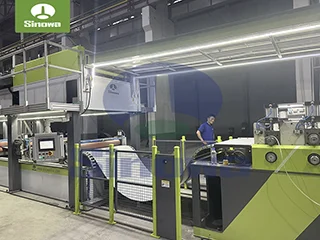
The overall structural design of a complete PU sandwich panel production line follows logical production sequences, with each functional unit closely interconnected to ensure material transmission and processing continuity. The initial functional section centers on raw material pretreatment and feeding, which lays a solid foundation for subsequent foaming and composite processing. Raw materials for PU panels mainly include polyurethane chemical raw materials and various surface base materials. Before formal production, chemical components need to be stored in sealed temperature-adjustable containers to maintain stable physical and chemical properties, avoiding performance fluctuations caused by ambient temperature changes. Meanwhile, surface base materials such as metal sheets or inorganic fiber plates are placed on automatic unwinding and feeding devices. These devices are equipped with tension adjustment and deviation correction structures to ensure that flat base materials are transported horizontally and stably without wrinkles or lateral displacement during the conveying process. The pretreatment process also includes surface cleaning and simple smoothing of base materials to remove dust, oil stains and surface burrs, enhancing the bonding tightness between base materials and polyurethane foam layers in subsequent composite processes.
Material mixing and foaming units serve as the core functional modules of the continuous PU sandwich panel line, determining the internal pore structure, density uniformity and thermal insulation performance of finished PU panels. In this working section, different polyurethane chemical raw materials are transported to high-precision mixing equipment through independent delivery pipelines. Inside the mixing device, raw materials are fully stirred and blended under constant temperature and pressure conditions to form a homogeneous liquid mixture. The mixing speed and material proportion are dynamically regulated according to the preset production parameters, which is essential for avoiding uneven chemical reactions and local density differences of raw materials. After mixing, the liquid polyurethane mixture is evenly poured between two layers of surface base materials through quantitative pouring components. With the gradual release of internal pressure, the mixed liquid undergoes chemical foaming reactions, generating countless tiny closed-cell structures inside the material. These dense and uniform bubble structures form the main insulation core of the PU panel, effectively reducing air convection and heat transfer inside the panel and achieving efficient thermal insulation effects.
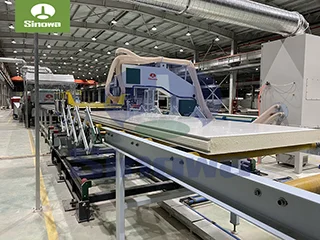
The continuous laminating and shaping process follows the foaming procedure, which is key to forming the stable integrated structure of composite panels. After the polyurethane raw material is poured, the semi-finished panels are sent to the laminating equipment through a conveying track. The laminating unit adopts a multi-layer roller group structure, which can apply continuous and uniform pressure to the composite materials. During the pressure application process, the equipment maintains a stable temperature environment to accelerate the curing reaction of polyurethane materials and enhance the adhesion between the foam core and surface base materials. The gap between the roller groups can be finely adjusted to control the overall thickness of the panel, realizing the production of panels with different specification dimensions. In the laminating process, the slow and stable conveying speed ensures that each part of the panel bears consistent pressure, preventing defects such as surface bulges, depressions and internal delamination. The integrated structure formed by high-temperature and high-pressure lamination greatly improves the overall mechanical strength of the panel, enabling it to withstand external bending and impact forces in subsequent usage scenarios.
Curing and constant-temperature maintenance procedures are indispensable links to stabilize the physical properties of PU panels. After preliminary lamination and shaping, the panels still have incomplete internal chemical reactions, and the molecular structure of polyurethane materials needs a certain period of standing and curing to reach a stable state. The production line is equipped with an independent constant-temperature curing channel, where the internal temperature and air circulation state are precisely controlled to create a mild and balanced curing environment. Inside the curing channel, panels are placed on parallel conveying supports to keep each panel in a flat state without mutual extrusion. With the extension of curing time, the internal foam structure is fully solidified, the bonding force between layers is further strengthened, and the shrinkage rate of the panel tends to be stable. This process effectively reduces the probability of panel deformation, cracking and performance attenuation in later use. The length of the curing channel and the conveying speed are matched with the production rhythm to ensure that each batch of panels can complete sufficient curing treatment without affecting the continuous production efficiency of the assembly line.
The post-processing section of the PU sandwich panel line covers fixed-length cutting, edge trimming, surface finishing and waste recycling, realizing standardized molding of finished products. After curing, the continuous long-strip panels are transported to the cutting unit, where intelligent sensing components identify the conveying length and trigger the cutting equipment to complete fixed-size cutting. The cutting tools adopt high-hardness structural design to ensure smooth and neat cutting sections without burrs or material chipping. Subsequently, the edge trimming device polishes and trims the four sides of the panel to eliminate uneven edges generated during production, making the overall dimension of the panel more accurate and standardized. In the production process, a small amount of leftover materials and defective panels will inevitably be produced. The supporting waste recycling system collects these waste materials through a conveying pipeline, and after crushing and reprocessing, the waste materials can be reused in the preliminary raw material mixing link. This cyclic processing mode reduces raw material consumption, lowers resource waste, and endows the production line with excellent environmental protection attributes.
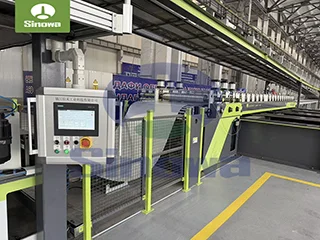
The automatic control system runs through the entire operation process of the PU sandwich panel machine, realizing intelligent regulation and real-time monitoring of each production link. The core control module integrates data collection, parameter adjustment and fault alarm functions. Sensors are installed in each functional unit of the production line to monitor key indicators such as material temperature, conveying speed, internal pressure and mixing proportion in real time. The collected data is transmitted to the central control terminal and presented in an intuitive data interface. When subtle deviations occur in production parameters, the system can complete automatic adjustment within a short time to keep the production state stable. In case of abnormal conditions such as equipment jamming and material interruption, the system will trigger an alarm signal and execute emergency shutdown procedures to avoid equipment damage and material waste. The highly automated control mode reduces manual intervention links, lowers the operational difficulty of the production line, and ensures the consistency and stability of batch-produced panel quality.
Reasonable ventilation, heat dissipation and safety protection designs are embedded in the overall layout of the production line to adapt to the characteristics of polyurethane material processing. Since chemical reactions will generate trace heat and volatile substances during raw material mixing and foaming, the production line is equipped with a circulating ventilation system to discharge harmful gases generated in the production process and maintain the freshness of the processing environment. The heat generated by mechanical operation and chemical reactions is dissipated through the embedded heat dissipation structure to prevent local overheating from affecting material reaction efficiency and equipment service life. All mechanical transmission parts are wrapped with protective shells to avoid safety hazards such as collision and extrusion during equipment operation. The operation area is separated from the processing area by isolation baffles, which not only ensures the safety of operators but also reduces the interference of external dust on the production environment, maintaining the cleanliness of the panel production process.
In actual industrial production applications, PU panel production lines have outstanding production adaptability and scalable production capacity. By adjusting production parameters such as raw material proportion, foaming density and lamination pressure, the same production line can manufacture panels with different thermal insulation grades, mechanical strength and surface textures, meeting the usage demands of different scenarios. For thickened panels used in low-temperature cold storage, the production line can increase the foaming time and optimize the internal bubble structure to enhance thermal insulation performance; for decorative panels used in building exteriors, the surface pressing process can be adjusted to form textured surfaces and improve the appearance decoration degree. The modular structural design enables the production line to expand functional modules according to production demands. Auxiliary processing equipment such as surface coating and anti-corrosion treatment can be added to realize one-stop deep processing of panels, further improving the added value of finished products.
The processing technology and equipment performance of polyurethane sandwich panel production line directly determine the service quality and application life of finished panels. Panels produced by standardized production lines have compact internal structures, stable chemical properties, and good waterproof, fire-retardant and anti-aging capabilities. In low-temperature and high-humidity environments, the closed-cell foam structure can effectively resist moisture penetration and avoid heat conduction caused by moisture accumulation; in high-temperature and strong-light exposure environments, the composite layered structure can slow down material aging and prevent surface fading and peeling. These excellent performances make PU panels widely used in temporary construction buildings, industrial plant enclosures, cold storage insulation layers and clean space partitions. With the continuous improvement of social requirements for building energy conservation and environmental protection, the market demand for high-quality PU composite panels is steadily increasing, which promotes the continuous technological optimization of production lines.
The future development direction of polyurethane sandwich panel line focuses on energy saving optimization, intelligent upgrading and green production innovation. In terms of energy consumption control, the production line will adopt high-efficiency energy-saving heating and power components to reduce energy loss during equipment operation, and optimize the heat circulation system to reuse the residual heat generated in the curing process. In terms of intelligent manufacturing, the production line will be combined with digital simulation technology to predict material reaction states and production defects in advance, realizing predictive maintenance of equipment and precise control of production processes. In terms of green production, the formula of polyurethane raw materials will be continuously optimized to reduce volatile substance emissions in the production process, and the waste recycling system will be further improved to maximize the utilization rate of raw materials. While maintaining efficient production capacity, the upgraded production line will achieve lower energy consumption and lower pollution emissions, conforming to the sustainable development trend of the modern building material industry.
In conclusion, the PU panel production line is a comprehensive and systematic manufacturing system integrating material processing, chemical reaction, mechanical molding and intelligent control. Each functional link is closely coordinated to complete the efficient and standardized production of polyurethane composite panels. From raw material pretreatment to finished product packaging, every processing procedure is designed to optimize panel performance and ensure production stability. With its flexible production mode, stable product quality and broad application range, this kind of production line has become an important processing equipment in the field of building insulation materials. Driven by technological progress and market demand, polyurethane sandwich panel machine will continue to evolve towards higher automation, lower energy consumption and stronger production adaptability, providing reliable technical support for the high-quality development of the construction industry and new material manufacturing industry.
https://www.cnsinowa.com/sandwich-panel-machines/pu-panel-production-line.html