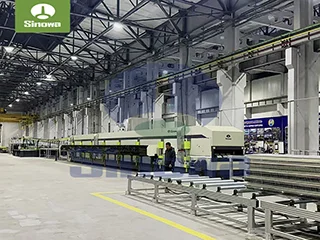
sandwich panel line
The overall structural composition of a multiple sandwich panel line follows a modular integrated design concept, and each functional module is closely linked to form a closed-loop production system covering the whole process from raw material input to finished product output. The front-end part of the production line is equipped with an intelligent raw material conveying and proportioning module, which is responsible for the automatic storage, transportation and accurate proportioning of various base materials and core materials. Different from single-functional production equipment, this module of the multiple production line can simultaneously adapt to solid bulk raw materials and liquid chemical raw materials, and complete quantitative feeding and uniform distribution through intelligent sensing components. The surface layer raw materials commonly used in production include metal sheet, fiber cement board and glass fiber reinforced board, while the core layer raw materials cover porous thermal insulation fillers such as rock wool, polyurethane and polystyrene. The diversified raw material compatibility enables the production line to flexibly adjust material combinations according to usage scenarios, laying a foundation for the diversified production of finished panels. In the raw material pretreatment stage, the production line is equipped with automatic cleaning and surface polishing components, which can remove impurities and oxide layers on the surface of the surface materials, improve the adhesion between the surface layer and the core layer, and effectively avoid the problems of delamination and hollowing of finished panels in subsequent use.
The middle section of the multiple sandwich panel line is the core composite molding area, which mainly includes gluing, laminating and constant temperature curing structures. The intelligent gluing system adopts rotary coating and pressure spraying integrated technology, which can evenly coat adhesive materials on the inner surface of the surface layer at a constant thickness. The system can automatically adjust the glue application amount and coating uniformity according to the texture and thickness of different base materials, ensuring that the adhesive layer can form a stable bonding structure without excess glue accumulation. The lamination process adopts a multi-group roller pressing structure, and the mechanical pressure is maintained within a stable reasonable range through hydraulic sensing adjustment. During the lamination process, the upper and lower surface materials and the middle core material are tightly fitted under continuous rolling pressure, and the internal gap of the composite structure is eliminated by means of micro-vibration leveling. The curing module behind the lamination area is equipped with a closed constant temperature heating space, which can dynamically adjust the internal temperature and air circulation speed according to the physical characteristics of different adhesives and core materials. In the curing stage, the molecular structure of the adhesive is fully cross-linked, and the composite layers are permanently bonded into an integrated structure, which significantly enhances the overall structural stability and compression resistance of the sandwich panel. The whole molding process operates continuously without frequent shutdown and debugging, which greatly shortens the molding cycle of a single panel.
The back-end functional modules of the production line include precision cutting, surface finishing and automatic stacking systems, which undertake the final shaping and storage work of finished products. The precision cutting component adopts servo drive control technology, with sensitive sensing and positioning functions. It can complete horizontal and vertical cutting according to preset dimensional parameters, and maintain a tiny dimensional tolerance range of finished products. For panels with special edge structures, the production line is also equipped with edge trimming and grooving components to process the splicing grooves and waterproof edges of the panels, facilitating the subsequent on-site assembly and installation of the products. The surface finishing process includes dust removal, smoothing and anti-scratch treatment, which can optimize the flatness and appearance texture of the panel surface and eliminate mechanical marks generated during rolling and cutting. The automatic stacking system adopts a dual-station alternating operation mode. While one station completes stacking and discharging, the other station receives newly processed finished panels, realizing uninterrupted connection of production links. This structural design effectively avoids the production stagnation caused by insufficient stacking speed, ensures the continuity of the whole production line operation, and reduces the manual handling frequency of finished products.
Compared with traditional single sandwich panel production line, multiple sandwich panel lines have prominent technical advantages in production flexibility, resource utilization and product consistency. In terms of production flexibility, this type of production line can complete the switching production of different types of panels in a short time through parameter adjustment and module combination. It can not only produce lightweight thermal insulation panels for civil buildings, but also process thickened reinforced panels for industrial workshops and special environment isolation structures. The flexible switching capability enables manufacturing enterprises to quickly respond to the differentiated market demand, avoid the production limitation of single product structure, and improve the market adaptability of production equipment. In terms of resource utilization, the integrated modular design reduces the redundant mechanical structure of the production line. The raw material conveying system is equipped with a recycling device, which can collect and reuse the leftover materials generated in the cutting process, reducing the waste of raw materials. At the same time, the centralized temperature control and power distribution structure optimizes the energy consumption distribution of each production link, avoids the long-term idling energy consumption of a single functional device, and realizes efficient energy saving in the production process.
In terms of product quality control, the multiple sandwich panel manufacturing line realizes full-process automatic monitoring through an intelligent sensing system. Temperature, pressure, feeding speed and glue application parameters in each production link are collected in real time and uploaded to the central control terminal. The system automatically compares the real-time data with the standard parameter threshold, and triggers an early warning and automatic adjustment mechanism once abnormal data fluctuations are found. This real-time monitoring mode replaces the traditional manual sampling inspection method, realizes the full coverage quality detection of each panel, and effectively reduces the defective rate caused by human operation errors. In addition, the continuous rolling and constant temperature curing process makes the internal structure of the finished panel more uniform. The bonding strength, compression resistance and thermal insulation performance of different batches of products can maintain stable consistency, which provides a reliable guarantee for large-scale engineering application.
The application scenarios of products manufactured by multiple sandwich panel lines cover multiple industrial and civil fields, showing strong industrial applicability. In the field of construction engineering, lightweight sandwich panels are widely used in the construction of temporary buildings, prefabricated houses and building partition walls. Their low self-weight characteristics can reduce the bearing load of the building foundation, and the excellent thermal insulation performance can effectively reduce the energy consumption of building heating and cooling. In the industrial manufacturing field, thickened composite panels with fireproof and anti-corrosion properties are applied to factory workshops, storage warehouses and clean production workshops. The special core material and surface treatment structure can resist the erosion of humid air and chemical substances, and maintain stable structural performance in harsh working environments. In the transportation and logistics industry, high-strength sandwich panels are used for the processing of carriage baffles and container inner lining plates. The composite structure has good shock resistance and compression resistance, which can protect goods from external extrusion and vibration during transportation.
With the continuous improvement of environmental protection production standards in various industries, the environmental protection optimization design of multiple sandwich panel lines has become an important development direction. Modern multiple production lines are equipped with closed dust removal and waste gas collection devices in the raw material pretreatment and gluing links. The dust generated by raw material cutting and polishing is filtered and collected through the ventilation system, and the volatile organic gases generated by adhesive curing are purified and then discharged, which effectively reduces the pollution emission in the production process. In terms of raw material selection, the production line is compatible with a variety of environmentally friendly recycled materials. The leftover materials of industrial fibers and recycled foam materials can be processed into panel core materials after crushing and recombination, realizing the secondary utilization of resources. This environmentally friendly production mode not only conforms to the global low-carbon manufacturing development trend, but also reduces the raw material procurement cost for production enterprises, forming a mutually beneficial development model of environmental protection and economic benefit.
In the actual industrial operation, the daily maintenance and parameter optimization of multiple sandwich panel lines are crucial to extend the service life of equipment and maintain stable production efficiency. The key moving parts such as rolling rollers and conveying chains need regular lubrication and wear detection to avoid mechanical jamming and component aging caused by long-term high-intensity operation. The sensing detection components of the central control system need to be calibrated regularly to ensure the accuracy of temperature, pressure and dimensional monitoring data. In addition, production personnel need to adjust the operating parameters of the production line according to the ambient temperature and humidity changes in the production workshop. For example, appropriately extend the curing time in low-temperature environment and reduce the glue application amount in high-humidity environment, so as to ensure that the bonding quality and molding effect of panels are not affected by external environmental factors. Standardized maintenance management can effectively reduce the failure rate of production lines, shorten equipment downtime, and create a stable and continuous production state for manufacturing enterprises.
Looking at the current development trend of the composite panel manufacturing industry, multiple sandwich panel lines will develop in the direction of higher intelligence, larger production span and greener manufacturing in the future. With the in-depth application of digital simulation technology, the production line will realize virtual debugging before formal production. Through digital modeling, the molding effect of different material combinations can be predicted, which reduces the trial production cost and parameter debugging time. The intelligent upgrading of the production line will also realize automatic material switching and intelligent sorting of finished products. The production line can independently match the production process according to the order demand, and complete the classified storage of finished products of different specifications without manual intervention. In terms of production scale, the optimized mechanical structure will further expand the raw material adaptation range, and realize the integrated production of ultra-thin lightweight panels and ultra-thick reinforced panels, meeting the personalized customization needs of more industries.
In conclusion, multiple sandwich panel lines represent the advanced production level of the current composite panel manufacturing industry. Through the modular integrated structural design, the production line realizes the organic combination of diversified raw material processing, continuous composite molding and intelligent quality monitoring. It not only solves the problems of single product type and low production efficiency of traditional production equipment, but also improves the comprehensive performance and production consistency of finished sandwich panels. With the continuous expansion of the application market of sandwich panels in construction, industry, logistics and other fields, multiple sandwich panel lines will rely on their flexible production capacity, efficient resource utilization and environmentally friendly manufacturing mode to become the core supporting equipment of the industry. In the future technological iteration process, the continuous optimization of intelligent control system and mechanical structure will further release the production potential of the production line, provide higher-quality composite panel products for all walks of life, and make important contributions to the high-quality development of the modern building materials manufacturing industry.
https://www.cnsinowa.com/sandwich-panel-machines/multiple-sandwich-panel-line.html