sandwich panel line
Raw material preparation serves as the initial foundational stage of the entire manufacturing workflow, determining the basic performance and surface quality of finished sandwich panels. The primary raw materials include color-coated stainless steel coils as surface and base layers, lightweight thermal insulation core materials, and high-viscosity environmental bonding adhesives. Stainless steel substrates selected for production feature dense metallic structures and excellent oxidation resistance, undergoing professional surface coloring treatments such as physical coating and electrostatic spraying to form uniform and durable color films on metal surfaces. These colored stainless steel coils maintain stable surface coloration under long-term exposure to external environments, avoiding fading and discoloration caused by temperature changes and humid conditions. The core insulating materials are chosen for their low thermal conductivity, lightweight texture and compression resistance, which endow finished panels with effective thermal insulation and sound absorption capabilities. Before formal production, all raw materials require strict preliminary inspection and pretreatment; stainless steel coils are checked for surface flatness, color uniformity and edge integrity, while core materials are screened for density consistency and structural uniformity. Adhesives are stored in constant-temperature environments to stabilize viscosity and fluidity, ensuring optimal bonding effects in subsequent composite processing. Raw material pretreatment also includes surface cleaning of stainless steel coils to remove residual oil stains, dust and oxide layers generated during metal rolling, creating a clean and smooth bonding interface for reliable adhesion between metal layers and core materials.
After raw material preparation, the sandwich panel production line enters the feeding and leveling stage, which guarantees flat and orderly transportation of raw materials for subsequent precision processing. The feeding system adopts an automatic unwinding structure to steadily release colored stainless steel coils, effectively avoiding material deviation and winding deformation during high-speed transmission. Equipped with precision leveling components, this section corrects subtle bending and surface unevenness of stainless steel coils generated during coil storage and transportation. Multiple sets of symmetrically arranged pressure rollers apply uniform mechanical pressure to the metal plate surface, eliminating internal stress of the steel plate and maintaining consistent flatness throughout the continuous feeding process. Meanwhile, the core material conveying device synchronously transports cut core materials at a constant speed, matching the transmission rhythm of stainless steel plates to ensure accurate alignment between metal plates and core materials in the composite process. The entire feeding and leveling process adopts closed-loop speed regulation to synchronize the operating frequency of different conveying units, preventing position misalignment and structural dislocation of composite layers caused by inconsistent transmission speeds. Auxiliary guiding structures are installed on both sides of the conveying track to limit the horizontal movement range of raw materials, further improving feeding accuracy and laying a solid foundation for neat composite structures of finished panels.
Surface treatment and modification constitute an indispensable processing link to enhance the surface durability and bonding performance of colored stainless steel plates. Although colored stainless steel coils have completed primary coloring treatment before entering the production line, secondary surface optimization is still required to adapt to composite processing requirements. The surface treatment unit first conducts deep cleaning through circulating liquid flushing and soft brush friction to thoroughly remove tiny impurities and static dust adsorbed on the metal surface. After cleaning, low-temperature drying is carried out to completely evaporate surface moisture without damaging the surface color coating. Subsequently, micro-roughness treatment is performed on the inner bonding surface of the stainless steel plate; fine and uniform textured traces are formed on the smooth metal surface through mechanical friction, which significantly increases the contact area between the metal plate and the adhesive and enhances the bonding firmness between layers. In addition, anti-corrosion and anti-oxidation auxiliary coatings are evenly sprayed on the edge areas of stainless steel plates. These auxiliary coatings can fill tiny gaps at the plate edges, effectively isolating air and moisture and preventing edge corrosion and delamination during long-term use. The surface treatment process strictly controls processing temperature and acting force to avoid scratching the outer colored layer of stainless steel plates and ensure the decorative aesthetics of finished panels.
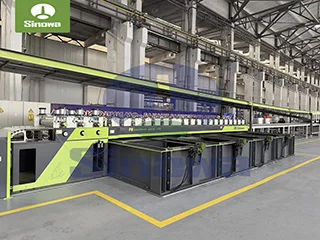
Gluing and composite pressing are the core functional stages of the entire sandwich panel line, directly affecting the structural stability and service life of color stainless steel sandwich panels. The automatic gluing system adopts a quantitative spraying method to evenly apply high-performance adhesive on the contact surfaces between the upper and lower stainless steel plates and the core material. The gluing thickness is precisely controlled within a reasonable range to avoid product quality problems such as glue overflow and bubble formation caused by excessive gluing, as well as insufficient bonding strength caused by too thin glue layers. During the gluing process, the adhesive maintains constant temperature activity to ensure good fluidity and permeability, which can closely fit the tiny gaps on the surface of the core material and form a dense bonding layer after curing. After gluing, the stainless steel plates and core material are accurately overlapped and sent to the composite pressing unit. The pressing unit is equipped with multi-group hydraulic pressure components to provide stable and uniform pressing force. Meanwhile, the internal constant-temperature system maintains a suitable processing temperature to accelerate the physical curing reaction of the adhesive. Under the dual effect of constant pressure and constant temperature, the composite layers are tightly bonded without gaps, and the internal air between layers is completely discharged to avoid hollow bulges inside the panels. The pressing time is adjusted according to the thickness of raw materials and the characteristics of adhesives to ensure that the adhesive reaches the optimal bonding strength and forms an integrated composite structure with strong compression resistance and anti-peeling performance.
Heating curing and constant-temperature shaping processes further optimize the internal structural stability of composite panels. After preliminary pressing, semi-finished panels are transported to an insulated curing channel for gradient temperature treatment. The internal temperature of the curing channel rises steadily from low to high and then decreases slowly, which not only promotes thorough curing of the adhesive but also avoids structural deformation caused by instantaneous temperature changes. The slow temperature change mode effectively eliminates residual internal stress generated during pressing and bonding, enhancing the overall flatness and structural toughness of the panels. During the curing process, symmetric circulating air systems are used to maintain uniform temperature distribution in the channel, ensuring consistent curing effects on all parts of the panels and preventing local uncured adhesive. After curing, the panels enter the constant-temperature shaping section for natural cooling and shaping. The low-speed conveying structure extends the cooling time of the panels, allowing the internal structure to stabilize gradually at room temperature. This processing method can effectively reduce the probability of later warping and deformation of finished panels and maintain long-term dimensional stability in complex usage environments.
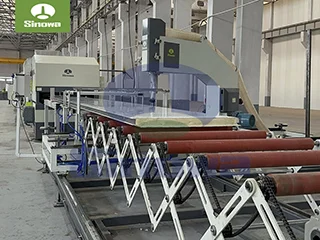
Precision cutting and edge trimming are key links to standardize the external dimensions of finished products. After completing curing and shaping, continuous long-strip composite panels are transported to the cutting unit. The intelligent metering system records the conveying distance in real time and sends cutting instructions according to preset dimensional parameters. The cutting mechanism adopts high-speed hard alloy cutting tools, which can smoothly cut stainless steel composite panels without burrs, metal cracks and coating peeling. The cutting speed is matched with the conveying speed to ensure flat and neat cutting sections and consistent dimensional accuracy of each panel. Subsequently, the edge trimming device polishes and smoothes the four edges of the cut panels to remove sharp metal burrs and tiny residual materials generated during cutting. For panels requiring edge sealing treatment, the edge sealing structure on the production line can complete automatic folding and bonding of metal edges, wrapping the exposed core material to prevent external moisture from penetrating into the interior and improve the sealing performance of the panels. All cutting and trimming parameters can be adjusted according to customer usage requirements, realizing flexible production of panels with different lengths, widths and edge processing forms.
Surface inspection and defect sorting are crucial quality control steps to screen qualified finished products. The inspection unit combines mechanical detection and manual fine inspection to conduct comprehensive quality evaluation from internal structure to external appearance. The mechanical detection system uses high-precision sensing devices to detect internal bonding compactness, panel flatness and dimensional deviation, automatically marking panels with hollow layers, insufficient bonding strength and dimensional errors. Manual inspectors focus on checking the surface aesthetics of colored stainless steel panels, observing whether there are scratches, color difference, indentation and other surface defects, and examining the flatness and firmness of edge trimming. Panels with minor defects are sent to the reprocessing area for secondary trimming and repair, while products with serious structural damage and irreversible appearance defects are sorted out as waste materials to avoid unqualified products from entering the finished product inventory. During the inspection process, staff record the defect types and quantities in real time, summarize the processing problems of each production link, and provide data support for subsequent production parameter optimization.
Cleaning, packaging and storage constitute the final processing stage of the continuous sandwich panel line, providing complete protection for finished color stainless steel sandwich panels. After passing quality inspection, qualified panels are sent to the surface cleaning area to remove surface dust, adhesive residues and processing traces. Soft cleaning cloths and neutral cleaning solutions are used to avoid corrosion and abrasion on the colored metal surface. After cleaning, the panels are naturally dried in a dust-free environment to keep the surface bright and clean. In the packaging stage, protective films are pasted on the upper and lower surfaces of the panels to prevent surface scratches and friction damage during transportation and stacking. Flexible anti-collision materials are wrapped around the four corners of each panel to reduce extrusion damage during handling. Multiple panels are stacked neatly and fixed with binding parts to maintain overall stability. Finally, packaged finished products are transported to constant-temperature dry warehouses for classified storage. The warehouse maintains low humidity and stable temperature to prevent metal oxidation and moisture mildew of core materials, ensuring that the performance and appearance of finished panels remain unchanged during storage.
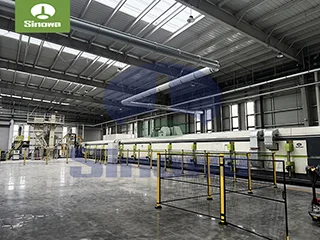
The overall structural design of the color stainless steel sandwich panel manufacturing line takes production efficiency, operational stability and energy conservation as the core design concepts. The entire production system adopts an integrated assembly structure with compact layout and reasonable space utilization rate, which can adapt to different factory construction scales. The transmission system uses low-noise motors and shock-absorbing structures to reduce mechanical vibration during operation, effectively avoiding panel displacement and surface friction damage caused by vibration. The intelligent control system realizes centralized regulation of all processing links; staff can adjust operating parameters such as feeding speed, gluing amount, pressing pressure and curing temperature through a simple control interface, realizing flexible switching of different production schemes. In terms of energy consumption control, the production line adopts circulating heating and heat preservation structures to reduce heat loss, and the residual heat generated by mechanical operation is recycled to assist in raw material preheating, effectively lowering comprehensive energy consumption. In addition, the production line is equipped with dust removal and waste collection devices to collect processing waste and floating dust generated during cutting and trimming, maintaining a clean production environment and realizing standardized and environmentally friendly production.
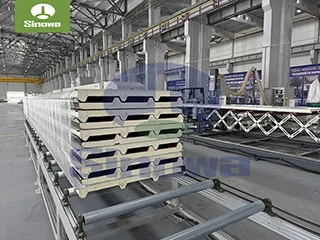
Products manufactured by the color stainless steel sandwich panel manufacturing line have prominent comprehensive performance advantages. The outer colored stainless steel layer endows the panels with strong weather resistance, enabling long-term stable use in high humidity, strong ultraviolet radiation and corrosive gas environments without surface aging and fading. The internal lightweight core material effectively reduces the overall weight of the panels, making transportation, handling and on-site installation more convenient while maintaining excellent thermal insulation and sound insulation effects. The integrated composite structure formed by high-strength bonding has good compression resistance, bending resistance and impact resistance, which can resist external mechanical extrusion and structural vibration. Meanwhile, diverse surface coloring and texture processing methods enrich the decorative attributes of the panels, meeting the personalized aesthetic needs of architectural decoration and industrial equipment appearance. These performance advantages make color stainless steel sandwich panels widely used in building exterior wall decoration, clean workshop construction, cold storage insulation, industrial equipment shell manufacturing and indoor high-grade decoration projects.
With the continuous upgrading of industrial manufacturing technology and the continuous improvement of market demand for high-performance metal composite materials, the color stainless steel sandwich panel manufacturing line is also evolving towards higher automation, finer processing accuracy and more diversified production functions. The optimized production line will introduce more intelligent sensing and automatic feedback systems to realize real-time monitoring and automatic adjustment of production parameters, further reducing human intervention and improving product consistency. The upgrading of surface treatment technology will enrich the surface color and texture types of stainless steel panels, and the improvement of bonding processes will enhance the environmental adaptability of composite structures. In the future, this type of production line will continue to rely on material science and mechanical manufacturing innovation to continuously optimize production processes, reduce production costs, expand application scenarios, and provide more high-quality and diversified metal composite panel products for the modern manufacturing and construction industries. Driven by technological progress, the color stainless steel sandwich panel manufacturing industry will gradually form a more standardized and refined production system, injecting lasting impetus for the long-term development of the metal building materials industry.
https://www.cnsinowa.com/sandwich-panel-machines/color-stainless-steel-sandwich-panel-manufacturing-line.html