sandwich panel line
The PU sandwich panel, also known as polyurethane sandwich panel, features a typical "sandwich" structure composed of two outer panels and a middle PU foam core. The outer panels are usually made of color steel plates (with galvanized or aluminum-zinc plated substrates), which provide excellent mechanical strength, weather resistance and aesthetic appearance. The middle PU foam core, formed by the reaction of isocyanate and polyether polyol, has ultra-low thermal conductivity, making it an ideal thermal insulation material. The PU sandwich panel production line is designed to realize the seamless combination of these three layers through a series of continuous and automated processes, ensuring the consistency and stability of product quality. Unlike traditional manual or semi-automatic production methods, the modern PU sandwich panel making line adopts integrated control systems and precision mechanical components, which not only improves production efficiency but also effectively reduces human errors, laying a solid foundation for the large-scale application of PU sandwich panels in steel structure workshops.
The production process of the PU sandwich panel line is a sophisticated and continuous workflow that can be roughly divided into several core stages: raw material preparation, panel pretreatment, PU foam mixing and pouring, composite lamination, cooling and shaping, precision cutting, and post-processing inspection. Each stage is closely linked and regulated by the central control system to ensure the smooth operation of the entire production line.
Raw material preparation is the first and fundamental step of the production process. For the outer color steel plates, the polyurethane sandwich panel line is equipped with automatic uncoiling systems that can handle large rolls of color steel coils with different widths and thicknesses. Before entering the next process, the color steel coils need to be inspected for surface quality to ensure there are no scratches, rust spots or coating defects. For the PU foam raw materials, including isocyanate, polyether polyol, catalysts, foaming agents and flame retardants, they are stored in special insulated tanks with constant temperature control functions. The temperature of these raw materials is strictly controlled within a specific range to ensure their chemical reactivity and stability. The production line is also equipped with automatic feeding and metering systems that can accurately adjust the proportion of various raw materials according to the product specifications, ensuring the performance of the PU foam core meets the requirements of steel structure workshop applications.
Panel pretreatment is a key link to enhance the bonding strength between the outer panels and the PU foam core. After uncoiling, the color steel plates are sent to the forming press, where they are rolled into specific shapes (such as corrugated or trapezoidal) according to design requirements. This shaping process not only enhances the rigidity of the panels but also optimizes the bonding area with the PU foam. Subsequently, the shaped color steel plates enter the preheating system, where they are heated to a suitable temperature. Preheating can improve the wettability of the plate surface, promote the reaction between the PU raw materials and the plate, and enhance the bonding strength. At the same time, preheating also helps to remove moisture on the surface of the plates, which avoids the formation of bubbles or gaps in the PU foam core and ensures the compactness of the composite structure.
The mixing and pouring of PU foam is the core stage of the entire production process, which directly determines the quality of the PU sandwich panel's thermal insulation and mechanical properties. The production line adopts high-pressure foaming equipment, which injects the pre-metered isocyanate and polyether polyol mixtures into the high-pressure mixing head at a specific pressure. Under the action of high pressure, the two raw materials are fully mixed and then evenly poured onto the preheated lower color steel plate through the pouring platform. The pouring amount and speed are precisely controlled by the central control system to ensure that the PU foam can fully fill the space between the upper and lower plates. During the pouring process, the PU raw materials undergo a rapid chemical reaction, generating a large number of bubbles and expanding to form a uniform and dense foam core. The entire pouring process is carried out in a closed environment to avoid the influence of external factors such as dust and temperature on the foam quality.
After pouring, the lower color steel plate with the PU foam mixture is sent to the composite lamination system together with the preheated upper color steel plate. This system is mainly composed of a double-track continuous forming machine, which clamps the upper and lower plates and the middle PU foam core between two parallel tracks. Under the action of constant pressure and temperature, the PU foam undergoes further foaming and curing reactions, and the three layers are firmly bonded into an integral structure. The pressure and temperature in the lamination process are strictly controlled: excessive pressure may cause the foam core to be compressed and affect the thermal insulation performance, while insufficient pressure may lead to poor bonding between the layers. The temperature control ensures that the PU foam cures completely, enhancing the structural stability and durability of the panels. The double-track design of the forming machine enables continuous production, greatly improving the production efficiency of the line.
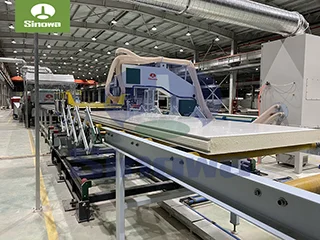
After the composite lamination, the semi-finished PU sandwich panels enter the cooling and shaping stage. Due to the exothermic reaction during the PU foam curing process, the semi-finished panels have a relatively high temperature and need to be cooled to room temperature to ensure dimensional stability. The continuous PU sandwich panel production line is equipped with a continuous cooling system, which usually uses air cooling or water cooling methods to rapidly and uniformly cool the panels. During the cooling process, the panels are kept flat by the conveying device to avoid deformation. After cooling, the panels are sent to the automatic cutting system, which uses high-precision tracking saws to cut the continuous panels into specific lengths according to the order requirements. The cutting system is equipped with a precise positioning device that can ensure the cutting accuracy and verticality of the panel edges, facilitating the subsequent installation of the panels in steel structure workshops.
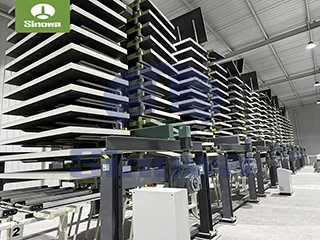
The final stage of the production process is post-processing inspection. The cut PU sandwich panels are subject to a series of quality inspections, including appearance inspection, dimensional measurement, bonding strength test and thermal conductivity test. The appearance inspection mainly checks for surface defects such as unevenness, bubbles and cracks on the panels. The dimensional measurement verifies whether the length, width and thickness of the panels meet the design standards. The bonding strength test is a key indicator to ensure the structural safety of the panels; the test samples are taken randomly to check whether the bonding force between the outer plates and the foam core meets the requirements. The thermal conductivity test ensures that the panels have excellent thermal insulation performance, which is crucial for the energy conservation of steel structure workshops. The qualified panels after inspection are then sent to the stacking and packaging area for neat stacking and packaging, waiting for delivery.
The continuous PU sandwich panel line has a number of technical advantages that make it highly suitable for the production of enclosure materials for steel structure workshops. First of all, it has high automation and continuous production capacity. The entire production process, from raw material uncoiling to finished product stacking, is completed automatically, with minimal manual intervention. This not only improves production efficiency (the production speed can reach 0-8m/min, and the daily output can meet the needs of large-scale steel structure projects) but also ensures the consistency of product quality. Secondly, the production line has strong flexibility and adaptability. By adjusting parameters such as raw material ratios, plate thicknesses and cutting lengths, it can produce PU sandwich panels of different specifications and types to meet the diverse needs of steel structure workshops, such as wall panels, roof panels and partition panels. In addition, the production line adopts precise control systems, such as PLC central control systems, which can real-time monitor and adjust key parameters such as temperature, pressure, and material flow during the production process, ensuring the stability and reliability of the production process.
The PU sandwich panels produced by the PU sandwich panel line have excellent comprehensive performance, which makes them an ideal enclosure material for steel structure workshops. In terms of thermal insulation performance, the PU foam core has an extremely low thermal conductivity, which is significantly better than traditional insulation materials such as EPS and XPS. This can effectively reduce the heat transfer between the inside and outside of the steel structure workshop, reduce the energy consumption of heating and air conditioning, and achieve the effect of energy conservation and emission reduction. In terms of mechanical properties, the combination of the outer color steel plates and the PU foam core gives the panel high bending strength and load-bearing capacity. When installed on the steel structure, it can enhance the overall rigidity of the building and resist wind pressure and other external forces. In terms of fire performance, by adding flame retardants to the PU raw materials, the produced panels can reach a high fire rating (usually B1 level), which can effectively inhibit the spread of fire and improve the safety of the steel structure workshop. In addition, the PU sandwich panels also have the advantages of light weight, easy installation, good sound insulation and corrosion resistance. Their light weight can reduce the load on the steel structure, and the prefabricated production method allows for quick on-site installation, shortening the construction period of the steel structure workshop. The sound insulation performance can create a quiet working environment, while the corrosion resistance ensures the service life of the panels in harsh industrial environments.
In the practical application of steel structure workshops, the PU sandwich panel production machinery plays an irreplaceable role. With the continuous development of the industrial sector, the demand for large-scale, high-standard steel structure workshops is increasing, and the requirements for enclosure materials are also getting higher and higher. The PU sandwich panel making line can produce high-quality panels that meet these requirements in a large-scale and efficient manner, providing strong support for the construction of steel structure workshops. For example, in the construction of large industrial plants, the PU sandwich panels produced by the production line are used as wall and roof materials, which not only ensure the thermal insulation and fire safety of the plants but also shorten the construction period and reduce the overall construction cost. In the construction of logistics warehouses, which are often steel structure buildings, the PU sandwich panels have excellent moisture-proof and thermal insulation performance, which can protect the stored goods and maintain a stable indoor environment. In addition, the PU sandwich panels can also be used in the construction of clean workshops, which require high air tightness and cleanliness. The panels produced by the production line have smooth surfaces and tight joints, which can meet the special requirements of clean workshops.
The development of the PU sandwich panel production machine is also closely related to the trend of green and low-carbon construction. In recent years, with the increasing emphasis on environmental protection and energy conservation, the construction industry has been promoting green building concepts. The PU sandwich panels produced by the making line have excellent energy-saving performance, which can reduce the energy consumption of buildings and reduce carbon emissions. At the same time, the production process of the modern PU sandwich panel making line adopts environmentally friendly raw materials and production technologies, reducing the emission of harmful substances. For example, the use of pentane as a foaming agent instead of traditional fluorinated hydrocarbons can reduce the damage to the ozone layer. In addition, the PU sandwich panels can be recycled and reused, which conforms to the concept of circular economy and has important significance for promoting the sustainable development of the construction industry.
Looking to the future, the polyurethane sandwich panel production line will continue to develop in the direction of higher automation, precision and intelligence. With the application of advanced technologies such as artificial intelligence and the Internet of Things, the production line will realize more intelligent monitoring and control. For example, through the installation of sensors in key production links, real-time data collection and analysis can be carried out, and production parameters can be automatically adjusted to optimize the production process. At the same time, the research and development of new raw materials and processes will further improve the performance of PU sandwich panels, such as higher fire rating, better thermal insulation performance and longer service life. The production line will also be more flexible, able to produce panels with more diverse functions to meet the increasingly complex needs of steel structure workshops. In addition, the integration of digital production and intelligent logistics will further improve the efficiency of the entire industrial chain, reducing production costs and improving market competitiveness.
In conclusion, the PU sandwich panel making line is an important equipment in the field of steel structure workshop construction, which realizes the high-quality and efficient production of PU sandwich panels through continuous and automated production processes. The PU sandwich panels produced by the line have excellent comprehensive performance, including thermal insulation, mechanical strength, fire resistance and corrosion resistance, which fully meet the requirements of steel structure workshops for enclosure materials. The application of the making line not only promotes the modernization and large-scale construction of steel structure workshops but also conforms to the trend of green and low-carbon development, making important contributions to the energy conservation and environmental protection of the construction industry. With the continuous progress of technology, the PU sandwich panel production equipment will continue to upgrade and improve, bringing more possibilities to the development of the steel structure construction industry and creating a more efficient, safe and environmentally friendly industrial building environment.
https://www.cnsinowa.com/sandwich-panel-machines/pu-sandwich-panel-making-line-for-steel-structure-workshop.html