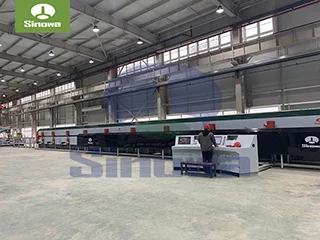
sandwich panel line
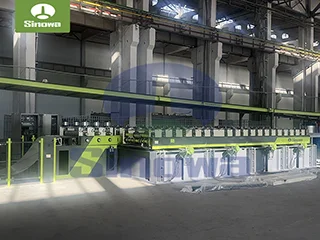
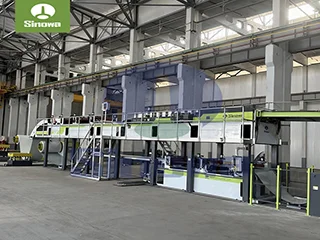
The structure of a PIR sandwich panel manufacturing line with a roll forming system is a complex assembly of interconnected modules, each designed to perform a specific function in the production workflow. At the starting end of the line, the uncoiling and feeding module is responsible for handling the metal facer sheets, which are typically supplied in coil form. This module consists of de-coilers that safely unroll the metal coils—commonly steel or aluminum—with tension control mechanisms to prevent wrinkling or deformation of the sheets. The tension control system ensures that the metal facers maintain a consistent flatness as they move through the subsequent processes, which is critical for achieving uniform bonding with the PIR core later in the line. After uncoiling, the metal sheets pass through a series of guiding rollers that align them precisely, preparing them for the roll forming process.
The roll forming module is the heart of the production line, responsible for shaping the metal facers into the desired profiles. This module comprises a sequence of tandem rolling stands, each equipped with precision-engineered rollers that gradually bend the metal sheets into the target cross-sectional shape. The rollers are designed based on the specific profile requirements, such as corrugated, trapezoidal, or flat designs, and can be adjusted to accommodate different sheet thicknesses and widths. The gradual bending process ensures that the metal retains its structural integrity without cracking or weakening, even when forming complex profiles. For double-layer production, some lines are equipped with dual roll forming systems that shape the upper and lower facer sheets simultaneously, improving production efficiency and ensuring symmetry between the two layers.
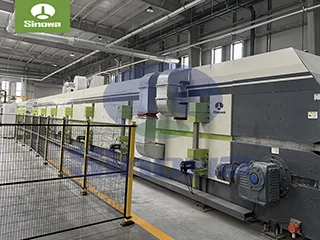
Following the roll forming process, the metal facers move to the preheating module, which plays a vital role in enhancing the adhesion between the facers and the PIR core. This module uses hot air circulation or infrared heating technology to raise the surface temperature of the metal sheets to an optimal level. The controlled preheating process activates the bonding agents and ensures that the PIR foam adheres firmly to the facers, preventing delamination over time. The temperature is carefully regulated based on the type of metal used and the properties of the PIR foam, as excessive heat can damage the metal coating or alter the foam’s chemical composition, while insufficient heat may result in poor adhesion.
The foam injection and mixing module is responsible for generating and depositing the PIR core between the two formed metal facers. This module includes a metering system that accurately measures the liquid chemical components of the PIR foam—typically polyol and isocyanate—along with additives such as flame retardants, blowing agents, and catalysts. The components are mixed in a high-pressure mixing head, where they undergo a chemical reaction to form the foam. The mixing head ensures thorough homogenization of the components, which is essential for achieving a uniform foam structure with consistent density and insulation properties. The foam is then continuously injected between the upper and lower metal facers as they move through the line, filling the entire gap between the sheets.
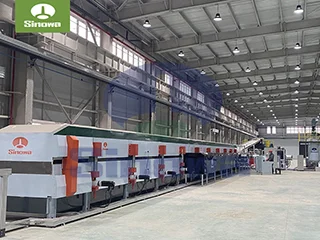
After foam injection, the panels enter the laminating and curing module, which consists of a double-belt conveyor system. This system uses two parallel, endless belts that apply uniform pressure to the sandwich panel as it moves forward, ensuring that the foam spreads evenly and bonds tightly with the metal facers. The belts also maintain the flatness of the panel and prevent warping during the curing process. The curing environment is controlled to facilitate the chemical reaction of the PIR foam, allowing it to expand, harden, and form a solid core. The length of the curing section is designed to provide sufficient time for the foam to cure completely, with temperature and humidity adjustments to optimize the curing rate without compromising the foam’s properties. Some lines incorporate cooling systems within this module to accelerate the curing process and reduce the overall production cycle time.
The final stages of the manufacturing line include the cutting, trimming, and stacking modules. The cutting module uses a precision saw or cutting tool—often with frequency control—to cut the continuous sandwich panel into individual panels of pre-set lengths. The cutting process is synchronized with the line speed to ensure clean, accurate cuts without damaging the panel edges or core. The trimming module then removes any excess material from the edges of the panels, ensuring that the dimensions meet the required specifications and that the edges are smooth and uniform. Finally, the stacking module automatically arranges the finished panels into neat piles, ready for packaging or transportation. This module may include robotic arms or conveyor systems that handle the panels gently to prevent surface scratches or structural damage.
The performance of a PIR sandwich panel manufacturing line with a roll forming system is determined by several key factors, including production efficiency, precision, foam quality control, and energy efficiency. Production efficiency is measured by the line’s speed, which typically ranges from 3 to 14 meters per minute depending on the configuration and panel specifications. High-speed lines are capable of producing large volumes of panels in a short period, making them suitable for mass production requirements. The precision of the line is reflected in its ability to maintain consistent panel dimensions, with thickness tolerances as low as 0.3 millimeters and length accuracy within a few millimeters. This level of precision ensures that the panels can be easily installed without the need for on-site adjustments, reducing construction time and costs.
Foam quality control is another critical performance indicator, as the properties of the PIR core directly affect the insulation, fire resistance, and durability of the final panel. Advanced manufacturing lines are equipped with real-time monitoring systems that track the foam density, temperature, and chemical ratio during the mixing and injection process. These systems can detect deviations from the set parameters and make automatic adjustments to ensure that the foam meets the required standards. The PIR foam produced by such lines typically has a low thermal conductivity, ranging from 0.021 to 0.023 W/m·K, and a high compressive strength, enabling it to withstand structural loads while providing excellent insulation.
Energy efficiency is an increasingly important performance factor, as manufacturers seek to reduce operational costs and environmental impact. Modern manufacturing lines incorporate energy-saving technologies such as variable frequency drives for motors, heat recovery systems that reuse waste heat from the curing process, and efficient insulation for heating chambers. These features not only lower energy consumption but also reduce greenhouse gas emissions, aligning with sustainable production practices. Additionally, the lines are designed to minimize material waste, with precise metering systems that reduce chemical losses and cutting mechanisms that optimize panel layout to minimize scrap.
The versatility of the manufacturing line is another key performance attribute, as it allows for customization of panel specifications to meet diverse application needs. The line can be adjusted to produce panels with varying thicknesses—typically ranging from 30 to 250 millimeters—and widths up to 1250 millimeters. The roll forming system can be reconfigured to produce different panel profiles, including roof panels, wall panels, and specialized profiles for cold storage or clean rooms. Furthermore, the foam injection system can be modified to adjust the foam density and additive composition, enabling the production of panels with enhanced fire resistance, water resistance, or sound insulation properties.
PIR sandwich panel manufacturing lines with roll forming systems can be classified into several types based on their production capacity, configuration, and specialized functions. Continuous production lines are the most common type, designed for high-volume, non-stop production of sandwich panels. These lines are fully automated, with integrated modules that handle all stages of production from uncoiling to stacking. They are ideal for large-scale manufacturing operations where consistent output and high efficiency are prioritized, such as producing panels for industrial warehouses or cold storage facilities. Continuous lines can be further categorized by their speed and panel size capabilities, with larger lines capable of producing wider and thicker panels at higher speeds.
Modular production lines are another type, characterized by their flexible design that allows for easy reconfiguration and expansion. These lines consist of independent modules that can be added, removed, or modified to adapt to changing production requirements. For example, a modular line can be equipped with additional roll forming stands to produce new panel profiles, or a second foam injection system to handle different core materials. This versatility makes modular lines suitable for small to medium-sized manufacturers that need to produce a variety of panel types or adapt to seasonal demand fluctuations. Modular lines are also easier to install and maintain compared to continuous lines, as individual modules can be serviced without disrupting the entire production process.
Specialized production lines are designed to meet specific application requirements, such as producing panels for cold storage, clean rooms, or prefabricated buildings. Cold storage panel lines, for instance, are equipped with enhanced cooling systems to ensure that the PIR foam cures properly at lower temperatures, and may include additional sealing modules to improve the panel’s water resistance and airtightness. Clean room panel lines feature specialized surface treatment modules that ensure the metal facers are free of dust and contaminants, and may produce panels with smooth, non-porous surfaces that are easy to sanitize. Some specialized lines are also designed to handle non-metal facers, such as fiberglass or plastic sheets, expanding the range of panel applications.
Double-layer production lines are a specialized type that can produce two separate sandwich panels simultaneously, doubling the production capacity compared to single-layer lines. These lines feature dual roll forming systems, foam injection heads, and laminating belts, allowing for parallel production of panels with the same or different specifications. Double-layer lines are particularly useful for manufacturers that need to produce large quantities of standard panels, as they significantly improve throughput while maintaining consistent quality. They are often used in large-scale construction projects where a high volume of wall or roof panels is required within a tight timeframe.
The applications of PIR sandwich panels produced by these manufacturing lines are extensive, spanning across construction, industrial, agricultural, and commercial sectors. In the construction industry, the panels are widely used for roofing and wall cladding in industrial warehouses, factories, and prefabricated buildings. Their lightweight nature reduces the structural load on the building, while their excellent thermal insulation properties lower heating and cooling costs. The panels’ fire resistance—typically reaching a high flame-retardant grade—also makes them suitable for buildings with strict fire safety requirements, such as hospitals, schools, and shopping malls.
Cold storage and refrigeration facilities are another major application area for PIR sandwich panels. The low thermal conductivity of the PIR core enables the panels to maintain stable internal temperatures, even in extreme cold conditions ranging from -180℃ to +120℃. This makes them ideal for use in food storage warehouses, pharmaceutical cold rooms, and refrigerated transport vehicles. The panels’ water resistance and airtightness prevent moisture infiltration and condensation, which can damage stored goods and compromise the efficiency of the refrigeration system. Additionally, the high compressive strength of the panels allows them to withstand the heavy loads associated with cold storage racking systems.
Clean rooms and food processing plants also benefit from the use of PIR sandwich panels. The panels can be produced with smooth, non-toxic surfaces that are easy to clean and sanitize, meeting the hygiene requirements of these environments. Their airtightness helps maintain controlled air quality by preventing the infiltration of dust, bacteria, and other contaminants. In food processing plants, the panels are used for wall and ceiling cladding, as well as partition walls to separate different production areas. In pharmaceutical clean rooms, the panels contribute to maintaining sterile conditions required for drug manufacturing.
Agricultural applications include the construction of livestock barns, greenhouses, and storage facilities. PIR sandwich panels provide effective insulation for livestock barns, helping to maintain optimal temperatures for animal health and productivity. The panels’ durability and resistance to moisture and pests make them suitable for use in harsh agricultural environments. In greenhouses, the panels can be used for side walls and end walls, providing insulation while allowing natural light to penetrate through transparent sections. The panels also offer protection against extreme weather conditions, such as strong winds and heavy snow, ensuring the structural integrity of the greenhouse.
Transportation and modular construction are emerging application areas for PIR sandwich panels. The lightweight and high-strength properties of the panels make them suitable for use in modular buildings, such as portable offices, construction site cabins, and disaster relief shelters. These panels enable rapid assembly of modular units, reducing construction time and labor costs. In the transportation sector, the panels are used in the construction of truck bodies, trailers, and ship cabins, providing insulation and structural support while minimizing weight to improve fuel efficiency. The panels’ fire resistance also enhances the safety of these vehicles, particularly for transporting hazardous materials or passengers.
In addition to these mainstream applications, PIR sandwich panels are used in specialized projects such as industrial chimneys, power plants, and offshore structures. Their resistance to high temperatures and chemical corrosion makes them suitable for use in industrial environments where exposure to harsh substances is common. In offshore structures, the panels’ durability and water resistance enable them to withstand the corrosive effects of saltwater and harsh marine conditions. The versatility of the manufacturing line allows for the production of custom panels tailored to these specialized applications, further expanding the scope of PIR sandwich panel utilization.
The continuous advancement of PIR sandwich panel manufacturing lines with roll forming systems is driven by the growing demand for energy-efficient, sustainable building materials. Manufacturers are investing in research and development to improve line efficiency, enhance foam properties, and expand customization capabilities. New technologies such as artificial intelligence-based monitoring systems are being integrated into production lines to enable real-time quality control and predictive maintenance, reducing downtime and improving overall productivity. Additionally, the development of eco-friendly foam formulations—with reduced volatile organic compounds (VOCs) and renewable raw materials—is aligning the production process with global sustainability goals.
As the construction and industrial sectors continue to prioritize energy efficiency and fire safety, the demand for PIR sandwich panels and their manufacturing lines is expected to grow steadily. The ability of these lines to produce high-quality, customizable panels efficiently makes them a valuable asset for manufacturers looking to meet evolving market needs. By understanding the structure, performance, types, and applications of these manufacturing lines, stakeholders can make informed decisions about equipment investment, production optimization, and product development, driving innovation and growth in the industry.
https://www.cnsinowa.com/sandwich-panel-machines/pir-sandwich-panel-manufacturing-line-with-roll-forming-system.html