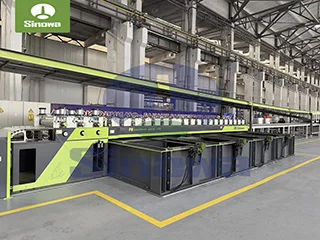
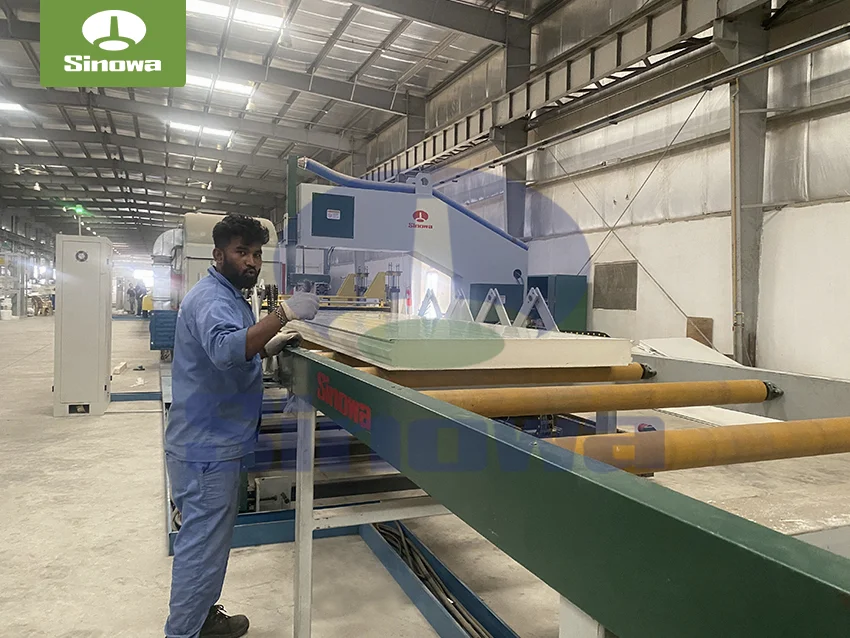
 sandwich panel machine
The basic working logic of insulated sandwich panel production line centers on the composite molding principle of double-sided surface materials and intermediate thermal insulation core materials. The finished panels produced by the equipment feature a typical three-layer structure, with dense and rigid metal or non-metal decorative protective layers on both sides and a porous, low-density thermal insulation core material in the middle. The core function of the machine is to accurately complete the alignment, compounding, bonding, curing, and fixed-length cutting of multi-layer materials in a continuous operating state, ensuring that the surface layers and core material form an integrated structural whole with stable bonding performance, excellent thermal insulation effect, and outstanding mechanical bearing capacity. Different from single-functional processing machinery, the insulated sandwich panel production line is a systematic assembly of multiple functional units, each of which cooperates precisely in accordance with preset programs to complete the entire production process from raw material input to finished product output without excessive manual intervention.
To fully understand the operational characteristics and application value of insulated sandwich panel line, it is essential to analyze the composition and functional attributes of each core functional unit of the equipment. The complete production system mainly includes raw material conveying and leveling units, surface layer preprocessing units, core material feeding and shaping units, foaming and injection units, composite pressing and curing units, cooling shaping units, fixed-length cutting units, and automatic stacking and discharging units. Each unit undertakes independent processing tasks and is linked through a unified control system to maintain the synchronization and continuity of the entire production process, avoiding material deviation, bonding failure, or dimensional errors caused by asynchronous operation of individual equipment.
The raw material conveying and leveling unit is the starting link of the entire production process, mainly responsible for the continuous supply and flat calibration of surface layer coil materials. In actual production, the surface materials of insulated panels are mostly coiled metal materials with good toughness and weather resistance. After the coiled materials are installed on the feeding support mechanism, the automatic conveying system slowly outputs the materials at a stable speed. The leveling mechanism equipped with multiple groups of precision rollers can eliminate the tiny bending, wrinkling, and uneven stress existing on the surface of the coiled materials after long-term winding, ensuring that the surface materials entering the subsequent processing link maintain a flat and uniform state. This link is crucial for improving the flatness of finished panels and avoiding local deformation or uneven thickness of panels caused by unleveled base materials. At the same time, the conveying speed of this unit can be adjusted steplessly according to different production process requirements and material specifications, adapting to the production needs of panels with different thicknesses and structural types.
The surface layer preprocessing unit follows the leveling process, focusing on improving the surface bonding activity and overall forming quality of the surface materials. This unit includes surface cleaning, film covering, and constant-temperature preheating functions. In the cleaning process, automatic dust removal and oil removal devices remove tiny impurities, dust, and residual oil stains on the surface of the base material, preventing foreign matter from affecting the bonding tightness between the surface layer and the core material. The film covering process attaches a protective film to the outer surface of the surface material, which can effectively avoid scratches, abrasion, and pollution during subsequent processing, transportation, and installation of the panels, maintaining the integrity of the panel surface appearance. The preheating treatment is a key process to enhance bonding performance. By heating the surface material to a constant and appropriate temperature, the surface activity of the base material is improved, which enables the subsequent foaming core material to form a tighter molecular bond with the surface layer material. This process is particularly important in low-temperature production environments or high-speed production states, as it can effectively avoid poor bonding, hollowing, or delamination between layers caused by temperature differences.
The core material feeding and shaping unit is responsible for the precise arrangement and fixed-thickness shaping of the thermal insulation core material, which directly determines the thermal insulation performance and thickness uniformity of the finished panels. Common core materials processed by the equipment include polyurethane, polyisocyanurate, expanded polystyrene, rock wool, and other thermal insulation materials with low thermal conductivity and light weight. For bulk foaming core materials, the equipment realizes automatic batching and uniform feeding of raw materials; for plate-shaped core materials such as rock wool, the precision cutting and shaping mechanism can cut the core materials into uniform specifications matching the surface panels, and complete automatic arrangement and synchronous feeding. In the feeding process, the deviation correction device of the unit can monitor the material position in real time, automatically adjust the feeding track, ensure that the core material is completely aligned with the upper and lower surface layers, and avoid thickness deviation or local material shortage of the panels caused by core material deviation. The entire feeding process maintains high synchronization with the operation speed of the front-end surface material conveying system, ensuring uninterrupted continuous production.
The foaming and injection unit is the core functional component that realizes the integral composite molding of insulated panels, mainly applicable to liquid foaming core material production processes. This unit adopts high-precision proportional mixing and automatic injection technology, which can mix multiple chemical raw materials in strict accordance with the process ratio and inject the mixed liquid material evenly and quantitatively into the gap between the upper and lower surface layers. After injection, the foaming material undergoes rapid chemical reaction, continuous expansion and filling, and fully occupies the closed cavity formed by the upper and lower surface layers, forming a dense and uniform porous thermal insulation structure after curing. The equipment can accurately control the injection volume, foaming speed, and reaction time according to the preset panel thickness and density parameters, effectively avoiding quality problems such as uneven foaming, excessive pores, or insufficient filling. For different types of foaming materials, the system can adjust the mixing ratio and injection process parameters to adapt to the foaming characteristics of different materials and ensure the stability of core material performance.
The composite pressing and curing unit undertakes the key task of layer bonding and structural shaping, which determines the overall structural strength and service stability of the finished panels. After the surface materials and core materials are initially compounded, they enter the double-belt pressing mechanism of the unit. The hydraulic and pneumatic combined pressing system provides stable and uniform pressing force, so that the upper and lower surface layers are closely fitted with the foaming core material, and excess air and gaps between layers are completely eliminated. At the same time, the constant-temperature curing system of the unit maintains a stable reaction temperature in the pressing area, which accelerates the curing and molding speed of the foaming core material, promotes the complete combination of the core material and the surface layer interface, and forms an integrated composite structure with high bonding strength. The pressing distance and pressure of the equipment can be accurately adjusted according to different panel thickness specifications, realizing adaptive production of panels with multiple thicknesses. The continuous circulating operation of the double-belt structure ensures that the panels maintain a stable pressing state during the forward conveying process, avoiding structural deformation caused by uneven stress.
The cooling shaping unit is an essential link to stabilize the structural performance of panels after curing and pressing. The high-temperature panels coming out of the curing area contain residual reaction heat and internal stress, and direct cutting and forming will easily lead to thermal deformation, size deviation, or surface wrinkling. The cooling unit adopts circulating air cooling or water cooling mode to uniformly reduce the surface and internal temperature of the panels, gradually eliminate internal stress, and fix the overall structural shape of the panels. The cooling speed and cooling area of the equipment can be adjusted according to the production speed and panel thickness, ensuring that the panels are fully shaped while matching the continuous production rhythm, without causing production stagnation due to excessive cooling time. Through scientific cooling treatment, the flatness and dimensional stability of the finished panels are greatly improved, and the later warping and deformation of the panels in the use process are effectively avoided.
The fixed-length cutting unit realizes the precise segmentation of continuous long-strip panels into finished products of standard specifications. Equipped with high-precision servo tracking and cutting system, the unit can automatically track the conveying speed of panels and complete synchronous dynamic cutting without stopping the production line. This non-stop cutting mode effectively improves production efficiency and avoids production efficiency loss caused by frequent start and stop of the equipment. The cutting tool adopts high-hardness wear-resistant materials, which can ensure smooth and flat cutting sections without burrs, cracks, or layer delamination. The system can freely set the cutting length parameters according to customer demand, realizing flexible production of panels with different specification lengths. At the same time, the automatic counting function of the unit can record the output of finished panels in real time, providing accurate data support for production management and output statistics.
The final link of the entire production process is the automatic stacking and discharging unit. The cut standard panels are automatically conveyed to the stacking platform through the conveying mechanism, and the mechanical arm or automatic stacking mechanism completes orderly stacking and arrangement of the panels. The equipment can adjust the stacking height and arrangement mode according to the panel specifications, ensuring neat stacking and stable placement of finished products, which is convenient for subsequent transportation and storage. The fully automatic stacking mode replaces manual handling and stacking, reduces labor investment, avoids surface damage and panel tilting caused by manual operation, and improves the overall neatness and standardization of finished product output.
Compared with traditional manual and semi-automatic panel production equipment, modern insulated sandwich panel machine has extremely prominent technical and production advantages, which are mainly reflected in production continuity, product consistency, processing accuracy, and comprehensive cost control. First of all, the equipment realizes fully automated continuous production from raw material feeding to finished product output. The entire production process is controlled by a unified intelligent system, with few manual operation links, which greatly reduces the impact of human operation errors on product quality. The coordinated operation of multiple functional units enables the production line to maintain a stable operating state for a long time, effectively improving unit time output and meeting the large-scale production needs of industrialized manufacturing.
Secondly, the equipment has ultra-high processing accuracy and product consistency. All process parameters such as material conveying speed, pressing pressure, curing temperature, injection volume, and cutting size are controlled by precise electronic systems, with extremely low parameter deviation. The error of panel thickness, length, and flatness is controlled within a tiny range, and the bonding tightness and internal structure uniformity of each batch of panels are basically consistent, which avoids the common problems of uneven product quality and large performance difference in traditional intermittent production modes. This high consistency ensures that the finished panels maintain stable thermal insulation performance, mechanical strength, and weather resistance in long-term use, improving the overall engineering quality of downstream application projects.
In terms of structural performance optimization, the integrated composite molding technology adopted by insulation sandwich panel machine enables the surface layer and core material to form a highly integrated whole. The scientific foaming filling and constant-temperature pressing process make the internal core material structure dense and uniform, with no hollow or gap defects. The finished panels produced have the characteristics of light weight, high strength, good toughness, and strong impact resistance. Under the premise of ensuring excellent thermal insulation and heat preservation effects, the panels have good load-bearing capacity and structural stability, and can adapt to complex installation and use environments. In addition, the equipment can realize flexible adjustment of production processes, by replacing feeding accessories and adjusting process parameters, it can produce insulated panels with different core materials, different thicknesses, and different surface layer specifications, with strong production flexibility and wide product coverage.
In terms of energy saving and environmental protection, modern insulated sandwich panel making machine has achieved significant optimization in the production process. The precise proportional batching system of foaming materials avoids raw material waste caused by excessive feeding, improves the utilization rate of chemical raw materials. The closed foaming and curing structure reduces the volatilization of raw material components, reduces the generation of production waste gas and waste residue, and meets the environmental protection production requirements of modern industrial manufacturing. At the same time, the high-efficiency production mode of the equipment reduces unit energy consumption, and the continuous and stable operating state avoids energy waste caused by frequent equipment start and stop, realizing the dual improvement of production efficiency and energy utilization efficiency.
The finished panels produced by insulated sandwich panel manufacturing machine has extremely wide application scenarios, covering multiple fields of modern industrial construction, civil architecture, and special engineering. In the field of industrial plant construction, such panels are widely used in the enclosure walls and roof structures of factory buildings, warehouses, and workshops. Their excellent thermal insulation performance can effectively reduce the temperature exchange inside and outside the factory building, reduce the energy consumption of factory ventilation and temperature adjustment, and create a stable internal production environment. The light weight and high strength of the panels can reduce the overall load of the building, simplify the building structure design, and shorten the construction cycle of industrial plants.
In the cold chain logistics and low-temperature storage industry, insulated sandwich panels are the core building materials for cold storage, constant-temperature warehouses, and fresh-keeping workshops. The low thermal conductivity of the core material can effectively block external heat transfer, maintain the low-temperature and constant-temperature state inside the cold storage, greatly reduce the operating energy consumption of refrigeration equipment, and improve the operational efficiency of cold chain storage. The stable bonding structure and good weather resistance of the panels can adapt to long-term low-temperature and high-humidity working environments, avoiding structural aging, delamination, and thermal insulation performance attenuation, and ensuring the long-term stable operation of cold chain facilities.
In civil building engineering, insulated sandwich panels are used for the thermal insulation and decoration of building exterior walls, roofs, and partition walls. The panels integrate thermal insulation, heat preservation, waterproofing, and decoration functions, which can simplify the building exterior wall construction process, reduce the use of multiple auxiliary building materials, and reduce the comprehensive construction cost. At the same time, the good sound insulation performance of the porous core material can effectively isolate external noise, improve the indoor living and working environment, and meet the modern building's requirements for energy saving, environmental protection, and comfort. In temporary construction facilities such as prefabricated buildings and mobile houses, the light weight and convenient installation characteristics of sandwich panels make them the preferred building material, which can realize rapid assembly and disassembly of buildings and meet the construction needs of temporary projects and emergency facilities.
In addition, insulated sandwich panels also have important application value in special engineering fields such as petrochemical industry, pharmaceutical workshops, and food processing workshops. These fields have strict requirements on the cleanliness, thermal insulation, and structural stability of the production environment. The smooth and easy-to-clean surface of the sandwich panels can avoid dust accumulation and bacterial growth, and the stable thermal insulation performance can maintain the constant-temperature and clean production environment required by the project, meeting the standardized production requirements of special industries.
To maintain the long-term stable operation of insulated sandwich panel production machine and ensure continuous output of high-quality finished panels, standardized daily maintenance and scientific operation management are essential. Daily maintenance work mainly includes equipment cleaning, lubrication of transmission parts, inspection of electrical and hydraulic systems, and calibration of precision components. In the daily production interval, it is necessary to thoroughly clean the residual core material debris, dust, and dirt on the equipment surface and processing area to prevent residual materials from affecting the processing accuracy of subsequent production. The transmission rollers, guide rails, and bearing parts of the equipment need regular lubrication maintenance to reduce mechanical wear, ensure flexible operation of the transmission system, and avoid jamming and running deviation.
Regular inspection of the hydraulic and pneumatic systems is crucial to maintain the pressing stability of the equipment. It is necessary to check whether the hydraulic pipeline and air pressure pipeline have leakage, whether the pressure value is stable, and adjust the pressure parameters in time to ensure that the pressing force and conveying power of the equipment meet the production process requirements. The temperature control system and foaming injection system, as the core precision components of the equipment, need regular parameter calibration to ensure the accuracy of curing temperature, foaming ratio, and injection volume, and avoid product quality problems caused by parameter drift. In addition, the cutting tool and protective parts of the equipment need regular inspection and replacement to ensure the smoothness of cutting processing and the safety of equipment operation.
Operator standardization training is also an important part of equipment operation management. Operators need to be familiar with the structural composition, process flow, and parameter adjustment logic of the equipment, master the correct start-stop operation, parameter setting, and fault judgment methods. In the production process, real-time monitoring of equipment operating status and product processing quality is required, and abnormal problems such as material deviation, unstable foaming, and inaccurate cutting should be found and dealt with in a timely manner to avoid large-scale defective products and equipment failure. Reasonable production scheduling and equipment load control can avoid long-term overload operation of the equipment, effectively extend the service life of the machinery and ensure the stability of long-term production.
With the continuous improvement of global building energy-saving standards and the rapid development of prefabricated building industry, the market demand for high-performance insulated sandwich panels continues to grow, which also puts forward higher technical requirements for insulated sandwich panel machinery. The future development trend of the equipment is mainly reflected in intelligent upgrading, high-efficiency and energy-saving optimization, and multi-functional integration. The intelligent control system will realize more accurate automatic parameter matching and intelligent fault diagnosis, and the equipment can automatically adjust process parameters according to different raw material characteristics and product specifications, further improving production intelligence and product yield.
In terms of production efficiency optimization, the continuous upgrading of mechanical transmission and foaming curing technology will further improve the operating speed of the production line, realize higher unit output, and reduce unit production energy consumption. At the same time, the equipment will develop towards multi-functional integration, realizing the integrated production of panels with different core materials and different structural types on a single production line, improving the versatility and flexibility of the equipment, and meeting the diversified and personalized production needs of the market. In addition, with the continuous improvement of environmental protection requirements, the equipment will further optimize the closed production structure and raw material utilization technology, reduce the generation of production waste, and realize greener and more environmentally friendly industrial production.
In summary, insulated sandwich panel machine as the core equipment of the modern energy-saving building material industry, have irreplaceable application value in industrial production and engineering construction. Through systematic and automated production processes, the equipment efficiently produces high-performance composite insulation panels, which not only promotes the standardized and large-scale development of the sandwich panel industry, but also provides high-quality material support for the energy-saving upgrading of the construction industry. With the continuous progress of mechanical manufacturing technology and building energy-saving technology, insulated sandwich panel production machinery will continue to complete technical iteration and performance optimization, adapt to the changing market demand, and play a more important role in promoting the high-quality development of the construction industry and green building engineering.
https://www.cnsinowa.com/sandwich-panel-machines/insulated-sandwich-panel-machine.html