 sandwich panel line
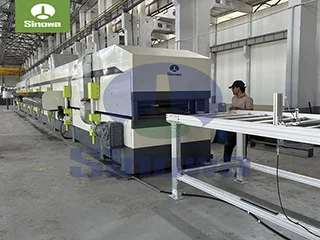
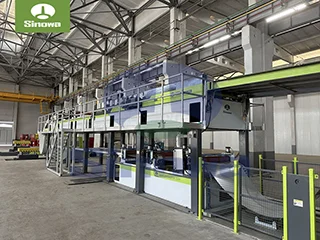
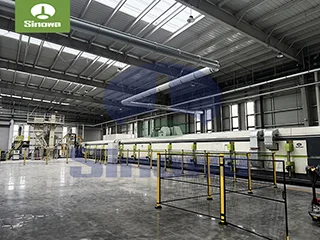
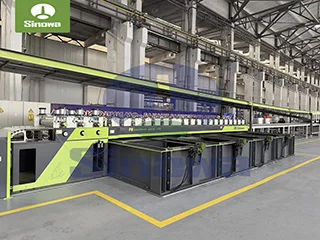
The full continuous PIR sandwich panel production line dedicated to roof and wall panel production is a tightly connected integrated equipment system without independent segmented operation, covering raw material feeding, surface pretreatment, roll forming, surface preheating, high-pressure foam mixing and injection, continuous lamination and curing, constant-temperature cooling, fixed-length cutting, edge trimming and automatic stacking. All functional modules operate synchronously under unified central control, avoiding manual intervention errors and discontinuous production defects caused by semi-automatic intermittent production equipment. Different from general PU sandwich panel production line, this customized line is optimized aiming at the differentiated stress characteristics, installation requirements and appearance standards of building roof panels and wall panels respectively, so it can switch production modes freely without replacing core equipment, realizing flexible switching between two types of building enclosure panels on one single production line. The whole line can be divided into three major functional sections according to production sequence: front-end metal sheet processing section, middle core material foaming and composite curing section, and back-end finished panel cutting and sorting section, and each section collaborates closely to ensure uninterrupted 24-hour continuous production.
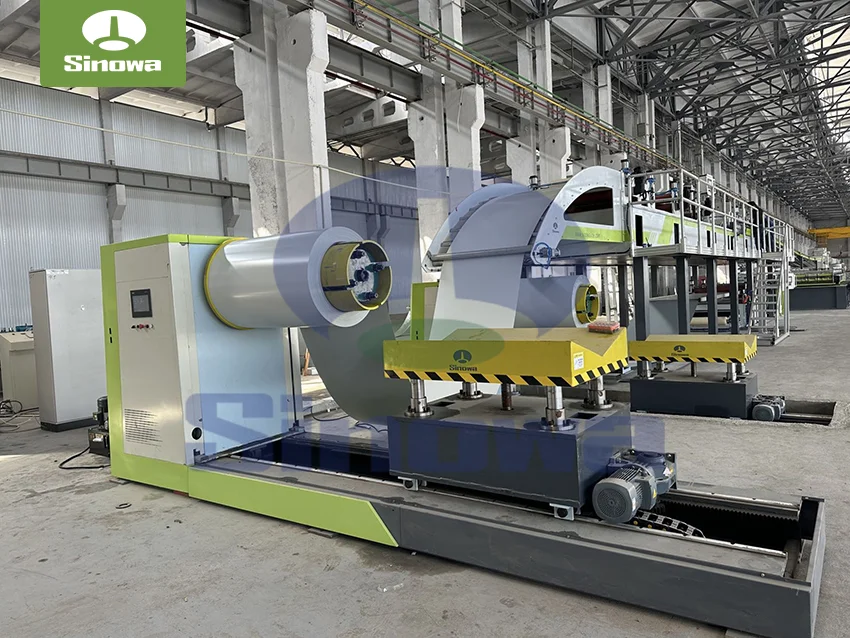
The front-end metal sheet processing section is the initial link of panel production, which directly shapes the outer surface profile of finished roof and wall panels and lays a foundation for subsequent firm bonding between metal facings and PIR foam core. This section mainly includes automatic uncoiling units, deviation correction devices, surface protective film laminating equipment, leveling rollers and profile roll forming machines. Raw materials adopted for panel facings are mostly continuous metal steel coils with smooth coated surfaces, featuring good weather resistance and surface hardness suitable for outdoor long-term exposure. Firstly, the uncoiling unit releases upper and lower metal coils stably and continuously, and the automatic deviation correction system tracks the running track of metal sheets in real time to prevent lateral deviation during high-speed transmission, which effectively avoids wrinkling, dislocation and edge misalignment of metal sheets in the follow-up composite process. Afterwards, transparent protective films are attached to both outer surfaces of upper and lower metal sheets to prevent surface scratch, dust adhesion and coating damage during production, transportation and on-site installation, maintaining the intact appearance of finished panels for building exterior decoration.
The core difference design of the PIR sandwich panel line is reflected in the roll forming module, which sets two sets of adjustable roller molds to produce exclusive profiles for roof panels and wall panels separately. For roof sandwich panels, the roll forming system processes raised trapezoidal ribs on the outer metal surface. These continuous stiffening ribs enhance the overall bending resistance and spanning capacity of roof panels, enabling the panels to bear snow load, wind pressure and other outdoor dynamic loads without excessive deflection after being laid on building roof purlins. Meanwhile, the special lap joint structure formed by roll forming can realize seamless splicing between adjacent roof panels, eliminating hidden water leakage risks on building roofs. For wall sandwich panels, the roll forming process adopts relatively flat surface design with fine hidden buckle structures on panel edges instead of large raised ribs. This design ensures smooth and neat overall wall appearance after installation, meets the aesthetic requirements of building exterior walls, and realizes hidden seamless assembly to optimize overall building thermal insulation performance and avoid thermal bridge loss at splicing gaps. Operators only need to adjust roller spacing and operation parameters through the central control system to switch between roof panel mode and wall panel mode rapidly, without disassembling or replacing mechanical rollers, greatly improving production flexibility and reducing model change downtime.
After profile shaping, metal sheets enter the preheating module before foaming composite processing, which is an indispensable auxiliary process easily ignored in low-end sandwich panel line. The metal surface will generate tiny temperature difference and surface tension changes during rapid transmission, and residual dust and oil stains will also affect the bonding effect between metal facings and liquid PIR foam. The closed-loop circulating preheating device heats upper and lower metal sheets to a constant moderate temperature evenly, removes surface moisture and tiny impurities, and activates the surface coating of metal sheets. This process significantly improves the chemical adhesion between metal surfaces and PIR foam, permanently preventing common quality problems such as core delamination, edge hollowing and partial peeling that frequently occur in inferior sandwich panels after long-term outdoor use.
The middle foaming and continuous lamination curing section is the core heart of the entire PIR sandwich panel machine, determining the thermal insulation performance, fire resistance, compressive strength and overall service life of finished roof and wall panels. This section consists of high-precision raw material proportional feeding system, high-pressure circulating foam mixing machine, free falling foam injection device, long-channel double-belt laminating machine and segmented constant-temperature curing oven. Different from polyurethane foam materials, PIR foam requires stricter raw material ratio control and reaction temperature environment during chemical polymerization, so the production line is equipped with full-automatic flow monitoring modules for all chemical raw materials including combined polyether, isocyanate, catalyst and blowing agent. The system dynamically adjusts raw material flow rate in real time according to production speed and preset foam density, ensuring that chemical components react completely and stably without material waste or insufficient reaction.
Liquid mixed PIR raw materials are evenly injected into the gap between upper and lower shaped metal sheets through the high-pressure mixing head in a linear continuous spraying mode. Compared with intermittent pouring methods, linear spraying makes liquid foam distribute uniformly along the whole width of panels, avoiding local density deviation of foam core. With the forward operation of double-belt laminating machine, liquid PIR foam expands freely under constant pressure and completes primary bonding with upper and lower metal facings. The double-belt laminating machine maintains stable and consistent clamping pressure throughout the composite process, which restricts excessive free expansion of foam and ensures unified panel thickness ranging from conventional thin wall panels to thick high-insulation roof panels used for low-temperature buildings. Subsequently, semi-finished composite panels enter the segmented curing oven with gradient temperature control. The oven is divided into initial curing zone, deep polymerization zone and stable shaping zone with different temperature settings respectively, matching the whole reaction cycle of PIR foam from foaming, polymerization to molecular structure shaping. Gradient heating avoids internal stress concentration inside foam core caused by one-time high-temperature heating, maintaining complete fine closed-cell structure of PIR foam. The closed-cell rate of qualified foam core produced by this line can reach more than 95%, which endows panels with ultra-low thermal conductivity, excellent waterproof and moisture-proof performance, and stable fire-resistant carbonization layer under high-temperature flame baking.
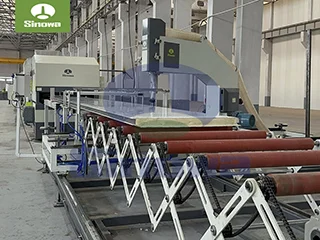
After completing high-temperature curing, panels enter the back-end constant-temperature cooling system to eliminate residual internal stress generated during high-temperature polymerization. Rapid forced cooling is forbidden in this process, so the PIR insulation board production line adopts gradual air cooling mode to reduce panel temperature to room temperature slowly and evenly. Slow cooling can effectively prevent surface deformation of metal sheets and internal cracking of foam core caused by violent temperature change, ensuring long-term dimensional stability of finished panels, which is particularly critical for roof panels bearing alternating outdoor temperature difference all year round. After cooling treatment, panels are transmitted to the fixed-length cutting unit equipped with high-speed synchronous cutting saw. The cutting equipment runs synchronously with panel transmission speed to ensure smooth cutting sections without foam crushing, metal edge curling and core layering. Operators can input arbitrary customized length data through the central control terminal to meet diversified size requirements of different construction projects for roof and wall panels.
Follow-up edge trimming and automatic stacking devices finish final post-processing work. Edge trimming equipment removes tiny unfoamed material residues on both sides of panels to ensure neat panel edges and smooth assembly during on-site construction. Finally, finished panels are automatically stacked layer by layer through mechanical stacking arms, realizing orderly finished product collection without manual carrying, reducing labor cost and avoiding secondary surface damage to panels caused by manual operation. The whole production process from coil feeding to finished panel stacking is completed automatically in one continuous line, with only a small number of operators required to monitor operation parameters on the central control platform, realizing unmanned intelligent production of core processes.
Compared with ordinary PU sandwich panel production machine and intermittent manual foaming equipment, this dedicated PIR roof and wall panel production line has irreplaceable technical and production advantages adapting to modern building enclosure demands. Firstly, it achieves dual-purpose production for roof and wall panels on one single line, reducing equipment investment cost for panel manufacturers and improving equipment utilization rate. The integrated parameter storage function can save exclusive production parameters of two panel types, and one-click mode switching can be completed within several minutes, supporting flexible order production for mixed roof and wall panel orders. Secondly, the precise foaming control system optimizes the inherent performance advantages of PIR materials to the maximum extent. The produced panels have better high-temperature stability than ordinary PU sandwich panels, and will not soften or deform under long-term high-temperature solar radiation when used as roof materials, solving the aging failure problem of traditional insulation roof panels in high-temperature areas.
In terms of building energy conservation, uniform fine closed-cell PIR foam core greatly reduces heat transfer efficiency through panel walls and roofs. Building projects adopting these PIR panels can cut down long-term air conditioning and heating energy consumption obviously, complying with global green building and energy-saving emission reduction trends. In terms of structural safety, the composite combination of profiled metal sheets and high-strength PIR foam core forms an integral stress-bearing structure. Metal facings bear tensile and bending stress, while foam core transfers shear force evenly between upper and lower sheets, improving overall structural rigidity of panels. Roof panels can realize longer spanning installation without intermediate supporting purlins, simplifying building steel structure systems and lowering overall construction engineering cost. In addition, the PIR insulation panel production line adopts closed raw material circulation design in the foaming section, which reduces volatile gas emission during chemical reaction, optimizing on-site production environment and meeting environmental protection production requirements of modern manufacturing factories.
Standardized daily operation and regular maintenance are essential to keep the PIR sandwich panel manufacturing line running stably for a long time and maintain consistent finished panel quality. Daily routine inspection focuses on the operating synchronization of front-end transmission rollers, real-time accuracy of raw material proportioning sensors and temperature stability of curing oven. Before daily startup, operators need to check the tightness of hydraulic and pneumatic pipelines to avoid pressure leakage affecting laminating pressure stability. Regular deep maintenance includes cleaning residual foam dirt inside mixing heads and laminating belts, calibrating cutting size precision of saw blades, and detecting temperature deviation of heating modules in curing oven. Timely maintenance avoids gradual parameter drift of long-running equipment, preventing batch quality defects such as uneven foam density, inconsistent panel thickness and incomplete core bonding. Besides, the central control system supports production data recording and fault self-diagnosis functions. The system can automatically alarm for abnormal parameters including transmission speed, heating temperature and raw material flow, helping staff locate and eliminate equipment faults rapidly and reduce production downtime loss.
With the rapid development of prefabricated architecture, low-carbon buildings and cold storage construction industries worldwide, the market demand for high-performance roof and wall insulation sandwich panels keeps growing steadily, which further drives the iterative upgrading of matched PIR sandwich panel making machine. Future optimization directions of such production lines will focus on higher intelligent automation level, more energy-saving heating circulation systems and wider production specification coverage. Advanced intelligent algorithms will realize automatic parameter matching according to customized panel thickness and profile requirements without manual setting, further reducing human factor interference. Optimized waste heat recovery systems in curing ovens will recycle waste heat generated during production to preheat metal sheets, lowering overall power consumption of the whole production line and realizing greener manufacturing process.
In conclusion, the continuous automatic PIR sandwich panel line tailored for roof and wall panels is a highly integrated, efficient and flexible intelligent manufacturing equipment matching modern prefabricated construction needs. Through scientific front-end sheet forming, precise middle PIR foaming composite and stable back-end finished product processing, the line gives full play to the superior insulation, fireproof and durable characteristics of PIR core materials, and produces targeted roof and wall panels adapting to different building stress and installation scenarios. It not only helps panel manufacturers improve production efficiency, enrich product categories and stabilize product quality, but also provides reliable, energy-saving and safe enclosure material solutions for various modern buildings. As the global construction industry continues to move towards prefabrication, energy conservation and low carbonization, this professional PIR sandwich panel production machinery will become more mainstream in the insulation panel manufacturing field, supporting the sustainable upgrading of the entire construction supply chain.
https://www.cnsinowa.com/sandwich-panel-machines/pir-sandwich-panel-line-for-roof-and-wall.html