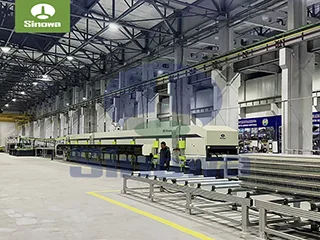
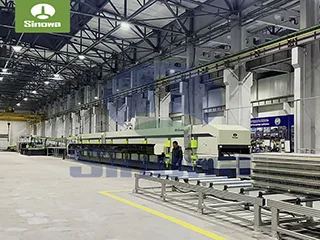
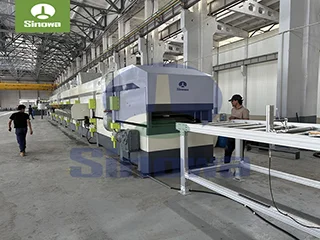
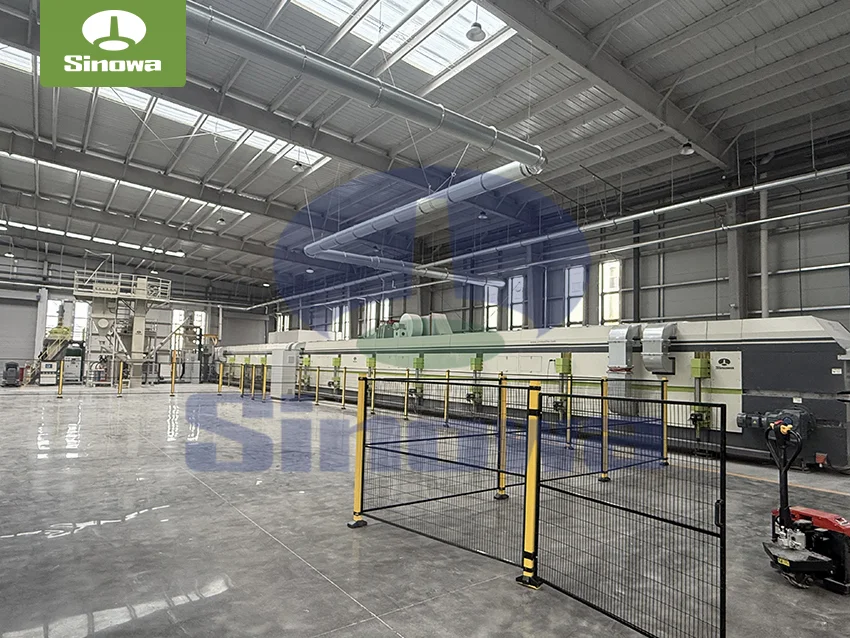
 sandwich panel machine
The fundamental working principle of PU sandwich panel manufacturing machinery for double-sided composite panels revolves around the continuous combination of two outer facing materials and a core polyurethane foam layer. The entire production process is characterized by automation and continuity, which not only improves production efficiency but also guarantees the consistency and stability of product quality. Unlike traditional manual or semi-automatic production methods, modern manufacturing machinery achieves precise control over each production link through advanced control systems, such as the precise metering of polyurethane raw materials, the accurate forming of facing materials, and the uniform foaming and curing of the core layer. This precise control ensures that the double-sided composite panels have uniform thickness, strong bonding between layers, and consistent performance indicators, laying a solid foundation for their wide application in various fields.
A complete set of PU sandwich panel manufacturing machinery for double-sided composite panels consists of several key components, each of which plays a vital role in the production process. The uncoiling system is the starting point of the production line, responsible for unwinding the coiled facing materials, which are usually metal sheets such as color steel sheets, stainless steel sheets, or aluminum sheets. The uncoiling system is equipped with tension control devices to ensure that the facing materials are unwound smoothly and stably without wrinkling or deformation. This is particularly important because any defect in the facing materials at this stage will be transmitted to the final product, affecting its appearance and performance. After uncoiling, the facing materials are fed into the roll forming system, which is another core component of the manufacturing machinery.
The roll forming system is designed to shape the flat facing materials into the desired profile through a series of rolling stands arranged in tandem. For double-sided composite panels, there are usually two sets of roll forming machines, one for the upper facing and one for the lower facing, which can be adjusted according to the specific profile requirements of the product. The roll forming process is a gradual bending process, where the facing materials are pressed and bent step by step under the guidance of rollers and gears until the desired cross-sectional shape is achieved. The roll forming system is equipped with adjustable frames, allowing for the production of panels with different widths and profiles to meet the diverse needs of customers. The precision of the roll forming system directly affects the dimensional accuracy and structural stability of the double-sided composite panels, so the rollers and frames are usually made of high-strength materials to ensure their durability and forming precision.
After the roll forming of the upper and lower facing materials, they are fed into the foaming and laminating area, where the polyurethane foam core is injected and formed. The foaming system is the key component that determines the thermal insulation and sound insulation performance of the double-sided composite panels. This system mainly includes a metering and mixing device, a foaming agent supply device, and an injection device. The metering and mixing device accurately measures the polyurethane raw materials, including polyol and isocyanate, according to a specific ratio, and then mixes them uniformly. The foaming agent is added to the mixture to promote the foaming reaction. The mixed raw materials are then continuously injected between the upper and lower facing materials through the injection device. The foaming reaction of polyurethane occurs rapidly after injection, and the foam expands to fill the entire space between the two facing materials, forming a dense and uniform core layer.
To ensure the full foaming and curing of the polyurethane core layer, the manufacturing machinery is equipped with a pre-heating system and a curing system. The pre-heating system usually adopts a hot air circulating heating furnace, which pre-heats the facing materials before the injection of polyurethane raw materials. This pre-heating process helps to adjust the temperature of the facing materials to the optimal range for the foaming reaction, promoting the adhesion between the foam core and the facing materials and ensuring the uniform foaming of the polyurethane. After the injection of the raw materials, the composite panel enters the curing system, where it is maintained at a specific temperature for a certain period of time to allow the polyurethane foam to fully cure. The curing system is also equipped with temperature control devices to ensure that the curing temperature is stable and uniform, which is crucial for the formation of a high-strength and high-performance foam core.
The double belt conveyor system is another important component of the PU sandwich panel manufacturing machinery, which plays a key role in the foaming and curing process. The double belt conveyor consists of two endless belts, one upper and one lower, which clamp the composite panel during the foaming and curing process. The belts are made of high-temperature resistant and wear-resistant materials to withstand the high temperature during curing and the pressure during clamping. The double belt conveyor not only transports the composite panel forward continuously but also applies a uniform pressure to the panel, ensuring that the foam core is evenly distributed and the panel has a flat and smooth surface. The pressure applied by the double belt conveyor can be adjusted according to the thickness and density requirements of the foam core, ensuring the flexibility of the production process.
After the polyurethane foam is fully cured, the composite panel is fed into the cutting system, which cuts the continuous panel into the desired length. The cutting system usually adopts a bandsaw cutting device, which has the advantages of high cutting precision, smooth cutting surface, and no damage to the panel. The cutting length can be set through the control system, and the cutting process is fully automated, ensuring the accuracy and consistency of the product length. Some advanced cutting systems are also equipped with dust collection devices to reduce the dust generated during the cutting process, improving the working environment and protecting the health of workers.
After cutting, the finished double-sided composite panels are transported to the stacking system, which arranges the panels neatly and stacks them to a certain height for subsequent packaging or transportation. The stacking system is usually equipped with automatic grabbing and placing devices, which can handle the panels gently without causing damage to their surface. Some production lines are also equipped with a packaging system, which wraps the stacked panels with plastic film or other packaging materials to protect them from moisture, dust, and damage during transportation and storage. The entire process from stacking to packaging can be completed automatically, further improving production efficiency and reducing manual intervention.
In addition to the above-mentioned key components, the PU sandwich panel manufacturing machinery for double-sided composite panels is also equipped with a central control system, which is the "brain" of the entire production line. The central control system adopts advanced programmable logic controller (PLC) technology, which can realize the centralized control and monitoring of all production links. Operators can set production parameters, monitor production status, and troubleshoot faults through the human-machine interface of the control system. The central control system also has data recording and statistics functions, which can record production data such as production quantity, production speed, and material consumption, providing a basis for production management and optimization. Some advanced control systems also support remote monitoring and control, allowing operators to monitor the production line in real time and adjust parameters even when they are not on site.
The PU sandwich panel manufacturing machinery for double-sided composite panels has a series of performance advantages that make it widely used in the production industry. First of all, it has high production efficiency. Due to the continuous and automated production process, the production speed can reach 3-7 meters per minute, and the daily output is much higher than that of traditional production methods. This high efficiency can meet the large-scale production needs of manufacturers and help them reduce production costs. Secondly, the machinery has good flexibility and adjustability. By adjusting the parameters of each component, it can produce double-sided composite panels with different widths, thicknesses, and profiles. The panel width can usually be adjusted between 600-1200mm, the thickness between 30-250mm, and the length can be customized according to customer requirements. This flexibility allows manufacturers to quickly respond to market changes and meet the diverse needs of different customers.
Another important performance advantage of the manufacturing machinery is its environmental friendliness. Modern PU sandwich panel manufacturing machinery usually adopts environmentally friendly foaming agents, such as 141b or pentane, instead of traditional chloroform carbon foaming agents, which are harmful to the ozone layer. This makes the production process more environmentally friendly and in line with the global trend of energy conservation and emission reduction. In addition, the machinery is equipped with dust collection devices and waste treatment systems, which can effectively reduce the emission of dust and waste, protecting the environment and the health of workers. At the same time, the precise control of the production process reduces material waste, improving the utilization rate of raw materials and reducing the impact on the environment.
The PU sandwich panel manufacturing machinery for double-sided composite panels also has the advantage of high reliability and durability. The key components of the machinery, such as the roll forming rollers, double belt conveyors, and metering devices, are made of high-quality materials and undergo strict processing and testing, ensuring their long service life. The advanced control system and automatic fault diagnosis function can detect potential faults in time and send out alarms, reducing the downtime of the production line and improving the reliability of production. In addition, the machinery is designed with easy maintenance in mind, with convenient access to components and simple maintenance procedures, reducing the maintenance cost and difficulty for manufacturers.
The double-sided composite panels produced by this advanced manufacturing machinery have excellent performance, making them widely used in various fields. In the construction industry, they are commonly used as wall and roof materials for industrial buildings, warehouses, factories, and commercial complexes. Their excellent thermal insulation performance can reduce the energy consumption of buildings, improving the energy efficiency of buildings. In cold storage and refrigeration facilities, the double-sided composite panels are particularly popular due to their excellent thermal insulation and moisture resistance, which can maintain a stable low temperature environment and reduce the energy consumption of refrigeration equipment. In addition, they are also used in clean rooms, food processing plants, prefabricated houses, and modular structures, where their advantages of lightweight, high strength, and easy installation are fully utilized.
The application of PU sandwich panel manufacturing machinery for double-sided composite panels has also promoted the development of the prefabricated construction industry. Prefabricated construction requires a large number of standardized and high-quality building components, and the double-sided composite panels produced by the manufacturing machinery fully meet these requirements. The machinery can realize the mass production of standardized panels, which can be directly assembled on the construction site, greatly shortening the construction period, reducing construction waste, and improving the quality of the project. With the continuous development of the prefabricated construction industry, the demand for PU sandwich panel manufacturing machinery is also increasing, promoting the continuous innovation and upgrading of the machinery.
In the process of using PU sandwich panel manufacturing machinery for double-sided composite panels, proper operation and maintenance are essential to ensure the normal operation of the production line and the quality of the products. Operators need to receive professional training to be familiar with the working principle and operation procedures of the machinery, and strictly follow the operation manual to operate the machinery. Regular maintenance of the machinery is also necessary, including the lubrication of moving parts, the inspection and replacement of worn components, and the cleaning of the production line. This can not only extend the service life of the machinery but also ensure the stability and reliability of the production process. In addition, regular calibration of the metering and control systems is required to ensure their precision, which is crucial for maintaining the consistency of product quality.
Looking into the future, with the continuous progress of technology and the increasing demand for energy-saving and environmentally friendly building materials, PU sandwich panel manufacturing machinery for double-sided composite panels will continue to develop in the direction of higher automation, higher precision, and more environmental friendliness. The integration of intelligent technologies such as artificial intelligence and the Internet of Things into the manufacturing machinery will realize the intelligent monitoring and optimization of the production process, further improving production efficiency and product quality. At the same time, the development of new materials and new processes will also promote the upgrading of the machinery, enabling it to produce panels with better performance and more functions. For example, the development of fire-resistant polyurethane foam and other new core materials will require the manufacturing machinery to adapt to the new foaming and curing processes, promoting the innovation of the machinery.
In conclusion, PU sandwich panel manufacturing machinery for double-sided composite panels is an important part of the modern building materials production industry, which plays a crucial role in the mass production of high-quality double-sided composite panels. The machinery integrates multiple advanced technologies, with a reasonable structure and perfect functions, realizing the continuous and automated production of panels. Its advantages of high efficiency, flexibility, environmental friendliness, and reliability make it widely used in various fields, promoting the development of the construction and related industries. With the continuous advancement of technology, the performance of the manufacturing machinery will be further improved, bringing more opportunities for the development of the double-sided composite PU sandwich panel industry. The continuous innovation and upgrading of this machinery will also contribute to the realization of energy conservation, emission reduction, and sustainable development in the construction industry, making an important contribution to the development of a green and low-carbon economy.
https://www.cnsinowa.com/sandwich-panel-machines/pu-sandwich-panel-manufacturing-machinery-for-double-sided-composite-panels.html