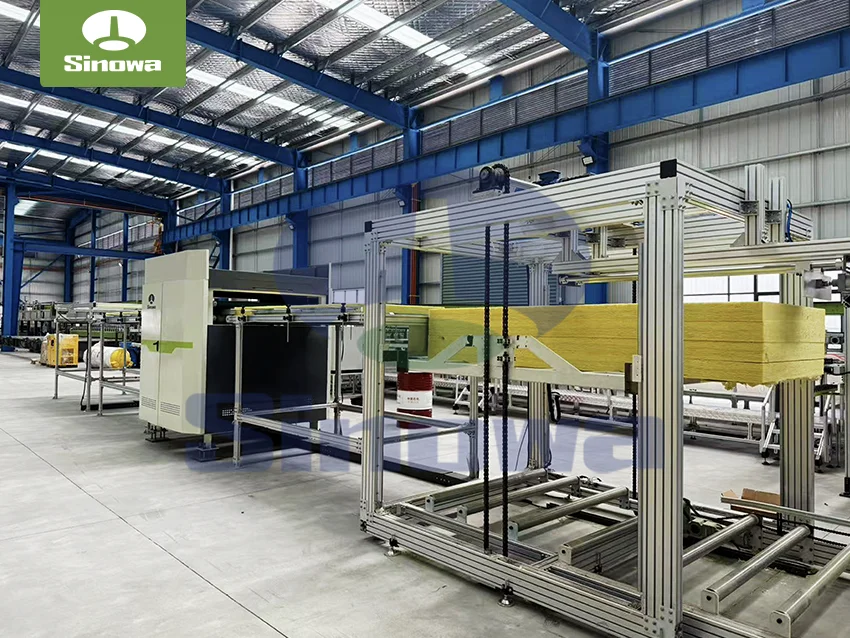
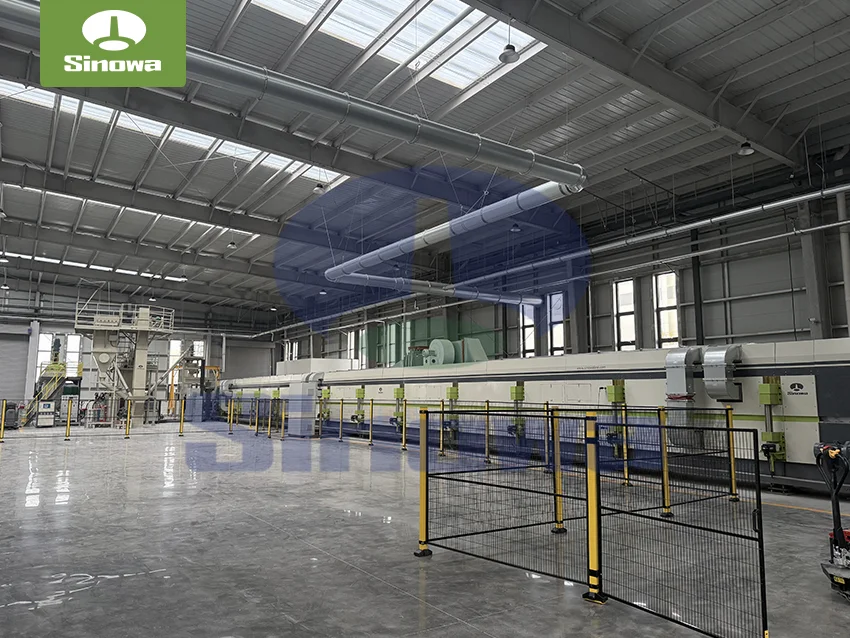
sandwich panel line
The overall operational logic of the foam polyurethane sandwich panel production line is based on the perfect combination of mechanical automation and polyurethane chemical foaming reaction principles. The core manufacturing idea is to take rigid polyurethane foam as the intermediate insulation core material and compound it with continuous flat or profiled surface materials through controlled foaming, pressing, and curing processes, forming a composite panel structure with integrated outer protective layers and inner thermal insulation layers. The entire production process follows a linear continuous operation mode, where raw materials enter the production line from the starting end, undergo progressive processing through each functional unit, and are output as standardized finished products at the terminal end without frequent equipment shutdown or repeated debugging, thus greatly improving production continuity and operational efficiency. All key processing links are matched with adaptive regulation systems to cope with the physical and chemical changes of polyurethane materials during foaming and curing, avoiding product defects such as uneven foam density, insufficient bonding strength, and surface warping caused by unstable process conditions.
The front-end processing section of the foam core sandwich panel line focuses on the pretreatment and forming of panel surface materials, laying a foundational guarantee for subsequent foam compounding. Surface materials used for polyurethane sandwich panels are mostly rigid sheet materials with good surface flatness and structural toughness, which are transported in coil stock form for continuous production. The coil unwinding unit steadily releases coiled surface materials through flexible tension control structures, effectively avoiding material deviation, stretching deformation, or wrinkling during the unwinding process. After unwinding, the surface materials enter the precision profiling unit, which shapes flat sheet materials into standardized cross-sectional structures matching product specifications through multi-group roller pressing. This profiling process ensures the dimensional uniformity of the upper and lower surface layers of the panel, providing a stable molding space for the intermediate foam core. In addition, the production line is equipped with a complete surface pretreatment process, which removes surface attachments such as dust, oil stains, and oxide layers on the surface materials through physical cleaning and surface adjustment treatment. This pretreatment step is critical to enhance the bonding performance between the surface material and polyurethane foam, as clean and smooth contact surfaces can achieve tighter molecular adhesion, preventing delamination and peeling of the composite layer during long-term service of the panel and improving the overall structural stability of the finished product.
The foam raw material proportioning and pouring unit is the core functional module of the PU foam production line, directly determining the thermal insulation performance, structural compactness, and physical strength of the sandwich panel core layer. Polyurethane foam is formed by the chemical reaction of two main raw materials, polyol and isocyanate, with auxiliary additives added to adjust reaction activity, foam fineness, and dimensional stability. The production line adopts a closed-loop metering and conveying system, which transports raw materials from sealed storage tanks to the high-pressure mixing head through precision dosing pumps. The storage tanks are designed with double-wall heat insulation structures and supporting stirring and constant-temperature control devices, which can maintain the activity and stability of raw materials for a long time, prevent raw material precipitation, stratification, or performance attenuation caused by temperature fluctuation, and ensure the accuracy of subsequent proportioning reactions. The metering system can realize continuous and adjustable proportional conveying according to production process requirements, precisely controlling the mixing ratio of different raw materials to avoid quality problems such as loose foam, poor thermal insulation effect, or excessive brittleness caused by unreasonable ratio.
After precise proportioning, the raw material mixture is fully stirred and homogenized by the high-pressure mixing head to form a uniform reaction solution, which is evenly poured on the surface of the lower layer material that has completed pretreatment and profiling. The pouring operation follows dynamic synchronous matching with the transmission speed of the production line, realizing continuous and uniform distribution of the reaction solution in the width direction of the panel. With the forward transmission of the surface material, the upper layer profiled material is accurately closed and covered through the automatic lamination mechanism, forming a closed molding cavity between the upper and lower surface layers. The polyurethane reaction solution in the cavity starts rapid chemical cross-linking reaction, accompanied by stable volume expansion and gradual gelation molding. The entire foaming expansion process is carried out in a relatively closed space, which effectively avoids foam overflow, uneven expansion, and external impurity interference, ensuring that the foam core layer can fully fill the gap between the upper and lower surface layers and form an integrated composite structure with close bonding.
The lamination and curing section undertakes the key task of shaping and stabilizing the composite panel, which is a decisive link for the final forming quality of the product. This section adopts a double-belt continuous pressing structure, which provides stable and uniform pressing force and constant-temperature curing conditions for the composite panel in the process of forward transmission. In the early stage of curing, the heating system conducts uniform heat conduction to the panel cavity to catalyze the cross-linking reaction of polyurethane raw materials, accelerate foam expansion and gel forming, and promote the tight combination between the foam core and the surface material. The temperature and pressure parameters in the curing zone are dynamically adjustable according to different production speeds and product specifications, which can adapt to the reaction characteristics of polyurethane materials under different working conditions and ensure that the foam forms a compact and uniform cellular structure. Moderate and stable pressing force can effectively control the overall thickness of the panel, eliminate local bulging or depression defects, and maintain the flatness and dimensional consistency of the panel surface.
After completing the high-temperature curing and preliminary shaping process, the panel enters the cooling and shaping section for post-processing stabilization. The just-cured polyurethane foam core still has residual reaction temperature and slight expansion stress, and direct cutting and forming may lead to dimensional deviation, surface deformation or internal structural loosening. The cooling section adopts circulating air cooling or water-cooled plate heat dissipation modes to conduct uniform and slow cooling treatment on the continuously transmitted panels. This gradual cooling mode can effectively release the internal stress of the foam core, fix the cellular structure of the polyurethane foam, and prevent secondary expansion or shrinkage deformation of the finished panel after molding. Through scientific cooling and shaping, the overall structural stability of the panel is significantly improved, and the flatness, thickness uniformity and dimensional accuracy of the finished product are fully guaranteed, laying a foundation for subsequent fixed-size cutting and finished product processing.
The terminal processing part of the PU sandwich panel production line includes automatic trimming, fixed-length cutting and finished product conveying mechanisms, realizing the final standardized forming of the panel. After cooling and shaping, the continuous integrated panel is transmitted to the trimming station, where the irregular excess materials on both sides of the panel are evenly removed through precision trimming equipment to ensure consistent width specifications of the panel. Subsequently, the cutting unit performs fixed-length cutting according to preset product size parameters. The cutting process realizes non-stop dynamic cutting synchronous with production line transmission, avoiding production shutdown caused by cutting operation and ensuring the continuity and high efficiency of the entire production process. The cut single finished panels are automatically conveyed to the finished product sorting platform, with flat and neat end faces and accurate overall dimensions, meeting the unified specification requirements of engineering supporting applications.
The automated control system runs through the entire operation process of the polyurethane sandwich panel line, serving as the intelligent core to ensure stable and efficient operation of the equipment. The system integrates real-time monitoring and synchronous regulation of multiple parameters including production line transmission speed, raw material metering ratio, mixing pressure, curing temperature, pressing pressure and cooling speed. All operating parameters can be adjusted and set according to different product specifications and process requirements, realizing intelligent switching of production processes. During continuous operation, the control system can automatically identify abnormal fluctuations of process parameters and conduct self-adjustment and correction, effectively reducing the occurrence of defective products caused by human operation errors or equipment parameter drift. The highly integrated automatic control mode simplifies the daily operation process of the equipment, reduces the threshold of manual operation, and enables the production line to maintain long-term stable high-efficiency operation.
The polyurethane sandwich panel foaming production line has prominent technical advantages in material utilization and product performance optimization. In terms of material application, the precise metering and uniform pouring system avoids excessive waste of polyurethane raw materials, and the closed foaming and integrated lamination process maximizes the conversion rate of raw materials into effective foam core structures, greatly improving raw material utilization compared with traditional intermittent production equipment. In terms of product performance, the continuous foaming and curing process makes the internal cellular structure of the polyurethane foam core fine and uniform, with no hollow holes or loose layers inside, endowing the panel with excellent and stable thermal insulation performance, low thermal conductivity, and good heat and cold insulation effects. At the same time, the integrated composite structure formed by synchronous foaming and bonding makes the surface material and foam core closely integrated, with high overall structural strength, strong compression resistance and bending resistance, and good durability in long-term use environments such as high temperature, low temperature and humidity alternation.
In terms of production adaptability, this PU sandwich panel line has flexible production capacity and can meet the manufacturing requirements of sandwich panels with different thicknesses, widths and surface specifications. By adjusting the process parameters of the lamination pressing system, raw material proportioning system and cutting system, the equipment can quickly switch between different product specifications, covering the production demands of wall panels, roof panels, cold storage insulation panels and other types of polyurethane sandwich panels. The continuous production mode can adapt to large-scale batch production orders, while also meeting the flexible production demands of small-batch and multi-specification customized products, with strong market adaptability and production flexibility.
With the continuous upgrading of modern construction and industrial manufacturing concepts, lightweight, high-efficiency thermal insulation, energy-saving and durable composite building materials have become the mainstream development trend. As the core manufacturing equipment of polyurethane sandwich panels, the continuous sandwich panel production line continuously optimizes process technology and structural design, realizing further improvement in production efficiency, product stability and energy-saving performance. The efficient automated production process reduces energy consumption per unit product and manual investment, while the high-quality finished panels produced provide reliable material support for energy-saving building construction, cold chain storage facilities, industrial plant insulation and other fields. In the future, with the continuous innovation of material formula and automation technology, the polyurethane sandwich panel foam production line will develop towards higher intelligence, higher precision and more energy-saving operation, continuously promoting the upgrading and iterative development of the composite insulation panel manufacturing industry.
https://www.cnsinowa.com/sandwich-panel-machines/polyurethane-sandwich-panel-foam-production-line.html