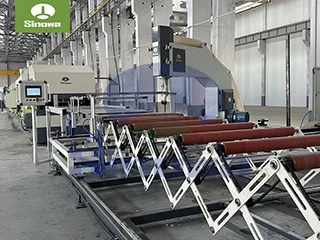
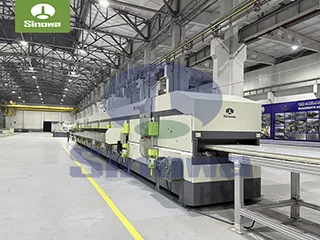
sandwich panel machine
The overall structural design of a modern foam core sandwich panel line follows modular and synchronized operational concepts, with every functional unit closely coordinated to form a complete closed-loop production system. The entire production line can be divided into multiple interlinked functional sections, including substrate feeding and preprocessing, foam raw material metering and mixing, automatic pouring and distribution, continuous laminating and pressure forming, thermal insulation curing, edge trimming, fixed-length cutting, and finished product stacking and conveying. Each section operates under unified system scheduling, maintaining consistent operating speeds and process parameters to avoid structural deviations, bonding gaps, or performance inconsistencies in finished panels caused by asynchronous equipment operation. The modular design not only simplifies daily equipment maintenance and component replacement but also allows for flexible adjustment of production configurations according to different raw material formulas and panel specification requirements, greatly enhancing the equipment’s adaptability to diversified market production needs.
The front-end substrate processing unit serves as the initial link of the entire production workflow, undertaking the pretreatment of upper and lower surface materials for sandwich panels. Common substrate materials include metal coil sheets, composite fiber plates, and other flat structural materials with good toughness and surface flatness. In this unit, coiled substrates are steadily uncoiled through automatic unwinding devices, eliminating material accumulation and tension deviation through precise tension control systems. After unwinding, the materials pass through multi-stage leveling structures to remove surface wrinkles, indentations, and internal stress generated during coil winding, ensuring the flatness and dimensional stability of substrates in subsequent compounding processes. Some production configurations also include surface cleaning and preliminary shaping processes to remove dust, oil stains, and impurities on the substrate surface, creating optimal bonding conditions for the foam core material and effectively improving the overall bonding strength and service durability of composite panels. The entire substrate pretreatment process is fully automated, with no manual intervention required in the material conveying and shaping process, ensuring continuous and stable material supply for subsequent foaming and compounding procedures.
The foam raw material metering, mixing, and pouring system constitutes the core functional module of the sandwich panel making machine, directly determining the foaming effect, core layer density, and internal structural uniformity of finished panels. This system is mainly applicable to liquid foam raw material formulations, with common foam core materials including polyurethane and polyisocyanurate foam materials that form micro closed-cell structures through chemical reactions. Different from traditional simple mixing equipment, the metering unit of advanced production equipment adopts high-precision pumping and proportional control structures, which can accurately transport different liquid raw materials and auxiliary additives to the mixing head according to preset process ratios. The entire metering process maintains high precision and real-time stability, avoiding fluctuations in raw material proportions that may cause uneven foaming, inconsistent core layer hardness, or insufficient thermal insulation performance of panels.
After precise proportional metering, multiple groups of liquid raw materials enter the high-speed mixing device for uniform stirring and fusion. The mixing structure is designed with efficient flow channel structures and stirring components, which can complete the uniform mixing of multi-component raw materials in an extremely short time and trigger mild chemical pre-reaction to form a homogeneous foaming liquid mixture. The mixed foaming liquid is evenly poured onto the surface of the lower substrate through an automatic pouring and distributing mechanism. The distributing mechanism can adjust the pouring width, thickness, and uniformity according to the target panel specifications, ensuring that the foaming liquid completely covers the effective processing area of the substrate without local accumulation or missing material areas. This precise distributing technology lays a solid foundation for the consistent thickness and uniform internal structure of the foam core layer of finished sandwich panels, avoiding local hollowing, uneven density, and other quality defects in the core layer.
The continuous laminating and pressure forming unit is a key structure to realize composite bonding and preliminary shaping of sandwich panels. After the foaming liquid is laid on the lower substrate, the upper and lower substrate materials with the foaming liquid interlayer simultaneously enter the double-belt pressing and conveying system. This system adopts a long-distance synchronous pressing structure, which can provide stable and uniform continuous pressure for the composite panel blank. Under the action of constant pressure, the foaming liquid undergoes uniform expansion and microscopic structural rearrangement, fully filling the gap between the upper and lower substrates and closely contacting the substrate surface. The mechanical pressure applied by the equipment can effectively eliminate tiny bubbles and gaps generated during the foaming process, enabling the foam core material to form a dense closed-cell structure and achieve tight physical bonding with the upper and lower substrates. The synchronous conveying design of the double-belt structure ensures that the panel blank maintains a fixed moving speed during the pressing and forming process, avoiding relative displacement between the core material and substrates that may cause bonding failure or panel deformation.
Coordinated with the laminating and pressing process, the thermal insulation curing system undertakes the task of stabilizing the chemical structure and mechanical properties of the foam core layer. The curing unit maintains a constant and uniform temperature environment inside the equipment through circulating heating and thermal insulation structures, providing stable temperature conditions for the complete foaming reaction and molecular curing of the foam raw materials. In the early stage of curing, the foam material completes rapid expansion and structural molding under the combined action of temperature and pressure; in the later stage of curing, the internal molecular cross-linking reaction is fully completed, enabling the foam core layer to form stable mechanical strength, toughness, and structural rigidity. Scientific and precise temperature control parameters can effectively avoid quality problems such as excessive foaming shrinkage, core layer cracking, or insufficient structural strength caused by too high or too low curing temperatures. The length of the curing section and temperature gradient settings can be adjusted according to different foam material formulas and panel thickness specifications, ensuring that each batch of panels reaches the optimal curing state and stable comprehensive performance.
After completing curing and composite forming, the continuous long-strip panel semi-finished products enter the post-processing unit for finishing and sizing treatment. The edge trimming mechanism first performs symmetrical trimming on both sides of the continuous panels to remove irregular edge parts generated during the foaming and compounding process, ensuring consistent width and flat and neat side sections of finished panels. The trimmed waste materials are automatically collected and processed in a centralized manner, which is convenient for subsequent recycling and reuse, reducing material waste in the production process. Subsequently, the fixed-length cutting system performs accurate flying cutting on the continuous panels according to preset length parameters. Driven by high-sensitivity servo control technology, the cutting tool can realize synchronous follow-up cutting with the moving panels, ensuring flat and vertical cutting sections and extremely high dimensional accuracy of finished panel lengths. The entire trimming and cutting process is automatically controlled by the system, which can switch processing parameters in real time according to different production requirements, realizing flexible production of panels with multiple specifications.
The final stage of the production process is finished product conveying, shaping inspection, and automatic stacking. The cut single panels are transported through the flexible conveying platform, with the continuous sandwich panel production line automatic turnover and alignment devices correcting the placement state of the panels to ensure neat and consistent panel orientation. The system is equipped with real-time detection structures for panel flatness, thickness uniformity, and surface integrity, which can automatically identify unqualified products with surface scratches, thickness deviation, or incomplete bonding, realizing preliminary screening of finished products. Qualified finished panels are automatically stacked by the stacking device, with the stacking height and quantity adjustable according to production and packaging requirements. The automated stacking function replaces traditional manual carrying and stacking operations, greatly improving production efficiency, reducing labor investment, and avoiding panel surface damage and dimensional inconsistency caused by manual operation errors.
The technical advantages of the continuous sandwich panel line are fully reflected in production stability, product performance optimization, and industrial production adaptability. In terms of production quality control, the full-process automated control system realizes integrated management of raw material metering, process temperature, operating pressure, conveying speed, and cutting dimensions. All core process parameters can be preset and intelligently adjusted, effectively avoiding quality fluctuations caused by manual operation differences and ensuring excellent consistency in the thickness, density, bonding strength, and thermal insulation performance of each panel. The closed continuous production environment reduces the impact of external temperature, humidity, and dust on the foaming reaction and composite bonding process, significantly improving the yield rate of finished products.
In terms of product performance improvement, the precise pressure control and constant-temperature curing technology of the sandwich panel equipment enable the foam core layer to form a uniform and dense closed-cell structure. This structural feature endows finished sandwich panels with outstanding thermal insulation, heat preservation, and sound insulation effects, while maintaining lightweight characteristics and high structural bending resistance and compression resistance. The tight composite structure formed by mechanical pressure bonding avoids the problems of core material delamination and hollowing that are prone to occur in traditional manual or semi-mechanical production, greatly extending the service life of sandwich panels in complex application environments. In addition, the flexible parameter adjustment capability of the equipment supports the production of panels with different core layer densities and thickness specifications, meeting the differentiated performance requirements of different application scenarios for thermal insulation, load-bearing, and structural stability.
In terms of production efficiency and economic benefits, the continuous sandwich panel assembly line production mode breaks through the bottlenecks of low output and long cycle of intermittent production equipment. The synchronized operation of all functional units realizes uninterrupted continuous production, greatly improving unit time output. The high-precision raw material metering and distributing system effectively controls raw material consumption, reduces unnecessary material waste, and improves raw material utilization efficiency. The high degree of automation of the equipment reduces the demand for on-site operating personnel, simplifies production management procedures, and reduces long-term production and operation costs for enterprises. At the same time, the stable product quality reduces the after-sales maintenance and replacement costs caused by product quality problems, bringing more stable economic benefits to production enterprises.
Sandwich foam panels produced by professional manufacturing machines have a wide range of application scenarios, covering multiple fields of modern industrial production and civil construction. In the building construction industry, such panels are widely used in the enclosure structures of industrial plants, warehouse buildings, temporary construction facilities, and clean workshops, relying on their excellent thermal insulation, wind resistance, and fire-retardant properties to reduce building energy consumption and improve building safety and comfort. In the field of cold chain logistics and thermal insulation engineering, the lightweight and efficient thermal insulation characteristics of foam sandwich panels make them ideal materials for cold storage walls, roof insulation layers, and thermal insulation compartment boards, effectively maintaining internal temperature stability and reducing equipment operation energy consumption.
In addition, these composite panels are also applied in industrial sandwich panel production machine insulation, municipal engineering facilities, and modular building components. With the continuous upgrading of industrial manufacturing standards and the increasing demand for energy-saving and environmentally friendly materials, the market requirements for the precision, stability, and intelligence of sandwich foam panel making machines are constantly improving. Modern equipment design is gradually developing toward higher automation intelligence, more flexible production adaptation, lower energy consumption, and more environmentally friendly production processes. Through continuous optimization of mechanical structure design, upgrading of intelligent control systems, and improvement of process parameter accuracy, the comprehensive performance of sandwich foam panel making machines is continuously improved, providing more reliable equipment support for the high-quality development of the composite panel material industry.
In practical industrial applications, the stable operation of foam sandwich panel production line is closely related to daily maintenance and standardized operation. Scientific equipment maintenance can effectively prolong the service life of mechanical components and control systems, maintain long-term stability of production accuracy, and avoid production shutdown losses caused by equipment failures. Regular cleaning of material conveying and mixing components, inspection of pressure and temperature control systems, calibration of metering and cutting precision, and lubrication of transmission structures are all key links to ensure the efficient and stable operation of the equipment. Standardized operating procedures can avoid process parameter errors and equipment operation faults caused by irregular manual operations, ensuring the long-term consistent production of high-quality sandwich foam panels.
As one of the core equipment in the field of new composite building materials, the sandwich foam panel making machine plays an important role in promoting the upgrading of the building material industry and the development of energy-saving buildings. Its efficient, stable, and intelligent production characteristics adapt to the trend of large-scale, standardized, and high-quality development of the modern building material industry. With the continuous innovation of foam material formulas and composite molding processes, the functional design and production performance of sandwich foam panel making machines will continue to be optimized, further expanding the application scope of foam sandwich panels and providing more advanced and reliable technical equipment solutions for green building construction, industrial thermal insulation, and modular manufacturing industries.
https://www.cnsinowa.com/sandwich-panel-machines/sandwich-foam-panel-making-machine.html