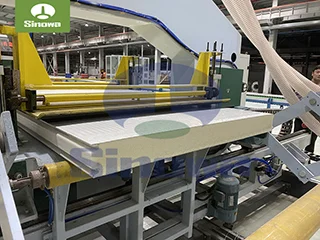
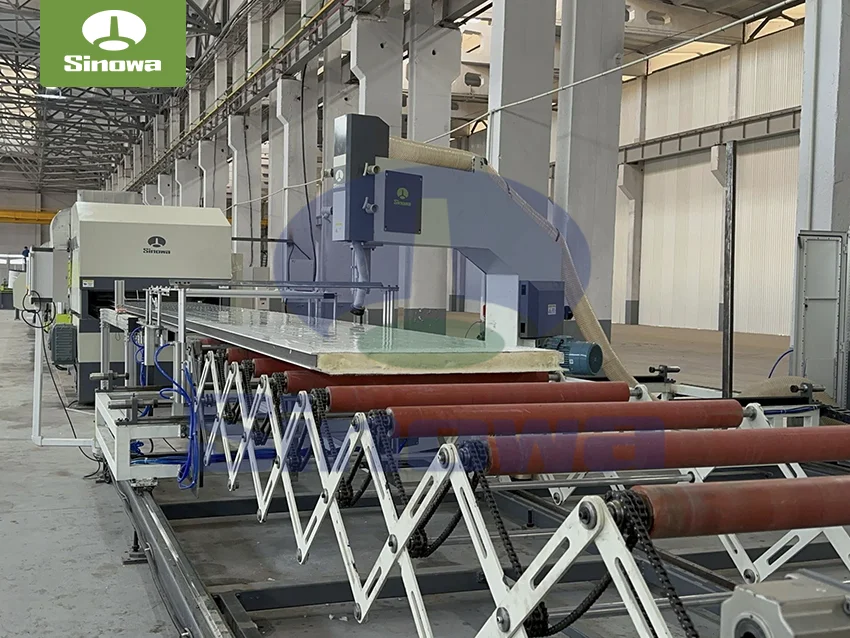
 sandwich panel machine
The overall structural design of the continuous PU sandwich panel machine follows a modular and synchronized operational concept, where each functional unit is closely connected and operates in precise coordination to avoid production discontinuity and quality fluctuations caused by independent unit operation. The entire production line can be divided into multiple functional links in sequence, including substrate unwinding and splicing, surface pretreatment and leveling, roll forming, preheating treatment, polyurethane raw material mixing and injection, continuous lamination and pressure forming, constant temperature curing, fixed-length cutting, cooling shaping, and automatic stacking. Every link is controlled by a unified intelligent control system to ensure consistent operating parameters, stable transmission speed, and coordinated working rhythm throughout the production process, laying a solid foundation for standardized and large-scale production.
The front-end feeding and pretreatment system serves as the primary guarantee for the surface quality and subsequent bonding performance of sandwich panels. This system mainly undertakes the feeding and finishing of upper and lower substrate materials, which are mostly metal coil materials with good flatness and structural rigidity. The unwinding unit adopts a continuous unwinding structure with automatic splicing functions, which can connect the tail end of the exhausted material coil with the head end of the new coil in a short time without stopping the continuous PU sandwich panel production line. This non-stop splicing function effectively eliminates production downtime caused by material replacement, greatly improving the overall continuity and operational efficiency of the equipment. After unwinding, the coiled substrates will pass through a multi-stage leveling mechanism, which uses precise roller pressure adjustment to eliminate subtle wrinkles, bending deformation, and surface unevenness generated during coil winding and unwinding, ensuring that the substrates maintain a completely flat and smooth state in the subsequent processing links.
Following the leveling process, the substrate surface will undergo professional cleaning and purification treatment. During the storage and transportation of raw material coils, tiny dust, oil stains, and oxide layers inevitably form on the surface, which will seriously affect the bonding tightness between the substrate and the polyurethane foam core layer if not removed. The continuous PU sandwich panel equipment is equipped with a multi-functional surface pretreatment unit, which combines physical wiping and micro-cleaning processes to thoroughly remove surface contaminants. Some optimized configurations also include surface drying and electrostatic removal functions, which further optimize the surface state of the substrate, enhance the interface adhesion between the metal substrate and the foam material, and prevent delamination, peeling, and other quality problems of finished panels in long-term use. After pretreatment, the clean and flat substrates will be synchronously transported to the roll forming unit through a precision transmission system.
The roll forming unit is responsible for shaping the flat substrate into the specific profile structure required for sandwich panels. According to the different application scenarios of finished products, the continuous PU sandwich panel line can adapt to the forming processing of various plate profiles, including flat plates, corrugated plates, and special-shaped structural plates. The forming process adopts a gradual multi-roller pressing mode, which avoids structural damage and surface cracking of the substrate caused by one-time strong bending. Each group of forming rollers is precisely calibrated in position and gap, and the roller surface is treated with anti-wear and anti-scratch processes to ensure that the substrate forms a standard and smooth profile while maintaining the integrity of the surface coating. The entire forming process is completed synchronously with the production line transmission speed, realizing dynamic forming and continuous feeding without material accumulation or transmission stagnation, which ensures the consistency of the plate profile of each finished product.
Preheating treatment is a key intermediate process that determines the foaming quality and bonding effect of polyurethane materials. After roll forming, the profiled substrates will enter the constant temperature preheating zone, which adopts uniform and stable heating methods to raise the surface temperature of the substrate to the optimal range required for polyurethane foaming reaction. The temperature control system of the preheating zone has high-precision adjustment capability, which can dynamically stabilize the heating temperature according to the production speed, substrate thickness, and environmental temperature changes. Appropriate preheating can effectively eliminate the temperature difference between the metal substrate and the polyurethane raw material, accelerate the molecular activity of the foam raw material during the subsequent reaction process, promote uniform foaming and full curing of the foam core layer, and avoid hollowing, uneven density, and insufficient bonding force caused by temperature mismatch. At the same time, preheating treatment can also enhance the toughness of the substrate surface coating, reducing the risk of coating damage during subsequent lamination and pressing.
The polyurethane foaming and injection system is the core functional component of the entire continuous sandwich panel machinery, which directly determines the thermal insulation performance, structural strength, and dimensional stability of the finished sandwich panels. The system is responsible for the precise proportioning, high-speed mixing, and uniform injection of polyurethane raw materials. Polyurethane foam is formed by the chemical reaction of two main raw materials, and the equipment’s automatic batching system can realize real-time precise proportioning of raw materials according to the set process parameters, avoiding performance differences of foam core layers caused by proportion deviation. The high-pressure mixing device ensures that the two raw materials are fully fused at the molecular level in an instant, generating a homogeneous and stable foaming liquid without local uneven mixing or material segregation.
The mixed polyurethane foaming liquid is evenly sprayed and coated on the surface of the lower substrate through a reciprocating sweeping nozzle mechanism. The nozzle can perform uniform sweeping covering along the width direction of the plate, realizing full coverage of the effective plate surface without dead angles, material accumulation, or local material shortage. The injection volume and spraying density can be intelligently adjusted according to the required core layer thickness and foam density of different products, which is convenient for switching production of sandwich panels with different specifications. After the foaming liquid is coated on the lower substrate, the upper and lower profiled substrates will be synchronously guided into the double-belt lamination unit, completing the preliminary composite molding of the upper and lower substrates and the intermediate foam layer.
The double-belt lamination and constant temperature curing system is the key link to realize the integral molding and structural strengthening of sandwich panels. This unit uses upper and lower circulating rubber conveyor belts to apply uniform and stable pressure to the composite plate body. The pressure value is precisely controlled within the optimal range, which can not only ensure that the polyurethane foaming liquid fully fills the gap between the upper and lower substrates and closely fits with the substrates, but also avoid excessive pressure leading to foam compression deformation and insufficient thermal insulation performance. The circulating conveyor belt operates synchronously with the production line speed, ensuring that the plate body maintains a stable pressure state during the entire curing process, and effectively avoids plate deviation, warping, and uneven core layer thickness caused by pressure fluctuation or transmission jitter.
The interior of the lamination unit is equipped with a sealed constant temperature curing zone, which provides a stable temperature environment for the foaming reaction and curing molding of polyurethane materials. After entering the curing zone, the polyurethane foaming liquid undergoes continuous expansion, cross-linking reaction, and solidification molding. With the gradual progress of the chemical reaction, the liquid foam is converted into a solid porous core layer with uniform and closed-cell structure, and forms a firm integrated bonding structure with the upper and lower substrates. The length of the curing zone and the production line running speed are scientifically matched to ensure that the foam core layer completes full reaction and strength formation before leaving the curing unit. Insufficient curing will lead to low core layer strength, easy deformation, and degumming of the plate body, while excessive curing will cause energy waste and reduced production efficiency. The intelligent temperature control system can dynamically adjust the internal temperature of the curing zone according to the production load and environmental changes, maintaining the stability of the curing environment at all times.
After completing curing and preliminary molding, the continuous plate body will be transported to the cooling and shaping unit. The high-temperature plate body just out of the curing zone has certain thermal residual stress, and the internal molecular structure of the foam core layer is not completely stable. The natural cooling and air circulation cooling structure adopted by the equipment can gradually reduce the temperature of the plate body, release internal residual stress, and complete the final structural shaping of the plate body. The graded cooling mode avoids quality problems such as plate warping, cracking, and core layer shrinkage caused by rapid temperature change, ensuring that the dimensional accuracy and structural stability of the finished plate meet the production standards. The cooled plate body has stable overall performance, uniform internal structure, and reliable bonding performance between layers.
The fixed-length cutting system realizes the precise segmentation of continuous molded plates into finished products of specified specifications. This automatic cutting unit adopts high-precision servo drive technology, which can set arbitrary cutting length parameters according to production requirements and complete fixed-length cutting in real time according to the running speed of the production line. The cutting tool is made of high-hardness wear-resistant materials, with smooth cutting sections and no burrs, cracks, or plate deformation during the cutting process. The cutting action is highly synchronized with the production line transmission, realizing dynamic cutting without stopping the machine, which effectively guarantees the continuity of production. At the same time, the system is equipped with an error correction and detection function, which can automatically identify plate transmission deviation and fine-tune the cutting position to ensure that the length error of each finished plate is controlled within a tiny range, realizing high-precision standardized production.
The final stage of the production process is automatic sorting, stacking and output. The cut finished plates will be transported to the stacking platform through the conveying mechanism, and the automatic stacking device neatly arranges the plates according to the set number and stacking specifications. The stacking mechanism runs stably and has precise positioning, which can avoid plate collision, scratching and stacking irregularities during the stacking process. The neatly stacked finished products are convenient for subsequent packaging, transportation and warehousing management, realizing the full-process automated operation from raw material input to finished product output, greatly reducing manual intervention and improving production standardization and efficiency.
The core advantages of the continuous polyurethane sandwich panel machine in industrial production are mainly reflected in high continuity, stable product quality, high production efficiency and strong process adaptability. Different from intermittent production equipment that requires repeated mold closing, feeding and mold opening, the continuous production mode realizes one-time continuous molding of plates, which fundamentally avoids quality differences between batches caused by intermittent production. All production parameters including substrate transmission speed, raw material proportioning, foaming injection volume, curing temperature and lamination pressure are digitally controlled and automatically adjusted, which can maintain long-term stable operation of process parameters and ensure that the thickness, density, bonding strength and thermal insulation performance of each finished plate are highly consistent.
In terms of production efficiency, the continuous operation mode eliminates frequent start-stop waiting time and material handling time in intermittent production, and the overall production capacity is far higher than that of traditional batch production equipment. The non-stop material splicing function of the front-end feeding system ensures that the equipment can operate continuously for a long time, greatly improving the effective production time and unit output. For large-scale building material production enterprises, this efficient continuous production mode can effectively reduce unit production costs, improve production capacity scale, and meet the market demand for large-volume and standardized sandwich panel products.
In terms of product performance optimization, the continuous polyurethane sandwich panel production line precise foaming and curing process endows PU sandwich panels with excellent comprehensive performance. The uniformly closed-cell porous structure formed by full foaming reaction gives the panels ultra-low thermal conductivity, excellent heat insulation and cold preservation effects, which can effectively reduce building energy consumption and meet the high requirements of modern energy-saving buildings for thermal insulation materials. At the same time, the integrated composite structure formed by high-pressure lamination and high-temperature curing makes the bonding interface between the substrate and the foam core layer have high peeling strength and shear strength. The finished panels have good wind resistance, compression resistance and bending resistance, and can maintain stable structural performance in complex environmental conditions such as high temperature, low temperature and humidity changes for a long time, without delamination, deformation and damage.
The equipment also has strong flexible production capacity and can adapt to the production of sandwich panels with different thicknesses, profiles and application types. By adjusting the equipment parameters such as lamination gap, foaming injection volume, cutting length and roll forming mold, it can quickly switch between producing wall panels, roof panels, cold storage special panels and other different types of products, meeting the diversified production needs of enterprises. The modular structural design of the equipment also facilitates daily maintenance and later function upgrading. Each functional unit is relatively independent, which can realize targeted inspection, maintenance and partial component replacement without affecting the overall operation of the production line, reducing equipment failure rate and maintenance cost, and improving the overall operational stability and service life of the equipment.
In terms of intelligent control, the continuous polyurethane sandwich panel line adopts an integrated automatic control system, which integrates parameter setting, real-time monitoring, fault diagnosis and data recording functions. Operators can complete the setting and adjustment of all production parameters through the central control interface, and the system can automatically optimize and match various parameters according to production conditions to ensure the best production state. The real-time monitoring system can track the operating status of each unit, production parameter changes and product quality indicators in real time. Once abnormal parameters or equipment faults are found, the system will automatically trigger early warning prompts and corresponding protection measures, effectively avoiding large-scale unqualified products and equipment safety accidents, and improving the safety and reliability of production operations.
From the perspective of industrial application value, the popularization and application of continuous PU sandwich panel production machine have greatly promoted the standardized and intelligent development of the energy-saving building material industry. The high-quality PU sandwich panels produced by the equipment are widely used in industrial factory buildings, purification workshops, cold storage warehouses, stadiums, temporary buildings and other fields. Their excellent thermal insulation, light weight, high strength, convenient installation and good weather resistance make them the preferred material for modern energy-saving and environmental protection buildings. The efficient and stable production capacity of the equipment provides a solid equipment guarantee for the market supply of high-performance sandwich panels, and also promotes the upgrading of building energy-saving technology and the optimization of industrial structure.
In terms of energy saving and environmental protection, the continuous production mode of the equipment effectively reduces raw material waste and energy consumption compared with traditional intermittent production equipment. The precise raw material proportioning and quantitative injection system avoids excessive use of polyurethane raw materials, reduces material waste, and the full foaming reaction improves the utilization rate of raw materials. The sealed curing and forming structure reduces the volatilization of chemical materials during the production process, making the production process more environmentally friendly and compliant. At the same time, the high-efficiency thermal insulation performance of the produced PU sandwich panels can effectively reduce the energy consumption of building heating and cooling, and play a positive role in promoting green building development and energy conservation and emission reduction in the construction industry.
In the actual production and operation process, the stable operation of the continuous PU sandwich panel making machine depends on standardized operation and daily maintenance. Regular inspection and calibration of key components such as transmission rollers, spraying nozzles, temperature sensors and pressure control devices can ensure the accuracy and stability of production parameters. Regular cleaning of the equipment’s material conveying system and curing zone can avoid material residue and dirt accumulation affecting product quality and equipment operation. Reasonable lubrication and maintenance of the transmission system can reduce mechanical wear, reduce equipment failure rate, and extend the service life of the equipment. Scientific operation and maintenance management can maximize the production efficiency of the equipment and ensure the long-term stable output of high-quality sandwich panel products.
With the continuous development of building energy-saving technology and industrial intelligent manufacturing technology, the performance of continuous PU sandwich panel manufacturing machine is also constantly upgraded and optimized. The future development direction of the equipment focuses on higher intelligence, higher production efficiency, lower energy consumption and stronger product adaptability. The upgrading of intelligent control technology will realize more precise parameter self-adaptive adjustment and full-process unmanned monitoring of production; the optimization of mechanical structure and foaming technology will further improve product performance stability and raw material utilization rate; the expansion of flexible production functions will enable the equipment to adapt to more personalized and customized sandwich panel production needs, providing more diversified solutions for the development of the modern building material industry.
In conclusion, the continuous PU sandwich panel production machinery is a highly integrated and high-efficiency intelligent production equipment tailored for the mass production of high-performance polyurethane sandwich panels. It organically combines mechanical manufacturing, chemical reaction control, intelligent detection and automatic control technologies, realizing the whole-process continuous, standardized and automated production of sandwich panels. Its excellent production efficiency, stable product quality and flexible production capacity make it a key equipment supporting the development of the modern energy-saving building material industry. With the continuous improvement of building energy-saving standards and the continuous expansion of the application market of sandwich panels, the continuous PU sandwich panel manufacturing line will continue to play an important role in the field of building material manufacturing, and promote the high-quality development of the construction industry and green building engineering.
https://www.cnsinowa.com/sandwich-panel-machines/continuous-pu-sandwich-panel-machine.html