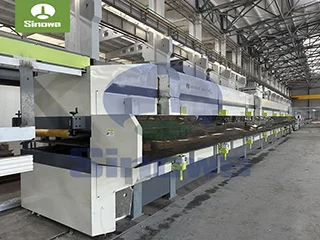
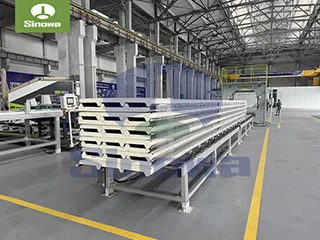
sandwich panel machine
The operational essence of PU sandwich panel machinery lies in the precise compounding of polyurethane foam core materials and double-sided surface materials, forming a layered composite structure with excellent thermal insulation, structural stability, and weather resistance. Different from traditional discrete manufacturing equipment, modern PU sandwich board production systems adopt a continuous assembly line design, where each functional unit is closely connected and logically coordinated to avoid intermittent production gaps and quality fluctuations caused by manual operation. The equipment system covers the whole production chain from surface material feeding, pretreatment, and roll forming to polyurethane raw material mixing, high-pressure foaming, closed composite pressing, constant temperature curing, cooling shaping, and fixed-length cutting, realizing one-stop molding of finished sandwich boards. This highly integrated working mode not only optimizes the production rhythm but also fundamentally guarantees the bonding firmness and structural uniformity between the core material and surface layers of each panel.
Raw material pretreatment and feeding serve as the initial and foundational link of the entire production process, determining the flatness and subsequent bonding effect of finished panels. The PU sandwich panel production line is equipped with automatic unwinding and leveling structures, which steadily release coiled surface materials such as color steel plates, aluminum alloy plates, and other metal or non-metal decorative plates. During the feeding process, the built-in calibration and deviation correction devices continuously adjust the conveying track of surface materials to prevent lateral offset and wrinkling, ensuring that the surface materials maintain a flat and tension-balanced state when entering the forming area. Meanwhile, the supporting pretreatment unit completes surface cleaning and uniform preheating of the board materials. Proper preheating eliminates the low-temperature resistance of the board surface, optimizes the adhesion condition between the surface material and polyurethane foam, and effectively avoids common quality defects such as hollowing, delamination, and incomplete fitting that easily occur in low-temperature production environments. The standardized feeding and pretreatment process lays a solid foundation for the stability of subsequent foaming and composite molding processes.
Foaming and injection molding is the core functional stage of PU sandwich panel line, which directly determines the thermal insulation performance and structural compactness of finished panels. The equipment is fitted with a precision raw material mixing and high-pressure injection system, which fully mixes polyurethane polyether and isocyanate raw materials in a fixed proportion through mechanical stirring and high-pressure atomization. The uniformly mixed liquid raw materials are evenly injected into the gap between the upper and lower surface materials through multi-point synchronous injection ports. Under the action of temperature control and pressure regulation inside the closed cavity of the equipment, the liquid polyurethane raw materials undergo rapid chemical reaction, continuous expansion, and uniform foaming. The mechanical pressure limiting and space limiting structure of the equipment can accurately control the foaming density and expansion range of the PU core layer, enabling the foam to fully fill the entire interlayer space without voids or uneven density distribution. After foaming, the primary composite structure formed by the surface material and PU core material initially completes bonding and shaping, presenting a dense closed-cell structure, which endows the sandwich board with excellent heat insulation, sound insulation, and pressure resistance potential.
Composite pressing and constant-temperature curing are key processes to finalize the structural stability of sandwich panels. After the completion of foam injection and primary foaming, the semi-finished boards are continuously transported to the pressing and curing unit along the production line. The equipment adopts flexible belt pressing technology, which provides uniform and stable pressure on the upper and lower surfaces of the boards, avoiding local deformation, thickness deviation, or core material extrusion caused by uneven pressure. The fully enclosed constant-temperature curing chamber creates a stable thermal environment for the chemical curing reaction of polyurethane foam, promoting the complete cross-linking and solidification of foam molecules. This slow and uniform curing process enhances the bonding strength between the PU core layer and the surface materials, making the integrated composite structure more durable and resistant to peeling. Compared with natural curing, mechanical constant-temperature curing greatly shortens the molding cycle, eliminates the influence of external ambient temperature and humidity on product quality, and ensures that the structural strength and performance of each batch of panels remain highly consistent.
Cooling shaping and fixed-length cutting are the finishing processes of panel production, responsible for standardizing the size and optimizing the surface flatness of finished products. The cured composite boards enter the circulating cooling system of the sandwich panel equipment, where the internal circulating air duct uniformly dissipates the internal heat of the boards, realizing gradual cooling and setting. Effective cooling can eliminate internal stress generated during the high-temperature curing process, prevent finished boards from warping, twisting, or shrinking after leaving the production line, and further stabilize the overall structural performance of the panels. After cooling and shaping, the boards are accurately measured and positioned by the automatic sensing system of the machinery, and the high-speed cutting device completes fixed-length cutting according to preset dimensional parameters. The cutting process maintains synchronous operation with continuous production, without stopping the assembly line, which ensures uninterrupted production rhythm and improves overall production efficiency. The cut finished panels have neat and smooth sections, uniform thickness, and no burrs, fully meeting the dimensional standard requirements of on-site construction and installation.
Modern PU sandwich panel machine features highly automated and intelligent operation characteristics, reducing reliance on manual operation and lowering human error risks in the production process. The equipment is equipped with an integrated control system that centrally regulates all links including feeding speed, raw material mixing ratio, foaming pressure, curing temperature, pressing time, and cutting size. Operators only need to set corresponding parameter values according to production demands, and the equipment can realize fully automatic cyclic operation. The real-time monitoring system built into the machinery can track the operating status of each functional unit, automatically identify abnormal fluctuations in parameters such as temperature, pressure, and speed, and trigger self-adjustment or early warning prompts. This intelligent control mode not only simplifies the operation threshold of the equipment but also realizes refined control of the production process, effectively improving the yield rate of finished products and reducing raw material waste caused by improper operation.
In terms of structural design, polyurethane sandwich panel production line has good flexibility and compatibility, adapting to diversified production demands in the market. By adjusting the equipment parameters and replacing simple auxiliary molds, the same production line can manufacture sandwich panels with different thicknesses, surface specifications, and structural styles, covering various types of wall panels, roof panels, and special-shaped enclosure panels required for construction. The equipment can match different surface materials including metal color plates, composite decorative plates, and fireproof plates, and adjust the foaming density and core layer thickness of polyurethane according to the usage scenarios of finished panels, meeting the differentiated performance requirements of thermal insulation, sound insulation, and structural load-bearing in different environments. In addition, the modular structural design of the machinery facilitates daily maintenance, component replacement, and equipment upgrading, reducing the difficulty and cost of later equipment operation and maintenance for production enterprises.
The application advantages of products produced by polyurethane sandwich panel line further highlight the practical value of the equipment in the industrial field. The finished PU sandwich panels have the characteristics of light weight and high strength, which can reduce the overall self-weight of buildings, lower the load-bearing pressure of building structures, and save construction and foundation investment costs. The dense closed-cell polyurethane core layer brings excellent low thermal conductivity, enabling the panels to achieve efficient thermal insulation and heat preservation effects, which can significantly reduce the energy consumption of building heating and cooling operations and conform to the global green building and energy-saving development trend. At the same time, the integrated composite structure formed by mechanical continuous molding has good waterproof, moisture-proof, wind-resistant, and seismic performance, with strong environmental adaptability, and can maintain stable service performance in high-temperature, low-temperature, humid, and other harsh environments.
In the field of industrial production, polyurethane sandwich panel machine has outstanding production efficiency and resource utilization advantages. The continuous assembly line production mode realizes uninterrupted processing of raw materials, greatly improves the hourly output and daily production capacity of panels, and can meet the large-scale and centralized procurement demands of engineering projects. The precise raw material proportioning and quantitative injection system of the equipment avoids excessive consumption of polyurethane raw materials, reduces material waste in the production process, and improves the utilization rate of raw materials. The automated integrated operation also greatly reduces the number of on-site operators, lowers labor costs in the production process, and improves the overall production benefit of the enterprise. In addition, the stable and standardized production process reduces the rate of defective products, avoids resource waste and cost loss caused by unqualified products, and further optimizes the economic benefits of production and processing.
With the continuous development of the construction industry toward greenization, industrialization, and prefabrication, the market demand for high-performance PU sandwich panels is constantly upgrading, which also promotes the continuous technological iteration and performance optimization of PU sandwich board manufacturing machinery. Modern equipment is gradually developing toward higher automation, more precise control, lower energy consumption, and stronger compatibility. The upgraded equipment optimizes the foaming reaction efficiency of polyurethane raw materials, further improves the compactness and uniformity of the core layer structure, and enhances the overall durability and service life of finished panels. At the same time, the energy-saving transformation of the equipment’s heating, pressing, and cooling systems reduces the energy consumption of unit product production, realizes green and low-carbon production, and adapts to the increasingly strict environmental protection production standards in various regions.
In practical industrial application, PU sandwich board production machinery has become the core production equipment for prefabricated building supporting materials, cold storage thermal insulation materials, industrial plant enclosure materials, and temporary building materials. The standardized and high-efficiency production capacity of the equipment provides stable and reliable material support for the rapid construction of modular buildings, cold chain logistics warehouses, industrial workshops, and municipal auxiliary facilities. Compared with traditional manual or semi-mechanical production methods, the fully automated mechanical production mode realizes unified standards for product size, performance, and quality, which is conducive to the standardized promotion and large-scale application of PU sandwich panels in the construction industry. With the continuous innovation of mechanical technology and the continuous expansion of market application scenarios, PU sandwich panel production machinery will play a more important role in the field of modern building material manufacturing, continuously empowering the high-quality development of the construction industry and green building engineering.
https://www.cnsinowa.com/sandwich-panel-machines/pu-sandwich-board-machinery.html