 sandwich panel line
The inherent structural advantages of polyurethane sandwich panels lay a solid foundation for commercial noise reduction. This type of panel adopts a typical composite sandwich structure, with dense and rigid metal or non-metal decorative panels as the outer protective layers and high-density polyurethane foam as the core filling layer. The special porous microporous structure of polyurethane foam enables it to effectively weaken sound wave energy during sound transmission. When external sound waves contact the panel surface, part of the sound energy is reflected by the outer dense panel, and the remaining sound waves penetrate into the foam core layer. The interconnected tiny pores inside the foam cause continuous friction and collision between sound waves and polymer materials, converting sound energy into thermal energy and dissipating it naturally, thereby achieving the effect of noise attenuation. In commercial application environments, this structural characteristic enables the panel to form an efficient sound insulation system for medium and low-frequency noise generated by mechanical equipment and high-frequency noise from human activities. Reasonably manufactured polyurethane sandwich panels can maintain stable sound insulation performance in a wide frequency band, effectively suppressing structural vibration noise and air-borne noise that are common in commercial spaces.
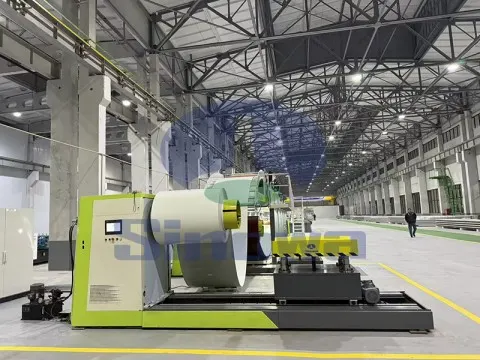
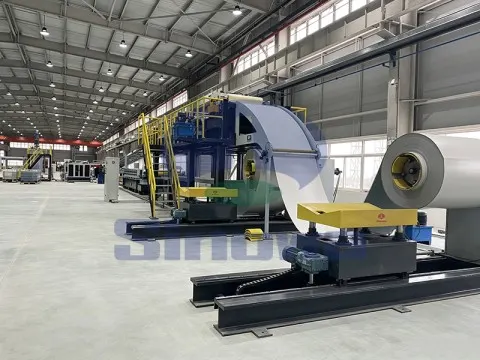
A complete PU sandwich panel production line for commercial noise reduction integrates multiple continuous processing units, realizing automated production from raw material pretreatment to finished product cutting and shaping. The overall production logic follows the principle of precise material compounding and continuous molding, focusing on optimizing the compactness of the foam core layer and the bonding firmness between layers to enhance the overall acoustic performance of the finished panels. The production process starts with the pretreatment of surface base materials. Flat coiled raw materials are uncoiled and leveled through professional unwinding equipment, eliminating surface wrinkles and internal stress generated during material storage and transportation. This leveling treatment ensures the flatness of the outer panel, which is crucial for avoiding acoustic performance attenuation caused by structural gaps in subsequent installation and use. After leveling, the surface materials undergo fine surface polishing and coating treatment to improve the adhesion between the outer layer and the polyurethane foam, while enhancing the weather resistance and surface abrasion resistance of the panels to adapt to long-term service in complex commercial environments.
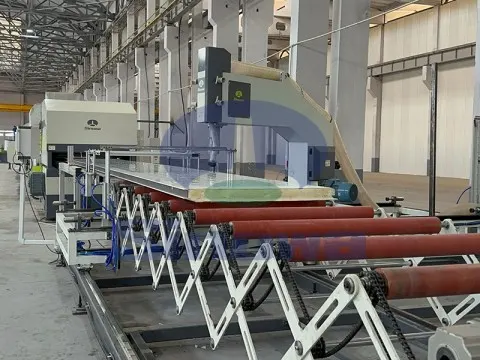
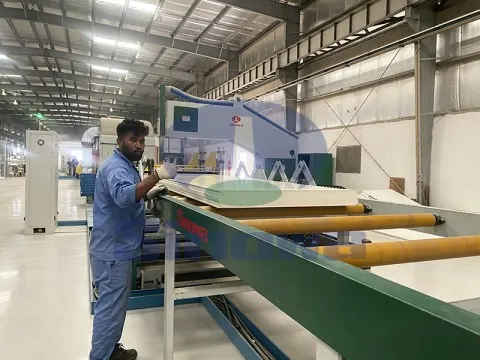
The foaming and compounding stage is the core link of the continuous sandwich panel line, which directly determines the noise reduction performance of polyurethane sandwich panels. In this production stage, quantitatively proportioned polyurethane raw materials are transported to the high-pressure foaming equipment through a closed conveying system. Under constant temperature and pressure conditions, the liquid raw materials undergo chemical reactions to generate uniform and stable foam materials. The production line is equipped with adjustable material injection devices, which can accurately control the foam density and pore structure according to the acoustic requirements of different commercial scenarios. For commercial spaces with severe low-frequency vibration noise such as equipment rooms and cold storage warehouses, the production line can increase the filling density of the foam core layer to enhance vibration damping performance; for shopping malls and office buildings dominated by high-frequency noise, the equipment adjusts the micropore distribution density to optimize the absorption effect of high-frequency sound waves. During the compounding process, the upper and lower surface materials and the foamed core layer enter the double-track pressing device together. The constant pressure and constant temperature pressing environment ensures that no gaps exist between the composite layers, avoiding sound leakage caused by hollow structures and greatly improving the overall airtightness and sound insulation performance of the panels.
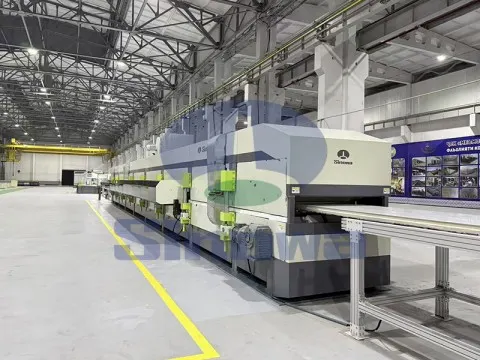
After preliminary compound molding, the semi-finished panels enter the curing and shaping area of the continuous sandwich panel production line. The independent constant-temperature curing chamber provides a stable heat preservation environment for the panels, which promotes the complete curing of polyurethane materials and further strengthens the bonding strength between layers. The curing time and temperature are intelligently adjusted according to the panel thickness and foam density to prevent internal structural deformation and performance degradation caused by uneven curing. In this link, the production line is equipped with real-time monitoring sensors to track the internal temperature and stress changes of the panels, feeding back data to the control system to dynamically optimize curing parameters. Fully cured polyurethane sandwich panels have more stable internal molecular structures, and their sound insulation performance will not fluctuate significantly due to temperature changes and subtle vibration interference in the external environment, which meets the long-term use requirements of commercial buildings with high environmental stability standards.
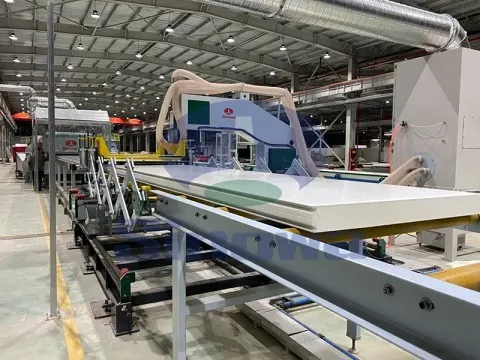
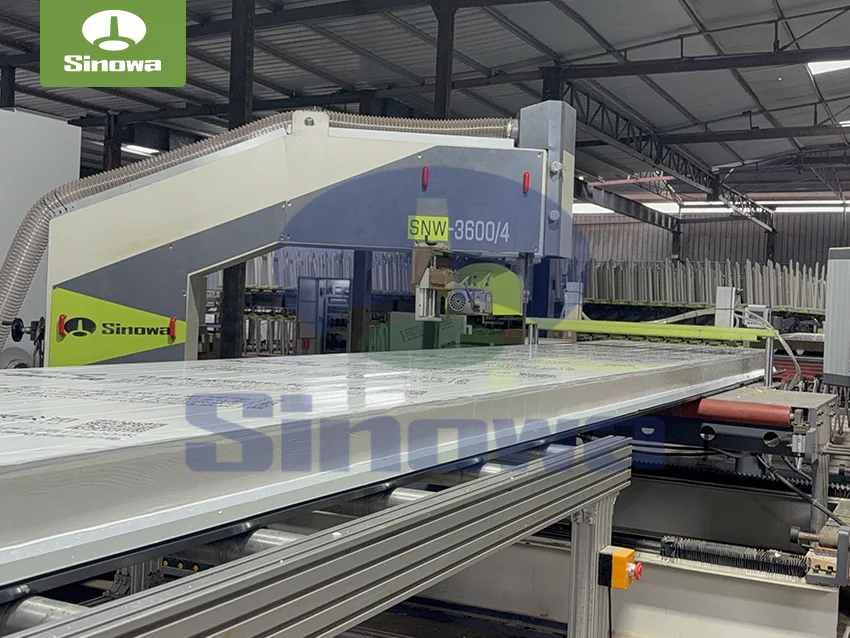
The final processing section of the production line includes fixed-length cutting, edge trimming, surface inspection and stacking packaging. The high-precision cutting equipment accurately cuts continuous molded plates into standard sizes according to production parameters, and the smooth and flat cutting sections effectively reduce the assembly gaps during on-site installation. The edge trimming process removes residual burrs and uneven foam on the plate edges, further optimizing the sealing performance of the plate assembly interface. The built-in inspection system of the production line conducts non-destructive sampling detection on the finished plates, focusing on checking the uniformity of the foam core layer, the bonding tightness of the composite interface and the flatness of the outer plate surface. Unqualified products with hollow cores and delamination will be automatically screened out to ensure that all delivered finished plates have consistent noise reduction performance. The fully inspected finished panels are automatically stacked and packed with moisture-proof and dust-proof protective materials, which facilitates safe transportation and on-site storage of products.
In order to adapt to the differentiated noise reduction needs of commercial scenarios, this type of sandwich panel production line has flexible performance adjustment capabilities in structural design. The equipment can adjust the plate thickness within a reasonable range to produce sandwich panels with different acoustic insulation grades. Thicker plates are applied to the enclosure structures of industrial commercial supporting facilities to resist high-intensity mechanical noise, while thin and lightweight plates are used for interior partition decoration of office buildings and retail stores to balance noise reduction effect and space utilization rate. In addition, the production line can match different surface layer materials according to the decoration style and environmental protection needs of commercial buildings. Different surface materials have varying sound wave reflection characteristics, which can be combined with polyurethane foam cores to form a diversified acoustic matching system, realizing targeted noise control in different frequency bands. The modular structural design of the production line also simplifies the daily maintenance work. The detachable processing units facilitate regular cleaning and replacement of vulnerable parts, reducing the shutdown maintenance time in the production process and improving the continuous production capacity of the production line.
Compared with traditional building noise reduction materials, polyurethane sandwich panels produced by professional production lines have comprehensive advantages in commercial application scenarios. In terms of acoustic performance, the uniform and dense foam structure of the panels can effectively weaken composite noise in the frequency range of 125Hz to 4000Hz, achieving stable sound attenuation effects. In terms of structural performance, the integrated composite molding process makes the panels have high compressive strength and bending resistance, which can withstand external wind pressure and structural extrusion without deformation, ensuring the long-term stability of noise reduction performance. In terms of construction application, the lightweight characteristics of the panels reduce the bearing load of commercial buildings, and the standardized size design simplifies the installation process, shortening the construction cycle of noise reduction renovation projects. Meanwhile, the closed-cell structure of polyurethane materials gives the panels excellent moisture resistance and thermal insulation performance. While realizing noise reduction, it optimizes the indoor temperature regulation effect for commercial spaces, reducing the energy consumption of heating and cooling equipment and creating an energy-saving and low-consumption operating environment for commercial venues.
The application scope of polyurethane sandwich panels produced by this automatic sandwich panel production line covers multiple commercial fields. In large commercial shopping centers, the panels are used for interior partitions and ceiling decorations to weaken crowd noise and equipment operation noise, maintaining a quiet and comfortable shopping environment. In modern office buildings, the panels serve as wall and partition materials to reduce the interference of external traffic noise and internal office cross-talk, improving office concentration and work efficiency. In logistics warehouses and cold storage facilities, the panels are applied to building enclosure structures to isolate the vibration noise generated by refrigeration equipment and handling machinery, and avoid noise impact on the surrounding commercial areas. In addition, for temporary commercial facilities such as exhibition halls and mobile business pavilions, the lightweight and easy-to-assemble characteristics of the panels also make them an ideal noise reduction building material, which can quickly build a stable acoustic environment for temporary commercial activities.
With the continuous improvement of commercial environmental quality standards, the market demand for high-performance noise-reducing building materials is constantly escalating, which promotes the continuous technological upgrading of polyurethane sandwich panel production line. In recent years, production line manufacturing technologies have gradually developed towards intelligent control and green production. The intelligent control system realizes one-click setting of production parameters, and automatically optimizes the foaming ratio and pressing pressure according to the acoustic performance requirements of customized products, reducing the error rate of manual operation. The green production transformation optimizes the raw material circulation system, reduces the volatilization of chemical substances during the foaming process, and minimizes the impact of the production process on the external environment. At the same time, the production line has added fine-tuning functions for microporous structures, which can further optimize the pore uniformity of the foam core layer, enhance the damping and sound absorption capacity for low-frequency noise, and make the product more adaptable to the complex noise environment of modern commercial buildings.
In the actual production and application process, the standardized production process of the polyurethane sandwich panel line effectively avoids the performance differences of handmade composite plates. The precise raw material ratio and constant temperature and pressure processing environment ensure that the density, pore structure and bonding strength of each batch of panels remain stable, so that the noise reduction effect of building enclosure structures will not be uneven due to product quality differences. Moreover, the production line focuses on the durability optimization of finished products. Through surface anti-aging treatment and internal structural stability optimization, the panels can maintain stable acoustic performance in long-term use, avoiding the attenuation of noise reduction effect caused by material aging and structural loosening. This long-term stability reduces the later maintenance cost of commercial building noise reduction projects and improves the comprehensive economic benefit of material application.
Looking ahead, the polyurethane sandwich panel production line for commercial noise reduction will further develop in the direction of multi-functional integration and personalized customization. On the basis of maintaining excellent noise reduction performance, the production line will integrate more functional processing technologies to produce composite panels with fire resistance, corrosion resistance and antibacterial properties, meeting the higher-level environmental requirements of high-end commercial places. The personalized customization function will be further upgraded to realize the independent adjustment of plate color, texture and acoustic parameters, adapting to the diversified architectural design styles of commercial buildings. With the continuous progress of industrial technology, the production line will also introduce more intelligent detection and feedback systems to realize real-time monitoring and dynamic optimization of the entire production process, further improve the yield and performance of noise-reducing panels, and provide more efficient and reliable material solutions for the acoustic environment optimization of the global commercial construction industry. As an important part of commercial noise reduction engineering, this type of production line will continuously empower the high-quality development of modern commercial spaces with technological innovation, and create quieter, more comfortable and more efficient operation environments for various commercial scenarios.
Sinowa is a professional manufacturer of sandwich panel machine in china, we provide diversified and high-performance sandwich panel production lines, including fully automatic continuous PU sandwich panel line and customized special lines to meet mass production and personalized order demands. These sandwich panel lines support processing multiple foam core materials, such as PU, PIR, mineral wool, rock wool and glass wool, covering different insulation and fireproof standards.
Featuring stable operation, high efficiency, energy saving and easy maintenance, our PU sandwich panel line deliver sandwich panels with excellent thermal insulation, fire resistance, sound insulation and lightweight durability. The finished panels are widely applied in industrial workshops, warehouse roofing and wall cladding, cold storage insulation, serving global construction and industrial insulation markets.
https://www.cnsinowa.com/sandwich-panel-machines/polyurethane-sandwich-panel-production-line-for-commercial-noise-reduction.html