 sandwich panel line
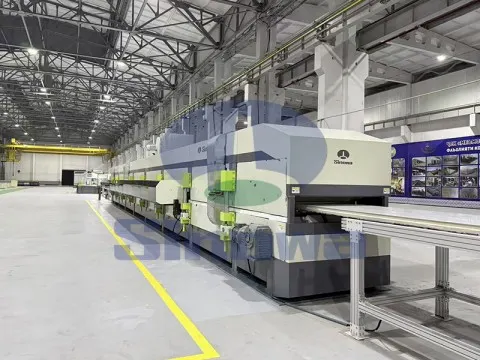
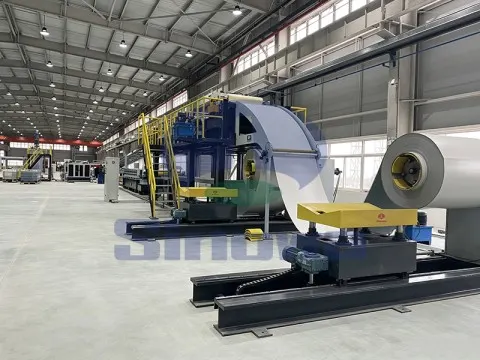
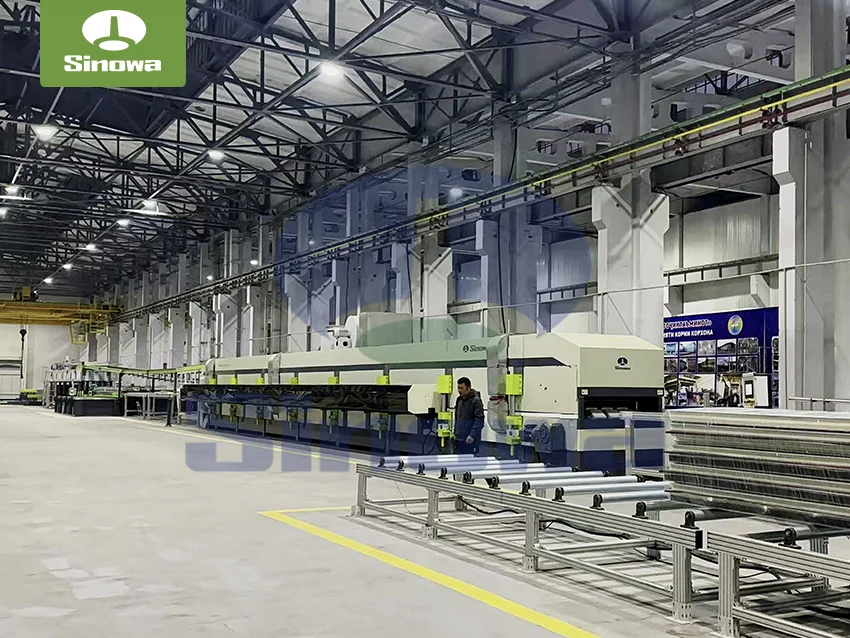
The overall structural composition of the metal carved insulated sandwich panel production line follows a streamlined production logic, with each functional unit closely connected to form an uninterrupted production workflow. The production line is mainly composed of raw material unwinding and leveling system, surface pretreatment unit, metal carving forming system, foaming material filling system, laminating and curing system, cooling shaping system, precise cutting system and finished product conveying system. Every functional module is designed with humanized mechanical structure and intelligent control logic, which can reduce manual intervention while ensuring the coordination and continuity of each production link. The internal mechanical transmission structure adopts high-strength metal accessories to adapt to long-term continuous industrial production, and the adaptive adjustment components are embedded in each processing unit to cope with raw materials of different thicknesses and hardness, realizing flexible switching of production parameters without tedious mechanical disassembly and replacement.
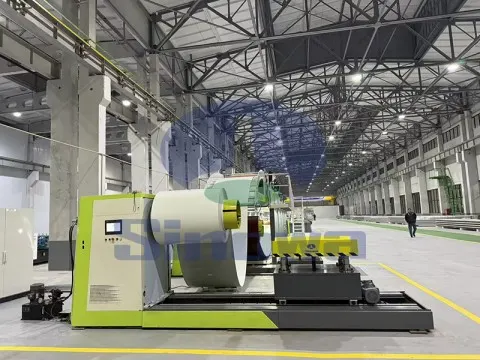
Raw material pretreatment acts as the initial and foundational stage of the entire production process, which directly affects the bonding tightness and surface flatness of subsequent composite processes. Metal coils used for panel surface layers are transported to the unwinding device through auxiliary conveying equipment, and the hydraulic unwinding structure can stably release coiled metal materials at a constant speed to avoid material deformation caused by uneven tension. After unwinding, the metal sheet will pass through a multi-group leveling roller set, which eliminates the internal stress of the metal sheet generated during coiling and storage. This process effectively improves the flatness of the metal surface and prevents irregular warping and bending of the finished panel in the later use stage. In the follow-up pretreatment process, the surface of the metal sheet will be cleaned to remove dust, oil stains and oxide layers attached to the surface. Physical dedusting and mild surface polishing methods are adopted to maintain the smooth metallic texture of the sheet, creating favorable bonding conditions for subsequent surface coating and internal foaming composite processing.
Surface decoration processing is a distinctive core link of metal carved insulated wall panels, and the intelligent carving system in the production line undertakes the key task of shaping panel appearance. Different from ordinary flat sandwich panels, metal carved panels require three-dimensional concave-convex textures on the metal surface to enhance the decorative effect and three-dimensional sense of the wall. The carving unit is equipped with numerically controlled pressing molds with customizable texture templates, which can simulate various natural textures such as stone grain, wood grain and artistic embossed patterns. During operation, the leveled metal sheet is accurately positioned by the conveying calibration device, and the hydraulic pressing structure applies uniform and stable pressure to complete one-time embossing and carving of the metal surface. The pressure control system can dynamically adjust the pressing intensity according to the metal thickness and texture depth requirements, ensuring that the carved lines are clear and layered without damaging the internal structural toughness of the metal sheet. After carving, the surface of the metal sheet will go through fine trimming to smooth the sharp edges generated by embossing, optimizing the surface touch and decorative fineness of the panel.
Surface coating protection is an essential procedure to enhance the weather resistance and corrosion resistance of metal carved panels. After the carving process is completed, the metal sheet will enter the automatic coating area of the production line. The coating process adopts uniform rolling coating technology to attach a high-molecular protective coating to the surface of the carved metal sheet. The coating material has excellent adhesion and ductility, which can closely fit the concave-convex carved texture without peeling or cracking. In the sealed coating operation space, the coating thickness is controlled within a reasonable uniform range to avoid quality defects such as local accumulation and missing coating. After coating, the metal sheet is sent to the constant-temperature drying channel for curing treatment. The gradient temperature control mode is adopted in the drying channel to slowly evaporate the volatile components in the coating, so that the protective coating can form a dense and stable protective film on the metal surface. This film can effectively isolate the erosion of external moisture, oxygen and corrosive substances, greatly extending the service life of wall panels in complex outdoor environments.
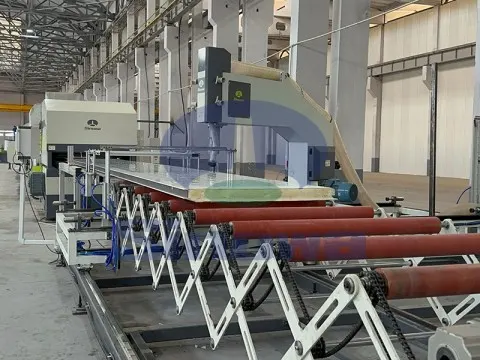
The internal thermal insulation core material filling and composite molding process determines the thermal insulation performance and structural stability of the sandwich wall panels. The production line is equipped with an automatic foaming feeding system, which mixes and injects high-performance polymer foaming materials into the gap between the upper and lower metal sheets. The raw materials of the foaming core layer are proportioned through an intelligent batching device to ensure the uniformity of material mixing and the stability of foaming density. In the closed composite space, the foaming material undergoes chemical reaction and gradual expansion to fill the entire gap between the metal plates without hollow gaps. Subsequently, the double-track laminating device applies constant pressure to the composite plate body. The laminating speed and pressure are precisely matched with the foaming curing speed, which can promote the tight bonding between the foaming core layer and the metal surface layer. The integrated composite structure formed by this process avoids the separation and delamination of the internal structure of the panel during long-term use, and improves the overall compression resistance and impact resistance of the wall panel.
Constant-temperature curing and cooling shaping are crucial links to stabilize the physical properties of composite panels. After lamination and preliminary molding, the panel is transported to the intelligent curing area, where the ambient temperature and humidity are accurately regulated to provide a stable reaction environment for the complete curing of the foaming core material. Moderate temperature curing can optimize the internal pore structure of the foaming layer, make the pore distribution uniform and dense, and significantly enhance the heat insulation and sound insulation capabilities of the panel. After curing, the high-temperature panel is sent to the circulating cooling system. The combined cooling mode of air cooling and water cooling is used to reduce the panel temperature to the normal ambient temperature at a uniform speed. The slow cooling method effectively prevents the panel from generating internal thermal stress due to rapid temperature change, avoids deformation, warping and cracking of the finished panel, and ensures the dimensional stability of the panel under different temperature environments.
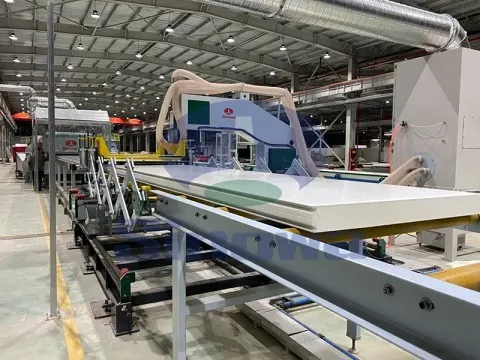
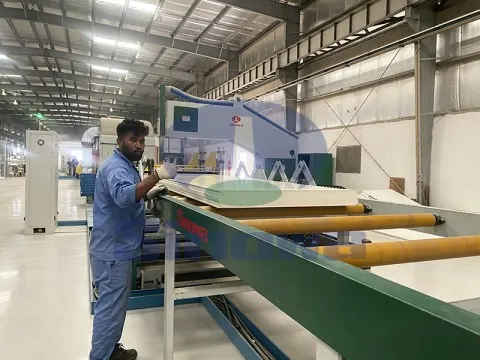
Precision cutting and post-processing operations realize the standardized sizing and finished product optimization of wall panels. The cooled and shaped semi-finished panels are transmitted to the cutting station along the automated conveyor belt. The cutting system is equipped with high-precision numerical control positioning components, which can set arbitrary cutting lengths and widths according to production requirements. The high-speed cutting tool adopts wear-resistant alloy materials to ensure smooth and neat cutting sections without burrs and metal collapses. After cutting, the edge trimming device performs edge sealing and smoothing treatment on the four sides of the panel. The edge sealing materials are tightly bonded with the metal layer and the foaming core layer to block the moisture penetration path at the edge of the panel, further improving the waterproof and moisture-proof performance of the wall panel. In addition, the production line reserves an adjustable processing station, which can complete simple bending and grooving operations on the panel according to the installation requirements of building walls, providing convenient structural conditions for on-site assembly and splicing.
The automated finished product sorting and conveying system realizes the orderly collection and temporary storage of finished panels. The processed qualified panels are automatically classified and stacked by the mechanical stacking device. The stacking speed and spacing are intelligently adjusted to prevent surface friction and extrusion damage between panels. The stacked finished products are transported to the finished product storage area through the roller conveyor line, and the whole process does not require a large number of manual handling operations. The closed production space of the entire production line can reduce the intrusion of external dust and impurities, maintaining the surface cleanliness of the finished panels. Meanwhile, the production line is equipped with a real-time monitoring system to track the operating status of each processing unit. Once abnormal parameters such as material deviation and pressure fluctuation are detected, the system will send out prompt signals and make adaptive adjustments to reduce the generation of defective products.
This type of sandwich panel line has prominent technical advantages in structural design and production performance compared with traditional sandwich panel production equipment. In terms of production efficiency, the continuous assembly line layout realizes seamless connection of multiple processes, greatly shortening the production cycle from raw materials to finished products. The intelligent control system simplifies the operation logic, and workers can complete the parameter setting and equipment monitoring of the entire production line through a simple operation interface, reducing the threshold of equipment use. In terms of production flexibility, the replaceable carving molds and adjustable processing parameters enable the production line to meet the personalized customization needs of different customers for panel patterns, thicknesses and sizes. In terms of production quality control, the integrated processing mode reduces human intervention errors, and the consistent mechanical processing parameters ensure the uniformity of the texture, thickness and performance of each batch of panels.
From the perspective of product performance, the metal carved insulated wall panels produced by this production line have comprehensive excellent characteristics. The metal surface layer with carved texture has strong weather resistance, which can resist ultraviolet radiation, rain erosion and temperature difference changes, and is suitable for long-term outdoor wall use. The internal foaming core layer has low thermal conductivity, which can effectively block indoor and outdoor heat transfer, realizing good building thermal insulation and energy saving effects. The integrated composite structure gives the panel high structural strength, which can resist external impact and local extrusion without permanent deformation. In addition, the compact internal pore structure of the core material has an excellent sound insulation effect, which can reduce the interference of external noise and improve the indoor living and working environment. The lightweight characteristics of the panel reduce the load-bearing pressure of the building wall, simplifying the wall construction process and shortening the construction cycle.
In terms of application scenarios, metal carved insulated wall panels produced by this production line cover a wide range of construction fields. In civil residential buildings, the panels are used for exterior wall decoration and thermal insulation transformation, realizing the integration of building decoration and energy saving. In commercial buildings such as shopping malls and office buildings, the diverse carved textures can meet the aesthetic design requirements of different building styles. In industrial construction fields such as factory workshops and temporary buildings, the panels rely on their advantages of easy installation, corrosion resistance and low maintenance cost to become the preferred wall building material. In addition, the panels are also applicable to special buildings with high requirements for thermal insulation and sound insulation, providing stable and reliable wall protection solutions for various functional buildings.
With the continuous development of the construction industry towards energy saving, environmental protection and intelligence, the upgrading direction of metal carved insulated sandwich panel production line has become increasingly clear. The future production lines will further optimize the energy consumption structure, adopt energy-saving driving components and waste heat recovery systems to reduce energy consumption in the production process. The intelligent monitoring system will be upgraded to realize full-process digital tracking of raw material consumption, production parameters and product quality, improving the refined management level of production. In terms of structural optimization, the production line will develop more compact and modular structural layout, which is convenient for equipment transportation, installation and daily maintenance. Meanwhile, it will be compatible with more environmentally friendly raw materials to meet the increasingly stringent environmental protection production standards in the construction material industry.
In conclusion, the metal carved insulated sandwich panel manufacturing line for walls is a highly integrated and intelligent industrial production equipment, which organically combines metal processing, foaming composite, surface decoration and precise cutting technologies. Through standardized and automated production processes, it stably outputs high-quality wall panels with decorative, thermal insulation and protective functions. The reasonable process flow, stable mechanical performance and flexible production capacity make this production line occupy an important position in the modern building energy-saving material manufacturing industry. With the continuous innovation of building materials technology and the expansion of market demand, this type of production line will keep optimizing and upgrading, continuously adapt to the diversified development needs of the construction industry, and provide reliable technical and equipment support for the popularization and application of high-performance composite wall panels.
Sinowa is a professional manufacturer of sandwich panel machine in china, we provide diversified and high-performance sandwich panel production lines, including fully automatic continuous PU sandwich panel line and customized special lines to meet mass production and personalized order demands. These sandwich panel lines support processing multiple foam core materials, such as PU, PIR, mineral wool, rock wool and glass wool, covering different insulation and fireproof standards.
Featuring stable operation, high efficiency, energy saving and easy maintenance, our PU sandwich panel line deliver sandwich panels with excellent thermal insulation, fire resistance, sound insulation and lightweight durability. The finished panels are widely applied in industrial workshops, warehouse roofing and wall cladding, cold storage insulation, serving global construction and industrial insulation markets.
https://www.cnsinowa.com/sandwich-panel-machines/metal-carved-insulated-sandwich-panel-production-line-for-wall.html