sandwich panel line
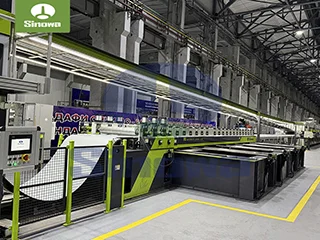
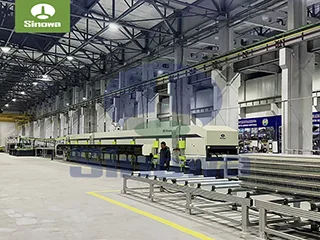
The basic structural design of an insulated sandwich panel production line follows the sequential logic of raw material input, processing, compounding, molding and finished product output, and the entire system consists of multiple interconnected functional modules with independent control functions and collaborative operating characteristics. Each module is equipped with specialized mechanical structures and sensing components to complete targeted processing procedures, and the coordinated operation of all modules realizes the continuous and streamlined production of sandwich panels. The raw material feeding module is the starting unit of the entire production line, which is responsible for the orderly transportation and preliminary arrangement of surface plates and core raw materials. For metal surface materials commonly used in industrial sandwich panels, this module is fitted with unwinding roller sets and tension adjusting structures. The roller sets can stably release coiled metal sheets, while the tension adjusting devices eliminate material deformation and offset caused by uneven traction during transportation, ensuring the flatness and linearity of surface materials entering the subsequent processing links. In terms of core material feeding, the module is designed with sealed conveying channels and quantitative feeding equipment to transport bulk porous raw materials such as rock wool, polyurethane foam and mineral wool. The internal baffle structure of the conveying channel avoids material scattering and loss, and the quantitative feeding component controls the feeding amount of core materials per unit time according to the preset production parameters, laying a foundation for the consistent thickness and uniform density of finished panels.
Following the feeding module, the surface material pretreatment module undertakes the key task of optimizing the surface state of panel substrates. During the storage and transportation of raw coiled materials, the surface is prone to accumulate dust, oil stains and oxide layers, which will seriously weaken the bonding tightness between surface plates and core materials and reduce the long-term structural stability of finished panels. The pretreatment process firstly adopts mechanical dust removal structures including high-pressure air blowing devices and brush roller sets to completely remove floating dust and particulate impurities on the material surface. For stubborn attachments such as oil stains and dense oxide layers, the insulation board production line is equipped with low-temperature cleaning and surface polishing components. The polishing structure uses fine abrasive belts to perform uniform grinding on the surface of metal plates, improving the surface roughness to enhance the adhesion of bonding materials. After polishing, the drying structure in the module quickly removes residual moisture on the material surface through circulating hot air, preventing moisture from remaining in the composite structure and causing internal mildew or corrosion. All pretreatment procedures are carried out in a closed space, which not only ensures the cleaning effect of raw materials, but also reduces the diffusion of dust and pollutants to the external production environment, realizing environmentally friendly processing.
The glue coating and material distribution module is the core link to realize the composite bonding of sandwich panels, and its operation accuracy directly determines the delamination resistance and service life of finished products. Modern insulation panel production line adopts automatic spraying and rolling composite gluing technologies, abandoning the traditional manual gluing method with uneven coating and low efficiency. The internal gluing system is equipped with intelligent flow control components, which can adjust the glue output per unit area according to the material type of surface plates and core layers. For rigid core materials with high density such as rock wool, the system increases the glue coating amount appropriately to enhance the contact adhesion between heterogeneous materials; for lightweight foam core materials, it reduces the glue usage to avoid excessive glue accumulation causing internal bulging of panels. The glue coating process maintains a constant temperature environment inside the equipment, which ensures the stable viscosity of the adhesive and prevents the glue liquid from solidifying prematurely or becoming too thin due to temperature fluctuations. After the completion of surface gluing, the core material distribution structure evenly spreads the quantitative core materials on the lower surface plate. The vibrating leveling component installed at the bottom of the distribution equipment eliminates internal gaps and cavities of bulk core materials, making the internal structure of the panel dense and uniform, and effectively improving the overall thermal insulation and sound insulation performance of the product.
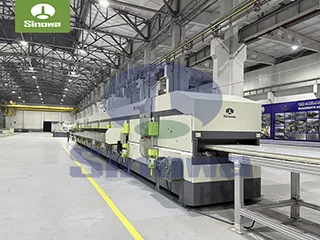
The compound molding and thermal curing module is the key functional unit to complete the permanent bonding of sandwich panel structures, and it mainly relies on mechanical pressure and constant temperature curing to realize the integrated molding of composite materials. The composite structure adopts an upper and lower double-layer roller pressing design, and the distance between the roller sets can be adjusted steplessly according to the preset thickness specifications of panels. During the pressing process, the equipment applies uniform static pressure to the stacked composite materials, which squeezes out the residual air between the surface plate and the core layer, eliminates bubbles and wrinkles inside the composite structure, and makes the bonding interface tighter. The internally arranged heating circulation system provides a stable temperature environment for curing, and the temperature gradient is scientifically set according to the thermal deformation characteristics of different raw materials. In the low-temperature preheating stage, the adhesive is slowly softened to fully infiltrate the tiny gaps on the material surface; in the constant-temperature curing stage, the chemical cross-linking reaction of the adhesive is accelerated to form a high-strength bonding layer; in the slow cooling stage, the internal stress of the composite panel is released gradually to avoid structural cracking caused by rapid temperature change. The entire curing process is completed in a closed thermal insulation channel, which not only improves the curing efficiency, but also reduces heat energy loss and realizes energy-saving production.
After the completion of thermal curing and preliminary shaping, the trimming and cutting module carries out precise shaping processing on the semi-finished continuous panels. Due to the traction deviation and material deformation in the early transportation process, the edges of the composite panels are prone to irregular warping and uneven margins, which affects the assembly accuracy and appearance flatness of subsequent engineering applications. This module is equipped with high-speed rotating alloy cutting tools and intelligent positioning sensing components. Before cutting, the infrared sensing system automatically detects the contour size and edge flatness of the panels, transmits the data to the control system, and adjusts the cutting track and tool operating angle in real time. The edge trimming process removes the irregular edge parts on both sides of the panel to ensure the straightness of the panel edges. The fixed-length cutting structure divides the continuous long-strip panels into standard-size finished products according to customized dimensional parameters. All cutting procedures adopt non-contact high-precision processing technology, which avoids surface scratches and structural damage to the panels during cutting, and ensures the smoothness and flatness of the cutting section. The waste materials generated during trimming are automatically collected by the sealed recovery pipeline, which is convenient for centralized recycling and reduces raw material waste.
The post-processing and finished product sorting module undertakes the final surface optimization and standardized storage of the panels. After cutting, the surface of the panels may have tiny burrs and residual glue stains, so the module is equipped with polishing and cleaning structures. The fine polishing roller set performs gentle grinding on the cutting section to remove burrs and sharp edges, improving the safety of panel handling and installation. The surface cleaning device uses neutral cleaning agents and soft cleaning cloths to wipe off residual impurities on the panel surface, maintaining the smooth and flat appearance of the finished products. For panels used in special environments such as humid and corrosive conditions, the post-processing module can additionally complete surface protective film covering. The transparent protective film is tightly attached to the panel surface through rolling pressure, which effectively prevents surface scratches, paint peeling and corrosion during transportation and stacking. Finally, the intelligent sorting and stacking structure automatically completes the horizontal transportation, turning and stacking of finished panels. The mechanical grabbing components operate stably with low noise, and the stacked panels are arranged neatly with consistent spacing, which is convenient for subsequent packaging, transportation and warehouse storage.
The automatic control system runs through all functional modules of the entire insulated sandwich panel line and is the intelligent core to ensure stable and efficient production. The system adopts a centralized integrated control mode, with a human-computer interaction terminal set in the production operation area. Operators can input production parameters such as panel thickness, size, operating speed and gluing amount through the terminal, and the system automatically synchronizes the parameter settings to each processing module. A large number of high-precision sensing elements are arranged inside each mechanical device, which monitor real-time data such as operating temperature, working pressure, material transportation speed and raw material consumption in the production process. When abnormal data such as excessive temperature, unstable pressure and material blockage occur, the control system will automatically trigger the early warning mechanism, simultaneously suspend the operation of faulty modules, and display the abnormal cause and processing position on the interaction terminal. The data storage function of the system records all production data in real time, which is convenient for production personnel to track the production status, optimize process parameters and complete production quality inspection. In addition, the system is designed with an interlocking protection logic between modules. When a single module fails, the upstream and downstream equipment will stop sequentially to avoid material accumulation and mechanical collision failures, greatly improving the operational safety of the production line.
The rational layout and environmental adaptation design of the insulated sandwich panel production line are crucial to improving production efficiency and reducing operating costs. In terms of plant layout, the production line follows the one-way flow logic of raw material input, processing and finished product output. The feeding area is set in the independent raw material storage area on one side of the plant, which is isolated from the processing area to avoid raw material contamination. The core processing modules such as gluing, compounding and curing are arranged in the middle closed workshop to maintain a constant processing temperature and reduce external environmental interference. The finished product sorting and stacking area is set in the open and flat area on the other side of the plant, which is convenient for loading and outbound transportation. The insulation sandwich panel machine is equipped with a complete dust removal and waste gas treatment system. The dust generated by raw material cutting and polishing is collected through negative pressure air ducts, and the volatile organic gases generated by adhesive curing are purified by filtration and adsorption structures before being discharged up to standard. The circulating water system is used for equipment cooling and raw material cleaning, realizing the recycling of water resources and reducing water consumption in the production process.
In actual industrial production, the daily maintenance and parameter optimization of the insulation sandwich panel manufacturing line directly affect the service life of equipment and the stability of product quality. Daily maintenance work mainly includes surface cleaning, lubrication maintenance and component inspection. After the daily production is completed, the residual raw materials and adhesive stains on the surface of rollers, cutting tools and conveying pipelines need to be completely cleaned to prevent material solidification from affecting the subsequent processing accuracy. The transmission bearings and moving hinge parts of the equipment are regularly coated with high-temperature resistant lubricating oil to reduce mechanical friction loss and avoid abnormal noise and jamming during operation. The staff regularly inspect the wearing parts such as cutting blades, polishing abrasive belts and sealing gaskets, and replace the aging and damaged components in a timely manner to ensure the processing precision of the equipment. In terms of process parameter optimization, production personnel adjust the operating parameters according to the external ambient temperature and humidity. In high-temperature and high-humidity seasons, appropriately extend the curing time and reduce the operating speed to ensure sufficient bonding reaction of the adhesive; in low-temperature and dry environments, increase the preheating temperature to avoid poor fluidity of the adhesive. Long-term production data analysis shows that scientific maintenance and parameter optimization can effectively reduce the equipment failure rate by more than thirty percent and extend the service life of mechanical components by nearly half.
Insulated sandwich panel production machine has significant technical advantages compared with traditional intermittent panel manufacturing equipment, which are mainly reflected in production continuity, product consistency and resource utilization efficiency. The continuous production mode realizes uninterrupted feeding, processing and molding, eliminating the standby time of equipment caused by single-batch mold closing and opening in intermittent production, and the comprehensive production capacity is several times higher than that of traditional equipment. The unified parameter setting and intelligent monitoring system ensure that the thickness, density, bonding strength and appearance flatness of each batch of finished panels remain stable, avoiding quality fluctuations caused by manual operation differences. In terms of resource utilization, the precise quantitative feeding structure reduces the waste of core materials and adhesives, and the sealed recovery system realizes the recycling of cutting waste materials. Meanwhile, the closed thermal insulation curing channel reduces heat energy loss, and the overall energy consumption per unit of finished products is significantly reduced. In addition, the highly automated operation mode minimizes the number of on-site operators, reduces the labor cost of production enterprises, and improves the safety level of the production workshop.
With the continuous upgrading of downstream application industries, the market has put forward higher requirements for the diversification, lightweight and environmental protection performance of insulated sandwich panels, which also promotes the continuous technological iteration of production lines. In terms of product diversification, modern production lines adopt modular adjustable structures. By replacing different feeding components and gluing systems, they can complete the production of multi-type sandwich panels such as metal composite panels, color-coated decorative panels and fireproof insulation panels, meeting the differentiated needs of different application scenarios. In terms of lightweight optimization, the insulation sandwich panel machinery optimizes the material distribution density and composite pressure parameters, reducing the overall weight of the panel on the premise of ensuring structural strength, which is convenient for transportation and on-site installation. In terms of environmental protection upgrading, the production line gradually adopts water-based environmentally friendly adhesives and low-volatile raw materials, and optimizes the waste gas and waste residue treatment process to realize green and low-carbon production. At the same time, the intelligent upgrading of the equipment is constantly advancing. The introduction of remote data monitoring and automatic fault diagnosis functions enables production management personnel to master the operating status of the production line in real time, further improving the intelligent management level of the production workshop.
In the context of the rapid development of the global construction industry and industrial manufacturing, the application scope of insulated sandwich panels will continue to expand, and the market demand for high-efficiency and intelligent production lines will maintain a steady growth trend. In the future, the technological development direction of insulated sandwich panel production line will focus on intelligent linkage, energy conservation and emission reduction, and flexible customization. The intelligent linkage technology will realize the interconnection between production lines and enterprise management systems, complete automatic scheduling of production plans and real-time tracking of product quality. The energy-saving transformation will adopt new thermal insulation materials and energy recovery structures to further reduce the energy consumption of the curing and heating links. The flexible customization function will realize one-click switching of panel specifications and rapid adjustment of production processes, meeting the personalized customization needs of small-batch and multi-variety products. While continuously optimizing mechanical performance and intelligent level, the production line will also pay more attention to production safety and environmental protection compliance, promoting the entire composite panel manufacturing industry to develop in a standardized, efficient and green direction.
To sum up, an insulated sandwich panel production line is a comprehensive industrial system integrating mechanical transmission, chemical processing, intelligent control and environmental protection treatment. It completes the efficient manufacturing of high-performance composite panels through multiple precise and coordinated processing links from raw material pretreatment to finished product sorting. The structural design, process parameters and operation management level of the sandwich panel making machine determine the comprehensive performance of finished panels and the economic benefits of production enterprises. With the continuous progress of industrial manufacturing technology, the performance of insulated sandwich panel production lines will be further optimized, which can provide more high-quality and reliable composite building materials for the construction, cold chain, industrial manufacturing and other industries, and make important contributions to the modernization and high-quality development of the global building material industry.
https://www.cnsinowa.com/sandwich-panel-machines/insulated-sandwich-panel-production-line.html