sandwich panel machine
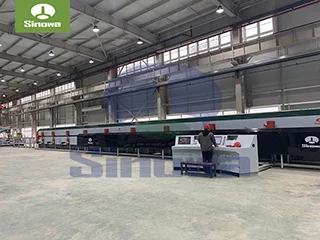
The foaming and laminating module represents the heart of the PUF panel machine, where the chemical reaction and physical forming of the polyurethane foam take place, and its structural refinement directly determines the uniformity, density, and insulation performance of the panel core. This module is equipped with a high-pressure mixing and injection system that precisely blends polyol and isocyanate raw materials in strict proportion, ensuring a thorough and homogeneous chemical reaction to generate closed-cell polyurethane foam with optimal thermal resistance. The injection mechanism is designed with adjustable flow rate and distribution width, allowing for even foam spreading across the entire surface of the lower facing material, while the upper facing material is synchronously fed and pressed onto the foam layer to form a sandwich structure. The laminating unit features a set of precision-adjustable pressure rollers, which maintain consistent clamping pressure and spacing throughout the production process to control the thickness and flatness of the panels, eliminate air bubbles within the foam core, and ensure tight adhesion between the foam and both outer facings. Adjacent to the foaming module is the curing and shaping section, which employs a temperature-controlled heating system to accelerate the cross-linking and solidification of the polyurethane foam, shortening the curing time without compromising the structural integrity of the foam. This section is insulated to maintain a stable thermal environment, with segmented temperature regulation to match the curing characteristics of the foam, ensuring that the panels achieve sufficient hardness and dimensional stability before entering the cutting stage. The cutting and trimming mechanism is equipped with high-speed saw blades or cutting tools driven by servo motors, enabling accurate cutting of the continuous panel strip into fixed lengths or custom sizes as per production requirements, with smooth cut edges and minimal material waste to boost production efficiency and resource utilization. The centralized control console serves as the nerve center of the entire machine, integrating electrical control, parameter setting, and real-time monitoring functions, allowing operators to adjust production speed, foam thickness, curing temperature, and cutting dimensions with high precision, while also providing fault alerts and operational feedback to simplify operation and reduce manual intervention.
In terms of performance, PUF panel machines are characterized by high production efficiency, stable operational reliability, wide material adaptability, and precise process control, making them suitable for large-scale, continuous production while meeting diverse application demands for panel specifications. Production efficiency is a key performance indicator, with modern PUF panel machines adopting continuous production technology and high-speed transmission systems, enabling a steady production speed that supports the output of hundreds of meters of panels per hour, significantly outpacing traditional manual or semi-automatic production methods and meeting the supply needs of large-scale construction projects and industrial manufacturing. Operational stability is another critical performance trait, as these machines are built with heavy-duty frames and high-quality transmission components, such as precision gears, bearings, and conveyor belts, to withstand long hours of continuous operation without significant wear or performance degradation. The robust structural design minimizes vibration and deformation during production, ensuring consistent panel quality even during extended running periods, while the optimized foaming and control systems reduce the incidence of production defects such as uneven foam density, surface wrinkling, or dimensional deviation. Material adaptability further enhances the machine's versatility, as it can accommodate a wide range of outer facing materials with different thicknesses, strengths, and surface treatments, from thin metal sheets to rigid composite panels, and can produce panels with varying core thicknesses, densities, and performance properties by adjusting foaming parameters and raw material ratios. This adaptability allows the same machine to manufacture panels for different purposes, from lightweight interior partition panels to heavy-duty load-bearing roof and wall panels, expanding its application scope and production flexibility. Process control precision is equally vital, with advanced PUF panel machines utilizing digital control systems and sensor technology to achieve real-time monitoring and adjustment of key production parameters, including material feeding speed, foam injection volume, curing temperature, and clamping pressure. The high-precision control ensures that each panel meets strict dimensional tolerances and performance standards, with consistent thermal insulation, compressive strength, and water resistance across all production batches, eliminating quality fluctuations caused by human error or environmental changes.
PUF sandwich panel machine is classified into distinct types based on production process, automation level, and application scope, each tailored to specific production scales, panel types, and operational requirements, offering targeted solutions for different manufacturing scenarios. Based on the production process, they are mainly divided into continuous PUF panel machines and discontinuous (batch) PUF panel machines. Continuous PUF panel machines are designed for large-scale, high-volume production, featuring a fully integrated linear production line that completes all processes from material feeding to final cutting in a seamless, uninterrupted flow. These machines are ideal for mass production of standard-sized wall panels, roof panels, and cold storage panels, offering exceptional efficiency and consistent quality, making them the preferred choice for large building material manufacturers. Discontinuous PUF panel machines, by contrast, operate in a batch production mode, with separate stations for foaming, laminating, and curing, making them more compact in size and flexible in operation. They are suitable for small-batch, customized production of special-shaped panels or low-volume orders, with lower investment costs and easier operation, catering to the needs of small and medium-sized manufacturers or enterprises producing custom panel products. Based on automation level, PUF panel machines are categorized into fully automatic, semi-automatic, and manual models. Fully automatic PUF panel machines feature integrated intelligent control systems that automate the entire production process, including material loading, parameter setting, foaming, curing, cutting, and panel stacking, with minimal manual involvement required only for routine inspection and maintenance. These machines offer the highest production efficiency and quality consistency, equipped with fault self-diagnosis and remote monitoring functions to reduce labor costs and operational risks. Semi-automatic PUF panel machines combine automated core processes with manual assistance for certain tasks such as material handling or size adjustment, striking a balance between automation and operational flexibility; they are more cost-effective than fully automatic models and suitable for manufacturers with moderate production demands and limited budgets. Manual PUF panel machines are simpler in structure, relying heavily on manual operation for most production steps, with basic foaming and forming functions; they are compact, low-cost, and easy to maintain, making them suitable for micro-enterprises or small-scale trial production of PUF panels. Additionally, PUF panel machines can be classified by application purpose into general-purpose models and special-purpose models. General-purpose PUF panel machines are versatile, capable of producing a wide range of standard sandwich panels for conventional construction and industrial use, while special-purpose models are engineered for specific high-demand applications, such as cold storage panel machines optimized for high-density foam and enhanced insulation performance, clean room panel machines designed for smooth, dust-resistant panel surfaces, and load-bearing panel machines reinforced for higher structural strength and compressive resistance.
The applications of PUF sandwich panel production machine span across multiple industries, driven by the superior performance of the polyurethane foam sandwich panels they produce, addressing critical needs for thermal insulation, structural support, and quick construction in various sectors. In the construction industry, PUF panel machines are widely used to manufacture wall panels, roof panels, and partition panels for prefabricated buildings, industrial workshops, warehouses, and commercial complexes. The panels produced by these machines offer excellent thermal insulation and sound absorption properties, reducing energy consumption for heating and cooling in buildings, while their lightweight yet high-strength design simplifies transportation and installation, accelerating construction progress and lowering overall project costs. Prefabricated buildings constructed with these panels feature high structural stability, fire resistance, and weather resistance, making them suitable for a variety of architectural styles and functional requirements, from large industrial plants to modern commercial office buildings and residential prefabricated homes. The cold chain logistics sector represents another major application field, where PUF panel machines produce specialized cold storage panels, walk-in freezer panels, and refrigerated container panels. These panels have ultra-high thermal insulation performance due to the dense closed-cell polyurethane foam core, effectively preventing heat transfer and maintaining stable low-temperature environments, which is essential for preserving perishable goods such as food, pharmaceuticals, and biological samples. The panels are also designed with tight sealing structures to avoid cold air leakage, further enhancing energy efficiency of cold storage facilities and ensuring the quality and safety of stored products throughout the cold chain.
In the industrial manufacturing sector, PUF panel machines are utilized to produce custom insulation panels and protective enclosures for various industrial equipment and production lines. The panels provide effective thermal insulation and noise reduction for high-temperature or low-temperature industrial equipment, maintaining stable operating temperatures and reducing energy loss, while also protecting equipment from dust, moisture, and mechanical damage, extending its service life. Additionally, these panels are used to construct industrial clean rooms, laboratories, and electronic manufacturing workshops, where the smooth, non-porous surface of the panels resists dust accumulation and is easy to clean, meeting the strict hygiene and environmental control requirements of precision manufacturing and scientific research. The agricultural sector also benefits from PUF panel machines, which produce insulation panels for livestock houses, poultry farms, and agricultural greenhouses. The panels help maintain a stable internal temperature and humidity in agricultural facilities, creating a favorable growth environment for livestock and crops, improving breeding efficiency and crop yield, while their corrosion resistance and moisture resistance make them suitable for the harsh environmental conditions of agricultural production. Beyond these core sectors, PUF panel machines find applications in the production of portable buildings, temporary shelters, and emergency construction facilities, as the quick-installation and high-insulation panels enable rapid construction of durable, comfortable structures in remote areas, disaster-stricken regions, or temporary work sites, providing reliable living and working spaces for personnel.
As industrial technology and construction standards continue to evolve, PUF sandwich panel making machine is undergoing continuous optimization and upgrading in structure, performance, and functionality, aligning with the growing demand for energy-efficient, environmentally friendly, and high-performance building materials. Manufacturers are focusing on enhancing the intelligence and automation of these machines, integrating advanced technologies such as artificial intelligence and Internet of Things to realize remote control, predictive maintenance, and adaptive process adjustment, further improving production efficiency and product quality. Environmental performance is also a key development direction, with optimized foaming systems adopting eco-friendly foaming agents and low-emission raw materials to reduce environmental impact during production, while energy-saving designs for heating and transmission systems lower power consumption and operational costs. The diversification of machine types and production functions is another prominent trend, with more customized and multi-functional PUF panel machines being developed to meet the demand for special-shaped, high-strength, and multi-functional sandwich panels in emerging industries. With their robust structural design, reliable performance, and wide-ranging applicability, PUF panel machines will continue to play a pivotal role in the global insulated panel manufacturing industry, supporting the development of energy-efficient construction, cold chain logistics, and modern industrial production, and providing stable, high-quality equipment support for the production of high-performance polyurethane foam sandwich panels across diverse sectors.
https://www.cnsinowa.com/sandwich-panel-machines/puf-panel-machine.html