sandwich panel line
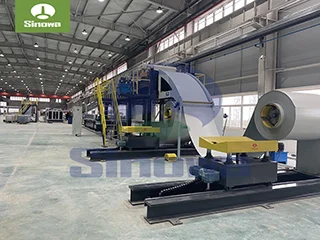
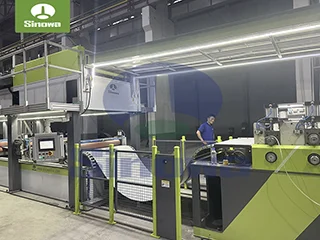
The overall structural composition of a complete PU insulated sandwich panel manufacturing line covers multiple functional modules, each undertaking independent processing tasks while maintaining precise collaborative coordination during long-term continuous operation. The front-end feeding module serves as the starting point of the entire production process, mainly responsible for the orderly supply of metal surface materials and auxiliary sheet materials. This module is equipped with multi-station unwinding structures that can store multiple rolls of raw sheet materials simultaneously, enabling non-stop material switching to avoid production stagnation caused by raw material replacement. Built-in correction devices monitor the conveying track of sheet materials in real time, fine-tuning the material deflection through automatic sensing and mechanical adjustment to ensure the horizontal flatness of surface materials in the conveying process and eliminate lateral deviation that may affect subsequent composite precision. Before formal forming, the surface pretreatment mechanism carries out dust removal and surface smoothing treatment on the raw sheets, removing tiny impurities and surface attachments generated during raw material storage and transportation. This simple yet essential pretreatment process enhances the surface adhesion between metal sheets and PU foam materials, effectively preventing peeling and delamination of composite layers in long-term service.
Following the feeding and pretreatment stage, the rolling forming module reshapes flat metal sheets into specific cross-sectional profiles to meet the assembly and connection requirements of different application scenarios. This module adopts multi-group roller sets arranged in an orderly gradient, and the curved radian and compression distance of each roller are precisely debugged to achieve gradual cold bending of metal materials. Compared with one-time stamping forming, gradient rolling effectively reduces internal stress of metal sheets, avoiding surface deformation and micro-cracks that may occur during intensive processing. The roller spacing and operating parameters can be adjusted according to the preset panel specifications, realizing flexible switching of sheet thickness, edge groove shape and connection structure. During the rolling process, real-time monitoring components track the dimensional accuracy of formed sheets, feeding abnormal data back to the control system for parameter correction, so that the flatness and dimensional tolerance of each processed sheet remain within a reasonable stable range. The formed metal sheets are then stably transported to the composite forming area through buffer conveying equipment, ensuring seamless connection with the foaming and bonding process.
The PU foaming and mixing module constitutes the core functional unit of the entire manufacturing line, determining the thermal insulation performance, density uniformity and bonding strength of finished panels. Polyurethane foam is formed by the chemical reaction between two main raw materials, and this module is designed to realize accurate proportional mixing and high-speed stirring of raw materials. The raw material storage area maintains a constant temperature and dry environment to prevent moisture from contacting with chemical raw materials, as moisture interference will disrupt the foaming reaction balance and lead to uneven internal pore structure of the foam. The conveying pump delivers different raw materials to the mixing chamber at a stable flow rate, and the intelligent flow control system dynamically adjusts the material ratio according to environmental temperature and production speed to adapt to the reaction characteristics of polyurethane under different working conditions. High-speed stirring components homogenize the mixed raw materials in an extremely short time to avoid local concentration difference, which ensures the consistency of foam density in all parts of the panel. After mixing, the liquid raw materials are evenly sprayed between the upper and lower metal sheets through quantitative spraying devices, laying a uniform foundation for subsequent composite curing.
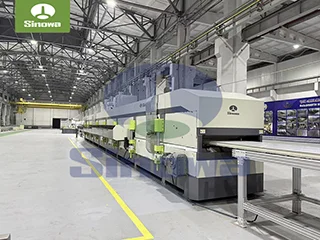
The continuous composite pressing module undertakes the key task of integrating surface sheets and PU foam into an integral structure, relying on constant temperature and constant pressure working conditions to complete foam curing and composite bonding. The pressing section is composed of upper and lower high-strength conveyor belts with excellent pressure resistance and temperature resistance, and the gap between the belts is adjusted according to the preset panel thickness to ensure uniform stress on the entire panel surface. During the pressing process, the internal temperature of the closed curing channel is kept within a fixed range to provide a stable reaction environment for polyurethane foaming and solidification. Moderate and continuous pressure makes the foaming raw materials fully fill the gap between metal sheets, eliminating hollow cavities and gap defects inside the panels. The length of the curing channel is scientifically matched with the production speed, ensuring that the polyurethane foam completes molecular polymerization and structural shaping before leaving the pressing area, forming a compact and stable thermal insulation core layer. The collaborative operation of temperature control system and pressure system effectively avoids quality problems such as inconsistent foam hardness and uneven panel thickness caused by unstable external conditions.
After completing composite curing, the panels enter the cooling and shaping stage to release internal stress generated during high-temperature pressing and foaming. The natural air cooling channel is connected behind the pressing module, adopting layered circulating air distribution to achieve uniform heat dissipation on the upper and lower surfaces of panels. Slow and balanced cooling can prevent the composite panels from producing bending deformation and internal structural cracks due to rapid temperature difference changes. In this stage, the internal molecular structure of polyurethane tends to be stable, and the bonding force between the foam core and metal sheets is further enhanced, improving the overall structural durability of the finished products. The conveying speed of the cooling area is synchronized with the front-end production rhythm to avoid panel accumulation and extrusion, and the surface flatness of panels is maintained through flexible limiting structures during transportation. Meanwhile, simple surface inspection is carried out manually and mechanically to preliminarily screen out defective products with obvious surface scratches and uneven bonding.
The precision cutting and edge trimming module processes the continuously produced long-strip composite panels into finished products of specified dimensions, realizing standardized product sizing. Driven by high-precision servo motors, the cutting equipment can complete transverse fixed-length cutting and longitudinal edge trimming according to preset dimensional parameters. The cutting tools are made of wear-resistant alloy materials to ensure smooth cutting sections without burrs and metal deformation, which improves the assembly convenience of subsequent panel installation. The edge trimming process optimizes the edge structure of panels, removing residual foam and irregular metal edges to form neat and uniform assembly grooves. The cutting system has independent parameter storage functions, which can quickly recall the dimensional parameters of commonly used panels to shorten the parameter adjustment time during production switching. All cutting actions are completed automatically under program control, and the error range of cutting dimensions is controlled at a low level to meet the high-precision assembly requirements of industrial buildings and cold storage projects.
The post-processing and stacking module serves as the final link of the production line, including surface cleaning, finished product inspection, automatic stacking and packaging preparation. The surface cleaning device removes dust, residual foam debris and oil stains on the panel surface through air blowing and soft friction, ensuring the smooth and clean appearance of finished panels. The intelligent inspection system detects multiple indicators such as surface flatness, coating integrity, cutting dimensional accuracy and internal bonding compactness through non-destructive sensing technology, eliminating unqualified products with internal voids and poor bonding. Qualified finished panels are transported to the stacking platform, and the mechanical stacking arm arranges the panels neatly in a fixed order to avoid surface friction and collision damage. The stacked panels are arranged with uniform spacing, which is convenient for subsequent binding and transportation, and also creates favorable conditions for finished product storage and inventory management. The entire post-processing process minimizes manual contact, reducing surface contamination and scratch damage caused by human operation.
The intelligent control system runs through all functional modules of the production line, acting as the central nerve to coordinate the synchronous operation of each mechanical structure. The centralized control panel integrates production parameter setting, real-time data monitoring and abnormal alarm functions, and operators can complete the adjustment of production speed, panel specifications, temperature parameters and material ratio through simple operation instructions. The sensor components distributed in each production link collect real-time data such as material conveying speed, heating temperature, pressing pressure and cutting dimension, and feed the data back to the control system for real-time analysis and dynamic correction. When abnormal conditions such as material blockage, temperature fluctuation and equipment vibration occur, the system will automatically trigger an alarm signal and execute slow-down or shutdown protection actions to prevent equipment damage and mass production of defective products. The data storage function records the production operation data for a long time, which is convenient for production traceability and subsequent equipment maintenance and parameter optimization.
In actual industrial production applications, the operating characteristics of PU sandwich panel production line determine their wide adaptability to diverse production demands. The continuous production mode greatly improves production efficiency compared with intermittent single-panel processing equipment, and the streamlined process reduces intermediate handling links and material waste. The modular structural design facilitates daily maintenance and later upgrading of the equipment; each functional module can be independently disassembled and debugged without affecting the overall operation of the production line. In terms of raw material compatibility, the production line can adapt to metal sheets of different thicknesses and surface treatment processes, and can also adjust the foam density and core layer thickness to produce insulated panels with different thermal insulation grades and mechanical strength. The panels produced by this kind of production line have excellent air tightness, thermal insulation performance and structural stability, and can maintain stable working performance in high temperature, low temperature and humid environments.
With the continuous progress of industrial manufacturing technology, polyurethane sandwich panel production line is evolving towards higher automation, energy saving and intelligent optimization. The upgraded production lines adopt more efficient heat circulation systems to reduce energy consumption in the heating and curing process, realizing low-carbon and environmentally friendly production. The optimized foaming mixing structure improves the utilization rate of chemical raw materials, reducing raw material waste and residual pollutants in the production process. In terms of intelligent upgrading, the production line is equipped with automatic fault diagnosis and remote monitoring functions, which can judge equipment wear and hidden faults through operating data, realizing predictive maintenance and reducing equipment downtime. In the future, with the continuous improvement of building energy conservation standards and the expansion of cold chain infrastructure construction scale, PU insulated panel manufacturing lines will further optimize production accuracy and production capacity, continuously adapt to the diversified and high-quality market demand, and provide reliable production support for the development of the insulated composite panel industry. The technological iteration of the production line will also drive the overall performance improvement of PU insulated panels, making such composite materials more widely used in modern industrial construction, commercial cold storage, transportation insulation and other fields.
https://www.cnsinowa.com/sandwich-panel-machines/pu-insulated-panel-manufacturing-line.html