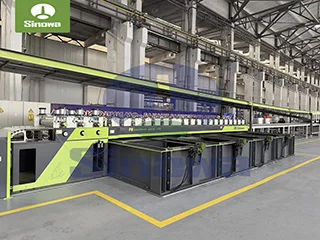
sandwich panel line
The overall structural design of an isolation sandwich panel line follows the principles of continuous operation, compact layout and intelligent coordination, and it is composed of multiple interconnected functional subsystems that jointly complete the whole manufacturing process of panels. The raw material processing subsystem is the initial functional module of the entire production line, which undertakes the pretreatment work of surface plates and core insulation materials. For metal surface plates commonly used in industrial production, this subsystem is equipped with flattening and dedusting devices to eliminate surface wrinkles, burrs and floating impurities generated during metal coiling. The mechanical flattening structure adopts multi-group roller sets with adjustable spacing, which can carry out micro deformation correction on plates of different thicknesses to ensure uniform flatness of the plate surface and lay a foundation for subsequent bonding and composite processing. For porous core materials such as rock wool, polyurethane and polystyrene, this subsystem is equipped with cutting and shaping components to cut bulk core materials into uniform specifications, while removing broken particles and irregular fragments on the material surface. The precise pretreatment of raw materials effectively avoids composite defects such as uneven bonding and internal gaps in subsequent processing, and improves the overall qualification rate of finished products.
Following the raw material processing stage, the glue coating and bonding preparation subsystem starts to operate, which is the key link to ensure the bonding strength between the surface plate and the core material. This subsystem is equipped with an automatic glue spreading structure, which can evenly apply environmentally friendly adhesive materials on the inner surfaces of upper and lower plates and the contact surfaces of core materials. Different from manual glue application methods in small-scale processing, the automatic glue spreading device realizes quantitative and uniform glue output through mechanical transmission and flow control structures. It can adjust the glue coating thickness according to the material texture and application scenarios of panels, effectively avoiding quality problems such as glue accumulation, leakage and sparse coating. During the glue application process, the constant temperature maintenance structure inside the subsystem keeps the adhesive in the optimal active state, ensuring that the adhesive can exert stable bonding activity without premature solidification. Meanwhile, the built-in dust isolation structure prevents external floating dust from adhering to the adhesive surface, which guarantees the tightness of the composite interface of the sandwich panel and enhances the long-term structural stability of the finished product.
The composite molding subsystem is the core functional section of the entire production line, undertaking the pressing and preliminary shaping of composite panels. After the completion of glue coating, the surface plates and core materials are accurately butted and stacked through the automatic conveying structure, and then sent to the pressure molding area. This area is equipped with a hydraulic pressing mechanism with adjustable pressure parameters, which can apply continuous and uniform static pressure to the stacked composite materials. The pressure range is scientifically controlled according to the hardness and compression resistance of the core material. For soft porous core materials, low and medium pressure is adopted to prevent internal structural collapse caused by excessive compression, while for rigid insulation core materials, moderate pressure is used to strengthen the fitting degree between layers. In the pressing process, the constant temperature curing auxiliary structure works synchronously to provide a stable temperature environment for the adhesive reaction, accelerate the molecular bonding reaction of the adhesive, and realize preliminary bonding and shaping of all layers of the panel. The integrated design of conveying and pressing ensures that the panels maintain a stable moving track during processing, avoiding lateral displacement and layer dislocation, so as to ensure the consistency of panel thickness and structural symmetry.
After preliminary composite molding, the panels enter the constant temperature curing subsystem for deep curing treatment, which is an essential procedure to improve the comprehensive mechanical properties of isolation sandwich panels. The interior of the curing area is a closed heat preservation space with evenly distributed heating and air circulation components. The temperature inside the space is kept within a reasonable constant range to provide a stable reaction environment for the deep curing of adhesives. During the curing process, the internal molecular structure of the adhesive is further cross-linked and stabilized, and the bonding force between the surface plate and the core material is continuously enhanced, which effectively improves the peeling resistance and shear resistance of the composite interface. In addition, the slow air circulation system inside the curing space can discharge trace volatile substances generated during the adhesive curing process, reducing residual gas inside the panel and avoiding structural bulging caused by gas accumulation in the later use stage. The curing time can be adjusted according to the panel thickness and core material type, so as to ensure that each batch of panels achieves the optimal curing state and meet the strength requirements of different usage scenarios.
The fixed-length cutting and edge trimming subsystem realizes the size standardization of finished panels, which is crucial for the unified installation and assembly of building engineering. The cured semi-finished panels are transported to the cutting area through the intelligent conveying track, and the high-precision sensing components inside the subsystem automatically identify the panel length and position. The numerical control cutting structure adopts sharp alloy cutting tools to complete fixed-length cutting smoothly, and the cutting section is flat without burrs or cracks. For the edge parts of the panels, the edge trimming mechanism carries out fine polishing and trimming to eliminate sharp edges and surface uneven areas, which not only improves the appearance flatness of the panels but also facilitates the seamless docking and assembly between panels during construction. Meanwhile, the debris collection device is equipped in the cutting area to uniformly recycle the cutting waste generated in the processing process, realizing centralized disposal of waste materials and reducing material waste in the production process. The automated cutting procedure avoids size errors caused by manual operation, and the dimensional tolerance of finished panels is controlled within a tiny range to meet the high-precision construction requirements of modern buildings.
The final stage of the continuous sandwich panel line includes surface inspection, cleaning and finished product stacking. The intelligent inspection components installed at the end of the production line conduct comprehensive non-destructive detection on the processed panels. The detection scope covers surface flatness, interface bonding tightness, edge integrity and overall dimensional consistency, and automatically screen out unqualified products with defects such as surface scratches, internal gaps and uneven thickness. For qualified panels, the automatic cleaning structure removes surface dust and residual processing debris to keep the panel surface smooth and clean. Subsequently, the mechanical stacking device arranges the finished panels in an orderly manner according to standardized stacking specifications. The stacking process adopts a buffer protection structure to avoid extrusion and collision between panels, preventing surface wear and edge damage. The whole ending process is completed by automated equipment, which reduces manual contact with finished products, effectively lowers the probability of artificial damage, and improves the neatness and uniformity of finished product storage.
Compared with scattered manual processing equipment, the integrated isolation sandwich panel production line has prominent technical and production advantages in industrial manufacturing. In terms of production efficiency, the streamlined connection of each functional subsystem realizes uninterrupted continuous production from raw material input to finished product output. The automatic conveying and processing structure reduces intermediate handling links, shortens the production cycle of a single panel, and can realize large-scale batch manufacturing. In terms of product quality control, the production line adopts unified parameter setting and mechanical processing standards. Factors such as glue coating amount, pressing pressure and curing temperature are precisely controlled by intelligent systems, which avoids quality fluctuation caused by human operation differences and ensures the stable performance consistency of each batch of panels. In terms of operational cost control, the highly automated production mode reduces the demand for manual labor, simplifies the production management process, and optimizes the material utilization rate through precise blanking and waste recycling structures, thereby effectively reducing comprehensive production consumption.
In terms of production safety and environmental protection, the modern isolation sandwich panel production line has carried out optimized design in multiple details. All mechanical transmission parts are equipped with closed protective structures to avoid mechanical injury risks caused by accidental contact during equipment operation. The electrical control system has overload protection and emergency braking functions, which can quickly cut off the power supply in case of abnormal equipment operation to ensure production safety. For harmful substances possibly generated in the production process, the sealed curing space and gas circulation purification structure effectively reduce the emission of volatile substances, and the recycled waste materials are centrally processed to avoid environmental pollution caused by random discharge. In addition, the low-noise transmission structure is adopted for the operating components of the production line to reduce mechanical operation noise, improve the on-site production environment, and meet the environmental protection production requirements of modern industrial workshops.
With the continuous upgrading of building energy conservation and environmental protection standards, the market demand for isolation sandwich panels with high thermal insulation, high fire resistance and light weight is constantly increasing, which also promotes the continuous technological iteration of isolation sandwich panel production lines. At present, the development direction of production lines focuses on intelligent upgrading and multi-functional optimization. More high-precision sensing elements and intelligent control modules are applied to the production line to realize real-time monitoring and dynamic adjustment of processing parameters. The production line can automatically identify raw material specifications and intelligently match processing parameters such as glue coating amount and pressing pressure, realizing flexible production of panels with different thicknesses and core materials. Meanwhile, the energy-saving transformation of the production line is gradually promoted. The waste heat generated by the curing and pressing links is recycled and reused, reducing energy consumption in the production process and improving the energy utilization efficiency of the equipment.
In the field of industrial application, isolation sandwich panels produced by automated production lines have covered diversified usage scenarios. In industrial factory buildings, these panels are used for wall and roof enclosure structures, relying on their excellent thermal insulation and weather resistance to reduce building energy consumption and improve the internal operating environment of factories. In clean workshops in the pharmaceutical and electronic industries, the smooth surface and stable sealing performance of the panels can reduce dust accumulation and meet the high cleanliness requirements of the production space. In low-temperature storage facilities, the low thermal conductivity of the core material gives the panels excellent cold insulation performance, which effectively reduces the operating energy consumption of refrigeration equipment. In addition, the panels also show good application potential in temporary construction buildings and municipal public facilities, providing convenient and reliable enclosure materials for rapid construction projects.
In the future, driven by material science and intelligent manufacturing technology, the isolation sandwich panel production line will further develop towards higher integration, lower energy consumption and stronger compatibility. The continuous optimization of composite bonding technology will improve the interfacial bonding strength and durability of panels, and the intelligent management system will realize the whole-process digital monitoring of production data, which is convenient for enterprises to carry out production scheduling and quality traceability. At the same time, with the popularization of green building concepts, the production line will be more compatible with environmentally friendly and degradable core materials and adhesive materials, realizing low-carbon and pollution-free production. As an important part of the building material manufacturing industry, the isolation sandwich panel production line will continuously empower the upgrading of the construction industry, provide high-quality composite insulation materials for various engineering projects, and create greater economic and social value for the modern construction field.
https://www.cnsinowa.com/sandwich-panel-machines/isolation-sandwich-panel-production-line.html