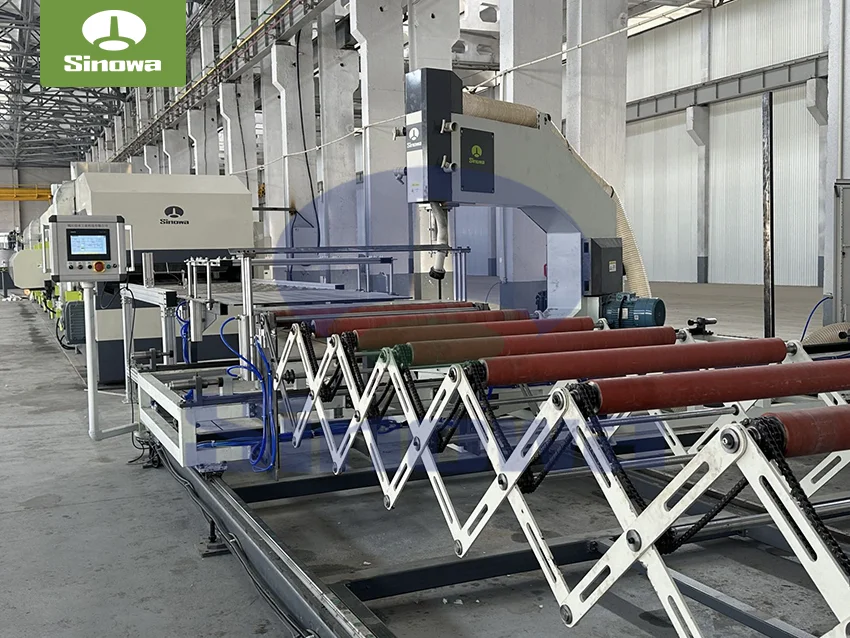
 sandwich panel line
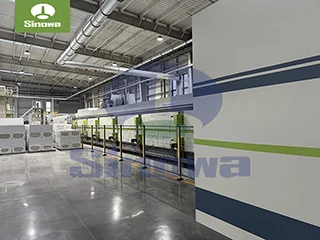
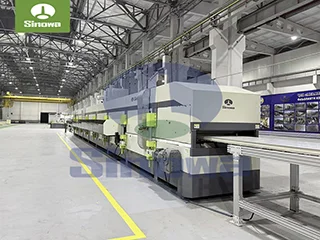
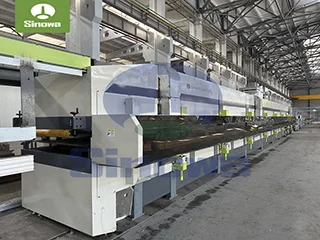
A complete PUR sandwich panel line is a highly integrated automated production system composed of multiple functional modules, each of which has an independent operational logic and interlocking collaborative relationships to ensure the continuity and stability of the production process. From the perspective of overall structural layout, the production line follows a linear streamlined arrangement, which conforms to the material conveying direction and simplifies the transfer links between processing procedures. The main structural components include raw material unwinding units, surface substrate pretreatment mechanisms, automatic gluing and foaming systems, continuous rolling composite devices, constant temperature curing cabins, fixed-length cutting mechanisms, post-processing trimming equipment, and finished product stacking systems. Each functional unit is matched with an intelligent transmission system and an electrical control system to realize synchronous operation, avoiding production stagnation caused by mismatched operating speeds of individual equipment. In addition, auxiliary facilities such as heat circulation systems, dust removal devices, and raw material circulation pipelines are configured inside the production line to create a stable production environment suitable for PUR foaming and composite molding, effectively reducing the interference of external temperature, humidity, and dust on product molding quality.
The raw material unwinding unit is the starting link of the entire assembly line, mainly responsible for placing and continuously outputting sheet substrates used for the upper and lower layers of sandwich panels. Common substrate materials include metal color-coated sheets, galvanized sheets, and non-metal composite flat plates, all of which are stored in a coiled state to facilitate continuous feeding. The unwinding structure is equipped with a hydraulic tension control component, which can dynamically adjust the feeding tension according to the running speed of the subsequent production line. This adjustment function effectively avoids substrate deformation, wrinkling, and uneven stretching caused by excessive tension or loose feeding during the conveying process. Meanwhile, the unwinding unit is matched with an automatic deviation correction mechanism. By sensing the lateral offset of the substrate in real time, it fine-tunes the placement angle of the material coil to ensure that the substrate always maintains a linear conveying track, laying a foundation for the consistent dimensional accuracy of subsequent composite molding. For production lines that need to switch between different types of substrates, the unwinding structure adopts a modular detachable design, which simplifies the replacement steps of material coils and shortens the downtime caused by raw material switching.
After completing stable feeding, the substrate will enter the pretreatment process, which is a key procedure to improve the bonding firmness between the surface substrate and the PUR core material. The pretreatment mechanism is mainly composed of surface cleaning equipment and surface flattening components. The cleaning structure removes oil stains, dust, and oxide layers attached to the surface of the substrate through physical brushing and air pressure purging. These impurities are common unavoidable attachments in the raw material storage and transportation links, and residual impurities will directly reduce the adhesion between the PUR foam layer and the substrate, leading to degumming and peeling of the finished panel during long-term use. The flattening component adopts multi-group dense roller sets to perform repeated rolling correction on the bent and uneven substrates. The gap between the rollers can be precisely adjusted according to the thickness of different substrates to eliminate internal stress generated during the coiling and processing of the sheet. After pretreatment, the surface of the substrate maintains high flatness and cleanliness, which creates favorable adhesion conditions for the subsequent foaming and gluing process and significantly improves the service life of the finished sandwich panel.
The foaming and mixing system is the core functional module of the PUR sandwich panel production line, determining the pore structure, density uniformity, and thermal insulation performance of the polyurethane foam core layer. This system is mainly composed of raw material storage tanks, metering transmission components, high-precision mixing chambers, and movable material distribution equipment. Two independent sealed storage tanks are used to store polyether polyol and polymethylene polyphenyl isocyanate respectively, which are the basic raw materials for PUR foaming. Each storage tank is equipped with a constant temperature heat preservation interlayer to maintain the raw materials within a constant temperature range, preventing the change of raw material viscosity and chemical activity caused by excessive temperature fluctuation. The metering transmission part adopts frequency conversion motors to drive independent metering pumps, which can accurately control the output flow of different raw materials. By adjusting the operating speed of the metering pumps, the mixing ratio of the two raw materials can be precisely controlled to meet the foaming density requirements of panels for different usage scenarios.
After precise metering, the raw materials are transported to the sealed mixing chamber for high-speed stirring and homogeneous fusion. The internal stirring structure of the mixing chamber adopts an optimized blade design, which can complete the rapid mixing of raw materials in a short time and eliminate tiny bubbles generated during the mixing process. Insufficient mixing will lead to uneven local density of the foam core layer, while excessive mixing will cause chemical reaction overheating and affect the structural stability of the foam. The mixed liquid foam is evenly sprayed on the inner surface of the lower substrate through the movable material distribution equipment. The material distribution mechanism can perform reciprocating horizontal movement according to the set track, cooperating with the linear conveying speed of the substrate to realize seamless and uniform coverage of the foam liquid on the substrate surface. The spraying thickness and distribution range of the foam can be adjusted through the control system to adapt to the production requirements of sandwich panels with different core layer thicknesses. In the entire foaming process, the system maintains a closed processing environment to avoid the volatilization of chemical components and reduce the impact on the production environment.
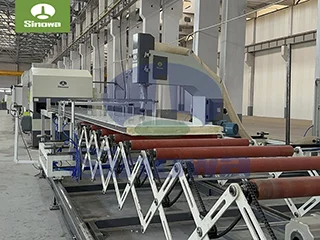
The continuous rolling composite device undertakes the key task of bonding the upper substrate, foam core layer, and lower substrate into an integrated structure. This equipment is composed of multi-group upper and lower pressing roller sets, a pressure sensing adjustment module, and a synchronous transmission mechanism. After the foam liquid is sprayed, the upper substrate is automatically covered by the feeding guide structure, and the three-layer structure enters the gap between the pressing rollers as a whole. The rolling pressure is accurately controlled within a stable range, and the pressure sensor monitors the extrusion force in real time to avoid core layer collapse caused by excessive pressure or insufficient bonding tightness caused by low pressure. The length of the rolling section is reasonably extended to prolong the pressure holding time of the composite structure, so that the foam liquid can fully infiltrate the contact surface of the substrate and form a stable adhesive bonding layer. Meanwhile, the internal temperature of the rolling area is maintained within the optimal reaction temperature range of PUR materials through the circulating heating system, which accelerates the curing reaction of the foam and enhances the bonding strength between layers.
The constant temperature curing cabin is an important facility to complete the secondary molding and structural stabilization of sandwich panels. After rolling and preliminary bonding, the semi-finished panels enter the closed curing cabin for continuous heat preservation treatment. The interior of the curing cabin is divided into multiple independent temperature control sections, and each section is equipped with a circulating hot air heating device and a temperature sensing element. According to the chemical curing characteristics of PUR foam, the temperature gradient in the cabin is scientifically set to realize staged slow curing of the panels. The low-temperature pre-curing section stabilizes the preliminary bonding structure to prevent layer dislocation during conveying; the medium-temperature strengthening section accelerates the cross-linking reaction of foam molecules to improve the compactness of the core layer; the constant-temperature shaping section eliminates the internal stress generated during the molding process. The sealed cabin body reduces heat loss, and the air circulation system ensures uniform temperature distribution in all areas of the cabin, avoiding local uneven curing of panels caused by temperature differences. The reasonable curing time matches the production rhythm of the assembly line, which not only ensures the complete curing of the foam structure but also avoids production efficiency reduction caused by excessive curing time.
The fixed-length cutting and trimming mechanism realizes the shaping and size classification of finished panels. After being discharged from the curing cabin, the continuous long-strip composite panels are conveyed to the cutting station through the transmission track. The high-precision length measuring sensor monitors the conveying distance of the panels in real time, and automatically sends cutting instructions when the panels reach the preset size. The cutting equipment adopts hydraulic driving mode to complete vertical cutting at a constant speed. The cutting blade is made of high-hardness alloy materials, which can smoothly cut composite structures composed of metal substrates and foam core layers without generating burrs and edge collapses. In order to meet the installation requirements of engineering construction, the trimming equipment is configured on both sides of the cutting station to perform edge planing and trimming on the two sides of the panels. The trimming width can be adjusted according to the usage standards to remove the uneven edge materials generated in the composite process, so that the edge of the finished panel maintains a flat and neat state. All cutting and trimming actions are linked with the conveying system, realizing non-stop dynamic cutting and effectively improving the continuous production capacity of the assembly line.
The post-processing and finished product stacking system is the final link of the assembly line, including surface detection, waste removal, automatic stacking, and temporary storage functions. After cutting and trimming, the panels pass through the surface detection platform, where the visual sensing device automatically identifies surface scratches, indentations, and uneven bonding defects. The system marks unqualified products separately and isolates them from the qualified product conveying line to avoid mixing defective products into the finished product stack. For the residual edge materials generated by trimming, the automatic waste removal device collects and concentrates them through the conveying pipeline to facilitate subsequent centralized processing and resource recycling. Qualified finished panels are transported to the stacking station, and the mechanical grabbing mechanism completes horizontal stacking in an orderly manner according to the set stacking height and arrangement mode. The stacking mechanism is equipped with a buffer protection structure to prevent surface wear and extrusion deformation of the panels during the grabbing and stacking process. The stacked finished products are neatly arranged, which is convenient for subsequent transportation, storage, and loading operations.
The intelligent electrical control system runs through all functional units of the PUR sandwich panel machine and is the core command center to coordinate the synchronous operation of various equipment. The system adopts an integrated control cabinet with a human-computer interaction display interface, which can visually display the operating parameters of each link, including raw material flow, processing temperature, conveying speed, rolling pressure, and cutting size. Production personnel can complete parameter setting, mode switching, and equipment debugging through simple touch operations. The internal program of the control system is equipped with an automatic compensation algorithm. When the raw material viscosity, ambient temperature, and conveying speed fluctuate slightly, the system can automatically adjust the operating parameters of metering pumps, heating devices, and pressure components to ensure the stability of product quality. In addition, the system has a built-in fault diagnosis and early warning function. When equipment failure, material blockage, and parameter abnormality occur, it will automatically trigger an alarm prompt and perform emergency shutdown protection to reduce equipment loss and production safety risks. The modular circuit design simplifies the later maintenance steps of the control system and improves the convenience of equipment operation and management.
In terms of production performance characteristics, the PUR sandwich panel assembly line has significant advantages in production continuity, product consistency, and resource utilization. The entire production process realizes automated feeding, processing, and discharging, with minimal manual intervention. Only a small number of operators are required to complete parameter monitoring and equipment maintenance, which effectively reduces labor costs and avoids quality fluctuations caused by manual operation errors. The standardized parameter setting mode ensures that the thickness, density, bonding strength, and dimensional error of each batch of finished panels are kept within a narrow fluctuation range, meeting the unified installation and construction standards of large-scale engineering projects. In terms of raw material utilization, the closed foaming system reduces the volatilization and waste of chemical raw materials, and the recycled waste materials generated in the trimming process can be reprocessed and reused after crushing treatment, realizing efficient utilization of production resources. Meanwhile, the optimized structural layout reduces the occupied space of the production line, which is convenient for factory planning and production line layout adjustment.
The finished panels produced by the assembly line have excellent comprehensive physical and chemical properties, which are closely related to the refined control of each processing link of the production line. The compact cellular structure formed by PUR foam after precise foaming and curing gives the panels low thermal conductivity, enabling them to maintain stable thermal insulation performance in high and low temperature environments. The composite structure formed by high-pressure rolling bonding enhances the overall mechanical strength of the panels, which can resist external impact and bending deformation during transportation and use. In addition, the optimized production process improves the waterproof, moisture-proof, and corrosion resistance of the panels. The seamless composite structure avoids moisture penetration, and the stable chemical properties of PUR materials can resist the erosion of humid air and weak corrosive media. These performance advantages make the panels suitable for diversified usage scenarios such as industrial factory buildings, cold storage warehouses, temporary construction facilities, and clean engineering workshops.
In the actual industrial production process, the daily maintenance and standardized operation of the PUR sandwich panel production line are crucial to extend the service life of the equipment and maintain stable production efficiency. Daily maintenance work includes surface cleaning of transmission rollers, checking the tightness of connecting pipelines, replenishing lubricating oil for rotating parts, and cleaning residual foam impurities in the mixing chamber. Regular maintenance involves detecting the accuracy of metering components, calibrating temperature and pressure sensors, inspecting the wear degree of cutting blades, and testing the sensitivity of the control system. The production environment should maintain constant temperature and low dust conditions. Excessively low ambient temperature will affect the foaming reaction efficiency of PUR raw materials, while excessive dust will adhere to the substrate surface and reduce the bonding quality. Operators need to follow standardized operation procedures to avoid parameter modification without authorization and equipment overload operation. Scientific maintenance management can effectively reduce equipment failure rates, prolong the continuous working time of the production line, and reduce the long-term operation cost of manufacturing enterprises.
With the continuous improvement of industrial manufacturing requirements for energy conservation, environmental protection, and high precision, the PUR sandwich panel manufacturing line is constantly evolving and optimizing in structural design and technical performance. In terms of environmental protection upgrading, the production line adds waste gas purification and noise reduction structures to reduce the emission of trace volatile substances in the production process and lower the mechanical operation noise, realizing green and low-carbon production. In terms of intelligent upgrading, the production line is connected with industrial data management systems to record production parameters, product output, and defect information in real time. By analyzing production data, enterprises can optimize production processes and improve product qualification rates. In terms of structural optimization, the lightweight and modular design of equipment components simplifies the disassembly, transportation, and transformation steps of the production line, enabling it to adapt to different factory spaces and customized production needs. In addition, the production line is developing towards multi-material compatibility, which can realize the composite processing of various substrates and core materials to expand the application scope of finished panels.
In the context of the booming global construction and industrial manufacturing industry, the market demand for high-performance composite sandwich panels continues to grow, which further highlights the industrial value of PUR sandwich panel assembly lines. As a mature and efficient composite material production equipment, it integrates multiple advanced processing technologies to solve the problems of low efficiency, unstable quality, and high resource consumption in traditional panel production. Through reasonable process layout, precise parameter control, and intelligent operation management, the assembly line can continuously provide high-quality standardized sandwich panels for the construction industry, creating reliable material support for energy-saving buildings, industrial facilities, and special engineering projects. In the future, with the continuous breakthrough of new material technology and intelligent manufacturing technology, the production performance of PUR sandwich panel assembly lines will be further improved, the production process will be more refined and environmentally friendly, and the customized production capacity will be continuously enhanced to adapt to the diversified and high-end development trend of the composite building material market. It will also play a more important role in promoting the standardized development of the building material industry and optimizing the industrial production system.
https://www.cnsinowa.com/sandwich-panel-machines/pur-sandwich-panel-assembly-line.html