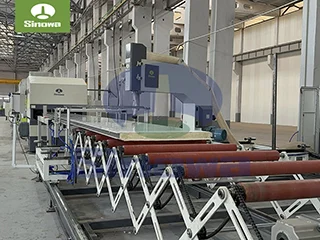
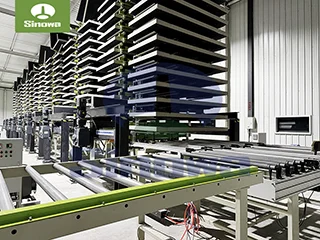
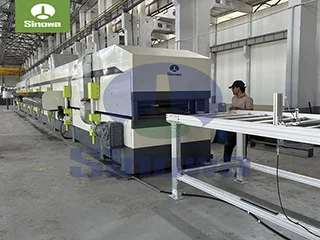
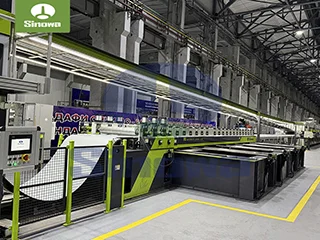
sandwich panel line
The core working logic of the automatic PU foam production line is based on the controllable exothermic chemical reaction between polyurethane raw materials. The basic formation of PU foam relies on the cross-linking reaction between two core liquid raw materials: polyol and isocyanate. With the assistance of functional additives including catalysts, surfactants, blowing agents, and stabilizers, the raw materials undergo rapid chemical cross-linking, while gas generated during the reaction forms dense and uniform tiny bubble structures. These bubble structures are wrapped and fixed by the polymer matrix formed by the curing reaction, ultimately forming porous polyurethane foam materials with different densities, hardness, and mechanical properties. The entire production process involves multiple delicate links including raw material storage, constant temperature regulation, precision metering, high-speed homogeneous mixing, continuous pouring, stable foaming, gradual curing, fixed-size cutting, and post-maturation shaping. Each link is interconnected and mutually restricted, and the automatic sandwich panel production line realizes precise and real-time control of all process parameters through intelligent systems, ensuring the consistency and stability of the foam’s cellular structure, density uniformity, and mechanical performance in each production batch.
The overall structural design of the automatic PU sandwich panel production line follows the principle of continuous streamlined operation, and the whole system can be divided into multiple functional modules with independent responsibilities and collaborative operation, covering the full production chain from raw material pretreatment to finished product output. The first core module is the raw material storage and constant temperature adjustment module, which is the foundation of stable foam production. Polyol, isocyanate, and various liquid additives have strict requirements on storage temperature and fluidity, as temperature fluctuations will directly affect the material viscosity, reaction activity, and final foaming effect. This module is equipped with sealed thermal insulation storage tanks matched with production capacity, supporting real-time temperature monitoring and constant temperature heating and cooling functions. Internal circulating stirring devices are configured for the storage tanks to prevent raw material precipitation, component stratification, and performance attenuation during long-term storage, ensuring that the fluidity and chemical activity of all raw materials remain in the optimal reaction state at all times. Meanwhile, the system is equipped with independent material supply pipelines and impurity filtration units to remove tiny impurities in raw materials, avoid bubble defects and structural abnormalities caused by impurity mixing, and lay a foundation for subsequent high-precision mixing and foaming.
The precision metering and high-pressure mixing module is the core component that determines the quality accuracy of PU foam products. The performance difference of polyurethane foam mainly comes from the proportion of core raw materials and additives, and tiny deviations in the mixing ratio will lead to obvious changes in foam density, hardness, elasticity, and curing speed. The automatic PU sandwich panel line adopts high-precision dynamic metering equipment, which can realize accurate flow control of each single raw material, with extremely low metering error. Different from the fixed ratio setting of traditional equipment, the intelligent metering system of the automatic line supports flexible adjustment of raw material proportions according to different foam product formulas, which can quickly switch production parameters between flexible soft foam, rigid hard foam, and semi-rigid foam to meet the production needs of diversified products. After precise metering, all raw materials are transported to the high-speed mixing chamber through high-pressure pipelines. The internal dynamic mixing structure drives the raw materials to collide and fuse at an extremely fast speed, realizing instantaneous and homogeneous mixing of multi-component materials. This high-pressure and high-speed mixing mode avoids the problems of uneven local mixing, incomplete reaction, and inconsistent pore size caused by traditional static mixing, ensuring that the chemical components of the mixed materials are uniform, the reaction speed is synchronous, and the generated foam cellular structure is fine and uniform.
Following the mixing process is the continuous pouring and stable foaming module, which is a key link in forming the basic shape and structural characteristics of PU foam. The fully automated pouring system can realize linear and uniform pouring of the mixed reaction materials on the conveying platform according to the set thickness and width parameters. The conveying platform adopts variable-frequency speed regulation technology, which can accurately match the material pouring speed and foaming expansion speed, ensuring that the materials can expand stably along the set track without deviation or accumulation. The foaming process is a spontaneous exothermic reaction process, and the temperature change during the reaction directly affects the expansion multiple and curing effect of the foam. The automatic PU sandwich panel machine is equipped with a three-dimensional temperature sensing and constant temperature control system in the foaming area, which can monitor the temperature of different positions in the foaming area in real time, and dynamically adjust the ambient temperature and heat dissipation efficiency according to the reaction heat release status. This effectively avoids product defects such as excessive foam expansion, local collapse, coarse pores, and internal hollowing caused by overheating, as well as insufficient foaming and low product elasticity caused by low temperature and incomplete reaction. In the foaming stage, the surfactant added in the raw materials can effectively stabilize the bubble wall structure, prevent bubble merging and cracking, and ensure that the foam forms a uniform and closed or open-cell structure as required by the product design.
The curing and shaping module undertakes the task of solidifying the preliminary foamed blank into a stable structural state. After the completion of foam expansion, the internal polymer cross-linking reaction continues, and the foam needs a certain period of constant temperature curing to complete the final molecular stabilization and structural shaping. The curing area of the automatic polyurethane sandwich panel production line adopts a fully enclosed thermal insulation structure, forming a stable constant temperature and constant humidity curing environment. The intelligent control system adjusts the curing time and ambient temperature in real time according to the foam thickness, density, and formula characteristics, so that the internal and external curing speed of the foam blank remains synchronous. This prevents quality problems such as inconsistent hardness inside and outside the foam, surface cracking, and structural deformation caused by uneven curing. Compared with the natural curing mode of traditional production processes, the automatic curing system greatly shortens the curing cycle, improves production efficiency, and eliminates the quality differences of finished products caused by environmental changes and manual operation errors. After curing, the foam blank forms a complete and stable strip-shaped foam body with uniform overall performance and no internal structural defects.
The fixed-size cutting and post-processing module is the final link to realize the standardized output of finished products. The continuously produced long-strip foam blank is transported to the cutting area through the automatic conveying system. The polyurethane sandwich panel line is equipped with multi-axis linkage intelligent cutting equipment, which can complete automatic length fixing, width trimming, surface leveling, and precise slitting according to preset product size parameters. The cutting system adopts high-speed and smooth cutting tools, which can realize flat and neat cutting sections without burrs, extrusion deformation, and pore structure damage, ensuring the dimensional accuracy and appearance quality of finished foam products. In addition to basic cutting operations, the post-processing part of the automatic production line can also be equipped with functional auxiliary units according to production needs, including surface dust removal, automatic stacking, and finished product conveying. The whole process from foam blank entering the cutting area to finished product stacking is fully automated without manual intervention, which effectively reduces the damage and pollution of foam products caused by manual contact, and improves the neatness and uniformity of product batches.
Compared with traditional semi-automatic and manual PU foam production modes, the comprehensive advantages of fully automatic polyurethane sandwich panel machine are reflected in multiple dimensions of quality stability, production efficiency, resource utilization, and production safety. In terms of product quality control, the full-process automated parameter control eliminates the interference of human factors. All key parameters such as raw material ratio, mixing pressure, foaming temperature, conveying speed, and curing time are controlled within a precise range, realizing zero-difference replication of production processes for each batch of products. The produced foam products have uniform density, consistent hardness, regular cellular structure, and stable mechanical properties, which greatly reduces the defective rate caused by process fluctuations. In terms of production efficiency, the continuous streamlined production mode realizes uninterrupted mass production, and the production speed is far higher than that of intermittent manual production. The intelligent linkage of each functional module realizes seamless connection of all production links, eliminates the waiting time and process gap of traditional production, and greatly improves the unit time output of foam products.
In terms of resource utilization and cost control, the automatic PU foamimg production line achieves refined management of raw material consumption through high-precision metering and quantitative pouring. It avoids the raw material waste caused by manual proportioning deviation, excessive pouring, and uneven mixing in traditional processes, and significantly improves the utilization rate of core chemical raw materials. At the same time, the intelligent early warning system of the production line can monitor the operating status of equipment and material supply in real time, timely discover and eliminate potential problems such as pipeline blockage, metering deviation, and abnormal temperature, reduce equipment failure rate and production downtime, and further reduce comprehensive production costs. In terms of production safety and environmental protection, the fully enclosed production structure of the automatic line effectively isolates volatile substances generated during the chemical reaction process, reducing material volatilization loss and workshop air pollution. The whole production process is controlled by an intelligent system, with few manual operation points, which reduces the safety risks of manual operation in chemical production environments and realizes safer and more environmentally friendly production operation.
The flexible performance of the automatic PU foam sandwich panel production line enables it to adapt to the diversified production needs of multiple industries, covering almost all application fields of polyurethane foam materials. In the daily consumer goods industry, the line can produce high-elasticity flexible foam for mattresses, sofas, cushions, and pillows. By adjusting raw material formulas and process parameters, it can produce foam products with different softness, elasticity, and compression resistance, meeting the comfort and durability requirements of daily bedding and furniture. In the construction and thermal insulation industry, the line can produce high-density rigid PU foam, which has excellent thermal insulation, heat preservation, and waterproof and moisture-proof properties. It is widely used in building wall insulation, roof heat preservation, and building energy-saving transformation projects, providing efficient thermal insulation support for modern green buildings.
In the cold chain and refrigeration industry, the high-insulation PU foam produced by the automatic insulation board production line is an indispensable core material for refrigerators, freezers, cold storage insulation layers, and refrigerated transportation equipment. The fine and uniform closed-cell structure of the foam effectively isolates heat transfer, greatly improves the refrigeration efficiency of cold chain equipment, and reduces energy consumption. In the automotive industry, the production line can produce special modified PU foam for automotive interiors, including foam materials for car seats, headrests, door interior panels, and shock-absorbing filling parts. The foam products produced by precise process control have good shock absorption, sound insulation, flame retardancy, and weather resistance, adapting to the complex use environment of automobiles and improving driving comfort and safety. In addition, the production line can also produce special functional foam materials for packaging, aerospace, medical supplies, and industrial shock-absorbing fields. By adjusting formula parameters and production processes, it meets the special performance requirements of different industries for foam density, flame retardancy, sound absorption, and compression resistance.
With the continuous progress of industrial intelligent manufacturing technology, the automatic PU foam sandwich panel machinery is also constantly upgrading and iterating towards higher precision, higher intelligence, and stronger flexibility. Modern new-generation production lines are equipped with intelligent data monitoring and remote debugging systems, which can collect, analyze and store all process data during the production process in real time. Production technicians can view the operating status of the production line and product quality data remotely, and perform parameter optimization and fault diagnosis without on-site operation, realizing digital and intelligent production management. At the same time, the modular design of the production line makes the equipment expansion and function upgrading more flexible. According to the market's new product research and development needs, new functional modules such as multi-formula alternate production and special material modified foaming can be added to quickly adapt to the market's personalized and customized product demand.
In terms of energy saving and consumption reduction, the upgraded automatic PU foam sandwich panel production machine adopts optimized power transmission and temperature control technology. The frequency conversion energy-saving system automatically adjusts the operating power of equipment according to production load, avoiding long-term high-power operation of idle equipment and effectively reducing production energy consumption. The optimized heat circulation system recycles the waste heat generated during the foaming reaction and equipment operation into the curing and raw material preheating links, realizing secondary utilization of heat energy and further improving the energy utilization efficiency of the production line. In addition, the advanced mixing and foaming technology reduces the generation of waste materials and defective products in the production process, realizing green and low-carbon production while ensuring production efficiency and product quality.
In the context of the rapid development of the global new material industry and the continuous improvement of industrial manufacturing standards, the market demand for high-quality and high-stability polyurethane foam products is continuously expanding, which also puts forward higher requirements for the performance and automation level of PU foam sandwich panel production equipment. The traditional extensive production mode relying on manual experience can no longer meet the standardized and large-scale production needs of modern industries. The fully automatic PU foaming line, with its precise process control, stable product quality, efficient production capacity, and flexible production performance, has become the mainstream equipment for the upgrading and transformation of the polyurethane foam industry.
In the future, with the deep integration of artificial intelligence, Internet of Things, and new material technology, the automatic PU foam production line will further realize intelligent full-process autonomous control, automatic formula matching, and predictive equipment maintenance. The sandwich panel line will have stronger independent research and development and production adaptation capabilities, which can quickly respond to the iterative upgrading of downstream industry products and the innovation of new material performance requirements. While continuously improving production efficiency and product quality stability, it will further promote the green, intelligent, and high-quality development of the entire polyurethane foam manufacturing industry, and provide more high-performance and diversified foam material support for the upgrading and innovation of various downstream industrial fields.
https://www.cnsinowa.com/sandwich-panel-machines/automatic-pu-foam-production-line.html