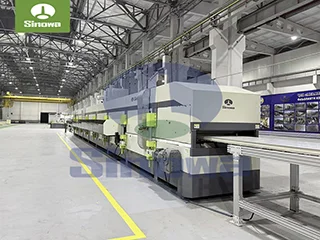
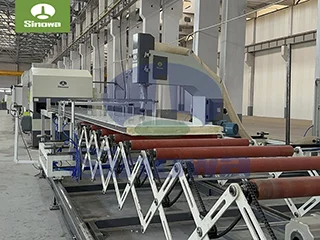
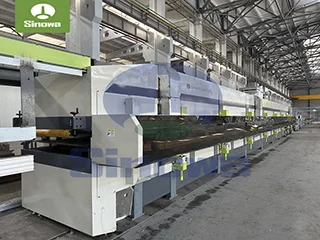
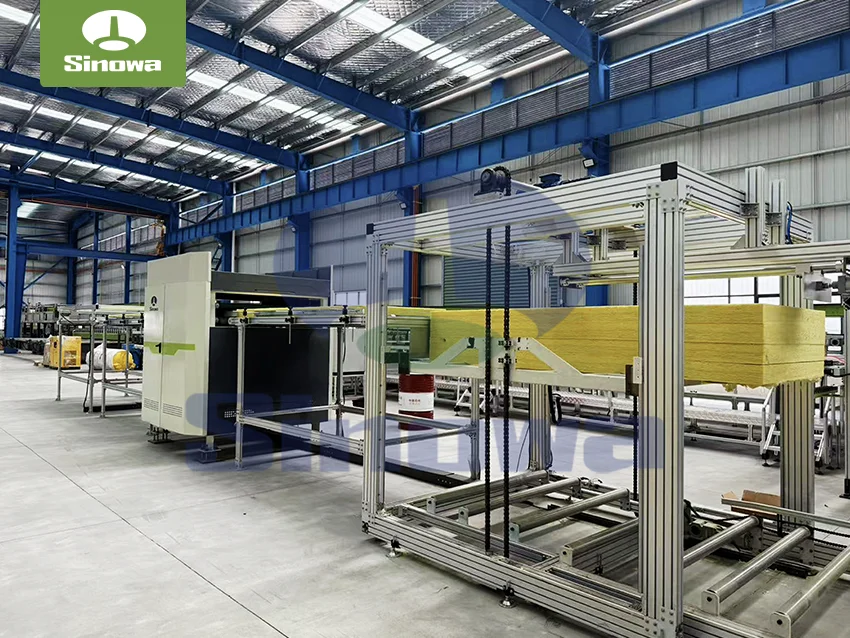
 sandwich panel line
The core design logic of the punching and silencing PU sandwich panel line lies in the hierarchical control of sound wave transmission and the precise shaping of composite structures. Ordinary PU sandwich panels rely solely on the porous structure of the internal foam core to weaken sound energy, which leads to limited sound absorption efficiency, especially for medium and low-frequency noise that occupies the main proportion of environmental noise. This innovative production process firstly performs uniform micro-punching treatment on the surface metal base material before composite molding, forming dense and regularly arranged tiny through-holes on the panel surface. These micro-pores constitute the first layer of sound attenuation structure, which can effectively capture incident sound waves, guide sound energy into the internal foam core layer, and convert sound wave vibration into thermal energy through the friction and collision of air molecules inside the holes, thereby achieving preliminary noise reduction. The subsequent continuous PU foaming and composite curing process further builds a multi-level sound insulation and absorption system inside the panel, forming a complementary acoustic structure with the surface punching layer to significantly improve the overall sound insulation performance of the finished product.
The entire production workflow of the punching and silencing PU sandwich panel production line adopts a fully continuous automated operation mode, with all functional units operating in synchronous coordination to ensure production continuity and product consistency. The whole process covers raw material pretreatment, precision punching forming, surface cleaning treatment, proportional PU raw material mixing and pouring, constant-pressure lamination compounding, constant-temperature curing shaping, fixed-length cutting and post-processing finishing, forming a closed-loop production system from raw material input to finished product output. Each processing link is equipped with independent parameter adjustment and adaptive control functions, which can adapt to different surface material thicknesses, panel specifications and functional requirements, realizing flexible production of diversified sound-insulating sandwich panels while maintaining stable production efficiency.
Raw material pretreatment is the basic guarantee for high-quality panel molding, mainly including the unwinding, leveling and surface conditioning of metal coil materials. The polyurethane sandwich panel production line is equipped with a stable coil unwinding and conveying mechanism, which can smoothly release continuous metal base materials and eliminate the bending deformation and internal stress generated during coil storage through multi-group roller leveling structures. In this stage, the surface of the base material is thoroughly cleaned to remove oil stains, dust and oxide layers generated during processing and storage. Clean and flat base materials can ensure the flatness of subsequent punching processing and the bonding tightness between the surface material and the PU foam core, avoiding composite defects such as degumming and hollowing caused by surface impurities, and laying a foundation for the long-term stable service performance of the panel.
Precision punching processing is the most distinctive core link of the polyurethane sandwich panel line and the key to realizing the silencing function of the panel. Different from simple stamping hole processing, the punching unit of the production line adopts a combined punch and die structure with high positioning accuracy, which can punch uniform micro-pores with controllable aperture and spacing on the surface of the moving base material in real time. The system supports flexible adjustment of punching density and aperture distribution according to different sound insulation requirements, realizing regional differentiated punching design for different panel application scenarios. In the punching process, the high-speed cooperative operation of the conveying system and the punching device ensures that the hole arrangement is regular and uniform without offset or missing punching. Meanwhile, the built-in auxiliary protection structure effectively avoids surface scratch and metal deformation of the base material during punching, maintaining the flatness and structural integrity of the panel surface. The dense micro-pore structure formed by this process does not damage the overall mechanical strength of the metal panel, but forms a uniform sound inlet channel, which greatly optimizes the sound energy absorption efficiency of the panel.
After the punching process is completed, the base material enters the automatic cleaning and dedusting unit to remove metal debris and fine dust generated during punching. A large amount of tiny metal particles will be attached to the surface and hole gaps of the base material after high-precision punching. If not cleaned in time, these impurities will affect the bonding effect between the surface material and the PU foam, and even cause local defects in the foam structure. The PU sandwich panel machine adopts an integrated dust removal design combining air blowing and adsorption, which can thoroughly clean the inside of micro-pores and the surface of the plate while ensuring no secondary pollution to the base material. The cleaned base material maintains a high-purity surface state, which ensures that the subsequent foaming raw materials can be fully compounded with the metal surface, improving the overall structural compactness and service durability of the sandwich panel.
The PU foaming and pouring system is the central link that determines the internal structure and comprehensive performance of the sandwich panel. This system relies on precise proportional metering and high-pressure mixing technology to process the two core raw materials of polyurethane, realizing uniform mixing and continuous quantitative pouring of raw materials. The internal closed-loop temperature and flow control unit maintains stable raw material mixing conditions at all times, avoiding performance differences of foam core caused by raw material ratio deviation and temperature fluctuation. During operation, the mixed polyurethane raw materials are evenly poured on the inner surface of the punched base material, and the liquid raw materials can fully infiltrate the micro-pore structures and surface gaps under the action of gravity and pressure, realizing the in-situ filling and bonding of the pore channels. After pouring, the polyurethane raw materials start to foam and expand steadily, forming a uniform closed-cell porous structure inside the panel. This foam core structure cooperates with the surface punching layer to build a dual sound insulation system, which can absorb and isolate high-frequency, medium-frequency and low-frequency noise in a targeted manner.
Constant-pressure lamination and constant-temperature curing are key processes for shaping the overall structure of the sandwich panel and solidifying acoustic performance. The polyurethane sandwich panel machine is equipped with a double-track continuous lamination structure, which can clamp and convey the upper and lower surface materials and the intermediate foaming layer at a constant pressure state. The stable pressure environment ensures that the polyurethane foam expands evenly without local bulging or collapse, and the foam core is closely bonded to the metal surface material to form an integrated composite structure. The constant-temperature curing system maintains a stable molding temperature in the lamination area, which can accelerate the curing reaction of polyurethane raw materials, shorten the molding cycle, and ensure the uniform density of the foam core. The precise control of pressure and temperature effectively reduces the internal stress of the panel, avoids deformation and warping of the finished panel, and ensures the consistency of structural performance and acoustic performance of each batch of products. The density deviation of the foam core processed by this process is controlled within a very small range, which guarantees stable and lasting sound insulation effect of the panel.
The fixed-length cutting and post-processing unit realizes the final shaping and finishing of the finished panel. After continuous lamination and curing molding, the integrated sandwich panel is conveyed to the cutting station through the synchronous conveying system. The intelligent cutting system automatically identifies the set panel specifications and performs precise fixed-length cutting, with smooth and flat cutting sections without burrs or cracks. After cutting, the edge trimming and finishing process is carried out to polish and shape the panel edges, eliminate sharp edges and residual burrs, and optimize the assembly compatibility of the finished panel. Meanwhile, the surface of the finished panel is inspected and sorted in real time, and panels with local processing defects are screened out to ensure that all off-line products meet the structural and acoustic performance standards. The entire post-processing process is automated, which not only improves production efficiency, but also ensures the uniformity of the appearance quality and dimensional accuracy of the finished products.
Compared with traditional PU sandwich panel production line, the biggest advantage of the punching and silencing PU sandwich panel line lies in its professional optimization of acoustic performance while retaining the excellent thermal insulation, heat preservation and structural stability of traditional panels. The surface micro-punching structure breaks through the single sound insulation mode of traditional foam core, realizing active capture and efficient attenuation of sound waves. When sound waves propagate to the panel surface, most of the sound energy enters the interior of the foam core through the micro-pores, and is continuously consumed through the friction, vibration and reflection of the porous foam structure, greatly reducing the sound wave transmittance. For low-frequency noise with strong penetration that is difficult to isolate by ordinary panels, the composite structure formed by punching and foaming can form a resonant sound absorption effect, effectively weakening low-frequency sound energy and significantly improving the comprehensive noise reduction capacity of the panel.
In terms of production performance, this integrated production line realizes the integration of punching, foaming, composite molding and finishing, eliminating the intermediate handling and secondary processing links required by separate processing equipment. The highly integrated structural design greatly simplifies the production process, improves the overall production efficiency, and reduces the manual intervention rate in the production process. The full-process automatic parameter control realizes precise adjustment of each processing link, avoiding product performance fluctuations caused by manual operation errors. The continuous production mode can realize uninterrupted batch production, and the produced panels have consistent pore distribution, uniform foam density and stable bonding performance, which effectively solves the problems of uneven quality and low production efficiency of traditional semi-automatic processing methods.
In terms of structural performance, the optimized production process ensures that the finished sandwich panel has high structural strength and good dimensional stability. The constant-pressure lamination process makes the surface material and the foam core form an integrated bonding structure, which has strong peeling resistance and compression resistance. The internal uniform closed-cell foam structure not only ensures lightweight panel quality, but also provides good buffer performance and structural toughness. The surface punching process is precisely designed according to the mechanical stress characteristics of the panel, which will not cause stress concentration or structural weakness of the plate, ensuring that the panel can maintain stable structural performance under long-term load and complex environmental conditions. In addition, the polyurethane foam core has excellent weather resistance, corrosion resistance and aging resistance, enabling the panel to adapt to various indoor and outdoor harsh application environments and extend the overall service life.
The finished panels produced by the punching and silencing PU sandwich panel making machine have extremely wide application scenarios, covering architectural sound insulation, industrial noise reduction, municipal environmental protection and other fields. In the field of building construction, these panels can be used for the enclosure walls, ceilings and partition structures of quiet rooms, offices, residential buildings and commercial buildings, effectively isolating outdoor noise and indoor mutual interference, and improving indoor living and office comfort. In industrial production scenarios, they are suitable for sound insulation enclosures of production workshops, equipment noise reduction covers and factory partition walls, which can effectively reduce industrial equipment noise transmission and improve the on-site working environment. In municipal engineering, the panels can be applied to noise reduction facilities on both sides of urban roads, elevated highways and railway lines, reducing traffic noise interference to surrounding residential areas and realizing urban noise pollution control.
With the continuous upgrading of environmental protection standards and the continuous improvement of public requirements for living and working environments, the market demand for high-performance sound-insulating and noise-reducing composite panels is constantly increasing. The punching and silencing PU sandwich panel manufacturing line, as a special equipment for the production of high-efficiency sound-insulating panels, has outstanding technical advantages and production value. Its unique punching and silencing composite process fills the performance gap of traditional sandwich panels in acoustic control, and the automated and integrated production mode meets the market demand for large-scale, standardized and high-quality functional panel production. In the future, with the continuous innovation of composite material technology and processing technology, this production line will further realize intelligent parameter optimization and personalized customized production, and its application scope and market value will be further expanded, providing more efficient and reliable material solutions for global noise control and green building construction.
https://www.cnsinowa.com/sandwich-panel-machines/punching-and-silencing-pu-sandwich-panel-line.html