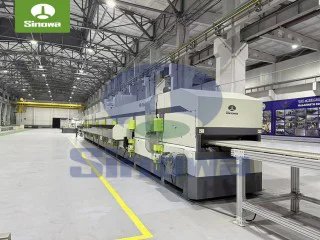
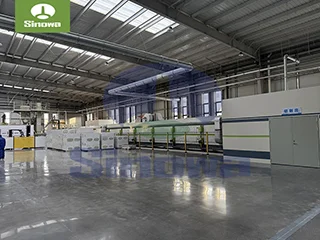
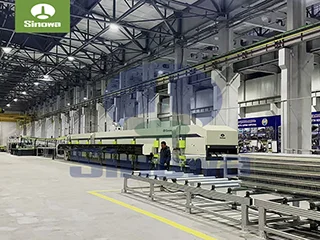
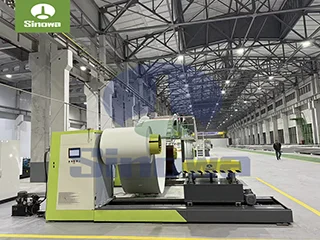
sandwich panel line
The core operational logic of the PIR insulation board production line centers on the accurate regulation of chemical foaming, polymerization, and molding processes, transforming liquid raw materials into solid, rigid foam boards with stable cellular structures. The fundamental chemical mechanism underpinning PIR foam formation differs distinctly from generic polyurethane foam materials. During production, excess isocyanate components undergo trimerization reactions under the action of specialized catalysts, forming stable isocyanurate ring structures that enhance the material’s thermal stability and flame resistance. Simultaneously, residual isocyanate reacts with polyol components to generate urethane linkages, building a robust three-dimensional polymer network that balances flexibility and rigidity in the finished foam. This dual reaction system requires the production line to maintain extremely strict control over raw material ratios, mixing temperature, reaction time, and environmental conditions, as even minor deviations can disrupt cell structure uniformity and compromise insulation performance.
Raw material preparation constitutes the initial foundational stage of the entire production process, laying the groundwork for stable subsequent reactions and high-quality board formation. The primary raw materials consist of two core liquid components: polyol composite materials and isocyanate monomers, each stored in independent sealed storage tanks within the production line’s raw material supply module. The polyol component is a composite mixture integrated with multiple functional additives, including catalytic agents that regulate reaction speed, flame retardant components that enhance fire resistance, and surface conditioning agents that optimize foam cell uniformity. Environmentally friendly physical foaming agents are evenly blended into the polyol system in precise proportions to replace traditional high-pollution foaming substances, aligning the production process with global environmental protection and low-carbon manufacturing standards. All raw material storage tanks are equipped with constant-temperature circulation systems to maintain liquid viscosity and activity within a stable range, preventing component stratification, precipitation, or performance degradation caused by temperature fluctuations. Before entering the mixing stage, automated filtering devices remove tiny impurities from liquid raw materials, eliminating foreign particles that might disrupt chemical reactions or cause structural defects in finished boards.
Following raw material pretreatment, the continuous sandwich panel production line proceeds to the high-precision metering and dynamic mixing stage, the most critical link determining foam reaction quality. The line adopts fully automated servo metering systems for all liquid components, delivering real-time, high-precision proportional feeding of polyol mixtures, isocyanate, and auxiliary additives. The metering system operates with ultra-low error margins, ensuring the molar ratio of core reaction components remains within the optimal reaction range required for PIR polymerization. After accurate metering, all raw materials are instantly transported to a high-speed turbulent mixing head, where intense mechanical stirring achieves uniform micro-level blending in an extremely short time. The high-speed mixing process ensures catalytic components, foaming agents, and functional additives are evenly distributed throughout the reaction system, avoiding local excessive or insufficient reactions that could lead to inconsistent cell sizes, hollow structures, or uneven density in the foam. The mixed liquid reaction material is continuously and evenly poured onto the surface of the base protective material laid flat on the production line’s conveyor system, initiating the sequential foaming and polymerization process.
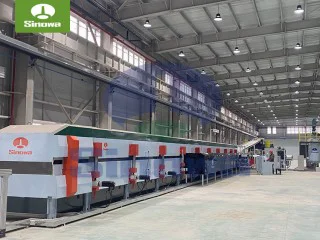
The continuous foaming and curing molding stage represents the core forming process of PIR insulation boards, where liquid reactants transform into solid foam structures with stable physical properties. Upon being poured onto the base material, the mixed liquid begins an orderly chemical reaction chain, including rapid foaming, chain growth polymerization, and cross-linking curing. The foaming agent gasifies under the heat released by the polymerization reaction, forming countless uniform micro closed cells inside the polymer matrix. The production line’s double-track conveyor system maintains stable linear operation speed, coordinating with the constant-temperature curing tunnel to create a balanced temperature field for reaction progression. The extended track design provides sufficient time for complete foaming and full curing of the PIR material, enabling the polymer network to fully cross-link and form a dense, stable closed-cell structure. During this process, the upper and lower leveling devices of the production line apply uniform and gentle pressure to the expanding foam layer, controlling the board’s thickness within a precise fixed range while smoothing surface irregularities generated during foaming. This mechanical leveling process effectively eliminates internal stress inside the foam, ensuring the finished board features flat surfaces, uniform thickness, and consistent internal density across the entire cross-section.
Temperature control throughout the foaming and curing process is meticulously calibrated by the production line’s intelligent temperature regulation system. Different temperature parameters are set for the early foaming stage, mid-term polymerization stage, and later curing and shaping stage to adapt to the varying heat release and reaction rate characteristics of PIR chemical reactions. In the initial foaming stage, a relatively mild temperature environment prevents excessive rapid foaming that might cause cell rupture and open-cell structure formation. In the polymerization and cross-linking stage, a moderately elevated temperature promotes full reaction of isocyanate trimerization and urethane bond formation, enhancing the material’s structural stability and thermal resistance. In the final constant-temperature curing stage, gradual temperature stabilization eliminates residual reaction stress and improves the dimensional stability of the insulation board. The entire temperature regulation process operates in real time through an intelligent control system, with multiple temperature sensors distributed throughout the curing tunnel feeding data back to the central control terminal to achieve dynamic adjustment and closed-loop control, avoiding product quality fluctuations caused by ambient temperature changes or equipment operation deviations.
After completing continuous curing and preliminary shaping, the semi-finished PIR board enters the surface finishing and composite processing stage. According to different application requirements, the PIR sandwich panel production line supports automated surface lamination treatment with various protective materials, including aluminum foil, fiberglass fabric, and other functional surface layers. The automated lamination system achieves seamless bonding between the surface protective material and the PIR foam substrate through precise glue coating and hot-pressing integration technology. The glue coating system applies a uniform thin adhesive layer on the board surface, avoiding excessive glue accumulation or partial glue shortage that might cause delamination. The hot-pressing device maintains constant pressure and temperature during the lamination process, enabling rapid curing of the adhesive and forming a tight, durable composite structure between the surface layer and the foam substrate. This composite processing significantly enhances the surface abrasion resistance, moisture resistance, and structural strength of PIR insulation boards, while further improving their overall thermal insulation performance by reducing surface heat convection and heat radiation loss.
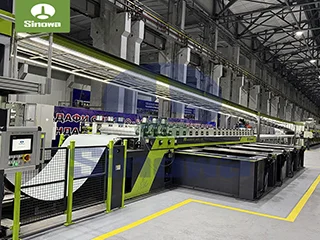
Subsequent to surface composite processing, the PIR sandwich panel line executes fixed-length cutting and edge trimming operations to standardize board dimensions. The integrated automated cutting system adopts high-precision servo positioning and synchronous cutting technology, realizing dynamic tracking and fixed-size cutting of continuously moving boards. The system can flexibly adjust cutting length and width parameters according to production requirements, adapting to multiple specification production demands. The high-speed cutting tools feature sharp and stable cutting performance, ensuring smooth, burr-free board cross-sections without causing edge collapse or cell structure damage. The edge trimming device automatically removes irregular residual materials on the board edges, standardizing the overall outline of each finished board and ensuring consistent dimensional accuracy of all products. All cut leftover materials are centrally collected through the line’s automatic recycling system, realizing resource recycling and reducing production waste, which improves the overall resource utilization efficiency of the production process.
Quality inspection is an indispensable systematic link in the entire continuous sandwich panel line, running through the full manufacturing process rather than relying solely on final finished product detection. The production line is equipped with multi-station online real-time detection modules to conduct continuous monitoring of key product indicators. Thickness detection sensors installed on the conveyor line dynamically measure board thickness at multiple points, automatically identifying and marking products with thickness deviations. Density detection equipment samples and analyzes the overall density and local density uniformity of the foam board to ensure internal structure consistency. Flatness detection devices scan the board surface in real time to screen out products with surface warping, depressions, or bulges. In addition to online real-time detection, regular sampling and performance testing are conducted for thermal conductivity, structural strength, and dimensional stability. Products that fail to meet quality standards are automatically screened out by the sorting system and transported to the reprocessing area, while qualified products proceed to the subsequent stacking and packaging process.
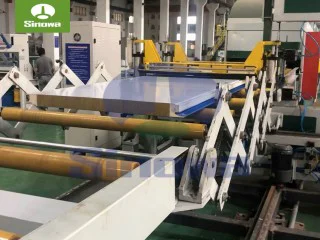
The final stage of the production workflow involves automated stacking and sealed packaging of qualified PIR insulation boards. The intelligent stacking system precisely arranges boards in fixed specifications and layers according to preset programs, ensuring neat stacking and uniform stress distribution of finished products to avoid extrusion deformation during storage and transportation. The automated packaging equipment adopts integral sealing and wrapping technology to form a complete protective film on the surface and periphery of stacked boards, effectively isolating external moisture, dust, and mechanical damage. The packaged finished products feature intact appearance and stable performance, capable of long-term storage and long-distance transportation without quality attenuation. The entire stacking and packaging process achieves unmanned automated operation, improving production efficiency while ensuring consistent packaging quality for each batch of products.
The overall structural design of the PIR sandwich panel machine embodies high integration, intelligence, and environmental protection characteristics, with each functional module closely coordinated to form a highly efficient and stable closed-loop production system. The core control system adopts centralized intelligent operation management, integrating raw material supply, metering mixing, foaming curing, forming processing, quality detection, and finished product output into a unified control platform. Operators can monitor the real-time operating status of all equipment modules, key process parameters, and product quality data through the central control interface, and remotely adjust production parameters according to production demands and product specifications. The automated control mode minimizes manual intervention errors, greatly improves production precision and batch stability, and reduces the technical threshold and operational risks of production operations.
In terms of equipment configuration, the production line’s conveyor system uses high-strength, wear-resistant double-track structures with stable operating speed and strong load-bearing capacity, capable of long-term continuous high-load operation without vibration or deviation. The mixing and reaction modules are made of corrosion-resistant high-precision materials, adapting to the long-term chemical corrosion of organic raw materials and ensuring long-term stable equipment operation accuracy. The curing tunnel adopts multi-section independent temperature control design, achieving refined temperature gradient regulation to meet the reaction heat demand of different stages of PIR foam forming. All power and transmission components of the production line are equipped with noise reduction and energy-saving structures, reducing operational energy consumption and production noise, making the entire production process more energy-efficient and environmentally friendly.
The advanced process technology of the PIR insulation panel production line endows finished products with outstanding comprehensive performance advantages that distinguish them from traditional insulation materials. The precise closed-loop process control enables the produced PIR boards to achieve an extremely high closed-cell rate, with uniformly distributed micro cellular structures inside the material. This dense closed-cell structure greatly reduces air heat conduction and convection inside the foam, enabling the material to maintain ultra-low thermal conductivity under conventional working conditions, delivering excellent and lasting thermal insulation effects. Meanwhile, the stable isocyanurate ring structure formed by the PIR reaction significantly improves the material’s high-temperature resistance and structural stability, allowing the boards to maintain stable physical properties in a wide temperature range without softening, shrinking, or deforming. In addition, the optimized formula and process design enhance the material’s flame retardant performance, enabling it to effectively inhibit flame spread and reduce heat release in high-temperature environments, with excellent fire safety performance.
In terms of environmental protection and sustainable production, the modern PIR insulated board production line completely abandons harmful foaming substances that damage the atmospheric environment, adopting fully environmentally friendly foaming systems and low-VOC auxiliary additives. The entire production process realizes zero harmful gas emission and zero pollutant discharge, complying with global environmental protection policies and green manufacturing development trends. The production line’s waste recycling system efficiently recycles and reprocesses edge materials and defective products generated during production, realizing full resource recycling and effectively reducing raw material waste and production costs. Moreover, the high-efficiency thermal insulation performance of PIR boards produced by the line can greatly reduce the energy consumption of building operation and industrial equipment operation, creating huge energy-saving and emission-reduction benefits in the downstream application field and forming a complete green industrial chain from production to application.
The production line also features strong production flexibility and product adaptability, capable of meeting the diversified production needs of different application scenarios. By adjusting raw material formula ratios, process temperature parameters, equipment operating speed, and surface composite forms, the line can produce PIR insulation boards of different thicknesses, densities, surface types, and performance grades. It can manufacture lightweight boards suitable for building exterior wall insulation, high-strength boards for roof and floor insulation, high-temperature resistant boards for industrial pipeline and equipment insulation, and high-moisture-proof boards for cold storage and low-temperature logistics facilities. This flexible production capability enables a single production line to cover multiple market demand scenarios, greatly improving the comprehensive utilization rate and economic benefits of production equipment.
In actual industrial production operation, the stable operation of the PIR insulation sandwich panel production line relies on standardized process management and daily equipment maintenance mechanisms. Regular calibration of metering systems, cleaning of mixing equipment, inspection of temperature control modules, and maintenance of conveyor and cutting systems are essential to maintain long-term production stability and product consistency. Standardized operation management can effectively avoid product quality fluctuations caused by equipment aging, parameter drift, or process irregularities, ensuring that each batch of PIR insulation boards maintains stable thermal insulation performance, structural strength, dimensional accuracy, and durability. With the continuous advancement of energy conservation and emission reduction requirements in the construction and industrial fields, the market demand for high-performance PIR insulation boards continues to grow, driving the continuous upgrading and optimization of production line technology.
The technological evolution of modern PIR insulation panel production line is mainly reflected in intelligent upgrading, precision improvement, and green optimization. The newly upgraded production lines integrate more advanced sensor detection technology, artificial intelligence parameter optimization algorithms, and remote monitoring and fault diagnosis systems, realizing full-process intelligent perception, automatic parameter adjustment, and early warning of abnormal conditions. The precision of raw material metering, temperature control, and cutting forming has been further improved, enabling the production of high-precision, ultra-thin, and ultra-stable special PIR insulation boards to meet the increasingly refined market application demands. At the same time, the energy-saving optimization of production line equipment structure and process flow further reduces unit energy consumption and carbon emissions in the production process, promoting the continuous development of the PIR insulation material industry in a high-efficiency, low-carbon, and sustainable direction.
As a core manufacturing carrier of high-performance thermal insulation materials, the PIR insulation board production line plays an irreplaceable key role in the modern energy conservation and environmental protection industry chain. Its integrated and automated production mode achieves large-scale, standardized, and high-quality manufacturing of PIR insulation boards, while its flexible and intelligent production characteristics adapt to the personalized and diversified development trend of the downstream market. The high-quality PIR insulation boards produced by advanced production lines are widely used in building energy conservation, industrial thermal insulation, cold chain logistics, new energy equipment, and many other fields, effectively reducing social energy consumption and carbon emissions, and providing solid material support for green building development and industrial low-carbon transformation. With the continuous progress of material science and production manufacturing technology, PIR insulation board production lines will continue to iterate and upgrade towards higher precision, higher intelligence, lower energy consumption, and stronger environmental protection, further releasing the application potential and market value of PIR thermal insulation materials.
https://www.cnsinowa.com/sandwich-panel-machines/pir-insulation-board-production-line.html