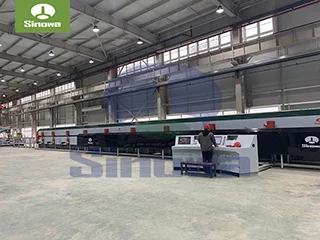
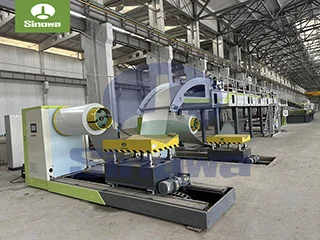
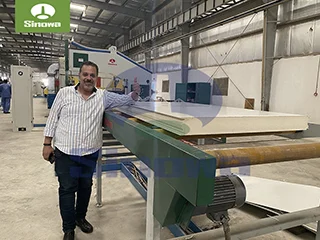
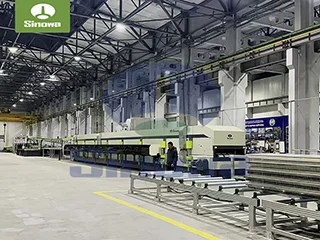
sandwich panel line
The PUR Panel Line mainly includes key equipment such as unwinding system, steel plate feeding system, steel plate automatic docking system, reinforcement unit, forming machine system, high-strength bonding system between steel plate and polyurethane, corona system, steel plate preheating, double track machine and heating system, automatic rock wool cutting and conveying system, n-pentane foaming system, cutting saw, etc. These equipment work together to complete the whole process from raw material uncoiling, processing and molding to filling polyurethane foam, curing and molding, and cutting finished products.
The working principle of the PUR Panel Line is roughly as follows: the two-component raw materials of hard foam are sent to the mixing head by the metering pump of the high-pressure foaming machine according to a certain proportion for mixing, then evenly distributed on the bottom surface material of the sandwich panel, and simultaneously sent to the double crawler laminating conveyor with the upper surface material. The rigid foam is foamed and solidified between the upper and lower conveying chain plates of the double crawler laminated conveyor. The cured sandwich panel is cut into finished products of a certain length by a cutting machine on the production line according to production needs.
Product Features
Efficient automation: The PUR Panel production line adopts a highly automated control system to achieve parameter linkage and fault self diagnosis of the entire line control, greatly improving production efficiency.
Flexible configuration: The PUR Panel Line can design multiple configurations according to customer needs. Through different combinations and configuration choices, different types of sandwich panels can be easily produced, such as roof sandwich panels, wall sandwich panels, and cold storage sandwich panels.
High quality insulation performance: Polyurethane sandwich panels have excellent insulation performance, low thermal conductivity, and no thermal bridging phenomenon, which can meet the needs of various insulation building materials and cold chain building materials.
Environmental protection and energy conservation: The PUR Panel production line is designed with emphasis on environmental protection and energy conservation, using advanced foaming technology and energy-saving equipment to reduce energy consumption and emissions.
When choosing a PUR Panel Line, the following points should be noted:
Assessing the strength of manufacturers: Choose manufacturers with rich production experience and capabilities to ensure the quality of the production line and after-sales service.
Understand product performance: Gain a detailed understanding of the performance parameters, production efficiency, product quality, and other aspects of the production line in order to select the most suitable production line for your needs.
Considering cost-effectiveness: Taking into account the cost-effectiveness of the production line while ensuring product quality, choose products with higher cost-effectiveness.
The PUR Panel Line is an efficient, automated, and flexibly configured production equipment that can meet the needs of various insulation building materials and cold chain building materials. When choosing, it is necessary to pay attention to the manufacturer's strength, product performance parameters, and cost-effectiveness.
Polyurethane (PUR) panel lines represent a highly engineered category of composite building and industrial materials that combine structural rigidity, thermal efficiency, and environmental resilience, making them a staple in modern construction, cold chain logistics, manufacturing, and interior design. Unlike single-material panels that rely on one core component for all functional needs, PUR panel lines are designed as multi-layered composite systems, where each layer works in tandem to deliver balanced performance that cannot be achieved with homogeneous materials. The fundamental structure of a standard PUR panel consists of three core components: an outer facing layer, a rigid PUR foam core, and an inner facing layer, with specialized edge profiling and bonding technology that unifies these layers into a single, monolithic unit. The bonding process is critical to the overall integrity of the panel; it uses a chemical fusion method that creates a permanent, seamless bond between the foam core and the facing materials, eliminating gaps, delamination risks, and weak points that could compromise structural stability over time. This integrated structure sets PUR panels apart from traditional insulated materials that rely on mechanical fastening or weak adhesive bonds, as the fused layers distribute stress evenly across the entire panel surface, enhancing load-bearing capacity and resistance to external forces such as wind, impact, and thermal expansion and contraction. The PUR foam core itself is a closed-cell structure, formed through a controlled chemical reaction between polyol and isocyanate compounds, which creates tiny, airtight cells that trap insulating gas and prevent moisture, air, and heat transfer. This closed-cell formation is the backbone of the panel’s thermal and moisture-resistant properties, as it eliminates porous gaps that would allow water vapor penetration or heat conduction, common issues with open-cell insulation materials. The density of the PUR foam core can be adjusted during manufacturing to tailor performance characteristics, with higher density cores offering greater structural strength and lower density cores prioritizing lightweight handling and enhanced thermal insulation without excessive weight gain.
Performance is the defining attribute of PUR panel lines, with a unique combination of mechanical, thermal, acoustic, and environmental properties that make them versatile across diverse operating conditions. One of the most prominent performance features is exceptional thermal insulation, with a low thermal conductivity rating that outperforms many traditional insulation materials such as fiberglass, mineral wool, and expanded polystyrene. This high thermal efficiency means thinner panel profiles can achieve the same insulating value as thicker conventional materials, saving valuable space in building envelopes, cold storage units, and transportation containers while reducing overall material usage and structural load on supporting frameworks. Beyond thermal performance, PUR panels exhibit strong mechanical properties, including high flexural strength, compressive resistance, and dimensional stability. They can withstand significant vertical and horizontal loads without warping, bending, or cracking, even in large-format panels used for roof and wall systems in commercial and industrial buildings. This dimensional stability is maintained across a wide range of temperatures, from extreme cold in subzero storage facilities to high heat in sunny, unshaded exterior applications, ensuring the panels retain their shape and structural integrity without expanding, contracting, or deteriorating over long service lives. Moisture and water resistance are another key performance metric; the closed-cell foam core repels liquid water and water vapor, preventing mold growth, mildew formation, and insulation degradation that often plagues porous materials in humid or damp environments. Unlike absorbent insulation, PUR panels do not lose their insulating properties when exposed to moderate moisture, making them suitable for use in basements, coastal buildings, food processing facilities, and agricultural structures where humidity levels are consistently high. Acoustic performance is also a notable advantage, as the dense foam core and layered construction absorb and dampen sound waves, reducing noise transmission between interior spaces and from external sources. This makes PUR panels ideal for commercial buildings, residential partitions, industrial workshops, and transportation vehicles where noise reduction is a priority for comfort and operational efficiency. Additionally, PUR panels offer good chemical resistance, standing up to mild acids, alkalis, and common industrial cleaning agents without surface erosion or core damage, further extending their usability in harsh working environments.
PUR panel lines are available in a wide range of types, categorized primarily by core density, facing materials, edge design, and intended functional use, each engineered to meet specific project requirements without compromising core performance. The most common classification is based on outer facing materials, which directly impact durability, aesthetics, and environmental resistance. Metal-faced PUR panels are the most widely used variant, typically featuring thin, rigid metal sheets on both sides; these metal facings add exceptional structural strength, weather resistance, and fire resistance, making them suitable for exterior building walls, roofs, cold storage warehouses, and industrial facilities. The metal facings can be finished with smooth, textured, or coated surfaces to enhance weatherability and visual appeal, while maintaining a lightweight profile that simplifies transportation and installation. Non-metal faced PUR panels include options with fiber cement, gypsum, composite board, or decorative laminate facings, designed primarily for interior applications such as wall partitions, ceiling systems, clean rooms, and interior cladding. These variants prioritize aesthetic versatility, smooth finish, and easy cleaning, making them perfect for commercial interiors, healthcare facilities, office buildings, and residential spaces where visual appeal and hygiene are critical. Another classification is based on PUR foam core density, which ranges from low-density lightweight cores to high-density structural cores. Low-density PUR panels are lightweight, flexible, and optimized for maximum thermal insulation, ideal for non-load-bearing interior walls, insulation liners, and portable structures where weight reduction is essential. Medium-density panels strike a balance between insulation and structural strength, suitable for general-purpose building envelopes, interior partitions, and refrigerated transportation containers. High-density PUR panels are engineered for heavy-duty structural use, with enhanced compressive and impact resistance, designed for load-bearing walls, roof systems, industrial flooring underlays, and high-traffic commercial spaces that require both insulation and structural support. Edge design is another key differentiator, with standard flat edges for basic overlapping installation and tongue-and-groove edges for precise, seamless fitting. Tongue-and-groove edge profiles create a tight, interlocking joint between adjacent panels, eliminating thermal bridges, air leaks, and moisture penetration at seams, which is critical for maintaining consistent insulation performance in cold storage, clean room, and exterior building applications. Some specialized PUR panels also feature reinforced edges for added strength in large-format installations or high-stress environments, ensuring joint stability and preventing edge damage during handling and installation.
The versatility of PUR panel lines is reflected in their extensive range of applications across residential, commercial, industrial, and specialized sectors, with each type selected based on the specific performance demands of the intended use case. In the construction industry, PUR panels are a cornerstone of modern energy-efficient building design, used for exterior wall cladding, roof insulation, partition walls, and prefabricated building modules. Their lightweight nature reduces the need for heavy supporting structures, lowering construction costs and speeding up installation times compared to traditional masonry and insulation systems. The thermal efficiency of these panels significantly reduces heating and cooling energy consumption for buildings, lowering long-term operational costs and supporting sustainable building practices by minimizing carbon emissions associated with energy use. For commercial and industrial cold chain facilities, including cold storage warehouses, refrigerated distribution centers, and food processing plants, PUR panels are the material of choice due to their superior thermal insulation and moisture resistance. They maintain consistent low temperatures with minimal energy loss, preventing temperature fluctuations that could spoil perishable goods such as food, pharmaceuticals, and biological samples, while also resisting the high humidity levels common in cold storage environments to avoid condensation and mold growth. In agricultural applications, PUR panels are used for greenhouse construction, livestock housing, and crop storage facilities, providing stable thermal conditions to support plant growth and animal welfare, while also resisting corrosion from agricultural chemicals and moisture from soil and irrigation. The agricultural sector benefits from the panels’ durability and easy maintenance, as they can withstand exposure to outdoor elements and regular cleaning without degradation.
Specialized industrial applications of PUR panel lines include clean rooms in pharmaceutical, electronics, and healthcare facilities, where non-metal faced variants with smooth, seamless surfaces are used to create hygienic, dust-free environments that are easy to sanitize and maintain. The non-porous surface of these panels prevents the accumulation of bacteria, dust, and contaminants, meeting strict hygiene standards for sensitive manufacturing and medical processes. In the transportation sector, PUR panels are used to construct refrigerated truck bodies, shipping containers, and railway refrigerated cars, providing lightweight, high-efficiency insulation that preserves the quality of perishable goods during long-distance transit. The lightweight property of the panels reduces the overall weight of transportation units, improving fuel efficiency and increasing payload capacity, while their structural strength protects goods from impact and vibration during transit. For interior design and residential use, PUR panels with decorative facings are employed for wall paneling, ceiling tiles, cabinetry, and built-in furniture, offering a combination of aesthetic flexibility, acoustic insulation, and durability. These interior panels come in a variety of finishes, colors, and textures to match different design styles, from modern minimalist to classic, and they are easy to cut, shape, and install to fit custom design requirements. Additionally, PUR panels are used in marine and offshore applications for interior cabin insulation, wall cladding, and refrigeration units on ships and offshore platforms, where their moisture resistance and corrosion resistance make them suitable for the harsh, salty marine environment. They are also utilized in temporary and portable structures, such as site offices, emergency shelters, and mobile clinics, due to their quick installation, portability, and ability to provide comfortable, insulated interior spaces in remote or temporary locations.
When selecting the appropriate PUR panel type for a specific application, several key factors must be considered to align performance with functional needs, including thermal resistance requirements, load-bearing demands, environmental conditions, installation constraints, and aesthetic preferences. For exterior applications exposed to wind, rain, and UV radiation, metal-faced, high-density panels with weather-resistant finishes are the optimal choice to ensure long-term durability and structural stability. For interior applications focused on aesthetics and hygiene, non-metal faced panels with smooth, easy-to-clean surfaces are preferred. In cold storage and temperature-controlled environments, panels with tongue-and-groove edges and high thermal efficiency cores are essential to eliminate thermal bridges and maintain consistent temperatures. For load-bearing structural applications, high-density PUR cores with reinforced facings are necessary to support vertical and horizontal loads without deformation. Regardless of the type, all PUR panel lines share the core advantage of combining multiple high-performance traits into a single, integrated material, eliminating the need for separate insulation, structural, and finishing layers. This integration not only simplifies installation and reduces material waste but also ensures consistent performance across the entire service life of the panel, with minimal maintenance required compared to multi-component building systems.
As demand for energy-efficient, durable, and versatile building materials continues to grow across global industries, PUR panel lines remain a leading solution due to their unmatched combination of structural performance, thermal efficiency, and adaptability. Ongoing advancements in manufacturing technology have further refined the composition and design of PUR panels, enhancing core density consistency, bonding strength, and environmental compatibility without compromising their fundamental benefits. The closed-cell foam structure, multi-layered composite design, and customizable performance traits make PUR panels suitable for evolving industry needs, from sustainable green building initiatives to strict cold chain regulations and hygienic industrial standards. Unlike materials that excel in only one performance area, PUR panels deliver a balanced blend of strength, insulation, durability, and versatility, making them a cost-effective long-term choice for projects across residential, commercial, industrial, and specialized sectors. Their ability to perform reliably in diverse environmental conditions, from extreme cold to high humidity and heavy industrial use, cements their position as a essential material in modern engineering and construction, with applications that continue to expand as industries prioritize efficiency, sustainability, and long-term performance in their material selections.
https://www.cnsinowa.com/sandwich-panel-machines/pur-panel-line.html