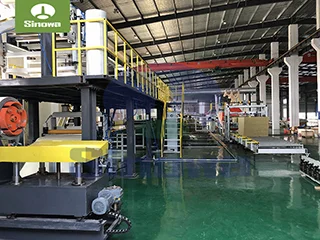
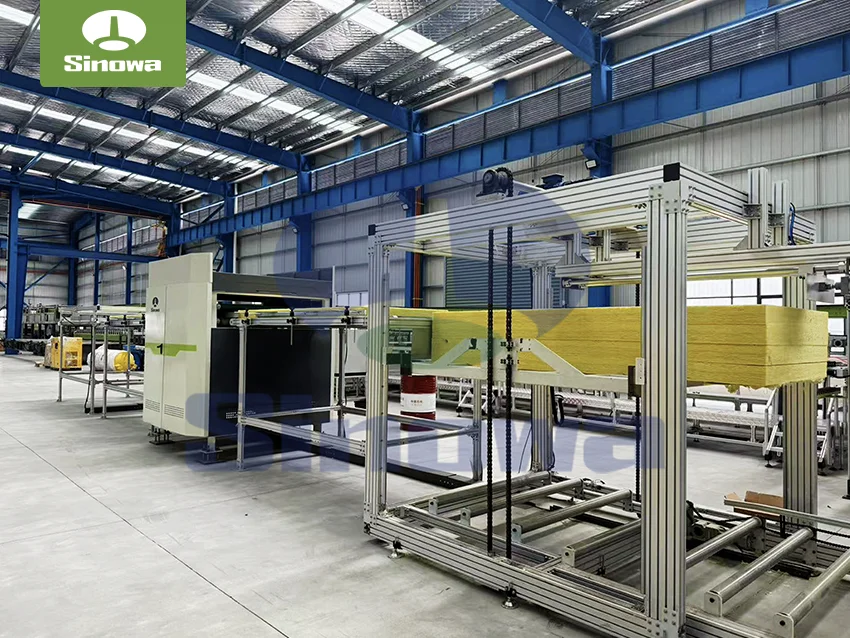
 sandwich panel machine
The inherent material advantages of rock wool constitute the fundamental premise for the wide application of rock wool sandwich panel machine in the manufacturing field. Rock wool is an inorganic fibrous thermal insulation material processed from natural volcanic rock and other basalt raw materials through high-temperature melting and fiber stretching treatment. The internal fiber structure of rock wool presents a disorderly interwoven state, which can effectively lock static air and form a stable heat insulation barrier. Meanwhile, the inorganic chemical properties of rock wool determine its non-combustible characteristics, enabling it to maintain stable physical structures under extreme high-temperature environments without generating toxic and harmful flue gas. In addition, the porous fiber structure of rock wool can absorb sound waves of different frequencies, achieving outstanding sound insulation and noise reduction effects. These inherent material properties make rock wool an ideal sandwich core material for building enclosure panels, and also put forward standardized and refined production requirements for supporting processing equipment, thus promoting the continuous technical iteration and structural optimization of rock wool sandwich panel machine.
A complete rock wool sandwich panel production line is a highly integrated automated mechanical system composed of multiple functional modules, and each independent module has clear division of labor and close collaborative connection in the production process. The overall structural layout of the equipment follows the linear production logic of raw material input to finished product output, and the main components include metal sheet unwinding mechanism, surface plate leveling and forming system, glue spraying and bonding system, rock wool core material feeding and arranging mechanism, composite pressing system, heating and curing device, fixed-length cutting mechanism, automatic stacking system and electrical intelligent control system. All modules are fixed on an integral rigid frame structure, which effectively reduces the vibration amplitude of the equipment during high-speed operation and ensures the overall operational stability of the production line.
The metal sheet unwinding mechanism is the starting unit of the rockwool board production line, mainly responsible for providing continuous raw metal sheets for subsequent molding processing. This mechanism is equipped with a rotatable material rack and a constant-tension control assembly. In the actual production process, the tension control system can dynamically adjust the unwinding speed according to the operating frequency of the subsequent molding equipment, avoiding material deformation or tensile wrinkles caused by excessive tension, and preventing material accumulation and stacking problems caused by insufficient tension. The structural design of the unwinding rack takes into account the compatibility of different metal sheet specifications, which can adapt to metal raw materials with different thicknesses within a reasonable range, laying a solid foundation for the diversified production of finished sandwich panels.
After the unwinding process, the metal sheet will be transported to the leveling and forming system through the automatic conveying roller table. This system is composed of multiple groups of precision leveling rollers and cold bending forming rollers. The leveling rollers are arranged in a staggered upper and lower structure, which can eliminate the internal stress of the metal sheet generated during rolling and storage, and correct tiny bending and deformation on the surface of the sheet to ensure the flatness of the raw material. The cold bending forming rollers adopt customized curved surface designs, and through continuous rolling and extrusion, the flat metal sheet is gradually processed into the required groove and edge-bending structure of the sandwich panel. The gap between the forming rollers can be finely adjusted through the electric control device, so as to meet the molding processing requirements of panels with different thicknesses and structural types. The forming accuracy of this system can be controlled within a tiny error range, which ensures the assembly tightness between adjacent panels in subsequent building construction.
The glue spraying and bonding system is a key functional unit to ensure the bonding stability between the metal surface plate and the rock wool core material. The system is equipped with an automatic glue storage tank and a high-pressure atomizing glue spraying assembly. Before the rock wool core material is compounded with the metal plate, the high-pressure nozzle evenly sprays the environmentally friendly adhesive on the inner surface of the metal plate. The atomizing technology can make the adhesive form a uniform thin film on the metal surface, effectively avoiding the quality problems such as local degumming and bulging caused by uneven glue application. At the same time, the glue spraying flow can be intelligently adjusted according to the production speed and panel specifications, which not only ensures the bonding strength of the product, but also avoids the waste of adhesive raw materials. The sealed structural design of the glue storage tank can isolate external dust and impurities, maintain the purity of the adhesive, and further optimize the bonding effect between materials.
The rock wool core material feeding and arranging mechanism is specially designed for the physical characteristics of rock wool materials. Rock wool raw materials are usually supplied in strip or block shapes, and this mechanism realizes automatic feeding, material arrangement and dense assembly of rock wool through the combination of conveying tracks and mechanical shifting components. In the production process, the equipment automatically arranges scattered rock wool strips in an orderly manner, eliminates gaps between rock wool monomers, and ensures the overall compactness and uniformity of the sandwich layer. For rock wool raw materials with different density specifications, the feeding speed and arrangement spacing of the mechanism can be adaptively adjusted. The mechanical shifting assembly adopts servo drive technology, which has high positioning accuracy, can complete rapid alignment and arrangement of core materials, and effectively improves the filling density of rock wool inside the panel. This processing method avoids the hollow phenomenon inside the finished panel, thereby ensuring the consistent thermal insulation and fire resistance of each section of the sandwich panel.
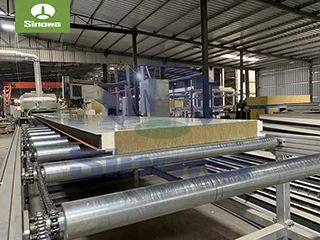
The composite pressing system is the core molding unit of the rockwool sandwich panel production line, which undertakes the composite bonding task of metal surface plate and rock wool core material. The system consists of upper and lower pressing roller sets and a pressure sensing adjustment device. After the glued metal plate and the arranged rock wool core material are butted, they enter the pressing area synchronously. The pressing rollers apply uniform vertical pressure to the composite material, so that the metal plate and the rock wool core material are closely fitted together. The built-in pressure sensing element can monitor the pressing force in real time and feed the data back to the central control system. When the material thickness changes slightly, the system can automatically adjust the gap between the pressing rollers to keep the pressing pressure in a constant stable range. The surface of the pressing roller is treated with anti-sticking coating, which can prevent the residual adhesive from adhering to the roller body and affecting the surface quality of subsequent products. The composite pressing process not only strengthens the bonding tightness between layers, but also shapes the overall flat outline of the sandwich panel.
The heating and curing device is arranged behind the composite pressing system, aiming to accelerate the curing reaction of the adhesive and enhance the permanent bonding performance between materials. The interior of the curing device adopts a closed thermal insulation cavity structure, and the heating elements are evenly distributed on the upper and lower sides of the conveying track. During the operation, the internal temperature of the cavity is maintained within the optimal curing temperature range of the adhesive through intelligent constant-temperature control. The hot air circulation system is equipped inside the cavity to make the temperature distribution in the heating area uniform, ensuring that each position of the sandwich panel can obtain consistent curing conditions. The composite panel after pressing enters the curing cavity at a constant speed, and completes the curing and setting of the adhesive in a short time. Compared with natural curing, mechanical heating curing greatly shortens the production cycle, improves the bonding firmness of the product, and reduces the probability of interlayer separation in the later use of the panel.
The fixed-length cutting mechanism realizes the precise segmentation of continuous composite panels according to customized production specifications. This mechanism is equipped with a high-speed cutting blade and an intelligent length measuring sensor. After the cured composite panel is transported to the cutting position, the sensor automatically records the conveying length of the panel. When the panel reaches the preset cutting size, the control system instantly triggers the cutting assembly to complete vertical and smooth cutting. The cutting blade is made of high-hardness alloy materials, which can keep the cutting edge sharp for a long time, ensuring that the incision of the finished panel is flat and burr-free. The cutting stroke and cutting interval can be freely set through the touch control panel to meet the production requirements of panels with different lengths. In addition, the cutting mechanism is equipped with a dust collection device, which can collect the tiny rock wool debris generated during cutting, reduce material waste, and maintain the cleanliness of the production environment.
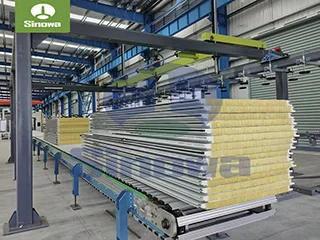
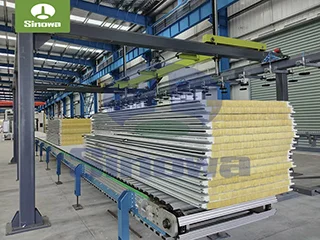
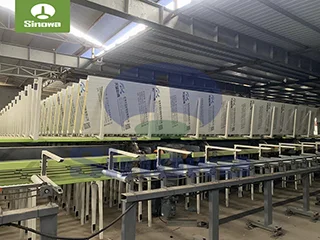
The automatic stacking system is the terminal processing unit of the rockwool sandwich panel manufacturing machine, responsible for orderly collection and stacking of cut finished panels. The system adopts a mechanical arm flipping and stacking structure, with flexible positioning and stable movement. After the cutting is completed, the finished panel is transported to the stacking station through the roller table, and the mechanical arm accurately grabs the panel and places it on the material storage rack in a fixed posture. The stacking height and spacing can be adjusted according to the panel thickness and storage requirements. The automatic stacking method replaces manual carrying, which not only reduces the labor intensity of operators, but also avoids surface scratches and deformation of the panel caused by human handling. At the same time, the neatly stacked finished products are convenient for subsequent packaging and transportation, optimizing the overall production and storage management process.
The electrical intelligent control system runs through all functional modules of the production line and is the central command hub of the entire rock wool sandwich panel production machine. The system takes the programmable logic controller as the core, and is connected with touch display screen, frequency converter, servo driver and various sensing elements. Operators can complete parameter setting such as production speed, panel specification, pressing pressure and curing temperature through the external touch panel. The control system has real-time data monitoring function, which can synchronously display the operating status, operating parameters and material consumption of each module. When abnormal conditions such as material blockage, equipment overload and temperature deviation occur during production, the system will automatically trigger an alarm prompt and perform emergency shutdown protection to avoid equipment damage and production safety accidents. In addition, the system supports parameter storage and one-click calling, which facilitates the rapid switching of different production specifications and improves the flexible production capacity of the equipment.
In terms of operational characteristics, rock wool sandwich panel machine has significant advantages such as high automation degree, stable operation performance and strong production compatibility. In terms of automation, the entire production process from raw material feeding to finished product stacking can be completed automatically by mechanical equipment, with few manual intervention links. Only a small number of operators are required to complete parameter monitoring and simple auxiliary work, which greatly reduces the labor cost of production enterprises. In terms of operation stability, the equipment adopts an integral welded rigid frame and high-precision transmission bearings. After mechanical aging treatment, the vibration and noise generated during high-speed operation are effectively controlled, and the failure rate of long-term continuous operation is low. In terms of production compatibility, the equipment can adapt to rock wool core materials with different density ranges, and can produce sandwich panels with different thicknesses and surface structures by adjusting the gap of molding rollers and pressing components, which meets the diversified product production needs of building material manufacturers.
The rock wool sandwich panel production machine also shows outstanding environmental protection and energy-saving characteristics in the production process. The equipment is equipped with a closed adhesive circulation system, which can recycle the excess adhesive generated during the glue spraying process, reducing the waste of chemical raw materials. The heating and curing cavity adopts multi-layer thermal insulation materials to reduce heat loss during heating, and the intelligent temperature control system can dynamically adjust the heating power according to the production load, effectively reducing energy consumption. For the rock wool debris generated during cutting and trimming, the supporting dust collection and recovery device can realize centralized collection and secondary utilization, avoiding the diffusion of fiber dust to pollute the production environment. All production links comply with modern industrial environmental protection standards, which not only reduces the production cost of enterprises, but also realizes the green and low-carbon production mode of building materials.
In practical industrial production applications, the daily maintenance and standardized operation of rock wool sandwich panel manufacturing machine are crucial to extending the service life of equipment and maintaining product stability. In terms of daily inspection, operators need to check the tightness of connecting bolts of each mechanical component before starting the machine every day, detect the flexible operation of transmission parts such as rollers and chains, and confirm whether the glue spraying nozzle and cutting blade are blocked or worn. For the pressure sensing element and temperature sensing probe in the control system, it is necessary to regularly calibrate the detection accuracy to ensure the real-time and effectiveness of monitoring data. In terms of lubrication maintenance, the rotating bearings and transmission gears inside the equipment need to be regularly filled with high-quality lubricating oil to reduce mechanical friction loss and avoid abnormal noise and wear during operation.
In terms of cleaning and maintenance, the residual adhesive and metal debris on the surface of the pressing roller and conveying roller should be cleaned regularly to prevent hardening attachments from scratching the surface of the processed panel. The dust collection device needs to dump the collected rock wool debris regularly to avoid pipeline blockage affecting the dust removal effect. For the heating curing cavity, the accumulated dust on the surface of the heating element should be removed periodically to ensure uniform heat conduction and avoid local overheating. In addition, the electrical control box should be kept dry and ventilated, and the dust on the circuit board should be cleaned regularly to prevent short circuit faults caused by dust accumulation. During the idle period of the equipment, the movable parts need to be coated with anti-rust oil, and the external protective cover should be closed to isolate rainwater and dust erosion.
Reasonable operation specifications are also important guarantees to avoid equipment failures. During the startup process, the equipment needs to follow the step-by-step startup logic. First, turn on the power supply to detect the self-inspection of the control system, then start the conveying and molding modules at low speed, and formally put into production after confirming that all parts operate without abnormality. In the production process, sudden adjustment of operating parameters is prohibited to avoid equipment jamming caused by inconsistent operation rhythm of each module. When replacing raw material specifications, it is necessary to stop the machine for static adjustment, and conduct trial production of a small number of samples after parameter debugging, and carry out mass production only after confirming that the product quality meets the standards. In case of sudden equipment failure, the operator should cut off the power supply in time for maintenance, and it is forbidden to disassemble the equipment with electricity to ensure production safety.
From the perspective of industrial application scenarios, rock wool sandwich panels produced by professional machines are widely used in various modern building fields. In large industrial plants and logistics warehouses, such panels are used for exterior wall and roof enclosure structures. Their excellent thermal insulation performance can reduce the temperature fluctuation inside the building, lower the energy consumption of refrigeration and heating equipment, and the good fire resistance can improve the overall fire safety level of industrial buildings. In cold storage and constant-temperature storage buildings, the high-density rock wool core material can form an efficient thermal insulation barrier, reduce the loss of internal cold air, and maintain the long-term stable low-temperature storage environment. In purification workshops and medical clean rooms, the smooth and seamless surface of the sandwich panel is not easy to accumulate dust, and the inorganic raw materials will not breed bacteria, meeting the high hygienic production standards of special industrial spaces.
In addition, rock wool sandwich panels are also commonly used in public buildings such as airport terminals and stadiums. These buildings have large spatial spans and high requirements for building sound insulation and fire prevention. The porous fiber structure of rock wool can absorb external noise and reduce indoor sound reverberation, creating a quiet and comfortable public activity environment. At the same time, the excellent fire resistance of rock wool can effectively delay the spread of fire and protect the life safety of personnel in the building. In temporary modular buildings and integrated housing projects, the lightweight characteristics of sandwich panels simplify the transportation and assembly process of building materials, shorten the construction cycle of buildings, and have good seismic resistance and structural stability.
With the continuous upgrading of global building industrialization standards and the increasing awareness of building energy conservation and environmental protection, the development trend of rock wool sandwich panel machinery is gradually moving towards intelligent upgrading, structural optimization and green production. In terms of intelligent technology, the equipment will be combined with internet of things technology to realize remote data transmission and cloud monitoring. Managers can view the operating status, production output and failure records of the production line in real time through mobile terminals and computer platforms, realizing refined remote management. The intelligent fault diagnosis system will further optimize the operation logic of the equipment, automatically judge potential failure risks through big data analysis, and carry out early warning maintenance to reduce the downtime loss caused by equipment failure.
In terms of structural optimization, the future rock wool sandwich panel production machinery will adopt a more compact integrated design, simplify the redundant mechanical structure on the premise of ensuring production performance, reduce the floor space of the production line, and adapt to the factory layout requirements of small and medium-sized building material enterprises. The material feeding and arranging mechanism will be further upgraded to realize intelligent sorting and filling of irregular rock wool raw materials, improve the utilization rate of raw materials, and reduce production costs. The pressing and cutting components will adopt higher-precision processing technology to further optimize the flatness and dimensional accuracy of finished panels, and meet the higher assembly requirements of high-end architectural engineering.
In terms of green production, the equipment will strengthen the recycling capacity of waste materials, realize the secondary processing and utilization of leftover materials generated in the production process, and achieve zero discharge of production waste. The heating system will adopt more efficient heating materials and heat circulation technology to reduce energy consumption per unit product. The adhesive spraying system will upgrade the atomization technology to improve the uniformity of glue application and reduce the volatilization of harmful substances in the adhesive. While improving production efficiency, the overall environmental protection level of the equipment will be continuously optimized to adapt to the increasingly strict industrial environmental protection policies.
In conclusion, the rock wool sandwich panel machine is a comprehensive automated production equipment integrating mechanical transmission, intelligent control, chemical bonding and thermal processing technology. It relies on a scientific and reasonable structural layout to complete the standardized production of high-performance rock wool sandwich panels through continuous collaborative operation of multiple functional modules. The equipment has outstanding advantages in production efficiency, product quality control, operation stability and environmental protection performance, and provides reliable technical equipment support for the development of the modern building enclosure material industry. With the continuous progress of industrial manufacturing technology and the continuous expansion of the construction market demand, the rock wool sandwich panel production equipment will continue to complete technical iteration and performance optimization, develop towards higher intelligence, higher efficiency and greener production direction, and make more important contributions to the high-quality development of the global construction industrialization industry. In the future market competition, enterprises that master advanced rock wool sandwich panel production equipment will gain more competitive advantages in the building material industry, and promote the entire industry to move towards standardized, refined and sustainable development.
https://www.cnsinowa.com/sandwich-panel-machines/rock-wool-sandwich-panel-machines.html