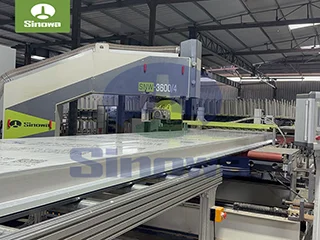
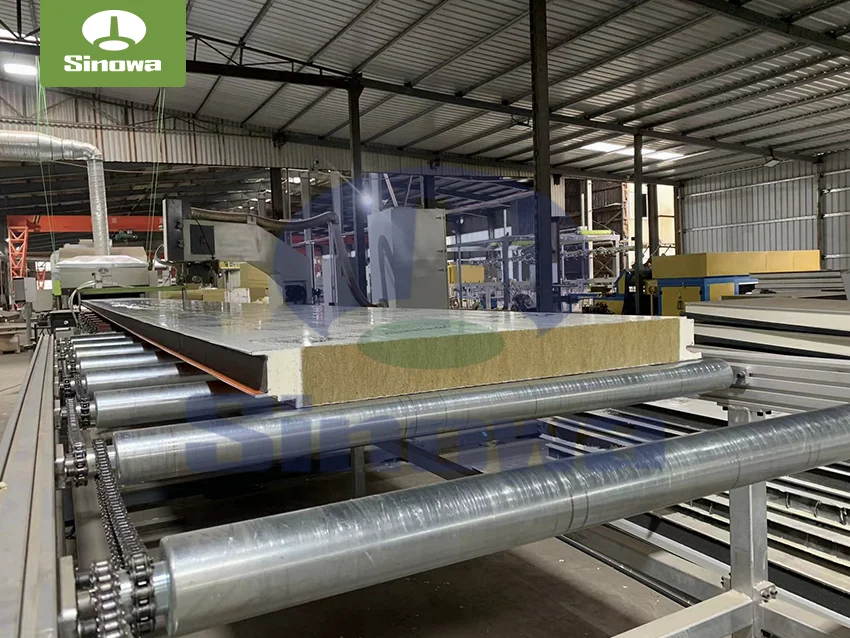
 sandwich panel line
The polyurethane fireproof rock wool sandwich panel production line is a fully integrated automated manufacturing system that integrates mechanical transmission, high-pressure chemical foaming, constant temperature composite pressing, intelligent sensing detection and centralized program control technologies. Different from intermittent semi-automatic production equipment for ordinary sandwich panels, this production line realizes uninterrupted one-stop forming from raw metal coil feeding to finished panel stacking, eliminating manual intermediate transfer and repeated positioning operations in traditional segmented production processes. The whole equipment system can be divided into six interlinked functional modules operating synchronously without independent partition nodes in actual production, including metal sheet pretreatment and roll forming module, rock wool core material automatic arrangement and surface treatment module, high-pressure polyurethane edge foaming and bonding injection module, continuous double-belt constant temperature composite pressing module, online fixed-length cutting and edge trimming module, as well as automatic finished board conveying, sorting and stacking module. All functional modules are connected by synchronous roller transmission systems with matched operating speeds, ensuring consistent material moving speed throughout the whole production process and avoiding layered dislocation, adhesive cracking and foaming unevenness caused by asynchronous transmission between front-end and back-end equipment.
The front-end metal sheet pretreatment and roll forming module undertakes the processing of upper and lower outer protective metal sheets of sandwich panels, which lays a foundation for the flatness and overall appearance of finished products. Raw metal coils are loaded onto automatic unwinding devices, and the unwinding system adopts buffer roller structures to eliminate tension fluctuation generated during high-speed coil releasing, preventing surface wrinkling and tensile deformation of metal sheets. After unwinding, metal sheets sequentially pass through multi-group leveling rollers to eliminate internal stress generated during coil storage and transportation, restoring complete flatness of sheet surfaces. Subsequently, continuous surface cleaning units remove fine dust, oil stains and residual impurities attached to metal surfaces; this pretreatment procedure is critical to enhance the bonding force between metal sheets and intermediate core materials, because tiny pollutants on sheet surfaces will directly reduce interfacial adhesion, leading to delamination failure of sandwich panels in long-term service. After cleaning, metal sheets enter continuous roll forming units, where multi-pass profiling rollers carry out gradual cold bending molding according to conventional wall and roof panel profile designs. The gradual molding mode avoids concentrated stress on metal substrates caused by one-time bending, effectively improving the overall impact resistance and bending resistance of outer metal sheets, and ensuring consistent profile size of each batch of molded sheets.
Following metal sheet processing, the rock wool core material automatic arrangement and surface treatment module completes standardized layout and interface optimization of the fireproof core layer. Rock wool, as the main fire-resistant core material of composite panels, relies on its fibrous porous structure to block flame propagation and high-temperature heat transfer, serving as the primary fireproof barrier of the whole sandwich panel. Before entering the composite working section, bulk rock wool raw materials are transported to automatic cutting equipment, which conducts longitudinal and transverse fixed-size cutting to match the width and thickness of molded metal sheets. After cutting, rock wool blocks are arranged continuously and closely through automatic material distribution equipment, eliminating gaps between adjacent rock wool units that may reduce overall fireproof performance. Meanwhile, the polyurethane sandwich panel production line is equipped with non-contact surface treatment devices for rock wool surfaces, which modify the upper and lower contact surfaces of rock wool core materials to enhance molecular compatibility between rock wool fibers and polyurethane foaming materials. Without this surface modification process, inert rock wool fiber surfaces will form weak bonding interfaces with polyurethane foam, resulting in overall structural separation of panels under external bending or vibration loads in later application scenarios. This targeted interface optimization design solves the long-standing industry pain point of poor bonding compatibility between inorganic rock wool materials and organic polyurethane polymer materials.
The high-pressure polyurethane edge foaming and bonding injection module is the most innovative core part of the entire polyurethane sandwich panel line, which distinguishes this equipment from ordinary full-rock wool sandwich panel production line. Different from full-surface polyurethane pouring technology used in pure polyurethane sandwich panels, this production line adopts targeted edge sealing and local bonding polyurethane injection design. Liquid polyurethane two-component raw materials are stored in constant-temperature sealed storage tanks, with independent circulating temperature control systems maintaining stable raw material activity all the time, avoiding chemical reaction failure caused by ambient temperature changes affecting foaming effects. During operation, high-precision metering pumps proportion two-component polyurethane raw materials strictly according to set process parameters, and mixed raw materials are transported to rotary injection nozzles through high-pressure pipelines. The nozzles conduct continuous linear injection along four peripheral edges of arranged rock wool core materials, and a small amount of polyurethane bonding materials are also sprayed evenly on the upper and lower contact surfaces between rock wool and metal sheets. After contacting air and matching temperature environment, polyurethane materials complete rapid micro-foaming reaction within several seconds, forming dense and seamless foam edge sealing structures around rock wool core layers. This design retains the full fireproof advantage of central rock wool core materials, while using closed polyurethane foam edges to completely block capillary gaps at rock wool splicing positions. It effectively solves the defect of easy water vapor penetration and air leakage at panel edges of traditional pure rock wool sandwich panels, and significantly improves the overall thermal insulation and waterproof performance of composite panels without damaging high fire resistance performance.
After completing core material layout and polyurethane edge foaming pre-treatment, semi-finished panels enter the continuous double-belt constant temperature composite pressing module for integrated curing and compound molding. This module adopts upper and lower circulating steel belt structures with synchronous operation, which provide uniform and stable surface pressure covering the whole panel area, different from intermittent point pressure of traditional roller pressing equipment. The internal closed constant temperature heating system maintains a stable curing temperature environment inside the composite section, matching the optimal reaction temperature required for polyurethane foam curing and interface adhesive bonding. In the process of synchronous forward movement of steel belts, upper and lower molded metal sheets are closely compounded with intermediate rock wool core materials and cured polyurethane edge structures under constant pressure and constant temperature environments. The collaborative control of pressure, temperature and transmission speed is the key to ensuring composite quality: excessive pressure will squeeze out foamed polyurethane structures and destroy edge sealing integrity, while insufficient pressure will lead to insufficient bonding compactness; mismatched temperature and moving speed will cause incomplete curing of polyurethane or excessive aging of foam structures. The built-in real-time sensing system of the rockwool board production line collects pressure, temperature and running speed data every millisecond, and feeds back data signals to the central control system for automatic closed-loop adjustment, realizing unmanned dynamic optimization of composite parameters during continuous production.
After integrated composite curing, panels enter the online fixed-length cutting and edge trimming module for finished dimension shaping. The rockwool sandwich panel production line supports non-stop dynamic cutting, which means the cutting equipment completes accurate slitting operation while panels keep moving forward at constant speed, without needing to pause the whole production line. This non-stop cutting mode greatly improves overall production efficiency and avoids production efficiency loss caused by frequent start and stop of mechanical equipment. High-precision servo driving systems control cutting tools to complete fixed-length cutting according to customized dimensional requirements, and follow-up edge trimming devices remove tiny burrs and residual polyurethane foam residues on panel cross-sections, ensuring smooth and neat cross-section of finished panels. All cutting and trimming processes adopt physical cold cutting modes without high-temperature cutting tools, which prevents secondary high-temperature damage to polyurethane foam edges and rock wool fireproof core layers, and maintains the original physical and fireproof performance of composite panels to the greatest extent.
The final automatic conveying and stacking module completes finished panel sorting and centralized stacking. Qualified panels after cutting are transported by segmented roller conveyors to finished product platforms, and automatic stacking manipulators orderly stack panels according to standardized stacking specifications. Buffer protection structures are arranged between stacked panels to avoid surface scratch damage of metal outer sheets during stacking. The whole process from raw material feeding to finished panel stacking realizes full automatic operation without manual intervention, greatly reducing labor input in production workshops and eliminating product quality fluctuations caused by manual operation errors.
Compared with separate production lines for pure rock wool sandwich panels and pure polyurethane sandwich panels, this composite sandwich panel production line has unique technological advantages in production stability and finished product performance consistency. Firstly, the overall synchronous control system realizes linkage operation of all front and rear equipment units. Once abnormal material blockage or parameter deviation occurs in a single module, the central control system will automatically adjust the operating speed of front and rear equipment synchronously instead of emergency shutdown, reducing production downtime rate and improving continuous operation stability of the whole line. Secondly, the targeted polyurethane edge sealing technology avoids the waste of polyurethane raw materials caused by full-surface pouring, optimizing raw material utilization rate while maintaining comprehensive panel performance. Thirdly, the whole sandwich panel production line adapts to different ambient temperature and humidity conditions in different production workshops. The intelligent system can automatically adjust polyurethane raw material proportioning, curing temperature and composite pressure parameters according to real-time environmental data, ensuring consistent panel performance produced in winter low-temperature environments and summer high-humidity environments.
The composite panels manufactured by this sandwich panel line perfectly combine the complementary advantages of rock wool and polyurethane materials. The inorganic rock wool core provides excellent high-temperature fire resistance, which can effectively block flame spread and maintain structural stability under long-term high-temperature baking, meeting the fire safety needs of high-risk industrial workshops and public building spaces. The polyurethane edge sealing structure makes up for the structural defects of rock wool materials, improving overall panel waterproofness, air tightness and structural bending strength. Meanwhile, polyurethane foam has low thermal conductivity, which further optimizes the overall thermal insulation performance of panels, making the composite products suitable for both high-fire-risk building envelopes and low-temperature cold chain storage enclosure structures requiring high thermal insulation effects. In terms of long-term service durability, closed polyurethane edges prevent moisture from invading internal rock wool fibers, avoiding performance attenuation problems such as fiber pulverization and thermal insulation reduction caused by long-term moisture absorption of rock wool core materials, effectively extending the whole service life of sandwich panels.
In actual daily production operation, the rock wool sandwich panel machine adopts hierarchical maintenance and intelligent early warning design to reduce equipment failure risks. The system divides equipment maintenance into daily routine inspection, weekly partial lubrication maintenance and monthly overall parameter calibration. The built-in fault self-diagnosis system can identify abnormal vibration of transmission parts, raw material pipeline pressure fluctuation and temperature deviation of heating sections in advance, and send early warning prompts before equipment failures occur, facilitating staff to carry out targeted maintenance without affecting normal production schedules. In addition, the human-machine interaction control interface is designed with simplified operation logic, allowing operators to complete production parameter setting, production data viewing and emergency manual control through simple screen operations, lowering the professional skill threshold for on-site operation personnel.
Looking ahead to the future development of building material manufacturing equipment, polyurethane fireproof rock wool sandwich panel production machine will further develop towards higher intelligence, energy conservation and environmental protection, and multi-functional compatibility. Future upgrading directions include integrating visual online appearance inspection systems to realize automatic identification and elimination of panels with surface defects and bonding gaps, replacing partial mechanical transmission structures with energy-saving servo motors to reduce overall power consumption of the whole line, and optimizing polyurethane foaming formulas to reduce volatile organic compound emission during production processes. Moreover, the production line will realize better docking with digital factory management systems, uploading real-time production output, equipment operating status and product quality data to industrial cloud platforms, realizing remote monitoring, production data statistics and unmanned workshop management.
In conclusion, the polyurethane fireproof rockwool sandwich panel production line is a highly targeted automated manufacturing equipment developed for the performance upgrading demand of modern building insulation fireproof panels. Through reasonable process layout, complementary application of two core insulation materials and full-process intelligent synchronous control, it breaks through the respective performance bottlenecks of single rock wool and single polyurethane sandwich panels. It provides efficient, stable and standardized manufacturing solutions for mid-to-high-end prefabricated building enclosure systems, cold chain engineering, fireproof industrial plants and public infrastructure projects. As global construction industry continuously improves requirements for building fire safety, energy conservation and environmental protection, this type of composite sandwich panel line will occupy an increasingly important position in the field of intelligent building material manufacturing equipment, and continuously drive the upgrading and iteration of overall manufacturing technology for thermal insulation fireproof composite panels.
https://www.cnsinowa.com/sandwich-panel-machines/polyurethane-fireproof-rock-wool-sandwich-panel-production-line.html