 sandwich panel line
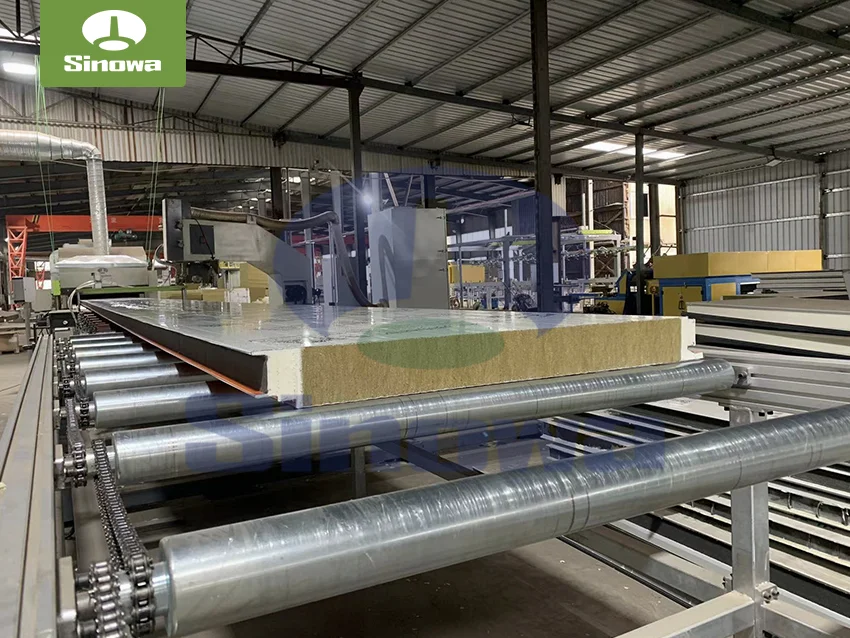
The overall structure of a complete color steel rock wool sandwich panel assembly line adopts modular integrated design, connecting multiple independent functional units through synchronous conveying systems to realize seamless docking of the whole production process without manual material transfer between stations. The whole equipment set can be divided into three major functional sections: front-end surface plate pretreatment and forming section, middle core material processing and composite bonding section, and back-end cutting, finishing and stacking section. Each module operates synchronously under unified central control, and the operating speed, pressure parameter, heating temperature and feeding volume of all units can be adjusted integrally according to preset panel specifications, ensuring consistent production rhythm and stable product quality throughout the line. Unlike intermittent manual composite equipment widely used in early small-scale factories, modern continuous assembly lines cancel independent offline processing links, effectively avoiding dimensional errors and bonding defects caused by secondary manual handling of semi-finished panels, and greatly improving the overall yield of finished panels.
The front-end section mainly undertakes the pretreatment and roll forming of upper and lower color steel coils, which lays a foundation for the flatness and structural accuracy of subsequent composite panels. This section starts with dual-station uncoiling equipment, which stores original color steel coils and realizes automatic coil switching without stopping production. This non-stop coil changing design eliminates frequent production downtime caused by raw material replacement, maintaining continuous and stable production efficiency. After uncoiling, the color steel plates enter a multi-group leveling unit to eliminate internal stress generated during steel coil rolling and storage. Residual internal stress inside steel plates will lead to panel warping, surface unevenness and dimensional deviation after composite molding, so multi-pass leveling treatment is indispensable to guarantee the flatness of steel plate surfaces within a controllable range. Following leveling is the roll forming process: the flat color steel plate passes through dozens of groups of precision forming rollers arranged in sequence, and gradually undergoes cold bending molding to form customized plate profiles including flat panels, hidden-buckle plates, ribbed roof plates and inner wall flat plates. The roller gap of the forming unit is precisely calibrated, and the progressive cold bending process avoids surface scratches and structural damage to the color steel coating, maintaining the original anti-corrosion and weather resistance performance of the color steel surface. After forming, trimming devices on both sides trim the edges of profiled steel plates to ensure unified width of upper and lower surface plates, eliminating staggered edges in subsequent composite procedures.
The middle core material processing and composite bonding section is the core functional part of the entire sandwich panel line, which directly determines the bonding strength, overall compression resistance and fireproof performance of finished sandwich panels. Rock wool, as the core inorganic fireproof raw material of the panel, has inherent fibrous porous structure characteristics, different from fluid foam raw materials. Therefore, the assembly line is equipped with a dedicated rock wool automatic processing and paving system instead of simple direct feeding. Bulk rock wool raw materials are firstly cut into uniform strips matching panel width through longitudinal and transverse cutting devices, and then pass through a fiber flipping and adjusting unit. This key device adjusts the arrangement direction of internal rock wool fibers to be perpendicular to the color steel surface, rather than parallel horizontal arrangement. Vertical fiber arrangement can significantly improve the compression resistance and structural stability of rock wool core layers, prevent core layer collapse under long-term external pressure, and maximize the fire blocking and sound insulation effects of rock wool materials. After fiber orientation adjustment, the rock wool strips are evenly paved on the surface of the lower formed color steel plate through an automatic quantitative paving machine, with controllable paving density and uniform overall thickness to avoid local hollowing or uneven core thickness.
After core material paving is completed, the rockwool sandwich panel production line enters the automatic adhesive spraying process. High-precision double-sided glue spraying systems are installed on both the inner side of upper color steel plate and the upper and lower surfaces of rock wool core strips, adopting pressure-stabilized spray guns to evenly coat structural adhesive without missing spraying or glue accumulation. The selected structural adhesive has excellent compatibility with both metal color steel surfaces and porous rock wool fibrous materials, featuring strong adhesion, aging resistance and stable performance in high and low temperature environments. The automatic metering system dynamically adjusts glue application amount according to production speed and panel thickness, realizing scientific glue dosage control, which not only ensures permanent tight bonding between steel plates and rock wool core layers to prevent delamination during long-term service, but also avoids excessive glue waste to reduce overall production material consumption. For panels requiring enhanced edge waterproof and dustproof performance, the assembly line supports optional automatic edge sealing units, which inject sealing materials into panel side gaps during the composite process to form continuous compact edge structures, blocking moisture and dust from penetrating into the fibrous rock wool core and improving the long-term durability of panels used in outdoor building enclosure systems.
Subsequently, the assembled semi-finished panels composed of upper steel plate, adhesive layer, rock wool core and lower steel plate enter the constant-temperature double-belt pressing and curing unit, the most critical link for integral composite molding. The double-belt pressing machine provides stable and uniform horizontal pressure throughout the whole panel length, avoiding local pressure difference that may cause panel surface depression and internal bonding gaps. Meanwhile, the circulating heating system inside the pressing belt maintains constant curing temperature in the pressing chamber, accelerating the curing reaction of structural adhesive without damaging the coating of color steel plates and the internal fiber structure of rock wool. Compared with natural room-temperature curing in traditional production modes, integrated hot pressing and curing shortens molding cycle greatly and realizes synchronous pressing and curing in continuous production state. After high-pressure constant-temperature composite curing, the upper and lower color steel plates and intermediate rock wool core form an integral sandwich structure with no relative displacement and internal gaps, and the overall structural rigidity of the panel meets the mechanical load-bearing requirements for building wall and roof enclosure.
The back-end finishing and stacking section undertakes fixed-length cutting, edge trimming, surface cleaning and automatic stacking work of cured integrated panels. The flying saw cutting device driven by servo motors conducts dynamic fixed-length cutting following the synchronous running speed of panels, realizing non-stop cutting without halting the whole rock wool sandwich panel line. This synchronous cutting mode avoids production efficiency loss caused by static cutting, and ensures smooth and burr-free cutting sections of rock wool sandwich panels, with high dimensional accuracy of finished panel length. After cutting, edge trimming devices polish panel cutting sections to remove residual rock wool fiber debris and excess adhesive, improving the appearance neatness and edge flatness of finished products. Finally, automatic mechanical stacking equipment arranges finished panels neatly according to preset stacking height and quantity, replacing manual carrying and stacking work. The automated stacking system avoids surface scratches and corner damage caused by manual handling, and unifies stacking specifications to facilitate subsequent finished product storage, loading and transportation.
The entire rock wool sandwich panel machine adopts centralized PLC intelligent control system to realize full-process automatic linkage operation. Operators only need to input parameters including panel thickness, panel width, finished product length, production speed, pressing pressure and curing temperature on the human-machine touch screen interface at the initial stage of production, and the equipment can run automatically without real-time manual intervention in subsequent production processes. The control system is equipped with real-time online monitoring modules, which collect operating data of each functional unit including running speed, internal pressure, heating temperature and raw material feeding status in real time. Once abnormal parameters such as blocked material conveying, uneven glue spraying and insufficient pressing pressure appear in any station, the system will send out early warning prompts automatically and conduct adaptive parameter adjustment or partial emergency shutdown to prevent defective products from flowing into subsequent processes. In addition, the control system supports flexible parameter switching, allowing manufacturers to rapidly adjust production specifications to produce wall panels, roof panels and special-thickness fireproof insulation panels according to different market order demands, improving the production flexibility and market adaptability of a single production line.
Compared with traditional semi-automatic sandwich panel production equipment, modern integrated color steel rockwool sandwich panel making machine has prominent advantages in production efficiency, product performance consistency, labor cost saving and environmental protection performance. In terms of production efficiency, full continuous automatic operation reduces manual auxiliary stations by more than two-thirds, and the stable synchronous operation mode improves hourly output significantly compared with discontinuous intermittent production equipment. In terms of product quality stability, unified mechanical parameter control eliminates quality differences caused by manual operation errors; all finished panels have consistent core density, bonding strength and dimensional tolerance, which is difficult to achieve in manual-assisted production lines. In terms of labor input, the whole line only requires a small number of on-site operators for routine inspection and parameter monitoring, cutting long-term labor expenditure for panel manufacturers. In terms of environmental protection, the closed structural design of the pressing and curing unit collects scattered rock wool fiber dust generated during core material cutting and paving, and the quantitative glue spraying system reduces volatile gas emission caused by excessive adhesive usage, effectively optimizing the on-site production environment and reducing production pollution.
Reasonable daily operation maintenance and regular equipment inspection are essential to extend the service life of the rock wool board production line and maintain long-term stable production performance. Daily maintenance work mainly includes cleaning residual rock wool fibers and residual adhesive on conveying rollers, forming rollers and pressing belts after daily production is completed, avoiding accumulated sundries scratching color steel plate surfaces and affecting conveying smoothness. Regular maintenance focuses on checking the synchronization of transmission systems, calibrating the gap of forming rollers and pressing belts, testing the accuracy of glue spraying metering pumps, and inspecting the heating module of the curing unit. Timely lubrication of transmission bearings and chain structures can reduce mechanical wear and reduce equipment failure rates during high-speed long-term operation. Meanwhile, standardized operation specifications require operators to avoid parameter adjustment during high-speed equipment operation, and conduct no-load trial operation for several minutes before formal production every day to check the operating state of each unit, which can effectively reduce sudden equipment failures and ensure orderly production arrangement.
Driven by the iterative upgrading of green building standards and building fire safety codes worldwide, the color steel rock wool sandwich panel production machine is evolving towards higher intelligence, higher energy efficiency and stronger multi-material compatibility in recent years. In terms of intelligent upgrading, more visual online detection systems are being added to realize automatic real-time identification of panel surface defects, internal bonding gaps and core thickness deviation, realizing automatic elimination of defective products without manual inspection. In terms of energy conservation optimization, upgraded circulating heating systems reduce heat loss during curing process, lowering overall energy consumption per unit of finished panel production. In terms of production compatibility, improved core material feeding units can adapt to mixed matching production of rock wool and other inorganic fiber core materials, further enriching product categories produced by a single assembly line. In addition, the equipment is gradually docking with factory digital management systems, realizing remote operation monitoring, production data statistics and equipment fault remote diagnosis, helping panel manufacturers realize digital intelligent factory management.
In conclusion, the color steel rock wool sandwich panel assembly line is highly integrated intelligent manufacturing equipment combining mechanical transmission, automatic control, material science and bonding curing technology. It solves multiple pain points of traditional manual and semi-automatic production modes including low efficiency, unstable product quality and high labor cost, and provides reliable high-quality fireproof insulation sandwich panels for the global modular construction industry. As the construction industry continues to raise requirements for building fire safety, energy conservation and construction speed, this type of rockwool insulation board production line will keep upgrading in automation level and production performance. It will continue to serve as core production equipment for fireproof building enclosure materials, supporting the popularization of safe, green and efficient prefabricated building systems worldwide and promoting the sustainable development of the whole construction industry chain.
https://www.cnsinowa.com/sandwich-panel-machines/color-steel-rock-wool-sandwich-panel-assembly-line.html