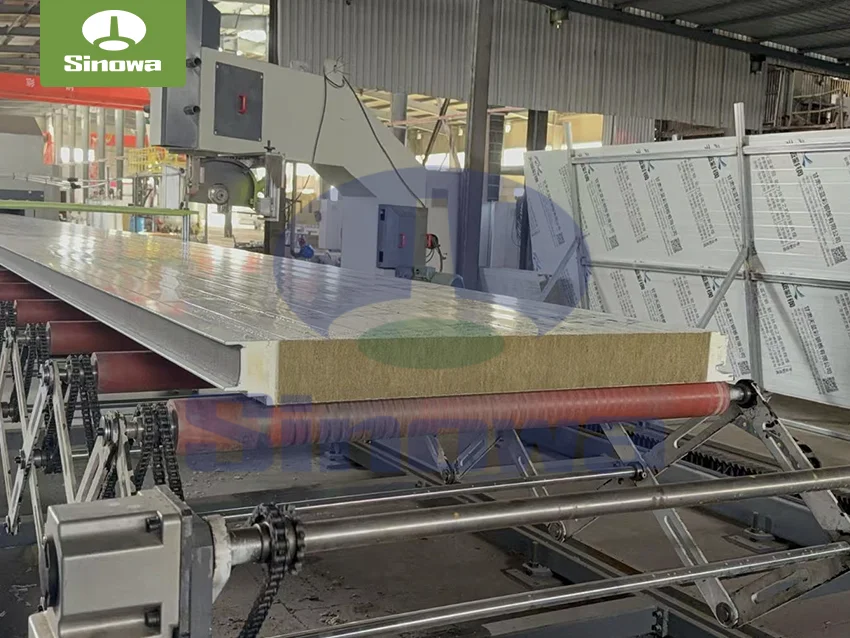
 sandwich panel machine
The basic structural design of rockwool sandwich panel making machine follows the principles of mechanical stability, production continuity and operational convenience, and the whole production line is composed of multiple interconnected functional modules with independent division of labor and coordinated operation. The overall frame of the equipment is made of high-strength metal materials processed by anti-deformation and anti-corrosion treatments. The thickened steel frame structure can bear the long-term mechanical vibration and material extrusion pressure generated during continuous production, effectively avoiding structural deformation and operational jitter caused by long-time high-load operation. At the same time, the bottom of the equipment is equipped with fixed support structures and horizontal adjustment components, which can adjust the horizontal balance of the production line according to different installation environments, ensuring the linear stability of material transmission in the production process and laying a foundation for the consistent molding quality of finished panels. Each functional module is connected by standardized assembly structures, which not only simplifies the subsequent disassembly, maintenance and component replacement work, but also facilitates the reasonable layout of the production site according to the plant space, realizing flexible arrangement of linear or segmented production lines.
The raw material feeding module is the starting part of the entire production line, undertaking the task of stable conveying and preliminary arrangement of surface base materials and core insulation materials. For the metal surface materials commonly used for sandwich panels, this module is equipped with special unwinding and flattening components. The unwinding structure adopts a rotary damping design to ensure that the coiled metal sheet can be released at a constant speed without tension fluctuation, preventing surface wrinkles, stretching deformation and edge warping of the metal sheet during feeding. The built-in flattening roller group uses multi-stage symmetrical pressing structure to eliminate the internal stress of the metal coiled material, smooth the uneven parts of the material surface, and ensure that the flatness of the surface material meets the composite molding standard. In terms of rockwool core material feeding, the module is equipped with a quantitative conveying and sorting mechanism. Bulk rockwool raw materials are transported to the designated station through the conveying device, and the automatic sorting structure screens and arranges the rockwool strips to ensure consistent thickness and uniform density of the core material. This processing method avoids the quality problems such as hollowing and uneven heat insulation performance of finished panels caused by messy accumulation of rockwool materials. All feeding actions are controlled by synchronous power system, and the feeding speed of surface material and core material keeps dynamic synchronization to match the rhythm of subsequent composite processing.
After the raw material feeding is completed, the materials will enter the surface pretreatment and gluing module, which is a key link to determine the bonding firmness between the surface material and the rockwool core material. The surface pretreatment unit is equipped with cleaning and roughening components. On the premise of not damaging the structural strength of the surface material, it removes dust, oil stains and oxide layers on the surface of the metal sheet through physical friction and air blowing purification, increasing the surface roughness of the material and improving the adhesion range of the adhesive. The gluing system adopts an even and quantitative coating mode, abandoning the traditional manual gluing and intermittent spraying methods. The internal glue supply pipeline is equipped with pressure regulating and flow control components, which can stably transport the adhesive to the gluing nozzle. The nozzle group is arranged in an evenly spaced linear structure, realizing full coverage gluing on the bonding surface of the surface material without missing coating or excessive glue accumulation. The gluing thickness can be finely adjusted according to the material specification and usage scenario of the sandwich panel. A moderate amount of adhesive can not only ensure the permanent bonding effect between layers, but also avoid the performance degradation caused by excessive glue layer affecting the thermal insulation and compression resistance of the panel. In addition, the gluing module is equipped with a constant temperature maintenance structure to keep the adhesive in the best active temperature range, preventing the glue liquid from solidifying too fast or losing viscosity due to ambient temperature changes.
The composite pressing module is the core functional section of the entire rock wool sandwich panel machine, responsible for realizing the tight lamination and primary molding of surface material, adhesive and rockwool core material. This module is composed of multi-group upper and lower pressing roller sets, which are arranged in gradient pressure structure. The initial pressing roller group applies low-pressure contact to the composite materials to complete the preliminary fitting of each layer and discharge the air mixed between the core material and the surface material, avoiding bubble gaps inside the finished panel. The middle pressing roller group gradually increases the extrusion pressure to make the adhesive penetrate into the tiny gaps of the rockwool fiber structure, enhancing the bite force between the core material and the surface material. The final pressing section maintains constant high pressure to complete the compact composite molding of the panel. All pressing rollers are equipped with synchronous rotation control system, and the rotation speed is consistent with the material feeding speed to prevent relative friction displacement between layers during pressing. The surface of the pressing roller is treated with smooth anti-sticking coating, which can effectively prevent the adhesive from adhering to the roller body and affecting the continuous pressing operation. Meanwhile, the gap between the upper and lower pressing rollers can be adjusted mechanically, so as to adapt to the production requirements of sandwich panels with different thickness specifications, realizing flexible switching of production specifications without replacing a large number of components.
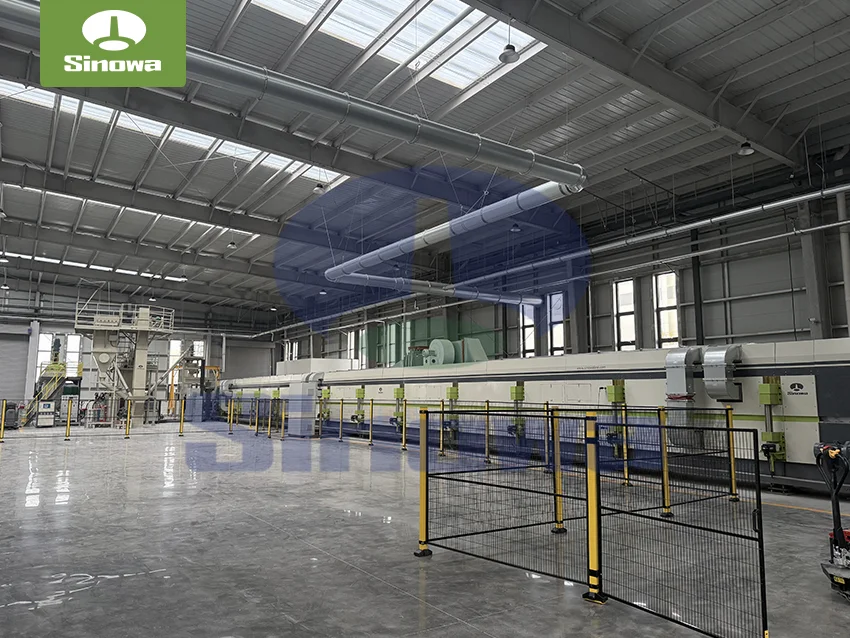
In order to accelerate the curing and forming of the adhesive and stabilize the composite structure of the panel, the production line is equipped with an independent constant temperature heating and curing module. This module adopts circulating hot air heating mode, and the internal heating cavity is provided with uniform heat conduction structures and temperature sensing elements. After the initially pressed composite plate enters the heating cavity, the hot air circulates in the closed space to uniformly heat the plate body. The temperature control system can realize stepless adjustment of heating temperature, and accurately lock the optimal curing temperature according to the characteristics of different adhesives and the thickness of rockwool core materials. Moderate high-temperature environment can accelerate the molecular reaction rate of the adhesive, shorten the curing forming cycle, and make the bonding structure between layers more stable. The interior of the heating cavity is equipped with heat preservation and heat insulation layers to reduce heat loss, improve energy utilization efficiency and avoid excessive energy consumption caused by long-term heating. In addition, the ventilation structure inside the cavity can timely discharge the trace volatile gas generated during the adhesive curing process, ensuring the safety of the production environment and avoiding gas accumulation affecting the physical health of operators. The cured panel has integrated internal structure, and the bonding strength between layers is significantly improved, which can resist external tension and shear force in subsequent use.
The fixed-length cutting and edge trimming module realizes the standardized sizing and appearance finishing of semi-finished panels. After heating and curing, the continuously produced long strip panels are transported to the cutting station through the conveying roller table. The intelligent positioning and measuring device installed at the station can automatically record the conveying length of the panels and send cutting instructions when reaching the preset size standard. The cutting tool adopts high-hardness alloy blade, which has the characteristics of wear resistance and high cutting precision. The cutting process maintains vertical downward feeding, and the incision is smooth and flat without burrs, cracks and material warping. For the edge parts of the panels, the edge trimming mechanism carries out symmetrical trimming treatment to ensure that the two sides of the panels are parallel and consistent in width, eliminating the dimensional deviation caused by material feeding errors. All cutting and trimming actions are linked with the production rhythm of the front-end module, realizing non-stop continuous cutting without manual intervention. The waste materials generated during trimming are collected by the centralized recycling device at the bottom of the equipment, which is convenient for subsequent centralized treatment and resource recycling, reducing the waste of raw materials.
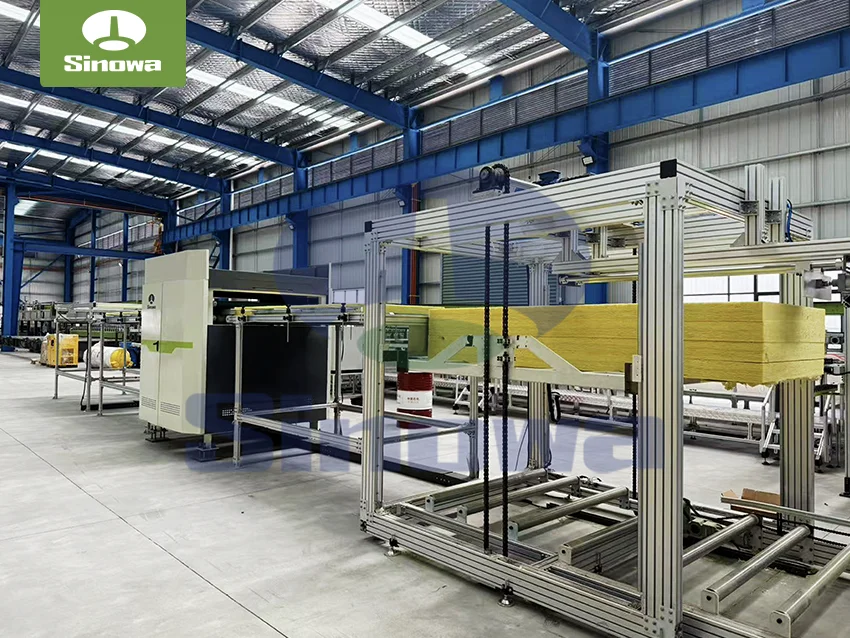
The final link of the production line is the finished product sorting, stacking and discharging module. The cut standard rockwool sandwich panels are transported to the stacking station through the turning and conveying structure. The station is equipped with an automatic stacking mechanism driven by servo power components. The precise encoding control technology enables the mechanical arm to accurately grasp and place the panels. According to the preset stacking sequence and layer spacing, the panels are neatly stacked on the loading platform. The stacking process has the functions of deviation correction and positioning, which can dynamically adjust the placement position of each panel to avoid inclination and dislocation during stacking. After the stacking quantity reaches the set standard, the discharging mechanism automatically pushes the finished plate stack out of the production line, which is convenient for staff to carry out packaging and warehousing operations. The whole stacking and discharging process is automated without manual carrying, which greatly reduces the labor intensity of production workers and avoids the plate damage and safety accidents caused by manual carrying. At the same time, the stacked finished products have neat overall arrangement, which is convenient for subsequent container transportation and on-site storage.
In terms of power and control system configuration, rockwool sandwich panel making machine adopts a centralized integrated control mode. The whole production line is equipped with a unified electrical control cabinet, which integrates frequency conversion regulation, signal sensing, fault feedback and parameter setting functions. The internal power transmission components are dominated by high-efficiency motors and synchronous transmission structures, which can provide stable power output for each functional module. The frequency conversion speed regulation technology realizes stepless adjustment of production line operation speed, which can meet the production efficiency requirements of different orders. When producing conventional specification panels, the equipment can run at a medium and high speed to improve output; when producing special customized panels, the operation speed can be reduced to ensure processing accuracy. A variety of sensing elements are installed inside each module to monitor the operating temperature, material tension, pressing pressure and operating speed of the equipment in real time. Once abnormal parameters such as material jamming, temperature overload and pressure deviation occur, the control system will automatically trigger the early warning prompt and execute the emergency stop protection procedure to prevent equipment damage and product batch quality problems. The simplified human-computer interaction interface is convenient for operators to set production parameters, view operating data and record production logs, and the operation logic is simple and easy to learn, reducing the professional threshold for equipment operation.
The rationality of the mechanical design endows rockwool sandwich panel making machine with outstanding production performance advantages in industrial application. In terms of production efficiency, the continuous assembly line processing mode eliminates the intermediate handling and waiting links of intermittent production equipment. All production processes from raw material feeding to finished product discharging are completed in one go, and the effective production time is fully utilized. The coordinated operation of multiple modules avoids mutual waiting between processes, and the overall production efficiency is far higher than that of semi-automatic processing equipment. In terms of product quality stability, the equipment realizes digital and mechanical precise control of each production link. The gluing amount, pressing pressure, heating temperature and cutting size are all locked by fixed parameters, which avoids the quality fluctuation caused by manual operation differences. The internal density and structural uniformity of the produced rockwool sandwich panels are consistent, and the indexes such as compression resistance, bending resistance and bonding strength maintain a stable qualified level. In terms of production flexibility, the equipment can adapt to the production of panels with different thickness, width and surface material types. By adjusting the gap parameters of each module and replacing a small number of simple accessories, the rapid switching of production specifications can be completed, meeting the diversified customization needs of the market.
In addition to the core production performance, rockwool sandwich panel making machine has made obvious optimization in energy consumption control and environmental protection design. The transmission structure of the equipment adopts low-friction mechanical accessories, which reduces the kinetic energy loss caused by mechanical friction during operation. The frequency conversion motor can automatically adjust the power output according to the production load, avoiding the ineffective energy consumption caused by constant power operation. The heating module adopts heat preservation and waste heat recovery structure, which reuses the residual heat generated in the heating process to preheat the incoming materials, effectively reducing the energy consumption required for a single plate processing. In terms of environmental protection, the closed production structure reduces the dust overflow generated by rockwool raw materials during processing. The adhesive volatilization gas generated in the production process is collected and purified by the gas treatment device, and then discharged after reaching the emission standard. The trimming waste generated in the cutting link is recycled in a centralized manner without random scattering. The whole production process does not produce a large amount of polluting waste water and solid waste, which conforms to the environmental protection production standards of modern building materials manufacturing industry and reduces the environmental pressure of the production plant.
In actual industrial production, the daily maintenance and standardized operation of rockwool sandwich panel making machine are crucial to extend the service life of the equipment and maintain stable production performance. Daily maintenance work mainly includes surface cleaning, component inspection and lubrication maintenance. After the daily production work is completed, the staff needs to clean the residual rockwool debris, adhesive residue and metal dust on the surface of the equipment to prevent the accumulation of sundries from affecting the normal operation of the transmission structure. It is necessary to regularly check the fastening degree of the connecting bolts of each module, the wear degree of the pressing roller and cutting blade, and the sensitivity of the sensing elements, and replace the severely worn accessories in a timely manner to avoid processing errors caused by component aging. The transmission gears, chains and rotating bearings need to be regularly filled with high-quality lubricating oil to reduce mechanical friction loss and prevent abnormal noise and jamming during equipment operation. In terms of standardized operation, the staff must follow the equipment startup sequence, complete the idle running preheating inspection before formal production, and start the feeding production after confirming that all parameters are normal. During the production process, it is forbidden to arbitrarily adjust the operating parameters without authorization, and avoid overloading the equipment for a long time. After the production is completed, the equipment shall be shut down in accordance with the specified procedures, and the power supply and air source shall be cut off to ensure the safety of equipment storage.
The application scope of rockwool sandwich panels produced by professional making machines covers multiple fields of modern construction engineering. In industrial factory buildings, such panels are used for wall enclosure and roof thermal insulation structures. Their excellent fire resistance can effectively block the spread of open fire, and the thermal insulation performance reduces the internal temperature fluctuation of the factory building, improving the production environment of the factory. In public buildings such as exhibition halls and shopping malls, the smooth and neat surface of the panels can meet the aesthetic requirements of building decoration, and the sound insulation effect can reduce the interference of external noise. In special environmental projects such as cold storage and constant temperature workshops, the stable thermal insulation structure of the panels can reduce the energy consumption of temperature regulation and maintain the constant temperature state inside the building. In addition, this type of panel is also widely used in temporary prefabricated buildings, logistics warehousing buildings and municipal engineering supporting facilities. With the continuous improvement of market demand for high-performance building materials, the application scenarios of rockwool sandwich panels are constantly expanding, which also puts forward higher requirements for the production capacity and processing technology of supporting making machines.
From the perspective of industry development trend, rockwool sandwich panel making machine is gradually developing towards higher automation, intelligent monitoring and energy-saving optimization. With the integration of Internet of Things technology, the new generation of equipment can realize remote data monitoring and production parameter debugging. Managers can view the real-time operating status, production output and energy consumption data of the equipment through the terminal, which is convenient for production scheduling and equipment management. The intelligent fault diagnosis system can independently analyze the abnormal vibration, temperature fluctuation and parameter deviation of the equipment, accurately locate the fault point and give maintenance suggestions, reducing the difficulty of equipment maintenance. In terms of structural optimization, the equipment is developing towards compact and integrated design. The optimized space layout reduces the floor area of the production line and improves the space utilization rate of the production plant. The application of new wear-resistant and anti-corrosion materials enhances the environmental adaptability of the equipment, enabling it to operate stably in high humidity and dust-intensive production environments. At the same time, the equipment is constantly optimizing the composite molding process, improving the bonding firmness and surface flatness of the panels, and promoting the overall quality upgrading of rockwool sandwich panel products.
In the entire building materials manufacturing industry chain, rockwool sandwich panel making machine undertakes the important task of standardized and large-scale production of thermal insulation composite panels. Its reasonable mechanical structure, mature production process and efficient operation mode lay a solid foundation for the stable supply of high-quality building insulation materials. The excellent performance of the equipment not only reduces the production cost of panel manufacturers and improves the economic benefits of production and operation, but also ensures the safety and durability of building engineering from the source of raw materials. In the future, with the continuous progress of mechanical manufacturing technology and the continuous upgrading of building energy-saving standards, rockwool sandwich panel making machine will continue to carry out technological innovation in terms of intelligent control, energy-saving consumption reduction and product diversification adaptation. It will further optimize the production process flow, improve the level of automated production, and provide more reliable mechanical support for the high-quality development of the modern construction industry and the popularization of energy-saving and environmental protection buildings. For production enterprises, paying attention to the performance optimization and maintenance management of such equipment is an important measure to enhance market competitiveness, and also an inevitable choice to adapt to the standardized and refined development trend of the building materials industry.
https://www.cnsinowa.com/sandwich-panel-machines/rockwool-sandwich-panel-making-machine.html